
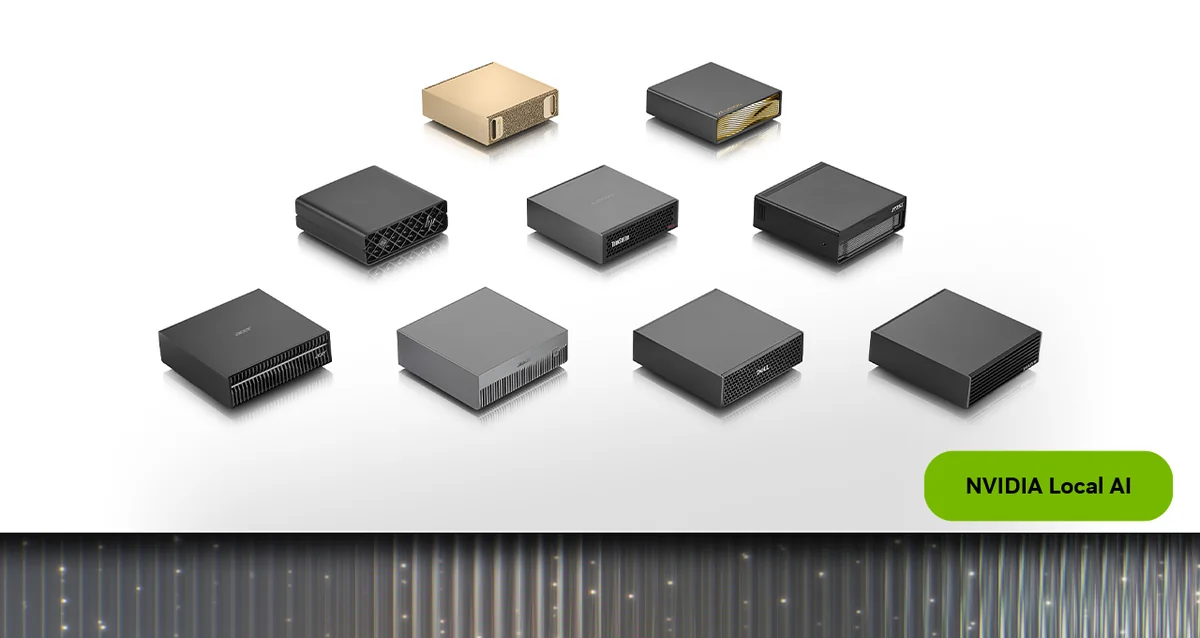
NVIDIA’s prices have become the main topic in every local AI and PC gaming community this month. In two weeks the 128GB DGX Spark went to $6,950, a 64GB model arrived at a higher price than the original 128GB one, RTX Spark laptops launched at up to $6,999.99, and GeForce cards kept climbing far above their list prices. We read through Reddit, the NVIDIA developer forums, Hacker News, The Register’s comments and the main hardware outlets. Here is what people are saying, who is defending NVIDIA, and what they are buying instead.
DGX Spark: from $3,999 to $6,950 in a year
| Date | Model | Price |
|---|---|---|
| October 2025 | DGX Spark 128GB (launch) | $3,999 |
| February 2026 | DGX Spark 128GB | $4,699 |
| October 2, 2026 | DGX Spark 128GB | $6,950 |
| October 23, 2026 | DGX Spark 64GB (partners only) | from $4,999 |
The Register puts the new 128GB price at “nearly 75 percent” above launch and ties it to memory prices. NVIDIA’s own blog presents the 64GB model as a way to keep “the platform at an accessible price point”. Our full breakdown is in DGX Spark 64GB pricing: what it means for RTX Spark.
The partner boxes do not help much. On Amazon US today, the GIGABYTE AI TOP ATOM with 128GB lists at $8,499.99 from a third-party seller, and Amazon search showed HP’s ZGX G1n at $6,699.
What the community says
The angriest reactions came from the people the DGX Spark was built for. In r/LocalLLaMA’s thread on the 64GB launch, one commenter wrote:
“feels like scam at this point: device was announced at 3k, released at 4k, now they want $7k and sell a gimped one for $5k”
Another commenter, who said the price changed while they were waiting in line at Micro Center, asked “who would even want a 64GB at $5k when you can buy an AMD box with similar performance for almost half.” A reader in The Register’s comments made the same point about NVIDIA’s wording: “‘More accessible’ doesn’t usually involve paying significantly more than the original better version cost not very long ago”. On Hacker News, one commenter suggested a more honest product name: “NVIDIA DGX Spark 64GB: Because RAM is expensive now.”
Reviewers were milder but agreed. ServeTheHome wrote that “$4999 for a 64GB machine feels quite high” and “$6950 for a 128GB machine feels lofty, too.” Digital Spaceport titled its video “The DGX Spark 64GB is a Local AI Warning Sign.”
Who defends it
The defense comes in three versions:
- It is the memory, not NVIDIA. On NVIDIA’s developer forums, an owner wrote that “we’re used to original pricing, which may have been subsidized by low RAM cost locked in 15+ months ago”. A Register commenter asked: “How is this Nvidia’s fault? Their suppliers have limited capacity to make parts”. ServeTheHome agrees that memory prices are still rising.
- It is not a consumer product. A forum user wrote that “Dgx spark is an entrypoint product” to NVIDIA’s infrastructure business. For CUDA developers who deploy to DGX servers, the Spark’s value is the software stack, not the price per GB.
- It still pays for itself. One Register commenter said two Sparks running a large model at “200+/second” save them “at least high triple digits worth of API tokens a month”. In r/LocalLLaMA, another argued it “is the superior choice for those wanting agentic workflows with larger models and needing lots of parallelism.”
RTX Spark laptops: expensive, and the cheap ones get less chip
RTX Spark went on sale on October 16. The prices were the story from the day they leaked.
| Device | Configuration | Price |
|---|---|---|
| Surface Laptop Ultra | 18-core N1X, 24GB, 512GB | $2,599.99 |
| Surface Laptop Ultra | 20-core N1X, 32GB, 1TB | $3,699.99 |
| Surface Laptop Ultra | 128GB, 1TB | $5,899.99 |
| Dell XPS 16 Creator Edition | 32GB, 512GB | from $3,799.99 |
| ASUS ProArt P16 | 64GB | $4,499.99 |
| ASUS ProArt P16 | 128GB, 2TB | $6,999.99 |
| HP OmniBook X 14 / Ultra 16 | 128GB, 1TB | $5,109 / $5,309 |
| Surface RTX Spark Dev Box (mini PC) | 128GB, 2TB, ships November | $5,999.99 |
Two details make the entry prices look worse than they are on paper. According to Tom’s Hardware, 24GB and 32GB models get the 18-core chip with 5,120 CUDA cores, and only 48GB and up get the full 20-core, 6,144-core version. And the 128GB tier that makes RTX Spark interesting for local AI starts above $5,000. The Surface RTX Spark Dev Box, a 128GB mini PC, costs $5,999.99, about $2,000 more than AMD’s Ryzen AI Halo at launch.
What the community says
PC Gamer’s Dave James wrote that these machines are “designed for a world that is specifically making systems like them harder to make and sell to normal humans”. PCWorld’s Michael Crider said “there’s nothing spare or affordable about them” and asked: “for seven thousand dollars you couldn’t toss in a Gen5 SSD?”
In r/nvidia, one commenter wrote: “Excellent pricing strategy. Price it so high that no one buys enough and you can reallocate to data centers while still claiming you’ve released something new.” In r/hardware, a commenter thought “the max of 128Gb RAM in 2026 looks way too low for the people who might even consider buying this thing.” On Hacker News, the expected bandwidth was the deal-breaker: “around 273 GB/s which is where I lose interest.”
Who defends it
RTX Spark has more defenders than the DGX Spark, mostly because $2,599.99 looks normal for a premium laptop. “$2599 isnt “so high no one can buy it”. Thats macbook territory and plenty of people buy macbooks,” a reply in r/nvidia said. Windows Central collected reactions like “Quite cheap tbh I expected it to start at $2999.” In r/LocalLLM, a post was titled “$5900 for the maxed out 128GB RTX Sparks Surface Laptop Ultra is not that bad”, and its author noted that Microsoft “seems to be the cheapest so far.”
GeForce cards: “effectively nothing at MSRP”
The MSRPs have not moved since January 2025. Street prices have.
| Card | MSRP | Lowest new price, October 11, 2026 |
|---|---|---|
| RTX 5090 32GB | $1,999 | $4,920.99 |
| RTX 5080 16GB | $999 | $1,450 |
| RTX 5070 Ti 16GB | $749 | $1,007.98 |
| RTX 5070 12GB | $549 | $725 |
Lowest new asking prices are from BuySellRam’s October 2026 market update, which tracks US listings. It found the RTX 5090’s floor up 64% since August, and none of the price floors it tracks went down.
Gamers Nexus put it bluntly in September: “There is effectively nothing at MSRP.” Its data had the average in-stock RTX 5090 at $4,880 and NVIDIA cards averaging about 70% over MSRP, against 28% for AMD and 21% for Intel. Its conclusion: “There’s no reason to launch a flagship at $2,000 MSRP if it can steadily sell at $4,000 to $5,000.” Hardware Unboxed’s September video was titled “So GPU Prices Are Even Worse Now…”.
Supply may get tighter. Tom’s Hardware reported on October 10 that NVIDIA has halted RTX 5090 production to send its chips to professional and data center cards, with a 24GB RTX 5080 rumored as the new gaming flagship. NVIDIA has not confirmed it. VideoCardz reports that the RTX 50 Super cards are on hold over the price of 3GB GDDR7 chips. The reaction in r/technology: “And we all thought the RTX 5090 was stupidly overpriced at 2k, and then at 3k and at 5k… and now poof, it’s gone.”
Is it really the memory?
This is where the community splits. Memory is getting more expensive: TrendForce expects conventional DRAM contract prices to rise 10% to 15% in the fourth quarter of 2026 and NAND 15% to 20%, and Gamers Nexus cites reports that a 3GB GDDR7 chip now costs $60 to $70. That is the case NVIDIA’s defenders make, and it explains the DGX Spark better than the GeForce cards.
The counter-argument is in the numbers. BuySellRam estimates the memory in a 32GB card at about $320, against an RTX 5090 markup of about $2,900: “Memory is clearly part of the story. It cannot be most of it.” Using Gamers Nexus’s higher chip price, the memory in a 5090 still comes to well under $800. AMD and Intel buy from the same memory makers and their cards sit much closer to MSRP. On Hacker News, the mood is resignation: “We will never see hardware at the previous affordable prices again.”
We covered the wider memory squeeze in Consumers are paying for the RAM crisis.
What the community buys instead
- 128GB Strix Halo mini PCs. The most common answer in r/LocalLLaMA. A 128GB Ryzen AI Max+ 395 box costs about half the price of a 128GB DGX Spark. It has a little less memory bandwidth (about 256 GB/s against 273) and no CUDA, but it is also a full Windows or Linux PC. See our Bosgame M5 review and GMKtec EVO-X2 review.
👉 See the Bosgame M5 on AmazonRyzen AI Max+ 395, 128GB / 2TB, $3,599 on Amazon (October 16, 2026)
🚀 See the GMKtec EVO-X2 on AmazonRyzen AI Max+ 395, 128GB / 2TB, $3,649.99 on Amazon (October 16, 2026)
- Mac Studio. Popular with people who want more memory bandwidth and can pay for it. In r/LocalLLM, a commenter wrote: “That 256GB Mac Studio looks better and better every day.”
- Used RTX 3090s. Still the speed option for models that fit in 24GB per card. On NVIDIA’s forums, a user weighing dual Sparks priced the alternative at eight used 3090s for about $1,500 each.
- Gorgon Halo, if you need 192GB. Ryzen AI Max+ PRO 495 boxes hold 192GB in one machine; see our GMKtec EVO-X5 Pro guide.
- Sipeed MaixStation, on paper. Announced this week at a target of about $3,999 for 128GB and 273 GB/s. It is a Kickstarter product with no independent tests yet; see our MaixStation comparison.
Our take
The criticism holds up best on the DGX Spark. A 64GB model at $4,999 costs $1,000 more than the 128GB model did at launch, and the 128GB model is now $6,950. Memory costs explain part of that, but the result is a product that has moved out of reach of the independent developers it was marketed to. If you need CUDA and DGX OS, it is still the reference box. If you only need to run local models, it is no longer the sensible buy.
RTX Spark pricing is easier to defend at the bottom and harder at the top. $2,599.99 is normal for a premium laptop, but that buys 24GB and a cut-down chip, and the configurations that matter for local AI cost $5,000 to $7,000.
On GeForce cards, the memory explanation is the weakest. When NVIDIA’s cards average about 70% over MSRP and AMD’s and Intel’s sit at 21% to 28%, the gap is not just the memory. Until supply improves, the community advice holds: do not pay flagship street prices if a cheaper card or a 128GB mini PC does the job.