
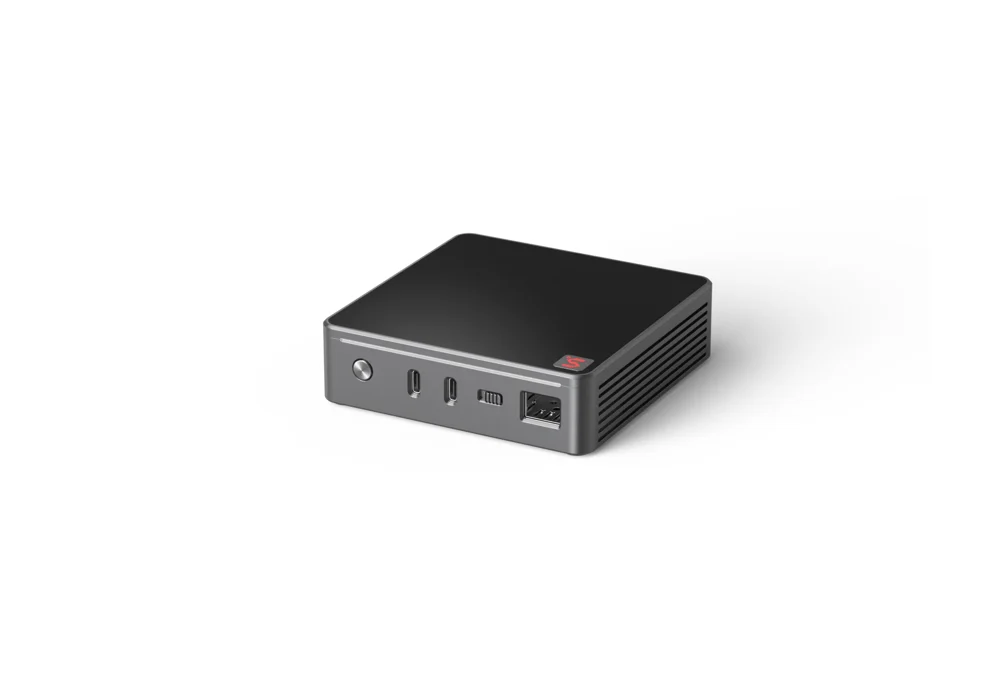
Sipeed, the Chinese company best known for small RISC-V and edge AI boards, announced the MaixStation this week: a palm-sized local AI box with 128GB of LPDDR5X, 273 GB/s of memory bandwidth and a typical draw of 40 W over USB-C. Sipeed aims it straight at NVIDIA’s DGX Spark, and its target price of about $3,999 is roughly what the Spark cost when it launched a year ago. You cannot buy one yet. Here is what it is, how it stacks up against DGX Spark, Strix Halo and Gorgon Halo, and how the reservation works.
What the MaixStation is and what it ships with
The MaixStation is built on the Axera AX8860P, a 6 nm chip with 16 Arm Cortex-A55 CPU cores and an NPU rated at 256 TOPS of dense FP4. The chip sits on a 78 × 78 mm module Sipeed calls Maix-V, which the whole family shares.
| Spec | Sipeed MaixStation (128GB) |
|---|---|
| Chip | Axera AX8860P, 16 × Cortex-A55, 256 TOPS FP4 NPU |
| Memory | 128GB LPDDR5X-8533, 256-bit bus, 273 GB/s |
| Storage | M.2 2280 slot for a PCIe 5.0 SSD |
| Power | 40 W typical, USB-C PD input (Sipeed says any 65 W power bank works) |
| Size | 110 × 110 × 30 mm, 363 cm³ |
| Front panel | Power button, USB-C power, USB 3.0, mode switch, 10G SFP+, status screen |
| Clustering | MCIO 8i (PCIe 5.0 x8) to link a second unit for 256GB |
| Software | Debian 13, Linux 6.18, preloaded Qwen3.8-Flash-Next with a web UI |
| APIs | OpenAI and Anthropic compatible, running on the device |
| Frameworks | vLLM and SGLang through an AXDSL backend; PyTorch, llama.cpp and Ollama listed as NPU-accelerated |
What comes out of the box is the interesting part. Sipeed says the MaixStation boots with Qwen3.8-Flash-Next, a 125B mixture-of-experts model, already loaded behind a web UI, and with OpenAI- and Anthropic-compatible APIs running on the device. You point Claude Code, Codex, n8n or any MCP client at it and go. A physical switch picks between two modes: USB-C device mode, where it shows up on a laptop without drivers, and 10G SFP+ server mode, where it serves a model to the whole office.
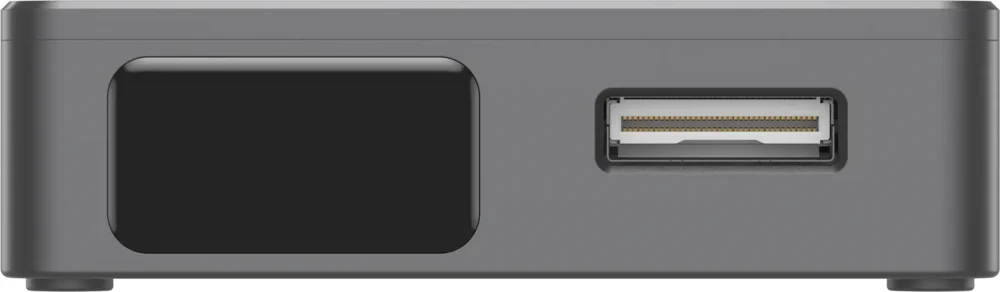
Sipeed has not published a box contents list, and its page does not say whether a power adapter is included. It does say a 65 W USB-C power bank can run it.
The full family
| Model | Memory | Target price | What Sipeed says it runs |
|---|---|---|---|
| MaixStation 32GB | 32GB | ”$1,xxx” | Qwen3.8-27B dense |
| MaixStation 128GB | 128GB | about $3,999 | Qwen3.8-Flash-Next 125B |
| 2 × MaixStation over MCIO | 256GB | 2 × 128GB | DeepSeek V4-Flash 284B |
| MaixStation Pro | 512GB | not announced | DeepSeek V4.1-Flash 552B |
| MaixBlade PCIe card (4 × AX8860P) | 512GB and up | not announced | Up to Kimi K3 with four cards |
There is no 64GB model. Sipeed’s reasoning is that no flagship open model lands at that size: 32GB fits the best dense 27B models and 128GB fits the best 125B MoE models.
MaixStation vs DGX Spark, Strix Halo and Gorgon Halo
| Sipeed MaixStation | NVIDIA DGX Spark | Strix Halo (Ryzen AI Max+ 395) | Gorgon Halo (Ryzen AI Max+ PRO 495) | |
|---|---|---|---|---|
| Example | MaixStation 128GB | DGX Spark / GB10 partner boxes | Bosgame M5 | GMKtec EVO-X5 Pro |
| Memory | 128GB | 128GB (64GB model from Oct 23) | 128GB | 192GB |
| Bandwidth | 273 GB/s | 273 GB/s | about 256 GB/s | about 273 GB/s |
| AI compute | 256 TOPS dense FP4 (NPU) | 1,000 TOPS sparse FP4, about 500 dense (Blackwell GPU) | Radeon 8060S iGPU + 50 TOPS NPU | Radeon 8065S iGPU + 55 TOPS NPU |
| CPU | 16 × Cortex-A55 | 10 × Cortex-X925 + 10 × Cortex-A725 | 16 Zen 5 cores | 16 Zen 5 cores |
| OS | Debian 13 | DGX OS (Ubuntu, CUDA) | Windows 11 or Linux | Windows 11 or Linux |
| Typical power | 40 W | about 120 W (240 W adapter) | 55 W to 140 W, depending on the box | 55 W to 140 W, depending on the box |
| Price, 128GB | about $3,999 (target) | $6,950 from NVIDIA; $6,699 to $8,499.99 for partner boxes on Amazon | $3,599 on Amazon | $6,799 at GMKtec for 192GB; $7,999.99 on Amazon |
| Price per GB | about $31 | about $54 | about $28 | about $35 to $42 |
| Can you buy it today? | No (Kickstarter, end of 2026) | Yes | Yes | Yes |
Amazon prices were checked on October 16, 2026. The DGX Spark price is NVIDIA’s current list price for the 128GB model, covered in our DGX Spark 64GB pricing piece.
What Sipeed’s benchmark chart actually shows
Sipeed’s headline is “25% faster prefill, 30% faster decode” than DGX Spark on Qwen 27B. Its own chart is more careful than the headline. The solid bars are what Sipeed calls “today’s conservative measurements”, and a lighter range shows where it expects tuning to take the chip. Both machines run FP4 with multi-token prediction (MTP) turned off.
| Model, FP4, MTP off | DGX Spark | MaixStation today | MaixStation after tuning (Sipeed target) |
|---|---|---|---|
| Qwen3.8-27B dense, prefill | 1,300 tok/s | 1,400 tok/s (+8%) | up to 1,600 tok/s (+23%) |
| Qwen3.8-27B dense, decode | 13 tok/s | 15 tok/s (+15%) | up to 17 tok/s (+31%) |
| Qwen3.6-35B-A3B MoE, prefill | 5,600 tok/s | 6,300 tok/s (+13%) | up to 7,700 tok/s (+38%) |
| Qwen3.6-35B-A3B MoE, decode | 80 tok/s | 80 tok/s (tie) | up to 88 tok/s (+10%) |
So the 25% and 30% figures are the top of the tuning range on the dense model. What Sipeed says it measures today is a single-digit to mid-teens lead on the dense 27B and a dead heat on MoE decode. That still counts for something at roughly half the price and a third of the power, but it is not a knockout.
The numbers are physically plausible. A 27B model at FP4 weighs roughly 14GB, and decode speed is roughly bandwidth divided by model size, so 273 GB/s caps it near 19 to 20 tok/s. Sipeed’s 15 tok/s would mean using about 77% of the bandwidth, against about 67% for the Spark’s 13 tok/s. Keep in mind that the Spark does 40 to 50 tok/s on the same model once MTP or speculative decoding is on. Sipeed says the MaixStation gets “a similar speed-up”, which has not been shown.
Sipeed did not chart Strix Halo or Gorgon Halo. Both are bandwidth-bound the same way. Gorgon Halo has the same 273 GB/s ceiling and Strix Halo sits about 6% lower, so on decode the four machines should land closer together than the marketing suggests. Prefill is where dedicated matrix hardware pulls ahead: GB10 boxes already lead Strix Halo on prompt processing in independent tests, and Sipeed claims the NPU beats GB10 there too.
Where the MaixStation wins
- Price per GB. About $31 per GB of unified memory against about $54 for NVIDIA’s 128GB DGX Spark, and $52 to $66 for the partner GB10 boxes on Amazon today (HP’s ZGX G1n lists at $6,699, the GIGABYTE AI TOP ATOM at $8,499.99). Only Strix Halo is cheaper per GB, and it gives you 256 GB/s instead of 273.
- Power and size. 40 W typical against about 120 W for the Spark, and 363 cm³ against 1,125 cm³. It is the only box in this group that Sipeed says runs from a power bank.
- Ready at power-on. A 125B model, a web UI and OpenAI- and Anthropic-compatible APIs out of the box. Sipeed’s dig is that “DGX Spark ships empty”, and it is a fair one for buyers who just want an endpoint for their coding agents.
- Cheap two-box clustering. Two units link with one MCIO cable for 256GB. Sipeed points out that past two units a DGX Spark cluster needs a 200G or 400G switch. One limit: for more than two MaixStations, Sipeed points you to the MaixStation Pro and MaixBlade, not to bigger cables.
- Prefill on paper. If the chart holds, prompt processing beats GB10 at a quarter of its marketing TOPS, which matters for long-context agent work.
Where it does not win
- It is not a PC. Sixteen Cortex-A55 cores are low-power phone-class cores, and Sipeed lists no display output. You cannot use it as a desktop, run Windows or play games. Every Strix Halo and Gorgon Halo mini PC is a full x86 computer with a Radeon iGPU that runs 1080p games.
- No CUDA. The DGX Spark runs the same CUDA, TensorRT and NIM stack as NVIDIA’s data center hardware, and fine-tuning works out of the box. The MaixStation runs vLLM and SGLang through a custom AXDSL backend. Sipeed says it will open-source the kernels and work on opening the AX8860 SDK, but a new model architecture means new kernels. igor’sLAB puts it bluntly: if the software does not deliver, it becomes “a low-cost piece of exotic hardware with impressive manufacturer slides”.
- Capacity. 128GB per box is the ceiling. A single Gorgon Halo box holds 192GB and can give 160GB to the GPU, which fits 200B to 300B MoE models without a second machine. See our Ryzen AI Max 400 Gorgon Halo guide.
- Networking is SFP+ only. There is no RJ45 port and no Wi-Fi listed. To plug it into a normal router you need an SFP+ to RJ45 transceiver, which runs $27 to $45 on Amazon, or a switch with an SFP+ port. The DGX Spark has 10GbE RJ45, Wi-Fi 7 and two 200 Gbps QSFP ports.
- Nothing is verified. No outside reviewer has run the hardware. The price is a target, the benchmarks are Sipeed’s own, and mass production has not been confirmed.
- Crowdfunding timing. The Kickstarter is due at the end of 2026 and Sipeed gives no shipping date. A Strix Halo or DGX Spark box ordered today is on your desk next week.
- Trust. Sipeed’s NanoKVM drew criticism in 2025 after a researcher found an undocumented microphone, a default SSH password in early units and DNS routed through Chinese servers. Sipeed disputed the framing, fixed the password issue and open-sourced the project. A box that holds your private documents deserves a look at its network traffic before you trust it.
How to preorder the Sipeed MaixStation
There is no preorder as such. Sipeed runs a reservation that turns into a discount on its Kickstarter. As of October 16 the page says “Reservation fee opens soon”, so you can join the survey now and pay when it opens.
- Answer the survey on Sipeed’s MaixStation page to lock your spot.
- Pay the $30 reservation fee (or CNY 200) by PayPal, WeChat Pay or Alipay. Each payment covers one machine and gives you one voucher code (Sipeed calls it an F-code). Payment needs a one-time code sent to your registered email.
- Back the Kickstarter within 48 hours of launch with a Kickstarter account that uses exactly the same email. Apple “Hide My Email” relay addresses are not accepted.
- Wait for delivery. At least 15 business days after your MaixStation arrives, message Sipeed your code through Kickstarter, and it refunds $100 per machine to your pledge.
Net, you save $70 per unit, and reservation holders get the Kickstarter date first plus 24 hours of priority on the Super Early Bird tier. The fee is refundable: ask before launch and Sipeed pays it back within 7 business days. Codes not used within 48 hours of launch are refunded automatically. Once a code is redeemed, the fee is not refundable. Volume buyers can write to [email protected].
The usual crowdfunding rule applies: a Kickstarter pledge is not a store purchase. Sipeed has run Kickstarter campaigns before, most recently for its MaixCAM2 camera, but delivery dates, final specs and support terms are not guaranteed until units ship.
What to buy today instead
If you need local AI now, these are the three boxes we would compare against the MaixStation:
- Strix Halo, best value: the Bosgame M5 with 128GB is a full Ryzen AI Max+ 395 PC that ships now and costs less than the MaixStation’s target.
👉 See the Bosgame M5 on AmazonRyzen AI Max+ 395, 128GB / 2TB, $3,599 on Amazon (October 16, 2026)
- Gorgon Halo, most memory: the GMKtec EVO-X5 Pro with 192GB, if you need models the MaixStation can only hold with two units. Amazon lists it as temporarily out of stock; GMKtec’s own store had it at $6,799.
🚀 See the GMKtec EVO-X5 Pro on AmazonRyzen AI Max+ PRO 495, 192GB / 2TB, $7,999.99 on Amazon
- DGX Spark, if you need CUDA: a 128GB GB10 box such as the GIGABYTE AI TOP ATOM. Expensive, but it runs NVIDIA’s full stack today. The Amazon listing is from a third-party seller, so check the warranty terms, and compare it with HP’s ZGX G1n, which Amazon search showed at $6,699.
✅ See the GIGABYTE AI TOP ATOM on AmazonNVIDIA GB10, 128GB / 4TB, $8,499.99 on Amazon
For the background on why these boxes cost what they do, see our NVIDIA DGX Spark review and NPU vs iGPU vs CPU for local LLMs.
Verdict
The MaixStation is the most interesting challenge to DGX Spark so far, because it attacks the two things NVIDIA has made worse this year: price and memory per dollar. On paper it matches the Spark’s 128GB and 273 GB/s at roughly 42% less, a third of the power and a third of the volume, with a model and APIs ready at power-on. On Sipeed’s own conservative numbers it is a little faster on dense models and even on MoE decode. The 25% and 30% headline gains are where Sipeed hopes tuning will take it.
What it is not is a computer you can buy, or one you can use for anything other than serving models. No CUDA, no Windows, no display, SFP+ only, no independent tests and a Kickstarter at the end of 2026. Reserving costs $30 and is refundable, so it is a cheap way to keep the option open. Do not pledge until the first independent benchmarks are out. If you need a local AI box this year, a 128GB Strix Halo mini PC does most of the same work today for less.