
What it is
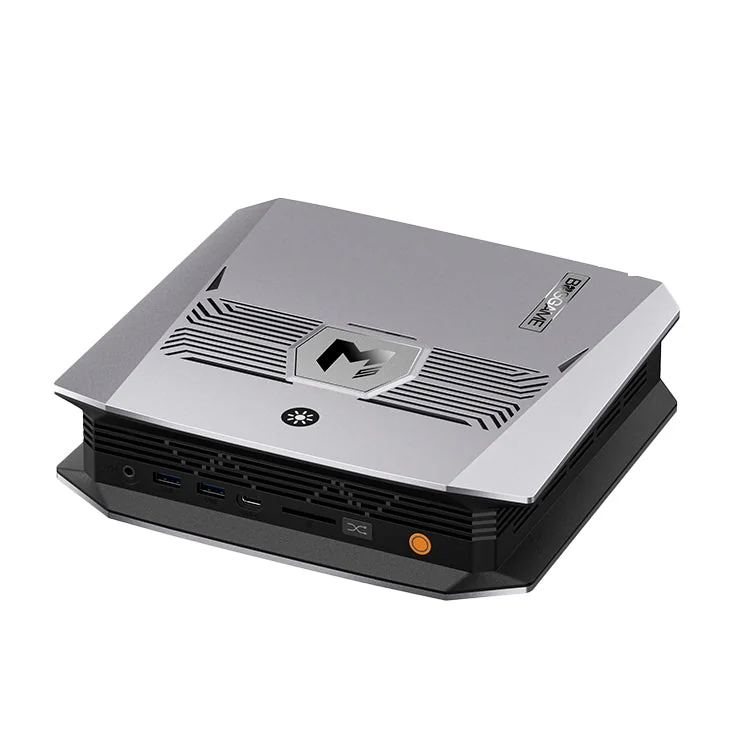
The Bosgame M5 AI Mini Desktop is a Ryzen AI Max+ 395 mini PC: 16 Zen 5 cores, the 40-CU Radeon 8060S, a 50-TOPS XDNA 2 NPU, and 96 GB or 128 GB of LPDDR5X-8000 on a 256-bit bus. It ships with a 2 TB PCIe 4.0 SSD, a second empty M.2 slot, two USB4 ports, Wi-Fi 7, and a front button that flips between three power profiles.
What makes it interesting in September 2026 is not the chip, which every Strix Halo box shares, but the price. At $2,999 for 128 GB / 2 TB direct, it is the cheapest 128 GB Strix Halo desktop on sale, and it runs the APU at a full 120 W sustained.
What the Bosgame M5 is good for
Local AI inference. This is the reason to buy a 128 GB Strix Halo machine (see what a Strix Halo box actually does with 70B models). Up to 96 GB of the pool can go to the GPU. Wccftech ran Qwen 3.8 27B at Q8 at roughly 7 tokens/s and DeepSeek V4 Flash, a 284B mixture-of-experts model, at around 12 tokens/s at Q3. ServeTheHome’s Qwen 3.6-35B runs put the M5 ahead of AMD’s own $3,999 Ryzen AI Halo box. The ceiling is the 256 GB/s memory bandwidth, not compute: a 32 GB discrete GPU is faster per token but cannot load these models at all.
Creator work. TechPowerUp measured 11,266 points in Photoshop, 16,844 in PCMark Digital Content Creation, and a 102,121-point OpenCL result that beat the ACEMAGIC Tank M1A+ Pro, its closest 128 GB rival. The full-size SD 4.0 reader on the front is the right call for a photographer’s desk.
Gaming. TechPowerUp’s 1080p numbers: Cyberpunk 2077 at 100 fps High and 88 fps Ultra, Baldur’s Gate 3 at 98 fps High, Counter-Strike 2 at 256 fps. Wccftech pushed to 1440p Ultra and got 61 fps in Forza Horizon 6 and 66 fps in Cyberpunk with FSR 4.1 Quality, which now works on Strix Halo via driver injection.
Build and connectivity
The chassis is metal, silver on top and black around the sides, with an angled front, an RGB strip with fixed modes (not software-addressable), and a vertical stand in the box. Reviewers agreed the build is solid.
Ports:
- Front: 1x USB4 (40 Gbps, DP out), 2x USB-A 3.2 Gen 2, full-size SD 4.0 reader, 3.5 mm audio, performance mode button (Quiet / Balanced / Performance, with an on-screen indicator)
- Rear: 1x USB4, 1x USB-A 3.2 Gen 2, 2x USB-A 2.0, HDMI 2.1, DisplayPort 1.4, 1x 2.5 GbE (Realtek), 3.5 mm audio, DC in (240 W brick)
- Four displays total, up to 8K60 per Bosgame; Wi-Fi 7 on a MediaTek RZ717
The power profiles separate the M5 from a fixed-TDP box. Wccftech logged them: Eco at 55 W sustained, Default at 85 W (120 W burst), Performance at 120 W sustained with a 160 W fast limit. ServeTheHome measured 160 to 170 W at the wall in Performance and recommends Default for AI work, since bandwidth-bound models gain little from the extra power beyond noise.
Memory, storage, and upgrades
The LPDDR5X is soldered, as on every Strix Halo system. If you need 128 GB, buy 128 GB on day one; the 96 GB variant saves $600 but caps GPU-assignable memory lower, which is the one thing you bought the platform for.
The 2 TB boot drive (a YMTC PC41Q on ServeTheHome’s and Wccftech’s units, a Kingston on TechPowerUp’s) is a midrange Gen 4 part at roughly 5.7 / 5.2 GB/s. The second M.2 2280 PCIe 4.0 slot sits behind a single-screw hatch, so adding a Linux drive takes two minutes. Reaching the cooler takes a full teardown.
Is the Bosgame M5 memory LPDDR5X-8000 or 8533?
Both, depending on the batch. TechPowerUp’s sample reported 8,533 MT/s and early listings said 8533; the current spec sheet says 8000. The difference is under 7 percent. Buy assuming 8000.
Pricing and where to buy
The M5 launched at $1,699 for 128 GB / 2 TB, and Slickdeals threads from earlier in 2026 show it as low as $1,840. Those prices are gone. Consumer LPDDR5X contract pricing rose 89 percent in Q2 2026 as AI server demand absorbed supply, and every 128 GB Strix Halo box repriced: the EVO-X2 128 GB / 2 TB now lists at $3,649.99, AMD’s Ryzen AI Halo at $3,999, and NVIDIA raised DGX Spark to $4,699.
Current pricing at time of writing:
- bosgame.com direct: $2,999 (128 GB / 2 TB), $2,399 (96 GB / 2 TB), shipped from US, German, or UK warehouses
- Amazon US (BOSGAME Official, ASIN B0H97V3LL5): $3,499 for 128 GB / 2 TB
Buy direct unless you want Amazon’s return handling; the $500 gap is real. The GMKtec EVO-X2 costs $650 more in the same 128 GB / 2 TB configuration, for the same silicon and the same single 2.5 GbE. The Corsair AI Workstation 300 is the extreme case: its 128 GB / 1 TB model launched at $1,999.99 and now lists at $4,699.99 on corsair.com, with an internal 350 W PSU and, again, one 2.5 GbE port.
What we’d flag
Single 2.5 GbE, nothing else. No 10 GbE, no second NIC, no OCuLink. ServeTheHome called this the biggest miss on the system, and they are right: a 128 GB inference box gets queried over the network, and 2.5 Gbps is thin for shuffling model files. The workaround is an M.2 10 GbE card in the second slot or a USB4 NIC. The EVO-X2 and the Corsair share the limitation; the Beelink GTR9 Pro ships with dual 10 GbE and is priced accordingly.
Fan noise in Performance mode. TechPowerUp measured 31.2 dBA idle and 45.6 dBA under sustained heavy load at 30 cm; ServeTheHome saw about 38 dBA in Default and mid-40s in Performance. Wccftech logged a brief 97.5 C spike in the 160 W burst window. It is steady airflow with no whine, and Default mode is quiet, but at 120 W this is not a silent PC.
Soldered memory and a one-year warranty. Bosgame’s warranty is 12 months (Amazon’s listing adds a 3-year parts clause). On a $3,000 machine whose most expensive component cannot be replaced, that is short.
Verdict
The Bosgame M5 is the Strix Halo box we would point most people at in late 2026. It runs the Ryzen AI Max+ 395 at a proper 120 W, puts the power profiles on a physical button, makes the second M.2 slot trivially accessible, and at $2,999 direct undercuts every other 128 GB Strix Halo desktop by $650 to $1,700 for identical silicon and the same bandwidth ceiling.
The trade-offs are narrow: one 2.5 GbE port, a fan you will hear when you actually use the 120 W, and a short warranty on soldered memory. If your workload is local LLMs, heavy creator apps, or 1080p to 1440p gaming without a discrete card, and you can live with 2.5 GbE or drop a faster NIC in the spare M.2 slot, buy it. If you need 10 GbE out of the box, the Beelink GTR9 Pro has it, and you will pay considerably more for the ports.