
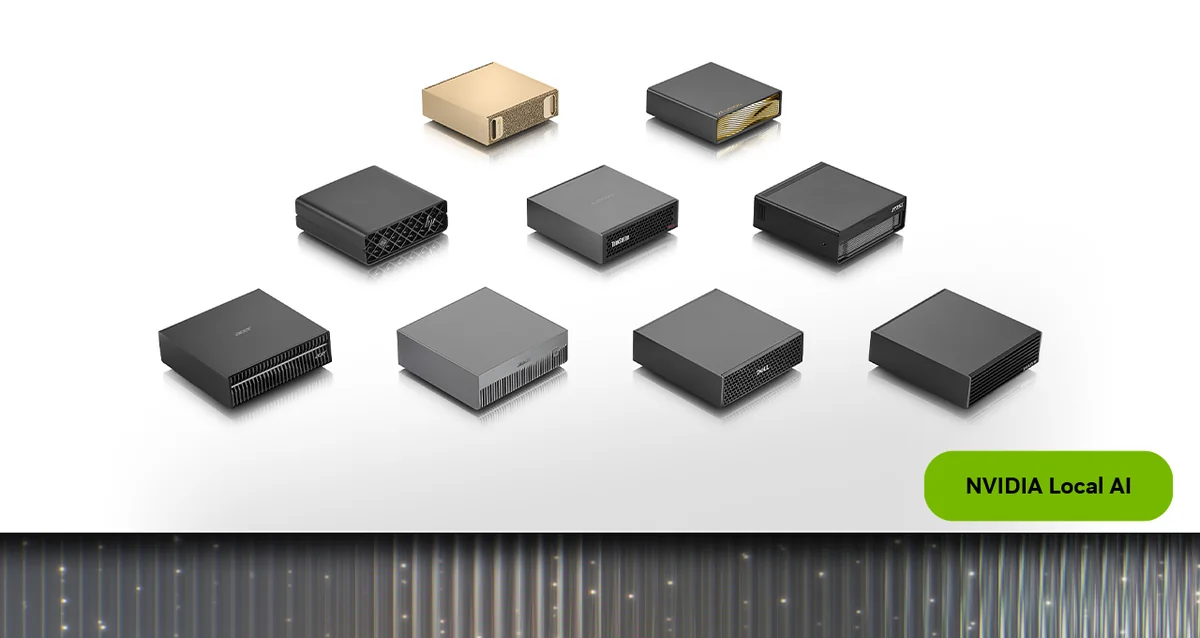
One year ago, NVIDIA DGX Spark launched at $3,999 with 128GB of unified memory and 4TB of storage. Today NVIDIA announced the DGX Spark 64GB: half the memory, half the storage, and a starting price of $4,999. On the same day, according to The Register, the 128GB DGX Spark went to $6,950. That is the second price increase in eight months, and it lands weeks before the first RTX Spark laptops and mini PCs reach stores with the same GB10-class silicon.
DGX Spark price history: $3,999 to $6,950 in one year
| Date | Model | Memory | Price |
|---|---|---|---|
| October 2025 | DGX Spark (Founders Edition) | 128GB | $3,999 |
| February 2026 | DGX Spark (Founders Edition) | 128GB | $4,699 |
| October 2, 2026 | DGX Spark | 128GB | $6,950 |
| October 23, 2026 | DGX Spark 64GB (partners only) | 64GB | from $4,999 |
The February increase was $700, and NVIDIA blamed constrained memory supply. The new $6,950 price for the 128GB model is close to 74% above launch. The new 64GB model costs 25% more than the 128GB machine did when it launched.
Measured per gigabyte of memory, the change is harder to defend:
- October 2025: $3,999 for 128GB, about $31 per GB.
- October 2026, 128GB: $6,950, about $54 per GB.
- October 2026, 64GB: $4,999, about $78 per GB.
What the NVIDIA DGX Spark 64GB actually is
According to NVIDIA’s announcement, the 64GB model keeps the GB10 Grace Blackwell Superchip, DGX OS and the full NVIDIA AI software stack. It is sold only through partners: Acer, ASUS, Dell, Gigabyte, HP and MSI, from Friday, October 23. The Register reports that memory bandwidth stays at 273 GB/s and the 20-core Arm CPU co-designed with MediaTek is unchanged.
NVIDIA says the 64GB box supports models up to 100 billion parameters. Its pitch for the smaller model is clustering. Two units linked with a QSFP cable pool their memory to 128GB, handle models up to 200 billion parameters, double the aggregate memory bandwidth and deliver “up to 1.7x” the performance of one unit.
Do the math on that pitch. Two DGX Spark 64GB units cost $9,998. A year ago, $3,999 bought one box with 128GB. The cluster gets you more bandwidth, but if your goal is fitting a model in memory, you pay about 2.5 times more for the same 128GB.
For the full platform background, our NVIDIA DGX Spark review covers what the GB10 does well and where the 273 GB/s ceiling bites.
Is the DGX Spark 64GB worth $4,999?
For most buyers, no. 64GB is the tier where a lot of local AI work starts to feel cramped. A 70B model at 4-bit fits, but long contexts, a second model or a fine-tuning run push you against the ceiling fast. What you get for the money is NVIDIA’s software stack and CUDA on your desk. If your employer requires DGX OS, or you deploy to DGX in the cloud, that has real value. If you just want to run local LLMs, it is hard to justify.
For comparison, Ryzen AI Max+ 395 mini PCs with 128GB sell for $3,099 on the official Bosgame and ACEMAGIC stores as of late September 2026. That is about $24 per GB, with twice the memory of the DGX Spark 64GB for $1,900 less. They do not run CUDA, and that matters for some workflows. We break down those prices in our piece on why the Ryzen AI Max+ PRO 495 is not worth $6,500. Related: our Bosgame M5 review and our explainer on NPU vs iGPU vs CPU for local LLMs.
What this means for RTX Spark
RTX Spark is the Windows version of this idea. It uses NVIDIA’s N1X chip with up to 20 Grace CPU cores, up to 6,144 Blackwell CUDA cores and up to 128GB of unified memory. Laptops from ASUS, Dell, HP, Lenovo, Microsoft Surface and MSI are due in October. Acer and Gigabyte follow later, along with mini PCs like the ASUS ProArt RTX Spark Mini PC and Lenovo’s SFF RTX Spark desktop.
NVIDIA has not published RTX Spark prices, and neither have the PC makers. The only figures in circulation are analyst estimates reported by VideoCardz: N1 systems from around $1,799 and N1X systems from around $2,899. Those are estimates, not prices, and they do not say how much memory those configurations carry.
Here is why we expect RTX Spark to disappoint on memory or price:
- It draws on the same constrained memory. Unified LPDDR5X is exactly what pushed DGX Spark from $3,999 to $6,950. NVIDIA itself cites memory supply for both price changes.
- PC memory is getting scarcer, not cheaper. TrendForce expects conventional DRAM contract prices to rise another 10–15% in Q4 2026. It also says PC DRAM supply could decline in 2027 as more capacity moves to servers.
- PC makers are already cutting specs. TrendForce reports that PC brands are shrinking SSD capacities in mainstream models to protect their bill of materials. A 64GB DGX Spark with half the storage is the same move at NVIDIA’s own counter.
Our expectation, and it is only an expectation until prices are public: the RTX Spark models near the analyst figures will ship with 32GB or less. The 128GB configurations that make the platform interesting for local AI will cost far more. The chip can do 128GB. Whether you can afford 128GB is a different question.
Should you wait for RTX Spark or buy a DGX Spark now?
- Do not pre-order an RTX Spark machine without a price and a memory configuration in writing. “Up to 128GB” describes the chip, not the laptop you will be offered.
- Compare price per GB of unified memory, not headline TOPS or petaflops. For local AI, memory capacity decides what you can run at all.
- If you need CUDA and DGX OS today, a 128GB GB10 system is still the useful tier. Look at partner 128GB boxes before paying $6,950 for NVIDIA’s own.
- If you do not need CUDA, 128GB Ryzen AI Max+ 395 systems cost less than half of the 128GB DGX Spark’s new price.
Related: our reviews of the ASUS Ascent GX10 and the MSI EdgeXpert MS-C931.
Verdict
The DGX Spark 64GB is a smaller machine at a bigger price. NVIDIA presents it as an “accessible price point”. It is accessible only next to the $6,950 the 128GB model now costs, and that comparison is NVIDIA’s own doing. A year ago $3,999 bought twice the memory. We do not recommend the 64GB model at $4,999 for local LLM work. RTX Spark pricing needs the same scrutiny: wait for real prices and real memory configurations before you get excited about the chip. We look at why consumers keep absorbing these increases in Consumers are paying for the RAM crisis.