
What it is
The GMKtec EVO-X2 is the first Strix Halo mini PC to ship in volume: AMD’s Ryzen AI Max+ 395, a 16-core Zen 5 chip with the integrated Radeon 8060S (40 RDNA 3.5 compute units), a 50-TOPS XDNA 2 NPU, and up to 128 GB of LPDDR5X-8000 unified memory. AMD’s stated platform performance is 126 combined TOPS across CPU, NPU, and iGPU.
In a 2-liter chassis with triple-fan cooling, two USB4 ports, Wi-Fi 7, an SD UHS-II card reader, and an aggressively-priced $1,499 starting point, the EVO-X2 is positioned squarely as a mini workstation for local AI work, content creation, and gaming, not as a budget-friendly NUC competitor. For most reviewers in 2025, it was the most-discussed mini PC of the year.
What it’s good for
Local large-model AI inference. This is the EVO-X2’s defining capability. With up to 96 GB of system memory allocatable as VRAM to the integrated 8060S, the EVO-X2 can run 70B-class quantized language models entirely on-device. This is something no mini PC in its price range can match, and few discrete-GPU desktops under $3,000 can. ServeTheHome and PCWorld both specifically called this out as the EVO-X2’s headline feature: a Strix Halo system with the unified-memory architecture that finally makes local 70B inference practical at a workstation price.
1440p AAA gaming. The Radeon 8060S is by a wide margin the most powerful integrated GPU ever shipped in a mini PC. ETA Prime measured Spider-Man 2 at 1440p with FSR around 70-80 fps (130 fps with frame generation) and DOOM: The Dark Ages around 70 fps at 1440p. 1440p Medium is the comfortable target for AAA titles; 4K is on the table for esports and older AAA games.
Content creation. Sixteen Zen 5 cores, 128 GB of memory bandwidth, and the 8060S handle Premiere and Resolve timelines through 4K cleanly. For Lightroom and Photoshop on multi-thousand-image catalogs, the headroom is enormous.
Workstation duty. Two USB4 ports, three M.2 slots, an SD card reader, Wi-Fi 7. This is a mini PC sized for desk use as someone’s primary machine, not a hidden-behind-the-monitor accessory.
Build and connectivity
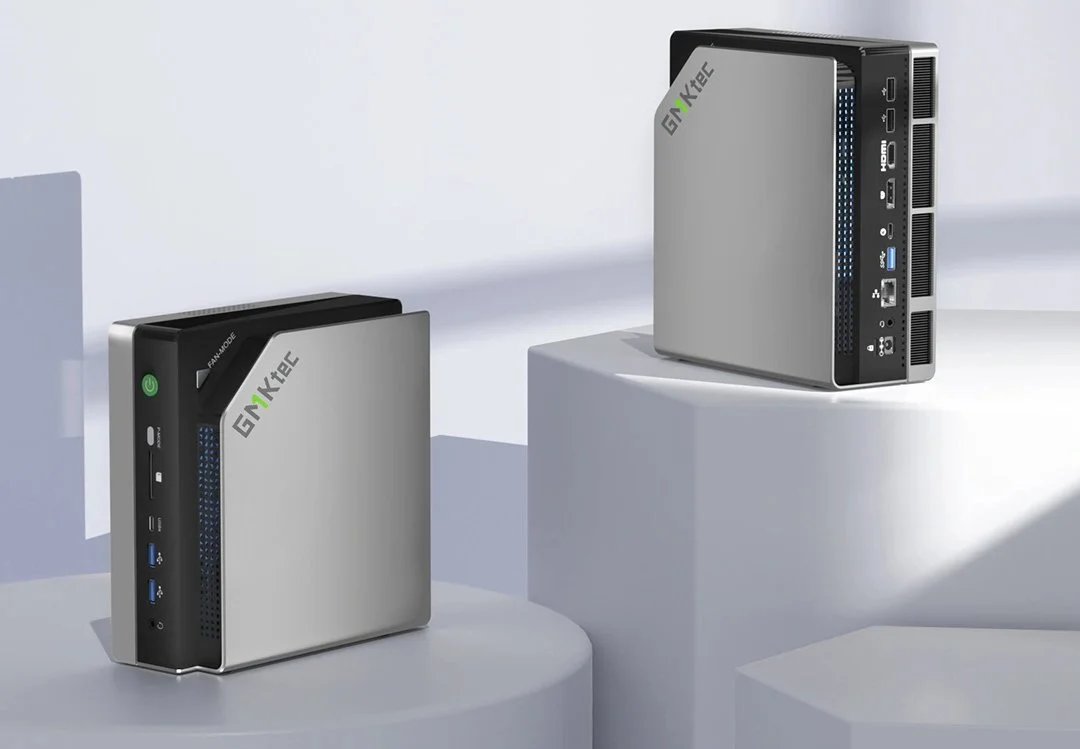
The chassis is a two-tone black-and-silver metal shell with triple cooling fans (two CPU + one for SSD/RAM zone) and configurable RGB lighting. Approximate footprint is 77 × 193 × 186 mm, larger than a NucBox K8 Plus but still small enough to live on a desk. There is a hardware power-mode toggle on the front panel, which is rare and welcome.
Port layout is workstation-grade:
- Front: USB4 Type-C, 2× USB-A 3.2 Gen 2, 3.5 mm jack, full-size SD UHS-II reader, mode toggle
- Rear: USB4 Type-C, USB-A 3.2 Gen 2, 2× USB 2.0, HDMI 2.1, DisplayPort 1.4, 2.5 GbE, 3.5 mm jack
- Display: up to four 4K/8K outputs across HDMI 2.1, DP 1.4, and the two USB4 ports
- Wireless: Wi-Fi 7 + Bluetooth 5.4
What the EVO-X2 does not have: 10 GbE, dual 2.5 GbE, OCuLink, or Thunderbolt 5. For a workstation-positioned mini PC at $1,499+, the single 2.5 GbE NIC is the most defensible omission.
Memory, storage, and upgrades
Memory is the EVO-X2’s defining feature, and also its hardest spec-sheet trade-off: all of the LPDDR5X-8000 is soldered. Strix Halo’s 256-bit-wide memory bus needs LPDDR5X-class signaling integrity that simply cannot be delivered through SODIMM connectors. This is a platform requirement, not a GMKtec choice, but it means you must pick your RAM SKU at purchase.
Configurations: 64 GB, 96 GB, or 128 GB of LPDDR5X-8000.
Storage is the flexible side: 1 TB or 2 TB PCIe 4.0 NVMe in slot one, plus two additional M.2 slots. GMKtec rates the system up to roughly 16 TB total across all three slots.
Pricing and where to buy
As of April 2026, configurations span:
- 64 GB / 1 TB: around $1,499 (Micro Center, GMKtec direct, Amazon)
- 96 GB / 2 TB: around $1,799 (GMKtec direct)
- 128 GB / 2 TB: around $2,199-$2,299 (GMKtec direct, Micro Center, Amazon)
Micro Center is the most consistent US retail option for the higher-end SKUs; Amazon stocks all three but availability fluctuates. GMKtec’s own store sells all configurations at MSRP with their 1-year warranty.
What we’d flag
This is a positive review, but a fair one: the EVO-X2 is not flawless.
- One-year warranty on a $1,499-$2,299 machine. This is the EVO-X2’s most defensible weakness. At this price, a 2- or 3-year warranty would be reasonable; competitors selling Strix Halo workstation desktops at higher prices include longer coverage. Consider an extended warranty if you intend to depend on this for production work.
- Soldered memory is permanent. Strix Halo’s memory bandwidth depends on it. Pick the RAM SKU you actually need, not the one that fits today’s budget.
- Single 2.5 GbE. A workstation-positioned $1,499 mini PC should arguably have dual 2.5 GbE or a 10 GbE port.
- Triple-fan cooling is audibly present under sustained load. Idle and light use are quiet; sustained 70B-model inference or 4K render is not. This is the cost of running a 16-core Zen 5 chip and a 40-CU GPU in a 2-liter chassis.
- GMKtec firmware history. Several reviewers note that early EVO-X2 units shipped with firmware that under-clocked memory or limited power modes; later BIOS revisions resolve this. Flash to the latest BIOS before benchmarking, and confirm your unit reports the rated memory speed.
- DisplayPort is 1.4, not 2.1. A small but visible gap given the rest of the spec sheet.
GMKtec EVO-X2 verdict
The GMKtec EVO-X2 is the best mini PC of its generation, and one of the most consequential mini PCs ever shipped. Strix Halo, 128 GB of LPDDR5X-8000 unified memory, the Radeon 8060S, and a workstation-grade port count make it the only practical way as of April 2026 to run 70B-class language models locally on a $1,499-$2,299 desktop machine.
The price is high. The warranty is short. The fans are present. None of those is disqualifying. If you have a real reason to want a Strix Halo mini PC (local AI development, 1440p AAA gaming on integrated graphics, or a creator workstation that disappears into 2 liters), the EVO-X2 is the one to buy. For everyone else, the EVO-X1 or NucBox K8 Plus will do far more for far less.