
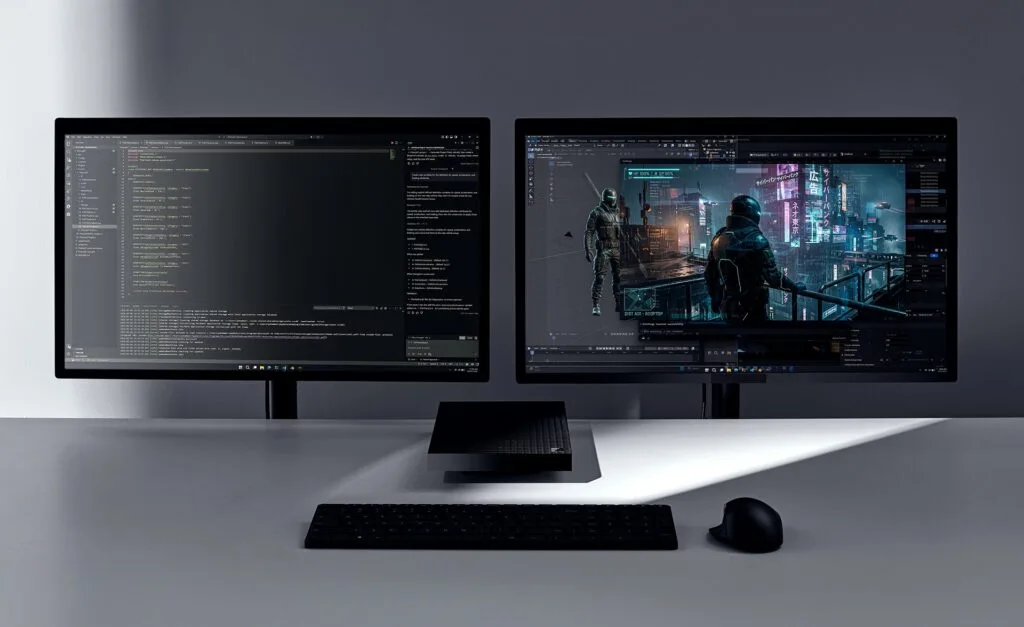
The Surface RTX Spark Dev Box is Microsoft’s first NVIDIA-powered AI mini PC: a compact, Windows-on-Arm developer machine built around the new NVIDIA RTX Spark superchip, with 128 GB of unified memory and up to 1 petaflop of AI compute. Microsoft revealed it at Build 2026 alongside the Surface Laptop Ultra, and it is squarely aimed at developers who want to prototype, fine-tune and run large models locally instead of renting cloud GPUs. This is a preview, not a review: the device is real and officially announced, but Microsoft has been deliberately sparse with the details that matter most for buyers: price, ship date and port speeds.
What is the Microsoft Surface RTX Spark Dev Box?
It is a passively cooled small-form-factor desktop in an aluminum chassis “engineered to double as a heatsink,” with a distinctive perforated top surface (early coverage counts roughly 1,000 ventilation holes) that reads like a flattened Xbox Series X. Conceptually it is Microsoft’s answer to the wave of Linux-based AI dev boxes built on NVIDIA’s GB10 Grace Blackwell platform (the NVIDIA DGX Spark and the ASUS Ascent GX10), except this one runs Windows.
Worth clearing up early: when the partnership was first teased, there was genuine confusion over whether Microsoft had actually committed to a desktop, since the headline reveal was the Surface Laptop Ultra and the “Dev Box” name initially surfaced in NVIDIA’s Q&A and a Windows-blog footer. That ambiguity is now resolved: Microsoft published a dedicated Surface Devices blog post and a Surface product page for the Dev Box. It is a confirmed, named product. What remains genuinely unconfirmed are the specifics below.
What’s confirmed: the RTX Spark superchip
RTX Spark is the Windows-on-Arm sibling of NVIDIA’s GB10 Grace Blackwell silicon, the same die family that powers the on-sale DGX Spark, not a next-generation chip. Per the joint NVIDIA/Microsoft materials, the confirmed pieces are:
- 20-core NVIDIA Grace Arm CPU, co-designed with MediaTek, linked to the GPU over NVLink-C2C.
- NVIDIA Blackwell RTX GPU with 6,144 CUDA cores and fifth-generation Tensor Cores with FP4 precision.
- 1 petaflop of AI compute.
- 128 GB of unified memory shared between CPU and GPU.
- Headroom to run 120B-parameter models with up to a 1-million-token context window locally “at interactive speeds,” or fine-tune models that previously needed cloud GPU instances.
- A 100 W thermal envelope, Microsoft’s first public hint at the RTX Spark chip’s power draw.
On the software side, it ships with a developer-tuned Windows 11 Pro, preconfigured with VS Code, GitHub Copilot, Git, Python and Node.js, plus WSL 2 with GPU passthrough and CUDA support and PowerShell 7. The pitch is “local-first AI development” with the CUDA stack available natively on Windows, something the Linux GB10 boxes can’t claim.
What’s still unknown
This is where buyers should keep expectations in check. As of mid-June 2026, Microsoft has not disclosed:
- Price. None announced. Given RTX Spark systems are positioned as premium developer hardware (not a successor to the budget Windows Dev Kit 2023), expect it to land near the DGX Spark’s ~$3,000–$4,000 bracket rather than below it.
- A firm ship date. Microsoft says only “later this year,” consistent with the Fall 2026 platform window for RTX Spark.
- Memory bandwidth. No figure published. If it inherits the GB10 family’s roughly 273 GB/s LPDDR5x ceiling, as documented in our DGX Spark review, then bandwidth, not compute, will be the real limiter on token-generation throughput. Treat any specific number as unconfirmed until Microsoft says otherwise.
- Port speeds and exact I/O. ServeTheHome notes the rear layout (USB-C, USB-A, HDMI, Ethernet, audio) looks “quite similar to NVIDIA’s own DGX Spark box, minus a couple of USB-C ports and the Spark’s defining ConnectX-7 QSFP Ethernet ports,” meaning the high-speed 200GbE clustering that defines DGX Spark is apparently not here. Link speeds are unstated.
- Storage capacity and SSD generation.
What it means for mini PCs
If the platform delivers, the Dev Box matters for one specific reason: it brings a 128 GB unified-memory, CUDA-native AI box to Windows without dropping to Linux. Today, a developer who wants this much coherent memory on the desktop chooses between DGX OS (Arm Ubuntu) on a GB10 box or an AMD Ryzen AI Max system like the Framework Desktop or GMKtec EVO-X2. Microsoft is betting that “stays in Windows, keeps CUDA, keeps Copilot” is worth a premium to a meaningful slice of AI developers.
The honest caveat: the absence of ConnectX-7 clustering and the likely ~273 GB/s bandwidth ceiling mean this is a single-box prototyping and fine-tuning tool, not a throughput monster. For interactive local inference on 70B–120B models it should be excellent; for high-volume serving it will be bandwidth-bound like every other GB10 device. Related: Dell XPS RTX Spark Desktop, Lenovo RTX Spark Mini PC and DGX Spark 64GB pricing and what it means for RTX Spark.
Expected timeline and price outlook
- Availability: later this year (Fall 2026 window), U.S. only, exclusively on Microsoft.com at launch.
- Price: none announced. Plan for premium developer-hardware pricing, not budget.
- Status: officially announced “pre-release product,” subject to regulatory approval; specs may shift before launch.
Sources & caveats
Everything here is drawn from NVIDIA’s and Microsoft’s own announcements plus first-look coverage from Tom’s Hardware, ServeTheHome and The Register. The chip-level specs (20-core Grace CPU, 6,144-CUDA Blackwell GPU, 128 GB unified memory, 1 petaflop, 120B-param support) are confirmed by NVIDIA and Microsoft. The device-level unknowns (price, exact ship date, memory bandwidth, port speeds and storage) are not, and we’ve flagged each as such above. RTX Spark is the GB10 Grace Blackwell family on Windows, not a new generation of silicon.
We’ll publish a full review when the Surface RTX Spark Dev Box actually ships and we can test local LLM throughput against its real memory bandwidth. Until then, the closest on-sale equivalents we’ve already reviewed are the NVIDIA DGX Spark and the ASUS Ascent GX10: same GB10 platform, Linux instead of Windows, and available to buy today.