
NVIDIA had two products that the local AI and PC crowd waited for: RTX Spark, its Arm chip for Windows laptops, and DGX Spark, the small Grace Blackwell box for running AI models at home. Both got huge attention when they were announced. Both are now losing it. Interest in RTX Spark fell by more than half within four days of launch, and DGX Spark is at its lowest level of interest since early March. The reasons are the same ones that hit AMD’s Ryzen AI Max+ 495: prices that went far above what people expected and reviews that did not match the promise.
RTX Spark: two spikes, then a fast drop
RTX Spark was announced at Computex 2026 and went on sale on October 16 in laptops from ASUS, Dell, HP, Lenovo, Microsoft and MSI. It arrived late: TrendForce reported in July 2025 that the chip, then called N1X, had slipped from the second half of 2025 to 2026.
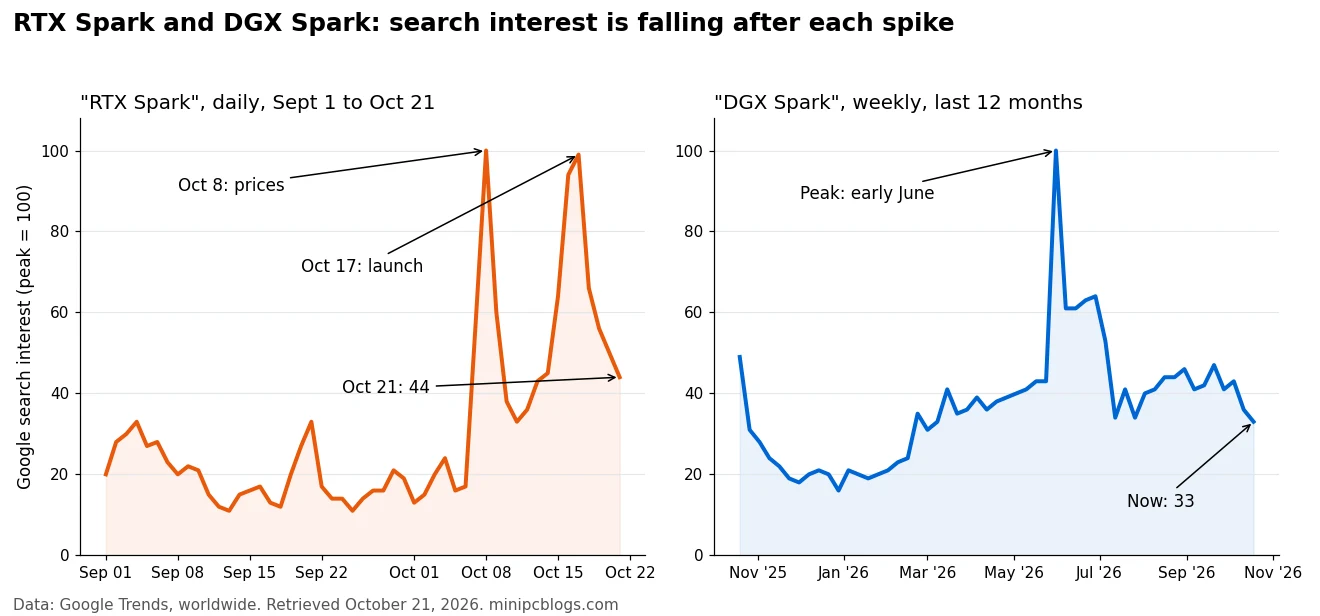
Google Trends shows two clear spikes and then a decline:
| Date | Event | Search interest (peak = 100) |
|---|---|---|
| July to September 2026 (average) | Before launch | 17 |
| October 8, 2026 | Prices and Surface Dev Box preorders | 100 |
| October 17, 2026 | First day after launch | 99 |
| October 21, 2026 | Four days later | 44 |
Interest is still above its summer level, which is normal four days after a launch. But the speed of the drop says a lot: most people looked, read the prices and reviews, and moved on.
What the reviews found
The reviews are not bad. HotHardware called the GPU and AI performance “class-leading,” and Tom’s Hardware found that a MacBook Pro with an M5 Max took about 25% longer than the Surface Laptop Ultra in its AgentPerf local AI test. The trouble is everything else people expected from an Arm laptop:
- Battery life. Notebookcheck’s headline says the ASUS ProArt P16 and Surface Laptop Ultra “disappoint due to low RTX Spark N1X efficiency.” In web browsing, RTX Spark is only slightly more efficient than AMD’s Strix Halo, which Notebookcheck called “a bit ugly for an Arm chip.” The Surface needs a battery 27% larger than a MacBook Pro 14’s to last as long.
- Single-thread speed. Tom’s Guide measured 2,604 single-core and 23,610 multi-core in Geekbench 7, against 3,690 and 29,659 for Apple’s M5 Pro.
- Games. PC Gamer called it “an impressive Arm-based gaming laptop but not one I’d recommend you buy just for PC gaming,” with 1% lows well below 20 fps in some games and under 1.5 hours of battery while gaming.
- Software. HotHardware listed some anti-cheat incompatibility, and several reviews noted that Copilot+ features were not ready at launch.
The price
RTX Spark laptops start at $2,599.99 for a Surface Laptop Ultra with 24GB and the cut-down 18-core chip. The 128GB configurations that make it interesting for local AI cost $5,109 to $6,999.99, and the Surface RTX Spark Dev Box costs $5,999.99. VideoCardz headlined that as “$2000 more than AMD’s Ryzen AI Halo.” Our full price table is in NVIDIA price backlash: DGX Spark, RTX Spark and GPUs.
DGX Spark: from must-have to “not worth the price”
DGX Spark launched in October 2025 at $3,999, and for a few weeks it was the most talked-about AI box on the market. A year later, its search interest is down to 33, two thirds below its peak in the first week of June and the lowest weekly level since early March.
| Date | DGX Spark 128GB price |
|---|---|
| October 2025 (launch) | $3,999 |
| February 2026 | $4,699 |
| October 2, 2026 | $6,950 |
| October 23, 2026 (new 64GB model) | from $4,999 |
That is 74% more in a year. NVIDIA blamed “industry wide memory supply constraints” for the February increase, and ServeTheHome agrees memory prices are still rising. The new 64GB model costs $1,000 more than the 128GB model did at launch. Our breakdown is in DGX Spark 64GB pricing.
The disappointment started early. In October 2025 John Carmack posted that his unit was “maxing out at only 100 watts power draw, less than half of the rated 240 watts,” and delivering “about half the quoted performance.” Apple’s MLX lead measured about 60 TFLOPS BF16, close to Carmack’s estimate. The memory bandwidth, 273 GB/s, limits how fast it writes text: Hardware Corner measured 38.6 tok/s on gpt-oss-120B, close to Strix Halo’s 34.1 and about half of an M3 Ultra Mac Studio’s 70.8.
Stability is still an issue a year later. On NVIDIA’s developer forums, a thread about units shutting down from high temperature has more than 210 posts across 11 pages, with new posts this week. Another, from June, describes a fully updated unit that powers off within about 60 seconds of vLLM load, with the owner going through an RMA. We did not see NVIDIA staff replies in those threads.
The community mood matches the search curve. On Hacker News earlier this year, one commenter summarized r/LocalLLaMA as unanimously not liking the Spark for running models and called it “not worth the crazy price.” In The Register’s comments on the 64GB launch, one reader wrote that NVIDIA was “desperate to milk every last penny out of every last mug before the bubble bursts.” Not everyone agrees: ServeTheHome says it gets “much more out of them than we projected,” and one Register reader says two Sparks save them “high triple digits” a month in API costs.
Are they selling?
As with the 495, there is no public sales data. NVIDIA has not published DGX Spark or RTX Spark unit numbers, and RTX Spark has only been on sale for five days. Some DGX Spark models have been reported as sold out, but with memory this scarce, that can mean small batches as easily as strong demand.
What we can say is that the wider audience that followed both launches is looking elsewhere. Search interest is falling, reviews and forums keep pointing to the same problems, and prices keep going up. That makes weak sales likely. We will update this article if NVIDIA or analysts publish numbers.
AMD has the same problem
This is not only an NVIDIA story. AMD’s Ryzen AI Max+ PRO 495 mini PCs lost 92% of their search interest within a month, priced at $6,399 to $7,399 for a small bandwidth gain. We covered it in Ryzen AI Max+ 495 hype faded fast: buyers moved on. Both companies are selling local AI hardware at prices set by an expensive memory market, which we covered in Consumers are paying for the RAM crisis, and buyers are noticing.
Our take
RTX Spark is a good chip in an awkward package. It is excellent at local AI and GPU work and mediocre at what most laptop buyers care about: battery life, single-thread speed and games. If you want a laptop that runs large models with CUDA, it is the best option on Windows. If you want an everyday laptop, a MacBook or a Snapdragon X2 machine makes more sense.
DGX Spark is still the reference box for CUDA developers who deploy to NVIDIA’s data center systems. For anyone who only wants to run local models, it no longer makes sense at $6,950. A 128GB Ryzen AI Max+ 395 box generates text at similar speeds for about half the price; see our Bosgame M5 review and GMKtec EVO-X2 review. A Mac Studio gives you far more bandwidth, and used RTX 3090s are still the fastest option for models that fit.
👉 See the Bosgame M5 on AmazonRyzen AI Max+ 395, 128GB / 2TB, $3,599 on Amazon (October 16, 2026)