
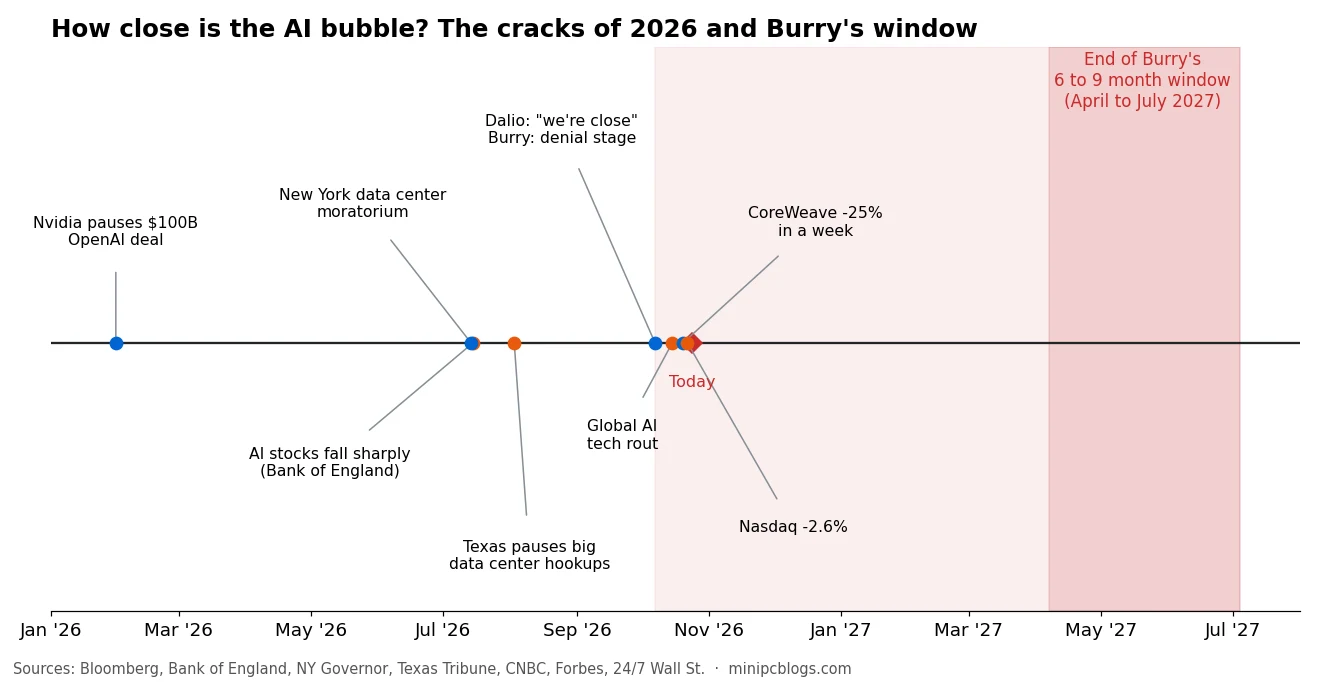
In the first three weeks of October 2026, some of the most respected names in finance said out loud what many people in tech only whisper. Ray Dalio said the AI boom is “close” to the point where bubbles burst. Michael Burry said the market is in denial. Ken Griffin called it “almost certainly” a bubble. The IMF and the Bank of England warned that a sharper correction is possible. Meanwhile the data centers that are supposed to justify all this spending are getting stuck: no power, no permits, angry neighbors.
This is our read of the evidence, with the data behind it. We are not predicting a date. We are showing how many of the classic warning signs are already flashing, and why the data center problem could speed things up.
How close are we?
The chart at the top of this article puts 2026 on one line. The cracks started in January, when Nvidia paused its plan to invest $100 billion in OpenAI. By March Jensen Huang said $100 billion was “probably not in the cards,” and the deal shrank to about $30 billion. In July AI stocks fell sharply, according to the Bank of England. October brought a global tech rout on the 15th, CoreWeave losing about 25% in a week, and the Nasdaq’s worst day since June on the 22nd (down about 2.6%, with Nvidia down 4.4% and AMD down 8.1%).
Then came the two warnings everyone is quoting:
- Ray Dalio (October 7, Forbes Global CEO Conference in Singapore) said AI has the features of a classic bubble and that “we’re close” to the bursting point. His triggers: the enormous debt behind AI investment while interest rates rise, and the pressure to turn paper wealth into cash.
- Michael Burry (early October) wrote that “the stock market is quite obviously in its first stage of grief, denial. Per 2000 and 2008, this stage lasts 6-9 months.” Nine months is the 270 days in the headlines. He did not say when the clock started. Counted from his post, the window closes around April to July 2027. In late September he also moved into put options on Nvidia, Micron and Palantir.
Both men have been early before. Burry told investors to sell in early 2023, before a long rally, and Dalio said in November 2025 that he would not sell just because something is a bubble. Their warnings matter because of what they point at, not because they come with a date.
The gap: spending far ahead of revenue
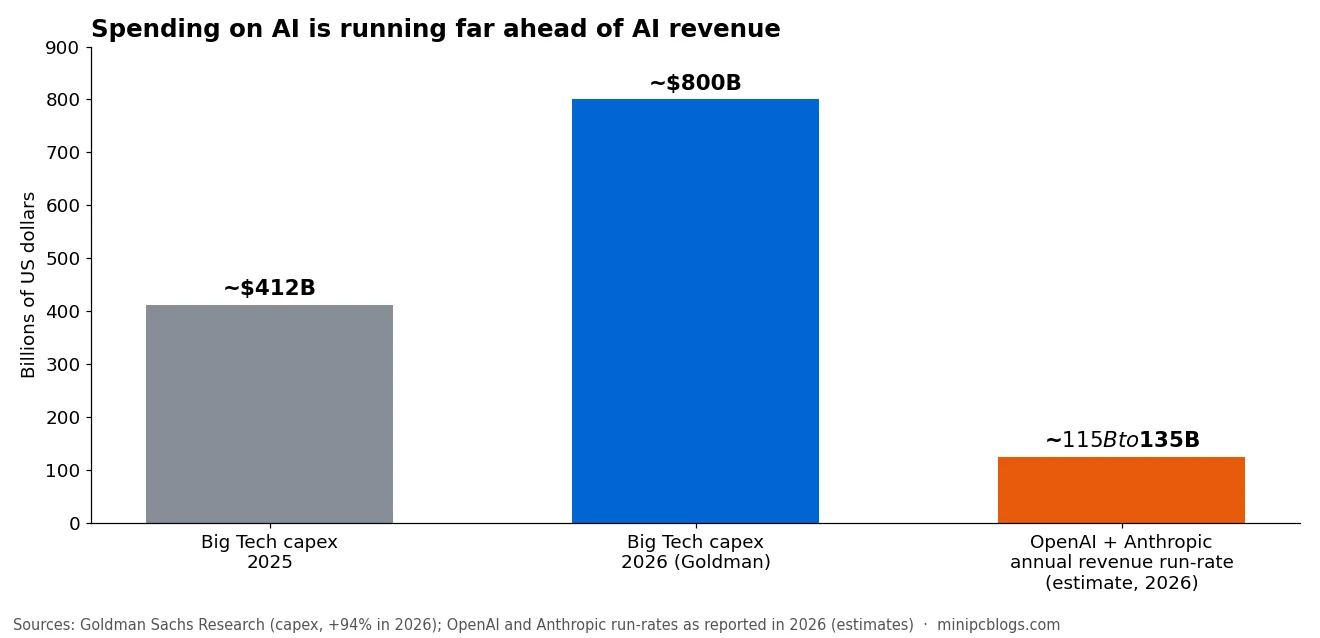
Goldman Sachs Research expects the largest US tech companies to spend about $800 billion on capital expenditure in 2026, up 94% from 2025, most of it on AI data centers and chips. On the other side, the two leading AI labs, OpenAI and Anthropic, are reported to be running at roughly $115 to $135 billion a year in revenue combined. That revenue is growing fast, but the spending is growing faster, and most of it has to be paid back by customers who are still figuring out if AI pays for itself.
The best known data point on that question is still MIT’s 2025 study: 95% of enterprise generative AI pilots showed no measurable impact on profit and loss. OpenAI’s own documents, reported by Fortune, project years of heavy losses before a profit around 2030. Ken Griffin put it bluntly on October 20: companies are paying AI bills “without clear evidence of productivity gains or a defined ROI timeline.”
The trigger Dalio is talking about: debt
Until 2025, Big Tech paid for AI with cash from its other businesses. In 2026 it switched to borrowing:
- The Bank of England counted about $450 billion of AI-related debt issued by early September 2026, more than double all of 2025.
- Amazon, Microsoft, Alphabet, Meta and Oracle sold about $200 billion of investment-grade bonds in the first half of 2026 alone, nearly double what the five issued in all of 2025, according to coverage of Dalio’s remarks.
- Oracle carries about $167 billion of debt, S&P rates it BBB-, one step above junk, and its credit default swaps hit records. At least $300 billion of its roughly $523 billion order backlog is tied to a single customer that loses money: OpenAI.
- CoreWeave, the largest GPU cloud, has about $52 billion of debt and lease obligations. Its 2032 bonds fell below 80 cents on the dollar with yields near 15%, and Bloomberg wrote that its troubles risk shutting the junk bond market for AI borrowers.
Then there is the circular money. Nvidia invests in its customers, AMD gave OpenAI warrants for up to about 10% of AMD, and OpenAI pays for computing with stock it received from CoreWeave. The IMF’s October report flags companies acting as “one another’s investors, financiers, and customers.” That is how a problem at one company becomes a problem for all of them.
The whole market rides on three stocks
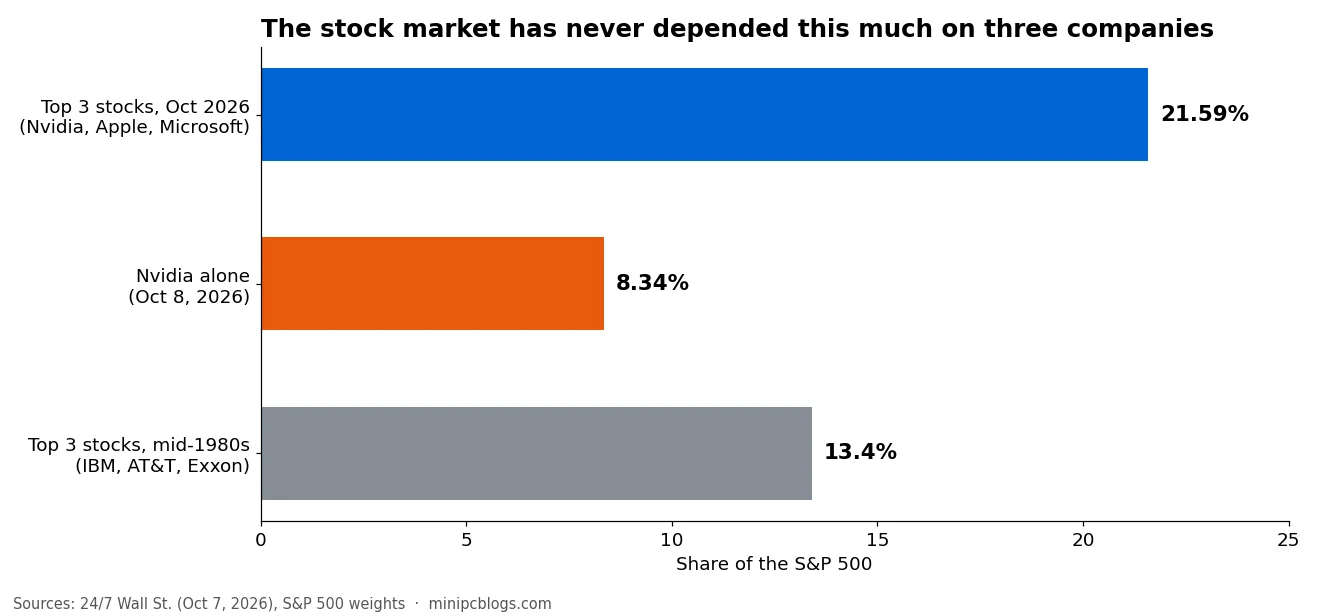
Nvidia alone weighs about 8.3% of the S&P 500, and Nvidia, Apple and Microsoft together are 21.59%, a record. The previous record for the top three, IBM, AT&T and Exxon in the mid-1980s, was 13.4%. If AI stocks fall, this is not a tech sector problem anymore: it hits every index fund and retirement account. The Bank of England estimates a sharp AI stock correction could cut UK economic output by up to 2.2 percentage points, and Panmure Liberum’s Joachim Klement sees a risk of the worst S&P 500 crash since 2008, as soon as 2027.
Why data centers could speed up the burst
Here is the part that gets less attention. The money is borrowed now, but it only comes back when data centers are running and selling computing. And data centers are getting stuck.
- Power. On August 3 the governor of Texas ordered an audit of every data center waiting to connect to the state grid. Since then, according to law firm summaries, ERCOT has not energized new computing loads of 75 MW or more. BNEF estimates the audit could delay 49.8 GW of data center demand and cost projects up to $15 billion. In the PJM grid, which serves Virginia and 12 other states, the capacity auction hit its price cap for the third year in a row and still came up 6.5 GW short of its reliability target.
- Equipment. GE Vernova, the largest gas turbine maker, has 116 GW under contract and is already taking orders for 2031. Large power transformers take more than two years to arrive.
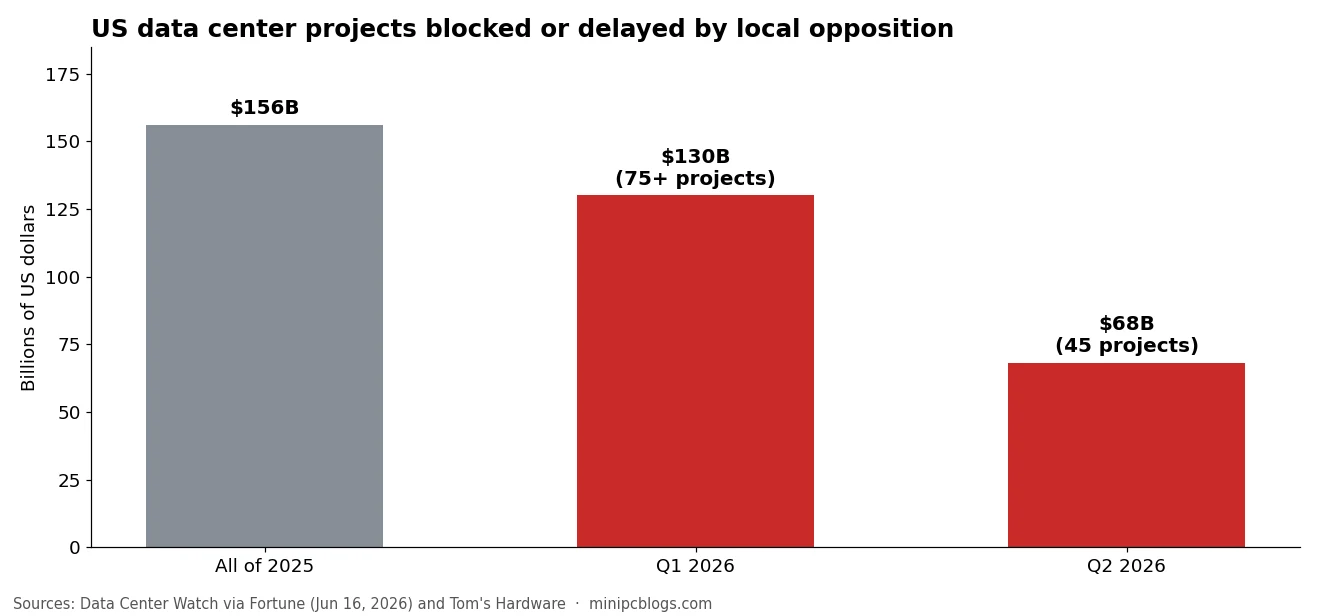
- Neighbors. Data Center Watch counted about $130 billion of US projects blocked or delayed by local opposition in the first quarter of 2026, almost as much as the $156 billion of all of 2025. Heatmap counts at least $260 billion of data center investment cancelled after local opposition so far in 2026, and its August poll found 75% of Americans oppose a data center near them.
- Governments. New York imposed the first statewide moratorium on data centers of 50 MW or more on July 14. North Carolina and Maine removed tax breaks, Arizona paused its sales tax exemption for three years, and Ohio stopped accepting new applications.
Put those together and you get the mechanism. A company buys GPUs with debt at 11% to 15%. The data center that should house them waits for power, a permit or a court. Every month of delay is a month of interest with no revenue. If lenders stop rolling that debt, as CoreWeave’s bonds suggest they are starting to, the weakest builders fail, their contracts with AI labs fall through, and the selling spreads to the companies that depend on them. That is how a physical bottleneck becomes a financial crisis.
There is an honest counterpoint here: GPU rental prices are not collapsing. An H100 still rents for about $3 to $4 an hour, and B200 prices rose in 2026. The data centers that do get built are being used. The risk is not empty buildings today. It is debt that grows faster than the buildings can be finished.
Why data centers are a bad deal for most countries
Governments compete to attract data centers with tax breaks, cheap power and fast permits. The numbers suggest most countries should think twice.
They eat the grid
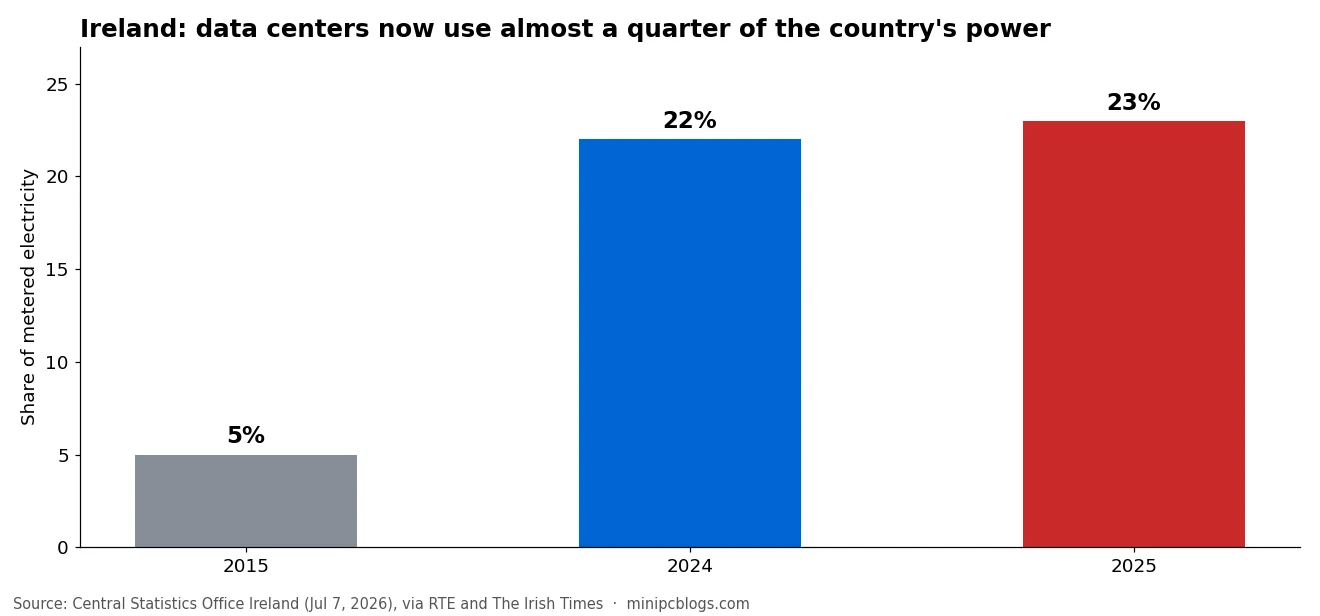
Ireland is the warning. Its data centers used 23% of all metered electricity in 2025, up from 5% in 2015, according to the Central Statistics Office. Their use grew 10% in one year while everyone else grew 2%. The regulator froze new connections in Dublin from 2021 to late 2025 over blackout risk, and now requires new data centers to bring their own power. Worldwide, the IEA expects data center electricity demand to more than double to about 945 TWh by 2030, with gas supplying a large part of the increase.
Households pay part of the bill. In the PJM grid, capacity prices went from $28.92 to $329.17 per MW-day in two years, largely because of data center demand, and those costs reached electricity bills in June 2026. US residential electricity averaged 18.31 cents per kWh in July, 4.9% more than a year earlier.
They drink scarce water
Many large data centers cool their servers by evaporating water, and they like to be built where land and power are cheap, which is often where water is scarce. Rest of World documented the pattern across Latin America: Google’s planned data center in Cerrillos, Chile, would have used 169 liters per second and was paused after a court ruling and local opposition; its project in Canelones, Uruguay, would have used about 2 million gallons a day, a figure that only came out through a court order during the country’s worst drought in 70 years. In Mexico, Querétaro hosts about a dozen data centers during a multi-year drought, and President Claudia Sheinbaum said in August that “México no tiene por qué ser el centro de datos de otros lugares del mundo” (Mexico has no reason to be the data center for other parts of the world).
They pollute more than the brochures say
- On-site gas turbines. xAI ran about 35 gas turbines at its Colossus site in Memphis while it held a permit for 15, emitting nitrogen oxides and formaldehyde in a neighborhood that already had poor air quality.
- Health costs. Researchers at UC Riverside and Caltech estimate that air pollution linked to US data centers (from power plants and diesel backup generators) could cause up to 1,300 premature deaths and about $20 billion in health costs a year by 2030.
- Climate goals slipping. Microsoft’s emissions rose 25% in fiscal 2025, mainly from data center expansion.
- Electronic waste. GPUs are replaced every few years, and a study in Nature Computational Science estimates generative AI could add 1.2 to 5 million tonnes of e-waste by 2030.
They create few lasting jobs
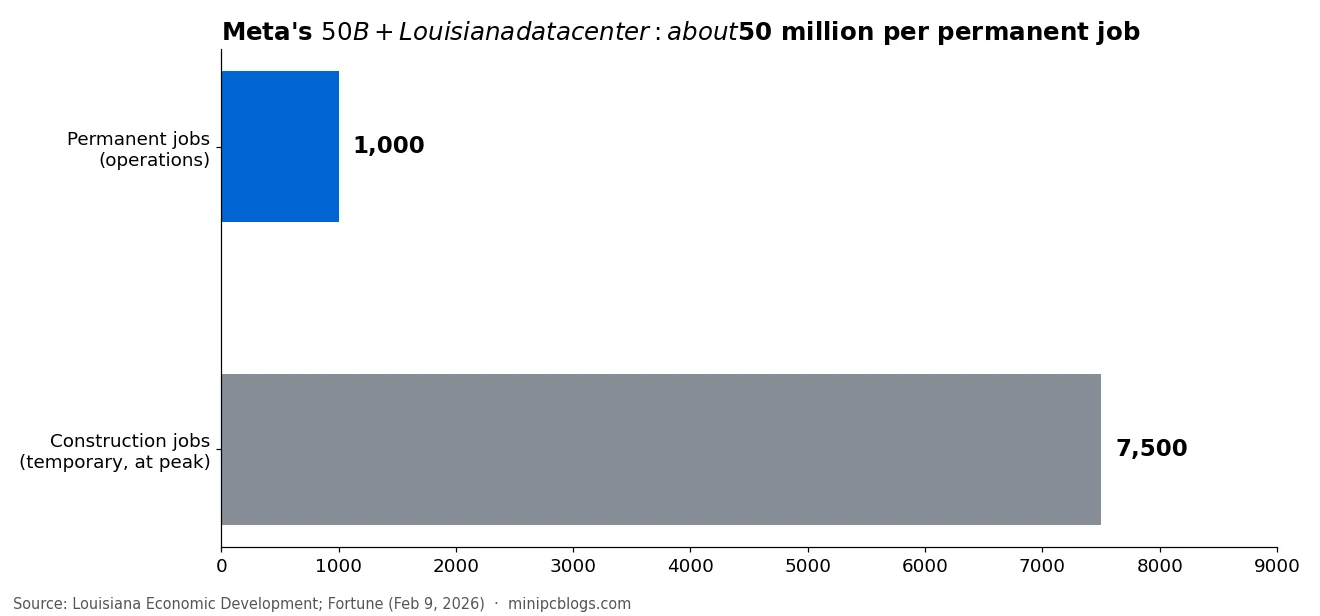
Data centers employ thousands of people while they are built and very few once they run. Meta’s Louisiana campus, expanded to more than $50 billion, plans about 7,500 construction jobs at peak and about 1,000 permanent ones: roughly $50 million of investment per lasting job. Virginia’s data center sales tax exemption cost about $930 million in fiscal 2023, its largest economic incentive, and Good Jobs First puts the cost at about $1.9 billion in fiscal 2025, or about $1.2 million per net new job that year.
To be fair, there are real benefits. Virginia’s audit office found the industry adds about $9.1 billion a year to the state economy, host counties collect large property taxes, and big tech companies sign renewable energy contracts that can fund new generation. But for a country deciding where to spend its power, water and tax incentives, a factory, a hospital or a university usually creates far more lasting work per dollar.
Who survives if it bursts
If the bubble pops, the pain will not be spread evenly.
Most exposed: companies that only resell someone else’s AI. A large share of AI startups are a product built on top of an API from OpenAI, Anthropic or Google. Their costs are set by someone else, and those prices are subsidized today: Axios wrote in March that AI companies are covering costs “but not forever.” ICONIQ’s 2026 State of AI report found AI products average a 52% gross margin, against 70% to 80% for traditional software, and 84% of AI companies saw margins shrink because of infrastructure costs. We are already seeing what happens when the subsidy ends: this month Cursor changed its plans so that the same month of Claude use that cost $20 now costs $50. And the provider decides which models exist. OpenAI shut down o1, o3-mini, o4-mini, GPT-4 Turbo and others on October 23, and GPT-4o leaves its API on January 14, 2027. A product that depends on one of them stops working unless it migrates in time.
Least exposed: companies that own their infrastructure and use open models. A business that runs open models such as Qwen, GLM or DeepSeek on its own hardware controls its costs and cannot be switched off by a price change or a model retirement. That is the logic behind the local AI boxes we cover on this site, from the 128GB Bosgame M5 and GMKtec EVO-X2 to the 192GB Ryzen AI Max+ PRO 495 machines.
Owning infrastructure is not risk-free, though. Hardware is expensive, especially with memory prices up sharply (see Consumers are paying for the RAM crisis), it has to be operated and replaced, and API prices have actually been falling in 2026 because of a price war. The point is not that every API customer will collapse. It is that a company with no control over its main cost has the least room to survive a shock.
What would prove us wrong
There is a serious case that this is not a bubble, or not yet:
- Revenue is real. Anthropic’s revenue run-rate grew several times over in 2026, Azure is growing about 40% a year, and the share of US firms using AI rose from 17.3% to 23.2% in nine months, according to the Census Bureau.
- Valuations are not 2000. Goldman Sachs says the market’s forward price-to-earnings ratio is about 19, in line with its 10-year average, although it warns that AI-driven earnings growth may not last beyond 2026.
- Demand still exceeds supply. Most data center delays come from power and permits, not from a lack of customers, and GPU rental prices are holding up.
- Smart money is split. JPMorgan’s Jamie Dimon wrote in April that AI investment “is not a speculative bubble,” and even Griffin says he remains a long-term believer.
Our take
AI is a real technology with real revenue. That was also true of the internet in 2000. What makes this moment dangerous is not the technology but how it is being paid for: debt that doubled in a year, deals where suppliers fund their own customers, a market where three companies are more than a fifth of the index, and data centers that cannot get power fast enough to pay back what was borrowed to build them.
We do not know if the burst comes in Burry’s window or years later. We do know that the warning signs of 2000 and 2008 are showing, and that data centers, the physical heart of the boom, are where the stress is building fastest. For countries, the lesson is to stop handing out water, power and tax breaks for a handful of permanent jobs. For businesses, the lesson is simpler: do not build your company on a price you do not control.
We covered how this boom already reached consumers in Consumers are paying for the RAM crisis, and how the hype around AI hardware is fading in RTX Spark and DGX Spark: the hype faded.