
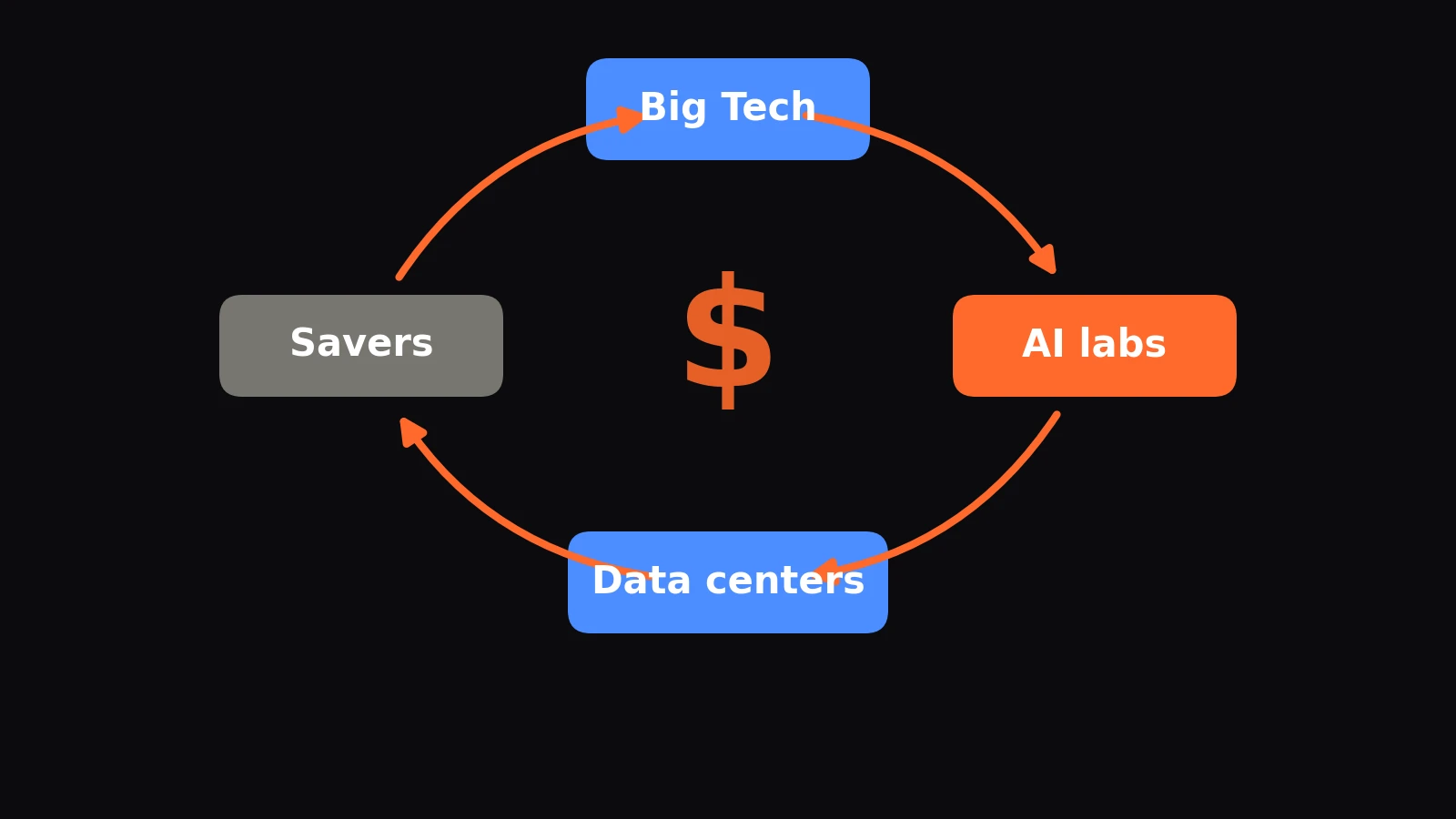
Retirement savings are paying for chips that Elon Musk’s SpaceX rents to Anthropic, a customer that can walk away on 90 days’ notice.
That sentence is built entirely from public documents. Athene, an insurer that sells retirement annuities, says in an October 30 investor presentation that it holds $2.72 billion of “financing of xAI lease of GPU chips”, carrying a single credit rating. Those chips sit in Colossus, the data centers that xAI, now part of SpaceX, rents out to “customers including Google and Anthropic”. Apollo, Athene’s parent, has since agreed to finance another $40 billion of chips for SpaceX. And Anthropic’s own prospectus says that contract, now worth up to $120.5 billion, can be cancelled by either side on 90 days’ notice once its initial periods end in early 2027.
It is one link in a much larger circle. We read more than 100 filings with the US Securities and Exchange Commission: quarterly reports, prospectuses, confidential drafts that became public, contract exhibits, mutual fund holdings and the letters the SEC sent to companies before they listed. Each document on its own looks ordinary. Together, they show the same handful of companies investing in, lending to and guaranteeing the AI labs that buy their chips and cloud services. The labs spend that money with them. The suppliers book it as revenue, mark up their stakes as profit, and raise more money from savers on the strength of those numbers.
Why it matters to you. If you own an index fund, a bond fund or an annuity, or pay an electricity bill in much of the eastern US, you are already in this circle. Mutual funds hold billions of dollars of data center bonds, insurers hold AI chip loans, and households in the PJM grid pay a $29.4 billion share of power capacity charges attributed to data centers.
Video: the AI money circle in about 15 minutes and 12 chapters. Narration uses a synthetic voice; every figure comes from the filings linked below.
This follows our earlier pieces, The AI Bubble’s Fine Print and The AI Bubble Could Burst Soon, and Data Centers May Pop It.
What we can and cannot say. We found no ruling, charge or regulatory action that calls any of this illegal. We did find inconsistencies between companies’ filings, disclosures that changed, and structures that existing rules were written for. We describe each one, the rule that applies and the evidence that is still missing. Where we did not find something, we say so. The sources listed below are the documents this article cites; every document our researchers consulted, more than 1,000, is listed on a separate page: The AI Money Circle: Every Source We Used.
How the circle closes
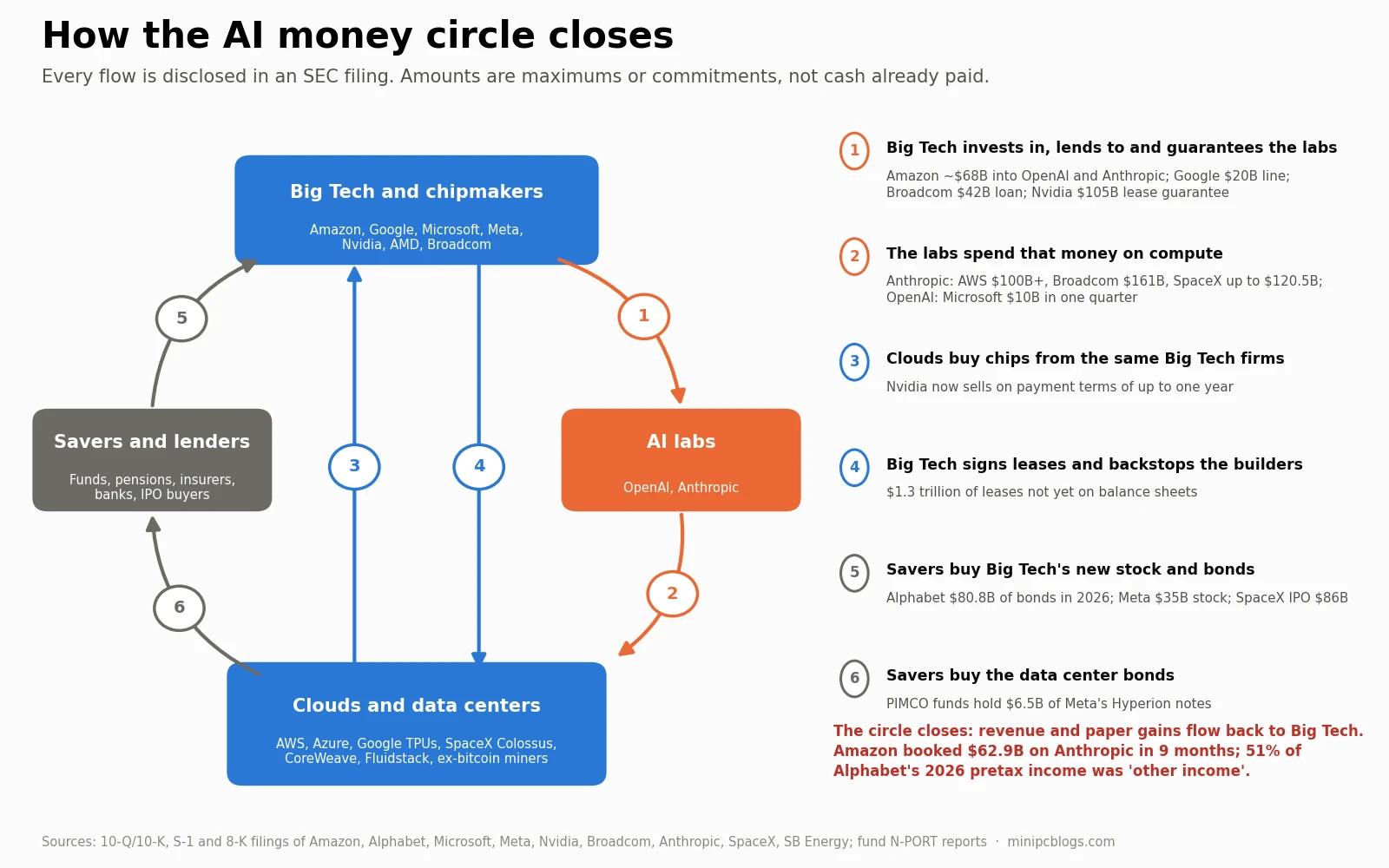
In short:
- Big Tech invests in, lends to and guarantees the AI labs. Amazon has put about $68 billion into OpenAI and Anthropic. Google has a $20 billion financing facility with Anthropic. Broadcom offers Anthropic up to $42 billion of loans. Nvidia guarantees up to $105 billion of lease payments for an OpenAI affiliate. AMD gives OpenAI and Meta stock warrants that vest as they buy AMD chips.
- The labs spend that money on compute from the same companies. Anthropic has committed more than $100 billion to Amazon Web Services, $161.2 billion of rent to Broadcom for Google-designed chips and up to $120.5 billion to SpaceX. OpenAI paid Microsoft $10.0 billion in a single quarter.
- The clouds buy chips from the same suppliers, increasingly on credit.
- Big Tech signs about $1.3 trillion of data center leases that are not yet on its balance sheets, and guarantees the rent of the builders, from neoclouds to former bitcoin miners.
- Savers buy the stock and bonds that fund it. Alphabet alone issued $80.8 billion of bonds and about $62 billion of new stock in 2026. Meta sold $35 billion of new stock in October. SpaceX raised about $86 billion in its listing.
- Mutual funds and insurers buy the data center bonds. PIMCO funds alone hold about $6.5 billion of the notes that financed Meta’s Louisiana data center.
The circle closes when that spending comes back to Big Tech as revenue and as paper profit, which lifts their stock and lets them raise more money.
Case 1: four contracts, one day
On March 31, 2026, four agreements were signed. Their dates appear in Anthropic’s prospectus and its exhibits:
- Google sold TPU8i chips to Broadcom under a “TPU8i Hardware Sales Agreement”.
- Broadcom leased those chips to an Anthropic subsidiary. Anthropic’s rent over the five-year leases is about $161.2 billion, and the leases cannot be cancelled.
- Broadcom agreed to buy up to $42 billion of Anthropic notes “solely to finance quarterly rent payments” under that lease. The interest is 9% a year, added to the debt instead of paid in cash, rising to 13% if Anthropic misses revenue conditions.
- Google signed a note purchase agreement with Anthropic for up to $20 billion, with draws “driven by the achievement of certain conditions under certain third-party compute agreements”.
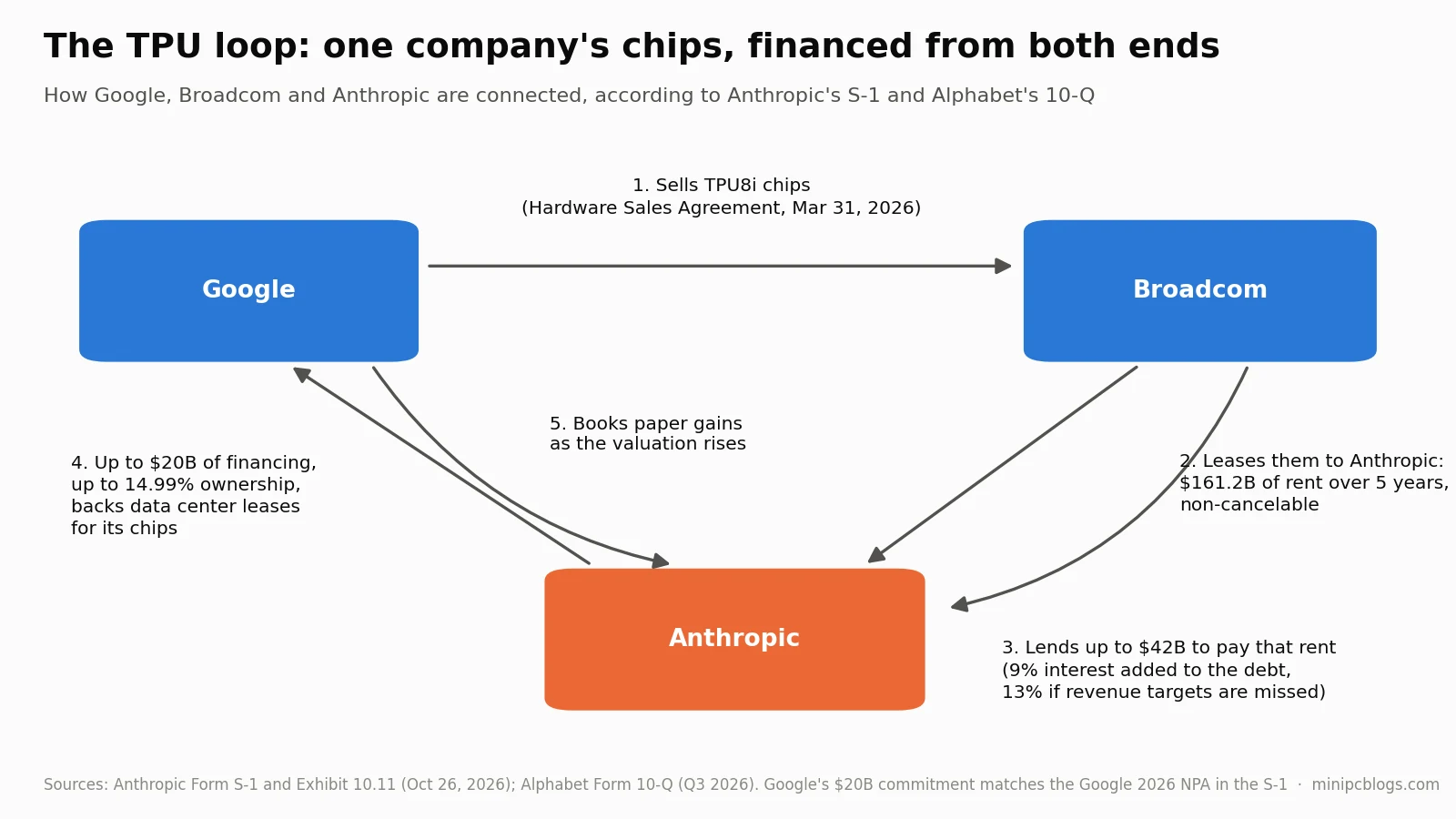
Two more details close the loop. The lease requires “Required Credit Support” from Google, or from an approved alternative provider, for the capacity Broadcom finances; capacity without it can be cancelled. And Alphabet’s quarterly report says some TPU sales include options requiring Google “to repurchase the hardware” at pre-set prices, with up to $6.6 billion of such obligations. Alphabet says Google Cloud’s growth came partly from “TPU system sales”, which it began recognizing in the second quarter of 2026, right after these contracts.
Alphabet accounts for these as sales because, it says, “based on the extent of the discount on repurchase and other factors, we do not believe counterparties have an economic incentive to exercise their option.” The repurchase prices and Google’s credit support terms are in a document that is not public: Section 11 of an order form between Google and Broadcom. Whether these are sales or something closer to financing under accounting rules depends on those terms.
The financing side was later described by one of the lenders. In an investor presentation published on October 30, Athene, Apollo’s annuity insurer, explains that in June 2026 “Apollo led a $35B financing” through an SPV called “Big Sky”: “Apollo affiliates purchased ~$35B of chips from Google and leased them to Anthropic.” Broadcom provides residual value support. And: “If chips never become operational, Google & Broadcom are required to make payments fully extinguishing the senior debt.” The same slide adds: “Simple structure has been used for vendor financing in other industries for decades.”
So Google sells the chips, reports TPU system sales as revenue, and is obliged to repay the buyers’ senior debt if the chips never work. Broadcom has backstopped up to $72 billion of these leases for “financial partners” ($29 billion in its quarter to August 2 and $43 billion on October 26).
Case 2: SpaceX and Anthropic
This is the case where public documents disagree most.
| Date | Document | What it says about the contract |
|---|---|---|
| May 3 (signed) | SpaceX prospectus, May 20 | Anthropic agrees to pay “$1.25 billion per month through May 2029” for compute at SpaceX’s Colossus data centers |
| Before May 20 | SpaceX draft | The contract was described only as an agreement “with a third party”. The SEC, citing press reports, asked SpaceX to say more, noting Anthropic would use “all of COLOSSUS’ compute capacity” |
| June 1 | SpaceX letter to SEC | The contracts are “not material” and SpaceX’s business is not “substantially dependent” on them; either side can cancel on 90 days’ notice |
| June 12 | SpaceX final prospectus | Same description as June 1. SpaceX lists on Nasdaq |
| July 13 | Anthropic draft | ”May 2026” agreements, “up to $44.4 billion” |
| August 4 | SpaceX quarterly report | An unnamed “Customer B” is 19.5% of revenue. Anthropic is not named |
| August 10 | Anthropic draft | Agreements from “May and July 2026”, “one of which was subsequently amended in June 2026”, up to $84.5 billion |
| October 22 | SpaceX quarterly report | ”Customer B” is 34.5% of revenue. Anthropic is not named |
| October 26 | Anthropic S-1 | Agreements “between May and October 2026”, up to $120.5 billion, about $3.1 billion a month |
| October 26 | SpaceX 8-K | A commitment for an Apollo-managed lessor to buy GPUs and lease them to SpaceX, about $40 billion of payments over five years |
Three things stand out:
- The June amendment. Anthropic says one agreement was amended in June, the month SpaceX listed. SpaceX’s prospectus text did not change between June 1 and June 12. If the amendment came before the listing and changed the economics, the prospectus would have been out of date; if it came after, it would not. The date is not public.
- The July agreement. As a public company, SpaceX entered a new agreement that added about $40 billion to the commitment, roughly twice SpaceX’s entire 2025 revenue of $18.7 billion. We found no 8-K, no mention in its quarterly reports and no subsequent-events note.
- The mismatch. SpaceX is taking on about $40 billion of five-year GPU leases with Apollo, on top of $20.2 billion of leases with a firm run by one of its directors, to serve a customer who, per Anthropic’s S-1, can cancel on 90 days’ notice once initial periods end in January and March 2027.
One more connection: Alphabet owns 7.2% of SpaceX, and Donald Harrison, Google’s president of global partnerships, has sat on SpaceX’s board since 2015. Since SpaceX absorbed xAI in February 2026, its prospectus lists Google as a key AI competitor. Section 8 of the Clayton Act bars an officer or director of one company from serving as director of a competitor above set size thresholds, with one year to resolve a conflict that arises later. Whether it applies depends on legal questions we cannot settle, such as how the market is defined and whether Google LLC counts as a corporation under the statute. If it does, the one-year window from the xAI merger ends around February 2027.
Case 3: Nvidia
In its annual report of February 25, 2026, Nvidia wrote that it had been “asked to offer financing arrangements to support our customers’ and partners’ buildout of datacenter infrastructure. We have not entered into any financing arrangements.”
Six months later, its quarterly report said: “Financing arrangements with certain investment-grade customers, including extended payment terms under large, multi-quarter agreements, will continue to affect the timing of our operating cash flows.” Payment terms now range “from 90 days up to one year”. In that quarter, receivables rose from $40.7 billion to $63.1 billion while revenue rose 18%, and operating cash flow was about $24 billion against $59.7 billion of net income. Five customers account for 70% of what Nvidia is owed.
The Ohio guarantee shows another gap. Nvidia’s filings describe guarantees of up to $105 billion for an OpenAI affiliate’s leases at SB Energy’s campus. SB Energy’s own prospectus adds that the guarantee is “intended to cover debt principal, accrued interest, invested equity, targeted equity returns”, that OpenAI pays Nvidia for it “under a separate agreement”, and that Nvidia is buying $3.0 billion of SB Energy stock, half of it prepaid at 90% of the listing price, on the same day. Nvidia’s filings mention neither the payment from OpenAI nor that equity purchase. SB Energy also writes that OpenAI “is not currently an investment-grade tenant”.
Nvidia’s commitments now run in both directions. In the quarter to July 26 it disclosed $36 billion of new “AI cloud agreements”: it books revenue on the upfront sale of hardware to cloud operators and commits to buy cloud capacity back from them for about six years, capacity that “the AI clouds can unilaterally stop providing to us and sell to third-party customers at more advantageous rates.” That comes on top of $29 billion of earlier cloud service agreements. Its chief financial officer’s commentary explains why it gives guarantees at all: many AI clouds and model makers “are growing faster than their balance sheets and long-term credit profiles can support.”
Adding up the figures in its quarterly report, Nvidia’s exposure to its own customers and partners was about $317.5 billion in July: $99 billion of equity stakes, $25 billion of commitments to invest, $108.5 billion of maximum guarantees, $65 billion of cloud purchase commitments and $20 billion of leases taken on behalf of others. Its revenue in the first half of the fiscal year was $177.8 billion. Gains on its investments added $32.6 billion over 18 months, about 20% of its first-half net income.
Two more links do not appear in Nvidia’s filings. Apollo describes Nvidia as an “anchor Limited Partner” in Valor Compute Infrastructure, a fund run by SpaceX director Antonio Gracias that buys Nvidia GPUs and leases them to xAI; the fund has raised $2.65 billion from 1,141 investors and Apollo lent it $3.5 billion. And Anthropic’s S-1 commits about $206 billion for compute on Nvidia GPUs through three companies Nvidia has invested in: SpaceX’s AI unit, Nscale and Lambda.
Case 4: OpenAI’s $730 billion of promises
OpenAI files almost nothing with the SEC, so its finances have to be pieced together from its partners’ filings. Adding up the contracts with a disclosed dollar value, we count about $725 billion to $735 billion of compute commitments: $250 billion with Microsoft Azure, $138 billion with Amazon Web Services, more than $300 billion with Oracle, about $18 billion to $22 billion with CoreWeave, and much of Cerebras’s $25.4 billion backlog. On top of that come about $430 billion of lease backlog that SB Energy estimates for its campus, and 26 gigawatts of Nvidia, AMD and Broadcom chips with no disclosed price. OpenAI’s annualized revenue in 2025 was about $20 billion.
Almost every supplier also funds OpenAI:
| Partner | What OpenAI committed to buy | What the partner gives OpenAI |
|---|---|---|
| Microsoft | $250 billion of Azure | $12.0 billion invested; stake “valued at approximately $135 billion” |
| Amazon | $138 billion of AWS | $50 billion, fully paid by September 30, 2026 |
| Nvidia | GPUs for 10 gigawatts, no definitive agreement disclosed | Guarantees of up to $105 billion of rent, paid for by OpenAI |
| AMD | 6 gigawatts of GPUs | Warrant for up to 160 million AMD shares at $0.01 |
| Cerebras | 750 megawatts, “more than $20 billion” | Cerebras gets a $1.0 billion loan from OpenAI and OpenAI becomes a shareholder |
| SB Energy | Data center leases in Ohio | OpenAI holds $500 million of preferred stock and penny warrants |
Some of the biggest numbers are promises, not contracts. Nvidia’s “up to $100 billion” investment went from a letter of intent “with an opportunity to invest” in its November 2025 report, to “finalizing” in February 2026, to no mention at all. What Nvidia did sign is the cap on guarantees of OpenAI’s rent. Broadcom’s 10 gigawatts have no disclosed value, and the Samsung and SK hynix memory deals are letters of intent. Amazon’s own 8-K made $35 billion of its commitment payable only on “specified milestones” or a listing, with a 2028 deadline; its quarterly report shows the full $50 billion paid by September 30, while OpenAI raised its AWS commitment from $38 billion to $138 billion over the same months.
The money also flows backward. OpenAI lent Cerebras about $1.0 billion. Cerebras says “no cash payments had been made” and that $86.3 million of OpenAI’s bills were credited against the loan instead. In July 2026 OpenAI exercised warrants for 10,033,508 Cerebras shares, worth about $1.86 billion at the listing price, against $74.4 million of revenue Cerebras booked from OpenAI in the first half.
In November 2025 OpenAI’s chief executive said the company does not “have or want government guarantees.” Its suppliers now provide private ones. Its conversion into a public benefit corporation was cleared by the Delaware and California attorneys general in October 2025; the California agreement requires 21 days’ notice to the attorney general before any change of control.
Who creates the demand?
Big Tech’s strongest answer to talk of a bubble is demand: AWS revenue grows 39% a year, Azure’s 48%, and the backlogs of signed contracts keep rising. So we asked who signed those contracts. Comparing the commitments the labs and their partners disclose with each company’s reported backlog:
| Company | Backlog | From labs it funds | Share, our calculation |
|---|---|---|---|
| Amazon (AWS) | $578 billion | OpenAI $138 billion, Anthropic at least $110 billion | About 43%; 35% counting only the 2026 expansions |
| Microsoft | $677 billion of commercial contracts | OpenAI, and Anthropic’s at least $44.9 billion | About 40%, range 35% to 48% |
| Google Cloud | $560.8 billion | Anthropic at least $114.5 billion, Crux AI $16.8 billion | About 23% |
| Oracle | $664 billion | About half likely OpenAI, which Microsoft, Amazon and SoftBank fund, not Oracle | Not funded by Oracle |
| Neoclouds and SpaceX’s AI unit | About $458 billion | OpenAI, Anthropic and xAI owe most of it | 58% owed by labs |
The growth says more. Amazon’s backlog rose by $378 billion in twelve months; the OpenAI and Anthropic contracts it names account for 63% to 66% of that, and its two biggest quarterly jumps match their announcements. At Google, Anthropic and Crux account for about 40% of backlog growth since December. At Microsoft, the OpenAI and Anthropic contracts signed during the year roughly equal the whole increase, although Hood said in July that “all sequential commercial RPO growth was driven by commitments from customers outside of frontier model companies.” Among the neoclouds, on about 61% of the backlog the payer is funded, guaranteed or partly owned by a company that also invests in, lends to or supplies the seller.
The labs’ own cash follows the same path. By our estimate from their partners’ filings and press reports, about 60% of the money OpenAI received from January to September 2026 came from Amazon and Nvidia, and about 75% including SoftBank. Anthropic’s S-1 shows that 48% of its revenue in the first half of 2026 was collected through the marketplaces of AWS, Google Cloud and Azure, which it describes as “collection agents.” The term “related party” does not appear in the S-1: Amazon and Google hold non-voting shares, which keeps them outside the related-party disclosure rules. In the second quarter of 2026 they bought Anthropic shares at $259.14 each while the concurrent Series H was priced at $589.01.
For chipmakers we can only estimate, because none names its customers. Based on the capital spending of the neoclouds and of xAI, all of them Nvidia investees, we estimate that 11% to 18% of Nvidia’s revenue over its last four quarters came from customers it funds. For Broadcom, the Anthropic racks it backstops are about 3% to 13% of revenue; for AMD, about 1% to 5% so far, although every large AMD GPU deal announced since 2025 comes with AMD warrants or AMD equity.
Revenue being paid today is a different story, and it matters. Anthropic’s entire compute bill was at most 8.3% of AWS and Google Cloud revenue combined in the second quarter of 2026, and at most 18.5% of their growth. Anthropic paid for its compute in the first half of 2026 with cash from customers: its operating cash flow was positive. OpenAI provides 10.8% of Microsoft’s revenue.
So the circle inflates the promised demand far more than the demand being paid today. The backlogs that justify new data centers, new debt and higher valuations rest heavily on a few labs that the same companies fund. If those labs grow into their commitments, the promises become revenue. If they do not, a large part of the backlog was never independent demand.
Paper profits
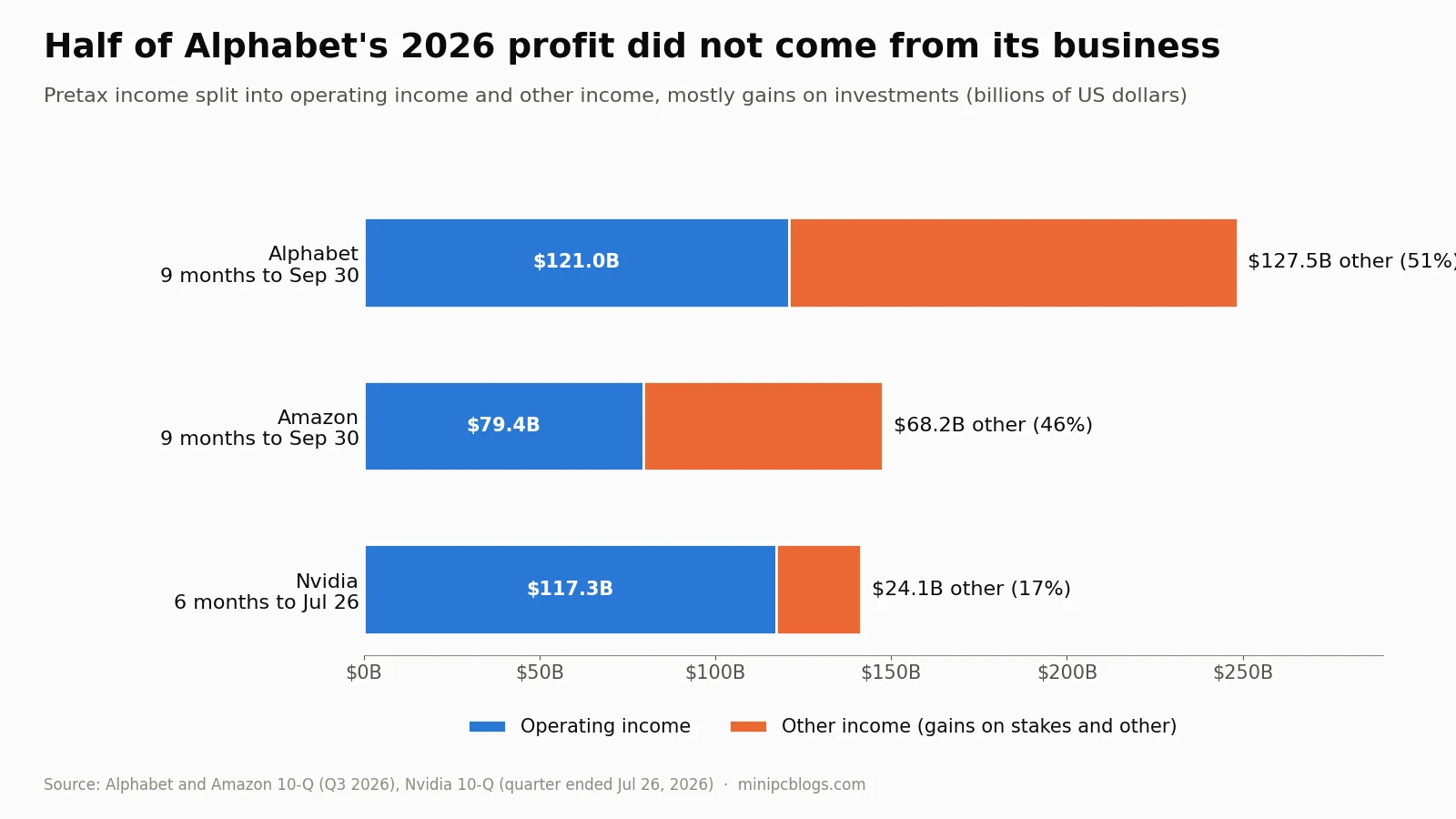
- Alphabet: of $248.5 billion of pretax income in the first nine months of 2026, $127.5 billion was “other income”, mainly unrealized gains on “a private company” and SpaceX. Alphabet never names Anthropic in its quarterly report; the $20 billion commitment it describes matches Anthropic’s Google agreement in amount and term. In the third quarter those gains reversed to an $8.2 billion loss, and net income fell 25% while operating income rose 30%.
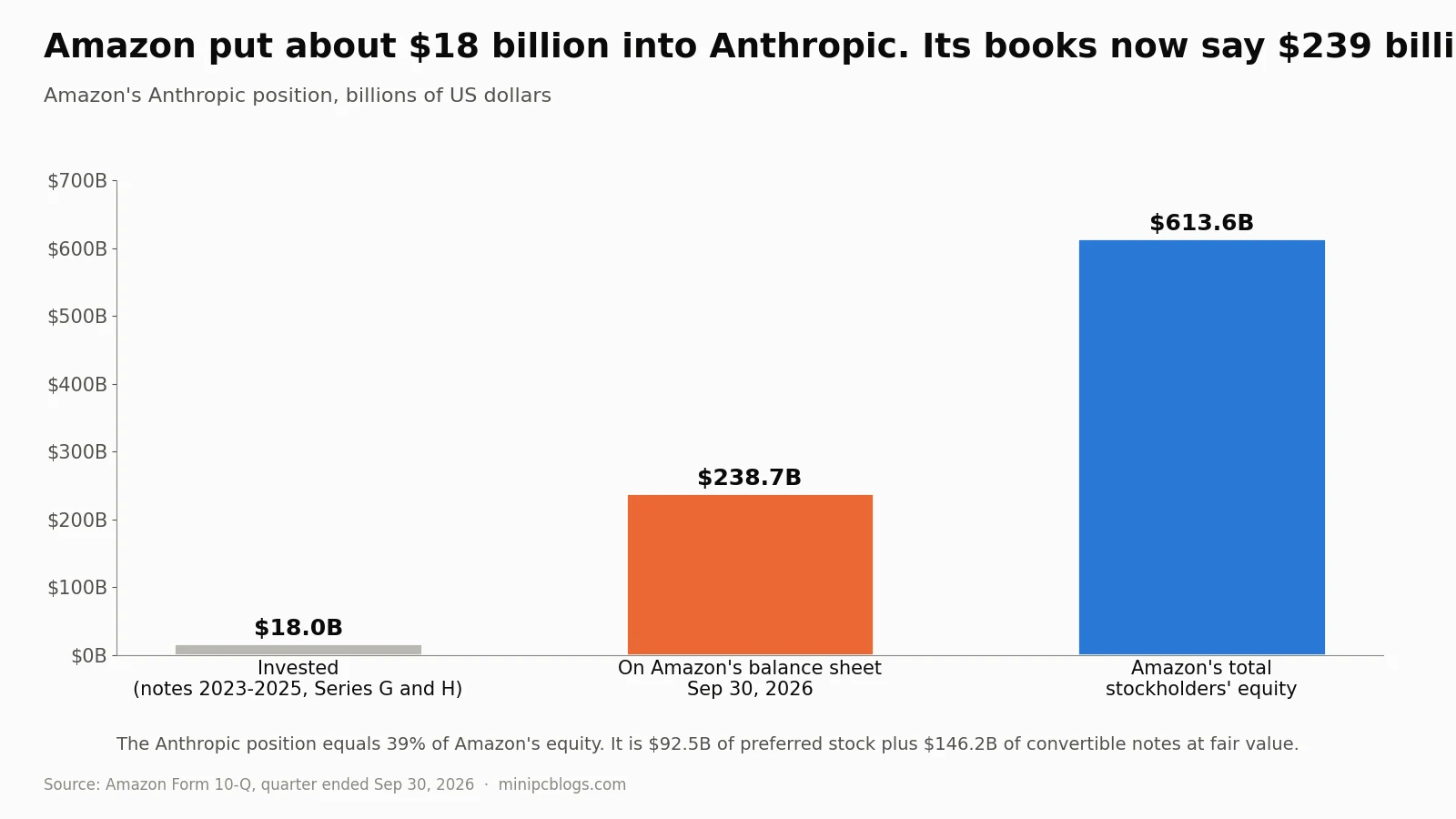
- Amazon: $62.9 billion of “upward adjustments” in nine months, “primarily from our nonvoting preferred stock in Anthropic.” After investing about $18 billion, Amazon carries its Anthropic position at $238.7 billion, 39% of its stockholders’ equity. Its $20 billion facility for Anthropic becomes available “as we reach certain delivery milestones of compute capacity”, so Amazon finances the purchases Anthropic makes from Amazon.
The same pattern shows up well beyond Amazon and Alphabet:
- SoftBank: gains on OpenAI were ¥6.73 trillion, about $43.9 billion, in the year to March 2026, about 110% of its pretax income. In August its Vision Fund 2 borrowed $10 billion against its OpenAI shares, guaranteed by SoftBank Group, and must post cash or repay if their value falls significantly.
- Tesla: it treats its stake of under 1% in SpaceX as “significant influence” because Elon Musk runs both companies, and marks it to market. That gain was $1.00 billion in the second quarter of 2026, about 89% of the quarter’s net income. SpaceX in turn booked a $561 million gain on its stake in The Boring Company, another Musk company, in the third quarter.
- Microsoft: its OpenAI line swung from a $4.1 billion loss to a $10.0 billion gain to a $19 million loss in consecutive quarters; the gain came from dilution and added $7.6 billion to net income. It also booked “a $3.2 billion gain from our investment in Anthropic,” a company its 10-K and 10-Qs never name.
- Nebius and Cerebras: Nebius’s reported profits rest on unrealized gains on its stake in ClickHouse; without them, by our calculation, it would have lost about $570 million in 2025. Cerebras’s 2025 profit of $237.8 million came from a $363.3 million gain on ending a contract with G42, while its operations lost $145.9 million.
Microsoft discloses its revenue from OpenAI because it treats OpenAI as a related party: $10.0 billion in the September quarter, roughly 11% of its total revenue. Amazon and Alphabet do not say how much revenue they earn from Anthropic or OpenAI. Anthropic’s own S-1 says 48% of its revenue in the first half of 2026 was collected through the marketplaces of AWS, Google Cloud and Azure.
Suppliers backing their customers’ stock
When Meta launched a $35 billion stock offering on October 26, its prospectus said that “NVIDIA Corporation, Advanced Micro Devices, Inc., and Broadcom Inc. (collectively, the ‘Cornerstone Investors’) have… indicated an interest in purchasing up to an aggregate of $5.0 billion of shares.” The interest was not binding and how much they bought is not yet disclosed. The three are among Meta’s main chip suppliers.
The pattern repeats lower down: Dell’s financing arm lent $7.5 billion to customers in one quarter, up from $2.4 billion a year earlier, mostly for AI servers. Google holds penny warrants in the former bitcoin miners whose rent it guarantees. AMD has committed up to $5 billion to Anthropic stock, released as AMD chips are delivered.
Who ends up holding the risk
- Mutual funds. Fund filings show at least $9.8 billion of the $27.3 billion of bonds that financed Meta’s Louisiana data center held in registered funds, about $6.5 billion of it by PIMCO. Notes from former bitcoin miners, paid by Fluidstack or CoreWeave rent, sit in high-yield funds and ETFs.
- Insurers. Athene, which sells retirement annuities, reports $12.9 billion of AI-related investments, including a $2.72 billion “financing of xAI lease of GPU chips” that carries a single BBB rating, and data center mortgages that “do not have Nationally Recognized Statistical Rating Organization (NRSRO) ratings”, classified as investment grade “based on a look-through to the off-taker”. The figures include its Bermuda reinsurance affiliates. Athene also gave a limited guarantee covering 15% of an Apollo fund’s purchase obligation in the $35 billion Anthropic chip deal, with no liability recorded, and Apollo, its parent, has since agreed a new $40 billion GPU lease for SpaceX. Athene argues the loans fully amortize within about five years and do not rely on chip resale values. On October 30, Pedro Machado of the ECB’s supervisory board, asked about banks buying credit protection from insurers, said “the case of AIG from the financial crisis immediately comes to mind” as “an example of unfunded protection provided by insurance companies”.
- Banks. A Chicago Fed staff analysis estimates large banks have about $450 billion of commitments to AI-related borrowers. The same five banks lent SpaceX a $20 billion bridge loan, led its listing, bought its bonds and then started coverage at “buy”.
- Neocloud lenders. CoreWeave’s own presentation describes one loan sized at about 102% of cost once stabilized, with five-year loans against contracts averaging about three years. Nvidia’s obligation to buy CoreWeave’s unsold capacity can end if CoreWeave enters insolvency proceedings.
- Households. PJM’s independent market monitor attributes $29.4 billion of capacity charges in the last four auctions to data center load, 46.2% of the total, paid through electricity bills.
Who pays more: memory, storage and power
The circle also reaches people who never buy an AI product. The memory makers say in their own filings that AI demand took supply away from consumers. SK hynix’s US prospectus says demand for HBM and server memory “has significantly constrained the supply of PC, mobile and consumer DRAM” and attributes the price increase to “industry-wide reallocation of production capacity to HBM.” Micron’s annual report says consumer supply “was redirected” to its other businesses.
| Indicator | Before | Now |
|---|---|---|
| DDR5 16Gb memory chip, spot price | $4.69 (end of 2024) | $61.50 (November 2, 2026) |
| Micron gross margin | 22% (fiscal 2024) | 81% (fiscal 2026) |
| HP average PC price | up 40.8% in a year, units down 15.8% | |
| SanDisk revenue | up 378% on about 10% more capacity shipped; gross margin from 29.8% to 85.0% | |
| US producer prices, computer storage devices | up 87% in a year | |
| US producer prices, transformers and switchgear | January 2020 | up 86% and 90% |
| Raspberry Pi 5 with 16GB | $120 | $305 |
Most of the growth comes from price, not volume. Western Digital’s consumer price per exabyte rose about 70% while the exabytes it shipped fell about 30% “as a result of the increased pricing levels.” Seagate says its revenue gain was “primarily due to favorable pricing actions.” HPE says its server revenue rose 35% “predominantly” because of higher prices. Nvidia’s data center business earns an operating margin of about 71%, against about 49% for its consumer graphics business, and in 2026 it stopped reporting gaming revenue separately.
Supply is booked years ahead. Micron received $12.75 billion of cash deposits from customers in fiscal 2026 and says their financial commitments have reached $32 billion. Nvidia reports $279 billion of supply commitments, “primarily memory.” OpenAI’s widely reported deal for up to 900,000 memory wafers a month is a non-binding letter of intent.
There are counterpoints: Vertiv grew on volume rather than price, and Super Micro’s gross margin fell to 10.8%. Class actions filed in 2026 accuse Micron, Samsung and SK hynix of fixing DRAM prices; they contain allegations only. The precedent is the 1999 to 2002 DRAM cartel, for which Samsung paid a $300 million US fine. For readers of this site the effect is direct: memory is one of the main reasons mini PCs, laptops and single-board computers cost more in 2026 than a year earlier.
More links in the circle
The three cases above are the clearest. The same pattern runs through almost every large company in the build-out.
Microsoft and OpenAI
Microsoft disclosed $24.1 billion of revenue from OpenAI in its last fiscal year and $10.0 billion in the September quarter alone, roughly 11% of its total revenue. OpenAI owed it $7.2 billion at quarter end, up from $6.0 billion three months earlier. Microsoft has funded $12.0 billion of a $13.0 billion commitment to OpenAI. On its January earnings call, chief financial officer Amy Hood said: “Approximately 45% of our commercial RPO balance is from OpenAI”, meaning almost half of Microsoft’s signed but unbilled commercial contracts depend on a company that, according to its own Ohio landlord, “is not currently an investment-grade tenant.”
Microsoft filed the terms of OpenAI’s recapitalization with the SEC in October 2025: its stake is “valued at approximately $135 billion”, an expert panel will verify any claim that OpenAI has reached artificial general intelligence, and OpenAI committed to buy an additional $250 billion of Azure. All of Microsoft’s equity-method investments together are carried at $12.4 billion.
Anthropic, in which Microsoft has agreed to invest up to $5 billion, is another Azure customer. Microsoft announced a $30 billion commitment; Anthropic’s S-1 says it committed to spend “at least $44.9 billion” on Azure from November 2026 to May 2033, “regardless of actual usage”. Nscale, a neocloud, lists Microsoft ($43.8 billion) and Anthropic ($44.6 billion) as its two large contracts.
Microsoft has also signed $364.6 billion of data center leases that have not started and are not on its balance sheet, 2.8 times the lease payments already on it and up from $92.7 billion fifteen months earlier. On its July earnings call, Hood said Microsoft was “extending the estimated useful lives of our datacenters and office buildings, from 15 to 25 years” and that “more of our future datacenter leases will shift from finance leases to operating leases.” Finance leases count in Microsoft’s reported capital spending; operating leases do not. We found no change-in-estimate disclosure in the 10-K or the following 10-Q, unlike Microsoft’s 2022 change to server lives, which it disclosed with a $3.7 billion effect. Microsoft calls this effect minimal. It priced $25 billion of new bonds on October 29.
The UK competition authority’s review of Microsoft’s €15 million investment in Mistral shows the same template at small scale: a convertible note paired with a commitment by Mistral to use Azure.
Google beyond the chips: Crux and Gemini
Alphabet’s quarterly report shows a second loop. Google holds a minority stake in Crux AI, a joint venture with Blackstone, guarantees up to $10 billion of the venture’s data center and energy obligations, and reports $16.8 billion of revenue backlog from it as a related party. Anthropic, in which Google can invest up to $30 billion more, committed to spend “at least approximately $114.5 billion” with Google from April 2026 to July 2033 “regardless of actual usage”, plus an estimated $125 billion to $150 billion of further TPU compute. By our calculation that minimum alone is about 20% of Google Cloud’s $560.8 billion backlog. Alphabet does not say how much of its backlog comes from AI labs.
Alphabet is also funding the build-out with outside money. In 2026 it raised about $62 billion of new equity, including a $20.5 billion public offering, a $10 billion private placement with an affiliate of Berkshire Hathaway and $19.0 billion of mandatory convertible preferred stock. It issued $80.8 billion of bonds and bought back no shares. Its free cash flow was negative in the second and third quarters, and its data center backstops total $75.7 billion.
Gemini’s numbers appear only in earnings releases, never in the 10-K or 10-Qs, and the definitions keep moving: “monthly active users” of 750 million and then 950 million became “one billion users” in the third quarter, with no qualifier. The cost of training Gemini sits outside Google Cloud, in Alphabet-level activities that lost $7.7 billion in the quarter. Court records in the search case show Google pays Samsung fixed amounts, per-device bounties and a revenue share to preinstall Gemini. The judge declined to ban such payments but limited default deals to one year and barred any exclusive Gemini deal with Apple.
Apple pays, but stays outside
Apple holds no stakes in AI labs, and its money runs one way: it pays Google for Gemini, which will power Siri, and confirmed in June 2026 that its Private Cloud Compute now also runs “on Google Cloud” with Nvidia GPUs. Neither company discloses the amounts. Google still pays Apple far more for search, about $20 billion in 2022 according to court records. Apple’s own spending on property and equipment fell 28% in the first nine months of its fiscal year, and it says it “relies on third-party cloud service providers.” Its other purchase obligations jumped from $14.8 billion to $35.1 billion in the quarter to December 2025, without a named counterparty. An advertising review board found its “available now” claims for Apple Intelligence unsupported, and Apple agreed to a $250 million consumer settlement over delayed Siri features without admitting wrongdoing.
Meta’s campuses off the balance sheet
Meta’s quarterly report describes a “Louisiana Venture” with a $27 billion development cost and a “Texas Venture” with $14 billion, each 20% owned by Meta and not consolidated. Meta builds and manages them, rents them on four-year leases renewable for up to 20 years, and promises the investors a minimum value if it leaves. Its maximum exposure to loss in these ventures rose from $45.95 billion at the end of 2025 to $68.40 billion in September 2026. The report never names Hyperion, Blue Owl or the bond issuers. Meta also carries a $14.72 billion contingent obligation to buy cloud capacity that matches Nebius’s disclosure of a deal in which Meta must buy up to $15 billion of capacity Nebius cannot sell to anyone else.
Oracle, SoftBank and Stargate
Oracle reports $664 billion of contracted future revenue, only 13% of it due within twelve months, and $288 billion of data center leases not yet on its balance sheet. In a single quarter it received $11.4 billion of customer prepayments that it accounts for as carrying a financing component, sold 141 million new shares for $19.9 billion, and classifies cash flows with the manufacturers that build its servers as “short-term financing related to capital expenditures.” Its annual report also discloses a guarantee of “up to $3.3 billion” of a lessor’s borrowing. Its annual and quarterly reports do not name OpenAI, but a financing notice it filed with the SEC on February 1, 2026 does: it lists OpenAI, with AMD, Meta, Nvidia, TikTok and xAI, among the “largest” cloud customers whose demand the $45 to $50 billion it planned to raise in 2026 would serve. The banks that underwrote its $18 billion bond sale are defendants, with Oracle, in a bondholder lawsuit that contains allegations only. By our calculation from its filings, Oracle’s free cash flow over the twelve months to August 2026 was about minus $28.7 billion, and its $125 billion of notes were valued at $105.7 billion, about 85% of face value, based on trading prices.
SoftBank, OpenAI’s other Stargate partner, paid for its share by selling and borrowing. It sold its entire Nvidia stake for $5.83 billion and $16.25 billion of T-Mobile shares, added $11.5 billion to a loan backed by its Arm shares, drew $30 billion on a $40 billion bridge loan and issued $11.1 billion of notes rated BB+ at up to 9.75%. Part of SoftBank’s money then reached Oracle: Oracle booked a $2.7 billion gain when SoftBank bought Ampere, a chip company in which Oracle held a stake.
CoreWeave and the neoclouds
CoreWeave had $35.6 billion of debt in June 2026, $10.6 billion of it due by the end of 2027. Its top three customers made up 36%, 26% and 10% of revenue. The interest margin on its new secured loans rose from 2.25 to 4.50 to 5.50 percentage points over SOFR between March and August. Its own presentation describes one facility at about 102% of cost once stabilized, and the company said lenders now underwrite “renewal risk”, because the loans run about five years against contracts averaging about three. Nvidia, which invested $2 billion in CoreWeave, must buy up to $6.3 billion of capacity CoreWeave cannot sell through 2032, but can end that obligation if CoreWeave enters insolvency proceedings, which is exactly when it would be needed.
Lower down the chain, Applied Digital’s $2.35 billion of 9.25% notes are repaid from CoreWeave rent; those leases were moved in March 2026 into the CoreWeave subsidiary that borrows under an $8.5 billion non-recourse loan, so one ring-fenced vehicle pays rent to another. Nscale’s prospectus says its funding plan “initially raised substantial doubt” about its ability to continue as a going concern before management judged that resolved; Nvidia guarantees one of its leases in exchange for warrants.
CoreWeave’s cushion is thin. In 2025 it had an operating loss of $46 million against $1.23 billion of interest expense; in the second quarter of 2026, a $49 million operating loss against $640 million. When data center deliveries slipped, the lenders on its DDTL 3.0 loan amended it on December 31, 2025 “for the timing of deliveries”: they cut the minimum liquidity requirement to $100 million for March and April 2026, pushed the first debt service test to October 2027 and allowed unlimited equity cures until October 2026. Magnetar sat on every side: it invested about $777 million before the listing, committed $520 million and $210 million to CoreWeave’s first large loans, and made a $230 million “prepayment” that was later reclassified as 12% debt with “no services” provided. After it stopped being a related party it sold about $6.0 billion of stock. Core Scientific, a landlord that gets 77% of its revenue from CoreWeave, saw its shareholders reject CoreWeave’s takeover, with 91% of votes cast against.
Nebius
Nebius’s contracts were written to be borrowed against. Microsoft’s statement of work, filed with Nebius’s annual report, starts only once Nebius obtains financing, lets Nebius pledge the contract and requires Microsoft to sign agreements with the lenders. Meta’s $27 billion agreement, of which up to $15 billion is Meta buying capacity Nebius cannot sell, puts a fully redacted “Financing Requirements” section ahead of every other term and calls for “a bankruptcy remote SPV structure”. Microsoft prepaid $6.96 billion, 40% of its $17.39 billion contract, refundable for any tranche it cancels, and customer advances supplied almost all of Nebius’s operating cash flow in the first half of 2026. Nvidia paid $2 billion for 9.3% of Nebius on March 11, 2026; two days later Nebius signed the Meta deal, built on Nvidia’s Vera Rubin chips. Nebius has had three auditors in three years, reports an open material weakness in its controls over fixed assets, and has pledged $13 billion of equipment. Its leases run up to 12 years against five-year customer contracts.
Cerebras
Cerebras shows the pattern in miniature. Revenue from G42 of Abu Dhabi, an investor, and its related parties was 83% of the total in 2023, 85% in 2024 and 86% in 2025, the last year mostly through MBZUAI, a university that is a G42 related party. G42 received about $301.8 million of stock through $0.01 warrants that Cerebras deducts from revenue. The US foreign investment committee let Cerebras withdraw its filing in March 2025 “based on” commitments that G42 would no longer buy shares or keep its volume commitments. Cerebras listed on Nasdaq at $185 a share in May 2026. OpenAI is now its customer, lender and shareholder at once (see Case 4), and Cerebras lost $450.5 million in the second quarter of 2026.
Dell and Super Micro
Dell’s financing arm lent $7.5 billion to customers in the quarter to July 31, against $2.4 billion a year earlier. Its financing receivables rose from $14.3 billion to $20.4 billion in six months, an increase Dell attributes “primarily” to “our AI-optimized servers offerings.” Revenue from sales-type leases, where profit is recognized up front, went from $181 million to $3.71 billion in a year, and receivables Dell grades as “Lower” credit quality rose from $1.8 billion to $4.4 billion. Its GAAP free cash flow was $986 million; its “adjusted” free cash flow of $8.1 billion adds back the financing it extended.
Super Micro reported negative operating cash flow of $6.8 billion in its fiscal year against net income of $2.2 billion, inventory up from $4.7 billion to $12.9 billion, one customer at 28.1% of sales and “extended payment terms” for some customers. Its internal controls were still rated not effective at June 30, 2026.
AMD and the memory makers
AMD gave OpenAI, and later Meta, warrants for up to 160 million AMD shares each at $0.01, vesting as they buy up to six gigawatts of AMD GPUs. AMD says it will record their value as a reduction of revenue when the related revenue is recognized; as of June 2026 the warrants had no effect on its results. It also discloses $4.1 billion of data center lease guarantees that “may be issued in exchange for warrants”, and has committed up to $5 billion to Anthropic stock, released as AMD chips are delivered. Micron, Samsung and SK hynix invested in Anthropic’s Series H; Micron also holds $12.75 billion of cash deposits from customers under take-or-pay supply agreements.
Musk’s companies
Before its listing, SpaceX absorbed xAI and booked it as a “reorganization of entities under common control”, so no goodwill was recorded. Valor Equity Partners, led by SpaceX director Antonio Gracias, leases GPUs to an xAI subsidiary under three leases totaling $20.2 billion, guaranteed by SpaceX and accounted for as debt because they are a “failed sale-leaseback.” The same five banks lent SpaceX a $20 billion bridge loan to retire xAI’s 12.5% debt, led its listing, placed $25 billion of bonds that repaid the bridge and, after the quiet period, started coverage with “buy” ratings. Tesla invested $2 billion in xAI after a shareholder vote that Tesla said “was not approved under the bylaw standard”; the vote was advisory, and a Delaware court dismissed shareholder suits in April 2026, with an appeal pending. Tesla sold $626 million of Megapack batteries to SpaceX in the first nine months of 2026.
Grok’s numbers changed under SEC review. SpaceX’s draft prospectus claimed “over 550 million MAUs” at the end of 2025. After the SEC asked whether that counted X users who never used Grok, and bots, the final prospectus reported 520 million for December 2025 and moved 550 million to March 2026; only 89 million and 117 million of those users used Grok features. SpaceX told the SEC that management “does not use key business metrics to manage the AI business other than nameplate compute draw.” Grok had 1.9 million paid subscribers in March 2026, and its revenue has never been disclosed. From 2024 through the third quarter of 2026, SpaceX’s AI business spent about $58.4 billion on capital projects against about $16.8 billion of revenue, by our addition, and one unnamed customer supplied about 72% of its AI solutions revenue in the third quarter.
Inside the group the figures do not match. Tesla’s reported revenue from xAI and SpaceX differs from what SpaceX says it bought: $430 million against $506 million in 2025, and $626 million against $480 million in the first nine months of 2026. Tesla’s margin on Megapacks sold to SpaceX was 23.6%, against 30.2% for its energy business as a whole. xAI, for its part, took in $2 million from Tesla in 2025.
Blue Origin: not part of it
We checked whether Jeff Bezos’s rocket company is in the circle. On the evidence available it is not: it does not invest in, lend to or guarantee any AI lab, and Anthropic’s S-1 does not mention it. Amazon does pay it to launch its Leo satellites, formerly Kuiper: at least about $2.6 billion from January 2023 to about April 2026 by our sum of Amazon’s proxy disclosures, including about $1.8 billion in the latest period, before New Glenn had carried any Leo satellite. Amazon says it has no written related-party policy and relies on its audit committee. A shareholder suit over those launch contracts was dismissed, and the Delaware Supreme Court affirmed in November 2025.
Databricks and Palantir
Databricks, valued at $190 billion in August 2026, has filed only Form D notices with the SEC and has never published audited financial statements; every notice marks revenue “Decline to Disclose”. About $3.17 billion of stock it issued in acquisitions was reported 92 to 426 days after the first sale, while its cash rounds were reported on day 15, the deadline set by Rule 503. A late notice does not by itself remove the exemption, and no authority has called it improper. JPMorgan led its $5.25 billion and $2 billion credit facilities, and JPMorgan funds co-led and joined its equity rounds. On March 31, 2026, a Robinhood retail fund valued its stock at $190.00 a share and a Fidelity insurance portfolio at $165.10.
Palantir ran an earlier version of the loop. In 2021 it bought $326 million of stock in 16 startups, most of them listed through SPACs, and each signed a Palantir software contract, $767.9 million in total; $48.3 million of Palantir’s $98.4 million of new-customer revenue that year came from them. Lifetime revenue from those customers was $321.5 million, about what Palantir paid for the stock, and its losses on the securities in 2021 and 2022 were $345.4 million. The SEC questioned the accounting in 2022 and closed its review without further action. A smaller version continues: in 2025 Palantir invested $40 million in Anduril, a company in which its chairman Peter Thiel may be deemed to control more than 10%, and received $17.66 million from Anduril as a customer. Its $10 billion Army enterprise agreement and the $1.275 billion Maven contract are coded in federal records as not competed.
The factories: TSMC, ASML and Intel
At the bottom of the chain the money also arrives early. TSMC held NT$234.2 billion, about $7.4 billion, of customer payments made “to retain the Company’s capacity” at June 30, 2026, and its ten largest customers made up 78% of its 2025 revenue; an unnamed “Customer A” went from under 10% in 2023 to 19%. ASML’s customer down payments due after more than twelve months nearly tripled in one quarter, from €3.57 billion to €9.30 billion. In 2025 it sold €3.51 billion of down-payment claims to financial buyers, cash that counts as operating cash flow, and in 2026 it stopped publishing bookings and backlog. Amkor, which packages chips, now expects $1.9 billion of customer advances, up from $300 million. Intel received $8.87 billion of government money in exchange for about 433 million shares, plus $5 billion from Nvidia and $2 billion from SoftBank at about $23 a share; in August 2026 it sold new stock at $95. No foundry commitment from Nvidia or SoftBank is disclosed. These companies are beneficiaries rather than weak links, because their customers fund them, but their orders depend on the same few buyers.
Arista: a supplier describes the effect
Arista, which sells data center network switches, wrote in its 2025 annual report that “Nvidia has made significant investments in several AI Neoclouds. We often see that these types of acquisitions and strategic investments are used to influence buying decisions rather than allowing for the selection of a best-of-breed vendor.” The same report added a new risk: AI networking markets may see “the correction of speculative bubbles that could adversely affect demand.” Arista does not finance its customers, but in August 2026 it disclosed for the first time that “from time to time, we also grant extended payment terms with certain large customers.” Its binding purchase commitments rose from $3.1 billion to $9.7 billion in 18 months, more than its revenue for all of 2025. It stopped naming its largest customers in 2025; its own percentages point to Microsoft at about 26% and Meta at about 16% of revenue, which is our deduction.
Energy and the grid
GE Vernova reports 122 gigawatts of gas turbine “backlog and slot reservation agreements”, of which 58 gigawatts are reservations, not firm orders. Down payments and reservations brought in $19.5 billion of cash in nine months, and the company warns that reservations “may not result in orders.” Utilities are trying to protect themselves with take-or-pay tariffs: AEP charges large data centers minimum demand of 80% to 90% of contracted load for up to 20 years. The Department of Energy guarantees loans for two nuclear plant restarts, including $1.0 billion for Crane, whose output Microsoft has agreed to buy. In the PJM grid, the independent market monitor attributes $29.4 billion of capacity charges to data center load and says data centers added $11.11 per megawatt-hour, 9.7%, to wholesale power costs in the first half of 2026.
Banks and private credit
No large US bank reports a separate data center or AI line. JPMorgan includes data centers in “Other Income Producing Properties”, which rose from $23.6 billion to $27.5 billion in six months, and more than doubled its purchased credit protection on technology, media and telecom borrowers. Bank of America’s largest concentration, lending to “asset managers and funds”, which includes private credit funds, stands at $257.4 billion. The Federal Reserve says bank commitments to nonbank lenders total $2.6 trillion, and that accepted redemption requests at business development companies, the retail private credit funds, somewhat exceeded new inflows in the first quarter of 2026 for the first time. Blue Owl, which financed Meta’s Louisiana campus, reported $3.4 billion of redemptions in nine months, mostly from its retail funds, which cap withdrawals at about 5% a quarter.
What the SEC letters show
The letters the SEC sends companies before they list are published after the review ends. Three stand out:
- CoreWeave and Nvidia. In January 2025 the SEC asked CoreWeave to file its contract with Nvidia. CoreWeave answered that it was “a standard committed customer contract” and immaterial. In September 2025, after a new $6.3 billion order under the same contract, CoreWeave told investors the contract was “no longer immaterial.”
- SpaceX and its customer. SpaceX first described the Colossus contract only as an agreement “with a third party.” The SEC, citing press reports that named Anthropic, asked it to consider describing the agreement in more detail, including its effect on SpaceX’s own AI models. When the SEC asked for a number behind the claim that “a growing portion” of users were paying subscribers, SpaceX removed the statement.
- SpaceX’s forum rules. SpaceX’s bylaws send shareholder claims, including federal securities claims, to the Texas Business Court, with mandatory arbitration for other disputes. The SEC required it to warn investors that a court might not enforce that provision.
- SpaceX and Grok’s users. The SEC asked whether the draft’s “over 550 million MAUs” counted X users who never used Grok and bot accounts. The final prospectus lowered the December figure to 520 million and says “supported accounts” “may include fake, spam or bot accounts.”
- Palantir’s SPAC investments. In 2022 the SEC questioned how Palantir accounted for software contracts signed by startups it invested in. Palantir acknowledged some could cancel their contracts if its investment did not close; the SEC closed the review without further action.
What regulators have already said
- The Bank for International Settlements found that 55.2% of investment into AI firms from 2021 to 2025 came from other AI firms, and that when a supplier finances a customer, “part of the supplier’s revenue growth reflects its own capital investment, rather than organic final demand.”
- The FTC staff called the cloud-investment structure “circular spending” in January 2025 and said company documents suggested investments were “linked to cloud spending commitments.”
- The IMF’s October 2026 report counts about $1.4 trillion of revenue commitments financed by $300 billion of equity and $650 billion of debt, and flags neoclouds as possible weak links.
- The Bank of England says off-balance-sheet financing “increases the complexity of identifying where risk ultimately sits.”
None of them has taken action.
Strains that are already visible
Some of the pressure is already in the numbers:
- Paper gains are reversing. Alphabet’s gains on its AI stakes turned into an $8.2 billion loss in the third quarter, and its net income fell 25% while operating income rose 30%. Nvidia’s public stakes were worth $63.4 billion at the end of June but carried at $36.9 billion four weeks later, after a sell-off in chip stocks.
- Cash is not keeping up with profit. Nvidia’s receivables rose 55% in one quarter and its operating cash flow was less than half its net income. Alphabet’s free cash flow was negative in the second and third quarters; Oracle’s was about minus $28.7 billion over twelve months.
- Credit is getting more expensive. The margin on CoreWeave’s new secured loans rose from 2.25 to 5.50 percentage points over SOFR in five months, and its lenders relaxed covenants after delivery delays. Oracle’s bonds fell from about 89% to about 85% of face value in one quarter.
- Suppliers say their customers are stretched. Nvidia’s own chief financial officer writes that many AI clouds and model makers “are growing faster than their balance sheets and long-term credit profiles can support.”
- Savers are starting to leave private credit. Accepted redemption requests at retail private credit funds exceeded new money in early 2026.
- Consumers are buying less. HP’s PC units fell 15.8% as prices rose 40.8%.
Against that, revenue is still growing: AWS grows 39% a year and Azure 48%, H100 rental prices are rising and Anthropic reported an operating profit in the second quarter. But much of the promised demand behind the build-out comes from labs the same companies fund. The filings show the features of a bubble and its first strains. They do not yet show it bursting.
October 2026: the market starts to price it
In the four weeks after these filings, the strain reached the markets, and the losses moved through the same links that had carried the gains.
| Date | What happened |
|---|---|
| October 14 | US inflation came in at 3.7%. CoreWeave fell 15.5%, Nebius 10.1% and Oracle 8.8%. CoreWeave’s 2031 and 2032 bonds fell to about 79.5 cents on the dollar, yields near 15% to 16%, and the cost of insuring its debt reached a record of about 1,195 basis points. |
| October 22 | Meta created a new class of non-voting shares to fund its AI spending, alongside its $35 billion offering and a $60 billion at-the-market program. Meta fell 7.0%; SpaceX fell 9.1% on the day 1.3 billion of its shares were released from lock-up; Nvidia fell 4.4% and the Nasdaq Composite 2.6%, its steepest fall since June. |
| October 29 | Alphabet fell 12.6%, a loss of about $497 billion of market value by our calculation and the largest one-day drop in its history, after a quarter in which a $12.4 billion unrealized loss “largely from SpaceX” pushed other income to minus $8.2 billion and free cash flow turned negative. |
| October 30 | Intel fell 28.6% on its PC outlook, AMD 10.9% and the chip index 7.2%. SpaceX closed at $134.72, below its $135 listing price. |
| November 2 | Oracle filed to raise $10 billion of stock and $10 billion of notes at once, five days after telling investors it would raise at most $20 billion more through fiscal 2030. |
From October 6 to October 30 the Nasdaq Composite fell 7.8%, and eleven companies in this story lost about $3.2 trillion of market value, by our calculation from closing prices.
Credit moved too. CoreWeave’s unlimited right to cure loan covenant breaches with new equity expired on October 28, and no waiver had been filed by November 2. Oracle’s five-year credit default swaps rose from 144 basis points in January to about 282 in mid-October, and S&P rates it one notch above junk. SoftBank’s rose to 432 basis points on October 20, ahead of a new valuation of the OpenAI shares that secure its $10 billion loan, due with its results on November 10. In private credit, investors in Blackstone’s BCRED asked to withdraw about 10% of the fund in the third quarter, in Blue Owl’s OCIC 16.8% and in its technology fund OTIC 39%. Each paid out 5%, the quarterly cap, and BCRED and OCIC paid with non-interest-bearing promissory notes. About $4.3 billion of requests at those two funds went unpaid and can be resubmitted.
Officials are divided. Federal Reserve Chair Kevin Warsh said on October 28 that the September rate increase had reached AI financing: “Interest rates get in the cracks.” The Bank of England’s Financial Policy Committee warned in September about “circular arrangements” that could amplify losses. Treasury Secretary Scott Bessent told a private investor conference he sees no systemic risk, according to the Financial Times. No regulator has opened an investigation, and we found no new SEC comment letters to these companies since June. In the House, a non-binding resolution opposes any bailout of AI companies.
Insiders sold during the run-up, mostly under pre-arranged plans. Nvidia director Mark Stevens sold about $947 million between August 31 and September 18, with no trading plan disclosed in his filings; CoreWeave’s chief executive sold about $141 million under a plan adopted in November 2025; Nebius’s chief operating officer sold $117.8 million on October 5 under a plan adopted in May. None of this shows wrongdoing; we report the timing.
Is this the burst? Not by the evidence so far: no company in the circle has defaulted, no fund has frozen withdrawals entirely, and the cloud businesses are still growing. But the mechanism this article describes is now visible in prices. A fall in SpaceX became a loss at Alphabet, stress at CoreWeave spread to Oracle, and Meta’s need for money weighed on its peers.
What could set it off
None of these structures is failing today. GPU rents are rising, cloud revenue is growing and Anthropic reported an operating profit in the second quarter. But the filings also show how one problem could become many, because the same companies sit on several sides of each deal. These are the triggers the documents themselves point to:
- A lab that cannot pay. OpenAI has about $730 billion of commitments against about $20 billion of annualized revenue, and Anthropic lists $265.6 billion. OpenAI’s own landlord calls it “not currently an investment-grade tenant”, and Anthropic’s SpaceX contracts can be cancelled on 90 days’ notice from early 2027. If a lab misses payments, the supplier’s revenue, the guarantor’s obligation and the lender’s collateral all fall at once.
- Contracts that end before the debt. CoreWeave’s loans run about five years against contracts of about three; Nebius signs leases of up to 12 years against five-year contracts; Meta’s campuses rent on four-year terms with residual value guarantees. Renewal is assumed. If customers do not renew, the debt stays.
- Collateral calls. SoftBank must post cash or repay its $10 billion loan if its OpenAI shares lose significant value. CoreWeave’s lenders have already relaxed its covenants once. Oracle’s bonds trade at about 85% of face value. A falling valuation can force asset sales that push valuations lower still.
- Paper profits that reverse. About half of Alphabet’s pretax income, 46% of Amazon’s, 110% of SoftBank’s and most of Tesla’s second-quarter profit came from revaluing stakes. Alphabet’s gains already turned into an $8.2 billion loss in the third quarter. A lower valuation for one lab would hit the earnings of several investors in the same quarter.
- Guarantors hit at the same time. Nvidia’s maximum guarantees are $108.5 billion, Google’s data center backstops $75.7 billion, Broadcom’s $72 billion and Meta’s maximum exposure $68.4 billion. Most of them depend on a handful of tenants: OpenAI, Anthropic and Meta’s own campuses. Guarantees cost little until they are called, and they would be called together.
- A listing that stumbles. Anthropic’s S-1 is on file, OpenAI is reported to be preparing a filing and SB Energy’s offering is unpriced. Several deals pay out on a listing, such as part of Amazon’s OpenAI commitment. A weak debut would reset the valuations behind the paper profits.
- Savers who want their money back. Accepted redemption requests at retail private credit funds exceeded new money in early 2026, and Blue Owl paid $3.4 billion of redemptions in nine months. Insurers hold AI chip loans rated by a single agency. Funds that cap withdrawals can stop paying out, which tends to spread fear.
- Prices and rules that change. If GPU and memory prices fall, the collateral behind the loans is worth less; if they keep rising, consumers buy fewer devices, as HP’s 15.8% drop in units shows. Power bills are already a political issue in the PJM grid. Accounting choices such as Microsoft’s longer building lives or Google’s repurchase options rest on judgments that auditors and the SEC can revisit.
The BIS, the IMF, the ECB and the Bank of England have each described some of these channels. What makes the system fragile is that they are connected: the companies that would lose revenue are the same ones that guaranteed the debt and booked the gains.
We have seen this before
- Telecom, 1999 to 2002. Lucent’s commitments to finance its own customers reached about $7.7 billion in mid-2000. It lent about $700 million to Winstar under a $2 billion facility; Winstar filed for bankruptcy in April 2001, and Lucent took large provisions. Nortel’s customer financing fell from $5.17 billion to $2.08 billion between 2000 and 2001. In 2004 the SEC said Lucent had improperly recognized about $1.148 billion of revenue in fiscal 2000, through side deals rather than vendor financing as such. The BIS itself draws the comparison.
- Enron, 2001. Enron kept debt off its books in special purpose entities. The rules that followed, now in ASC 810, are why today’s data center ventures are tested and disclosed. The open question today is not hidden entities but guarantees such as Meta’s residual value promises, which stay off the balance sheet until a loss looks probable.
- 2008. The 2008 crisis was driven by mortgage fraud, inflated ratings and banks borrowing 40 dollars for every dollar of capital. Today the main risk takers are cash-rich technology companies, and the ECB says private credit “differs from the pre-crisis US subprime mortgage market.” The closest echo is in insurance: banks are asking insurers for unfunded default protection to free capital, the trade that brought down AIG, but at a scale of tens of billions, not hundreds.
Patterns and the rules that apply
| Pattern | Rule | What the filings show | What is missing |
|---|---|---|---|
| Undisclosed growth of a major customer contract | Securities Act Sections 11 and 12; Regulation S-K Items 303 and 601(b)(10) | SpaceX never named Anthropic after listing while the commitment grew to $120.5B | The date of the June amendment |
| Officer of one company on a competitor’s board | Clayton Act Section 8 | Google officer on SpaceX board; SpaceX names Google as a competitor | Legal reading of LLC status and market definition |
| Sales with buyback and credit support | ASC 606 repurchase agreements | Google TPU sales with repurchase options and required credit support | Repurchase prices and credit support terms |
| Investing in a customer that then buys from you | ASC 606 consideration payable to a customer | Amazon, Google, AMD and Broadcom fund Anthropic purchases | Whether investments were priced above fair value |
| Undisclosed revenue from funded companies | ASC 850 and ASC 323 | Amazon and Alphabet do not report revenue from Anthropic | How much of their cloud growth it represents |
| Changing financing disclosures | SEC Rule 10b-5, Item 303 | Nvidia went from no financing to financing in six months | Terms and amounts of the arrangements |
| Selling hardware and buying the capacity back | ASC 606 consideration payable to a customer | Nvidia’s $36B of “AI cloud agreements” | Prices and terms of the buyback |
| A change in estimates announced only on a call | ASC 250; Item 303 | Microsoft extended building lives from 15 to 25 years | Microsoft’s measure of the effect, which it calls minimal |
| Revenue settled with loan credits | ASC 606; ASC 850 | Cerebras credits OpenAI’s bills against OpenAI’s loan | Cash terms of the loan |
| Investing in startups that become customers | ASC 606 | Palantir’s 2021 SPAC investments | Nothing: the SEC closed its review in 2022 |
| Investors that are also suppliers, outside related-party rules | ASC 850; Regulation S-K Item 404 | Anthropic’s S-1 never uses “related party”; Amazon and Google hold non-voting stock | Whether their influence warrants disclosure |
| Late notices of private share sales | Regulation D, Rule 503 | Databricks reported acquisition stock 92 to 426 days late | Nothing: a late notice does not by itself remove the exemption |
For comparison, AMD says it will record the value of the warrants it gave OpenAI and Meta as a reduction of revenue, which is the treatment for consideration paid to a customer.
What we did not find
- No authority has called any of these deals illegal, and the lawsuits we found (against Oracle, CoreWeave and Microsoft) contain allegations only.
- Insider selling was mostly under pre-arranged trading plans. We found no large sales just before the late-October earnings drop.
- Anthropic’s change of auditor in 2025 reported no disagreements.
- GPU rental prices are not collapsing: an H100 rents for about $3 an hour and rising.
- Blue Origin plays no material role, and Apple holds no stakes in AI labs.
- ASML’s €1.3 billion investment in Mistral is not a loop: Mistral is not an ASML customer.
- Nvidia’s “$100 billion” OpenAI investment was never signed as announced, and OpenAI’s 900,000-wafer memory deal is a letter of intent. No primary document confirms Databricks’ reported $100 million deal with Anthropic.
- Nvidia’s Jensen Huang sold 5,475,000 shares for $968.6 million in 2025 under a pre-arranged plan and has made no open-market sales since.
- Part of the demand is real and already paid: AWS grows 39% a year, Azure 48%, and Anthropic posted an operating profit in the second quarter of 2026.
Disclosure
This article was researched with the help of AI tools, including Anthropic’s Claude. Anthropic is one of the companies examined here. We held it to the same standard as the others and report what its own filings show, including the findings that are unfavorable to it.
Verdict
The AI boom is not a fraud. But the filings show an industry that increasingly pays for its own growth: suppliers fund their customers, guarantee their rent, buy their stock and count the result as revenue and profit. The risk does not disappear. It moves into footnotes, special purpose vehicles and the portfolios of mutual funds, insurers and banks, and into household electricity bills. Consumers already pay part of the bill through memory, storage and power prices. If AI revenue keeps growing, the circle holds. If it slows, every link unwinds at once, and the people holding the last link are the ones least likely to know they are in it.