
Most of what has been written about the AI bubble comes from stock prices and famous investors. We wanted to see what the companies themselves have signed. So we read the latest quarterly filings that Microsoft, Meta, Alphabet, Amazon, Oracle and Nvidia sent to the US Securities and Exchange Commission, plus Anthropic’s IPO prospectus, page by page, footnotes included.
There is no single smoking gun. Nothing here is illegal or secret: every figure is in a public document. But when you put the footnotes side by side, three things stand out that the earnings headlines barely mention:
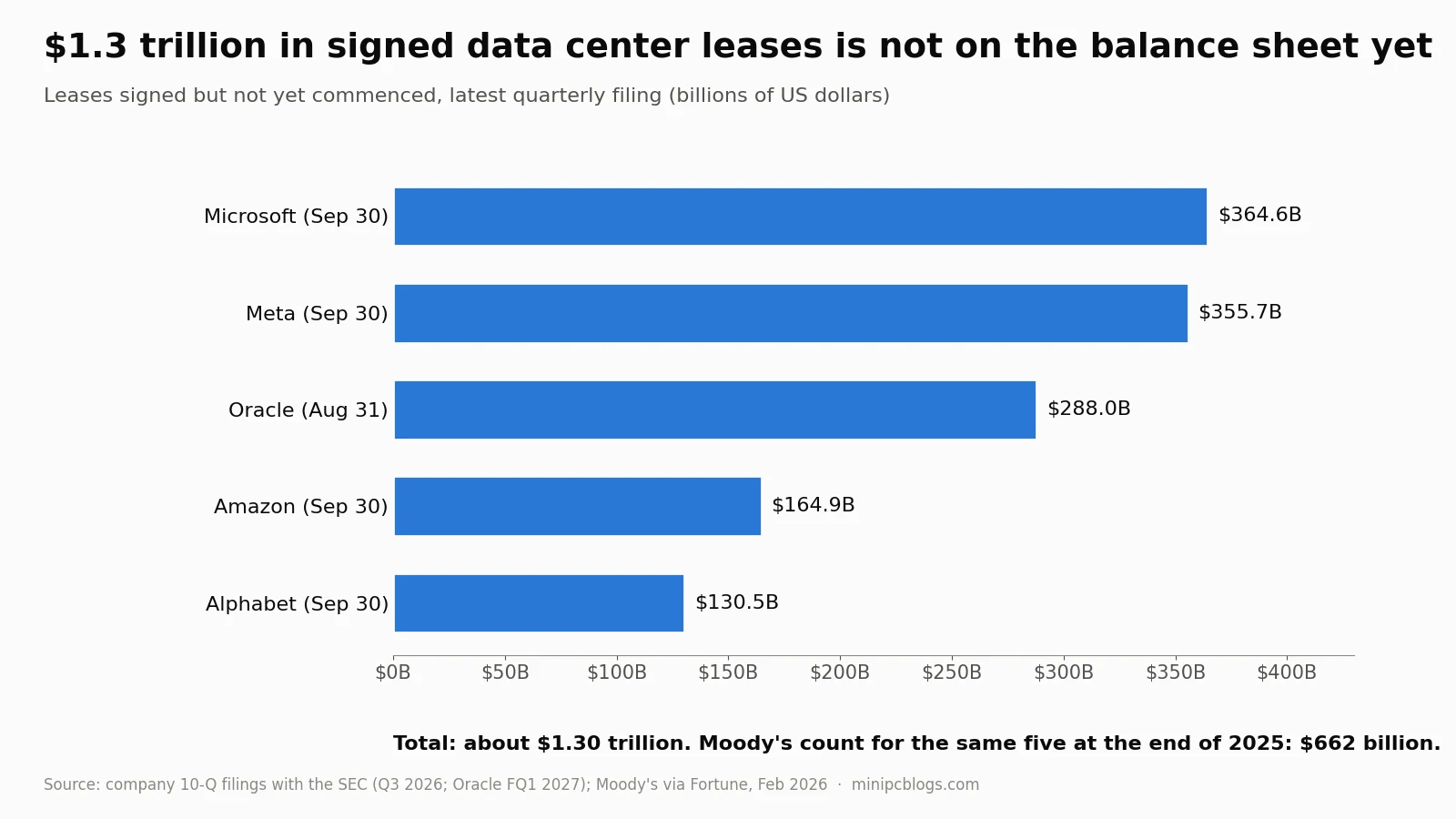
- About $1.3 trillion of signed data center leases are not on anyone’s balance sheet yet, double what Moody’s counted at the end of 2025.
- The biggest suppliers are now guaranteeing their customers’ bills, including up to $105 billion that Nvidia would pay if an OpenAI affiliate cannot.
- The cash is running out of room: two of the big spenders burn cash, two stopped buying back stock, and one is selling new shares.
This follows our earlier piece, The AI Bubble Could Burst Soon, and Data Centers May Pop It, which covered the warnings from Ray Dalio, Michael Burry, the IMF and the Bank of England.
Finding 1: $1.3 trillion in leases that are not on the balance sheet yet
When a company signs a 20-year lease for a data center that is still being built, accounting rules let it leave that obligation off the balance sheet until the building is handed over. It only appears as a sentence in the notes. Here is that sentence from each company’s latest filing:
| Company | Leases signed but not yet commenced | Start dates | Lease terms |
|---|---|---|---|
| Microsoft | $364.6 billion | Fiscal 2027 to 2034 | 1 to 20 years |
| Meta | $355.73 billion | Rest of 2026 to 2036 | Up to 30 years |
| Oracle | $288 billion | Fiscal 2027 to 2029 | 15 to 19 years |
| Amazon | $164.9 billion | 2026 onward | Not stated in total |
| Alphabet | $130.5 billion | 2026 to 2031 | 1 to 26 years |
| Total | about $1.30 trillion |
Microsoft notes that some of its arrangements are subject to contractual conditions being met. In February, Moody’s counted $662 billion of uncommenced data center leases at the same five companies as of the end of 2025, and warned that it equaled 113% of their adjusted debt. Nine months later the number has roughly doubled.
Meta shows the speed best. Its leases not yet commenced were $182.88 billion on March 31, $278.99 billion on June 30 and $355.73 billion on September 30, almost double in six months. Its long-term debt on the balance sheet is $84 billion. In other words, the debt investors see is less than a quarter of the long-term rent Meta has already signed.
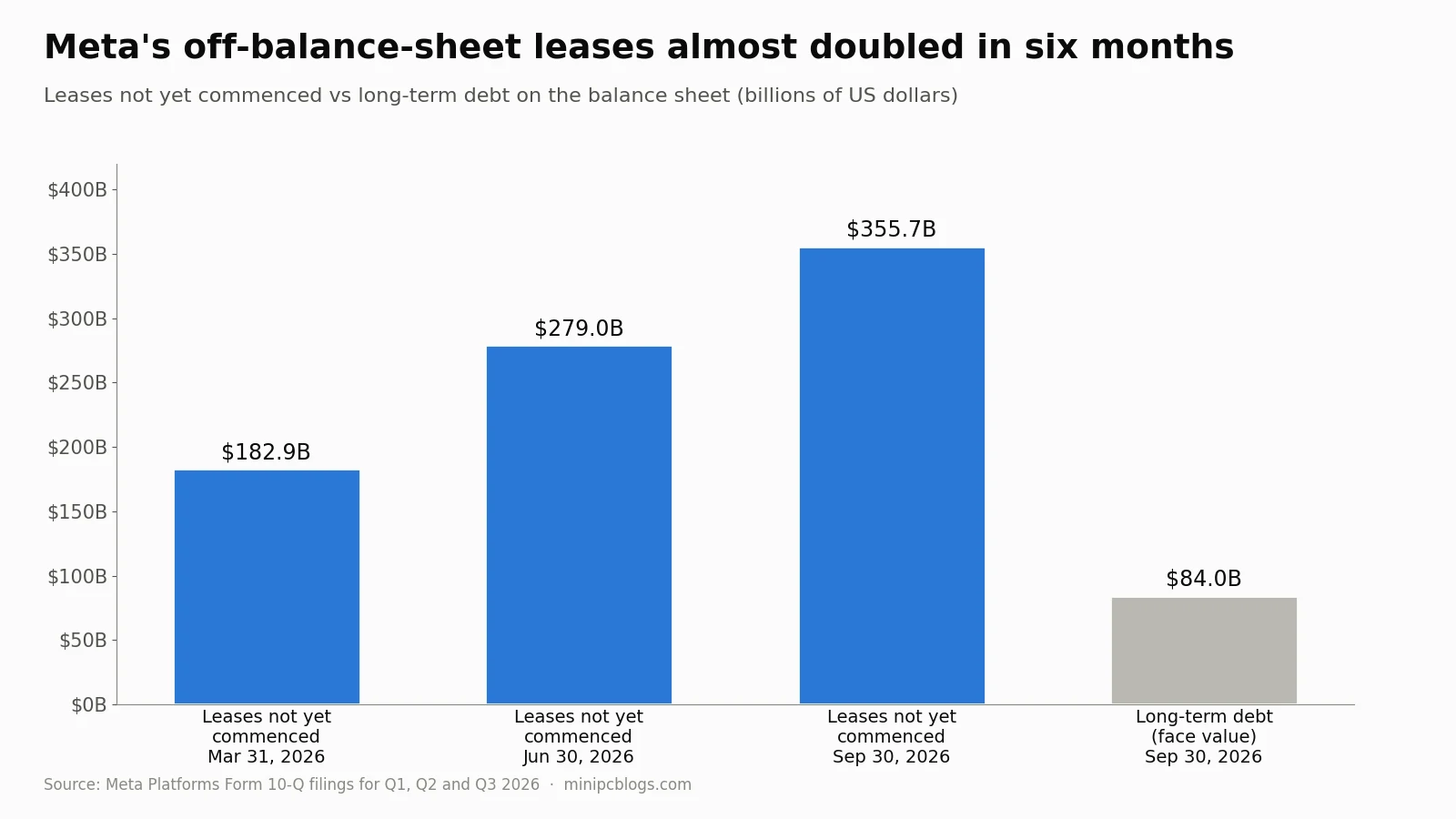
Why this matters: these leases cannot simply be walked away from, and they start to bite exactly when the data centers open, mostly between 2027 and 2030. If AI demand keeps growing, they will be filled. If it slows, the companies are left with decades of rent on buildings full of chips that lose value every year.
Finding 2: the suppliers now guarantee their customers’ bills
This is the part that reminded us most of 2000. During the telecom bubble, equipment makers lent money to their own customers so they could keep buying equipment, and took the losses when those customers failed. The 2026 version is guarantees.
- Nvidia and OpenAI. Nvidia’s 10-Q says that in August 2026 it agreed to guarantee, up to $105 billion, defined portions of lease and power payments for “an affiliate of OpenAI Group PBC” at SB Energy’s campus in Pike County, Ohio, about 4.25 gigawatts of capacity under 20-year leases. Nvidia pays if the tenant defaults. The guarantees end “upon certain events, including OpenAI achieving a satisfactory credit rating”, a sign that OpenAI’s own credit was not enough on its own for this financing. In return, the site will run Nvidia hardware. Nvidia also holds an option to guarantee about 3.8 more gigawatts.
- Nvidia and its other customers. The same filing lists $36 billion of commitments to rent back cloud capacity from the “AI clouds” that buy its chips, typically for six years, equity investments of $99 billion plus $25 billion more committed, and payment terms of “90 days up to one year” for customers with large data center builds. Inventory rose from $21.4 billion to $31.6 billion in six months.
- Alphabet. Google reports $75.7 billion of “backstop obligations relating to data centers, including data center lease payments and the associated energy costs”, of which $48 billion is already signed with third-party data center providers and booked as credit derivatives. It adds $22.8 billion of financial guarantees, including $6.6 billion under contracts that require it to buy back TPU chips it has already sold. Its commitments to unconsolidated entities rose from $1.1 billion at the end of 2025 to $31.9 billion, including $20 billion of future funding for an unnamed “private company”.
- Meta. Meta moved its biggest data center projects into joint ventures it does not consolidate, and promises the investors a minimum value for the buildings if it leaves. Those residual value guarantees rose from $28.1 billion to $41.5 billion this year.
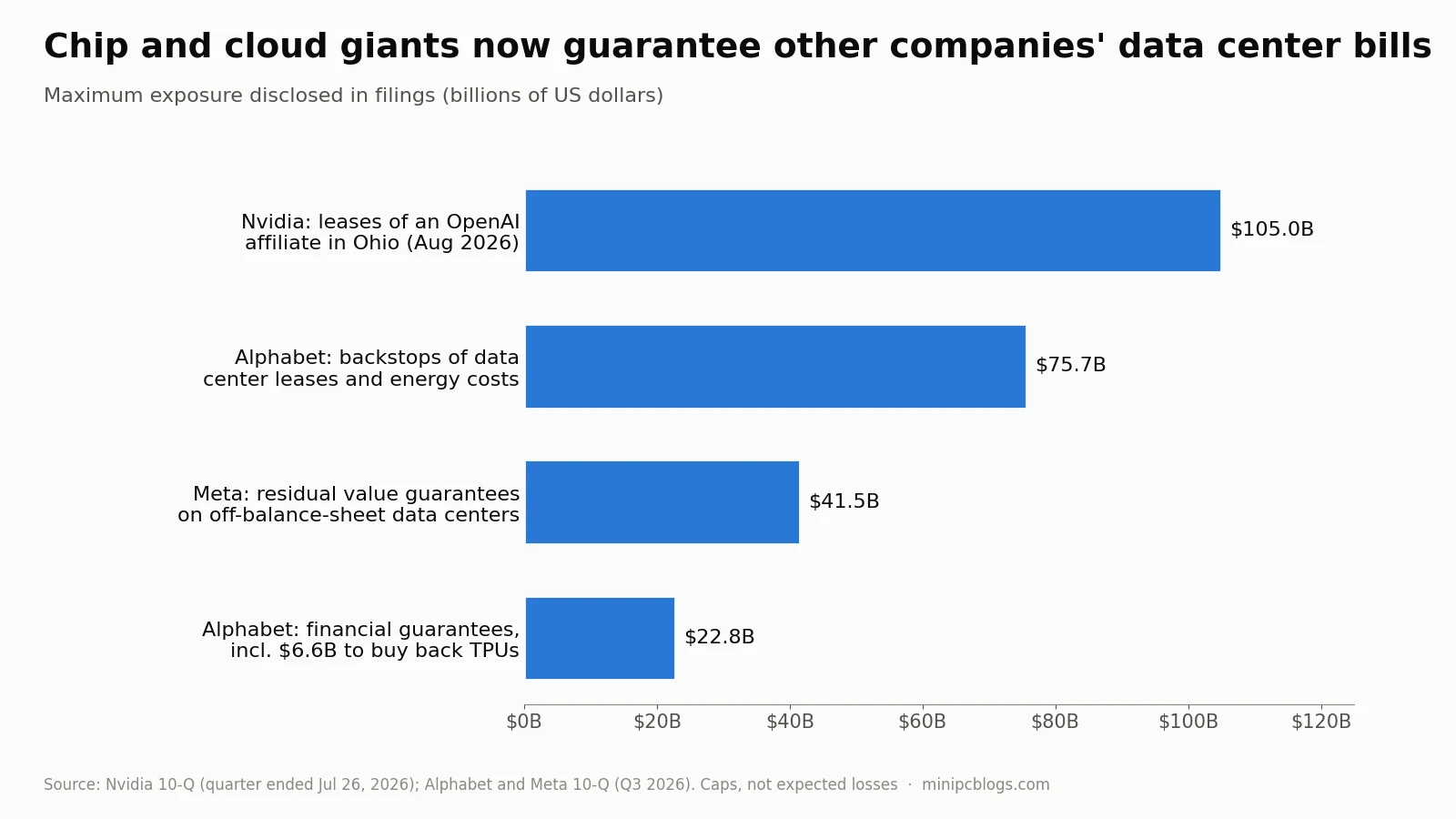
These are caps, not expected losses, and each company says a payout is not probable today. But they connect the balance sheets of the strongest companies to the weakest tenants. If one large AI customer stumbles, the cost lands on Nvidia, Google and Meta, not only on its lenders.
Finding 3: the cash cushion is getting thin
Big Tech used to pay for everything out of its own pocket and still have money left to buy back stock. That stopped in 2026.
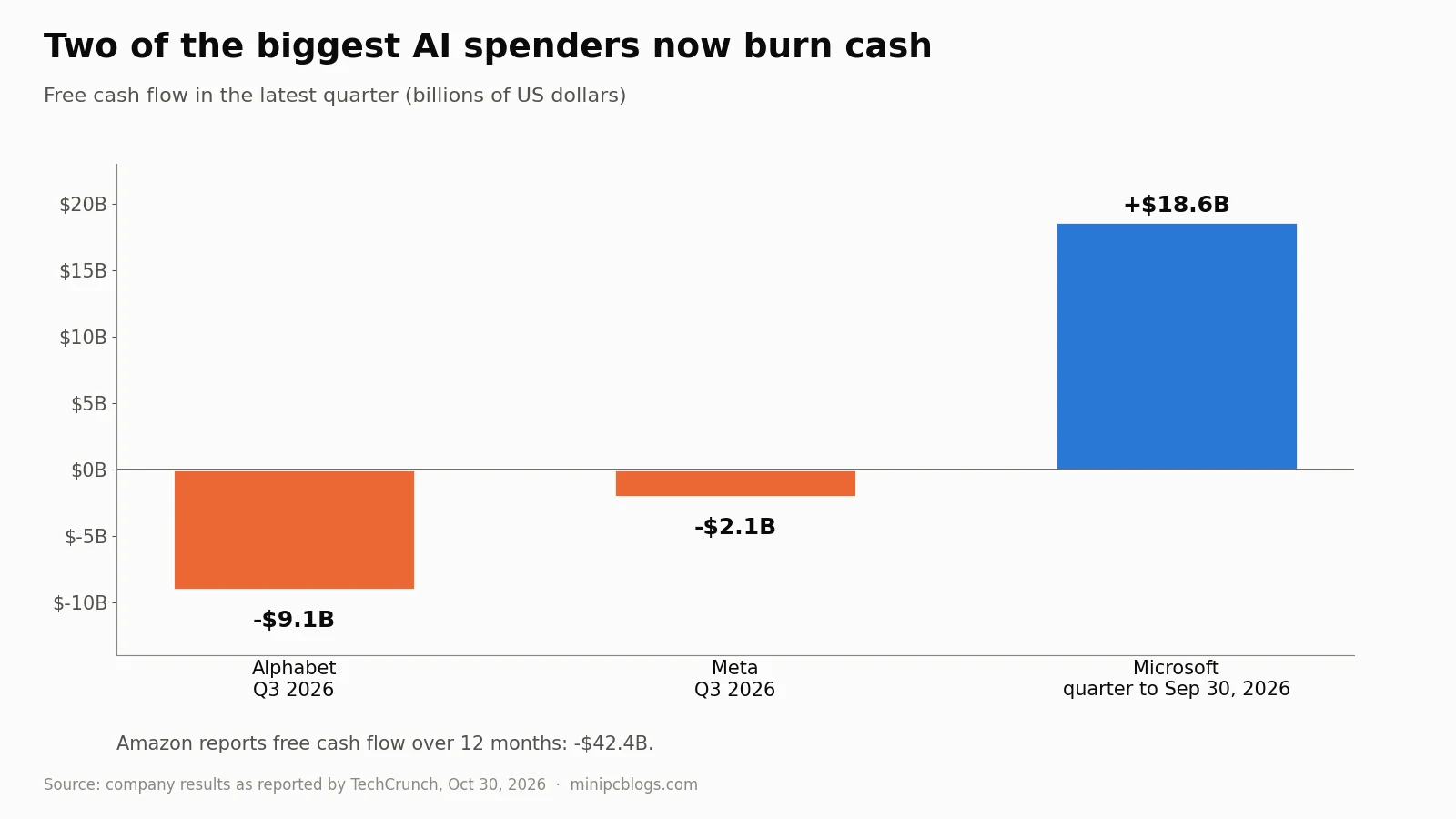
- Free cash flow turned negative. Alphabet burned $9.1 billion in the third quarter, its second negative quarter in a row, with $51.4 billion of quarterly capex. Meta burned $2.1 billion. Amazon is at minus $42.4 billion over the last twelve months. Microsoft is the exception, with $18.6 billion of positive free cash flow.
- Buybacks quietly stopped. Alphabet’s filing says it repurchased no shares in the first nine months of 2026, with $69.5 billion still authorized. Meta repurchased nothing either, against $26.2 billion in the same period of 2025. Neither made it a headline.
- Borrowing took over. The five largest spenders raised $326 billion of debt in 2026, about triple 2025, according to S&P Global Market Intelligence. Alphabet’s latest bonds pay a 5.55% average coupon for 15 years. Amazon borrowed $115.1 billion in nine months.
- Oracle is selling stock. Oracle set up a program to sell up to $20 billion of new shares. Its share count went from 2,880 million to 3,024 million in a single quarter, while it reports $664 billion of future contracted revenue and $288 billion of leases not yet on its balance sheet.
Investors noticed. After its results on October 29, Alphabet had its worst day on record, down about 12% and roughly $500 billion in value. Amazon fell 7% despite 39% growth at AWS. The Nasdaq ended October about 8% below its October 6 record.
Where the risk concentrates: the AI labs
The money flows toward a handful of AI labs, and that is where the guarantees point.
OpenAI is the most connected and the most fragile. According to Wall Street Journal reporting, it lost $9.3 billion on $5.7 billion of revenue in the first quarter of 2026 and $12.3 billion on $6.7 billion in the second. Internal forecasts reported by the Financial Times show $278 billion of negative free cash flow from 2026 to 2030 and the money from its record March funding round running out by 2028. It is the tenant behind Nvidia’s Ohio guarantee, the largest customer in Oracle’s backlog, a major Microsoft and CoreWeave customer, and holds warrants for AMD shares. When credit traders priced CoreWeave’s default risk at more than 60% in October, this web of shared customers was part of what they were pricing.
Anthropic looks healthier on operations. Its S-1 shows $16.3 billion of revenue in the first half of 2026 and an operating loss of only $693 million. But its fixed or minimum compute commitments jumped from $54.6 billion at the end of 2025 to $265.6 billion on June 30, 2026, with terms of up to 20 years. The filing says those contracts must be paid “regardless of actual utilization”, while most of its revenue is consumption-based and can fall quickly if customers cut back.
Disclosure: we researched this article with the help of AI tools, including Anthropic’s Claude. We applied the same standard to Anthropic as to every other company: only what its own filing says.
What already happened in China
China ran the same experiment a little earlier, and it did not end well for investors.
- The stock bubble popped. According to Reuters, the STAR50, China’s tech board, fell 40% in less than four months through late October, wiping out about $480 billion. Even after the fall it traded near 100 times earnings, down from almost 250 at the peak. The Nasdaq 100 trades around 30.
- Too many data centers. Under the “Eastern Data, Western Computing” program, many new facilities in western China reportedly run at only 20% to 30% utilization. In February, the co-CEO of SMIC, China’s top chipmaker, warned that companies wanted to build a decade of capacity in one or two years.
- Price wars. Chinese AI providers have cut model prices by up to 97% since 2024, and fund managers now expect chipmakers to face the same price war as every other Chinese manufacturer.
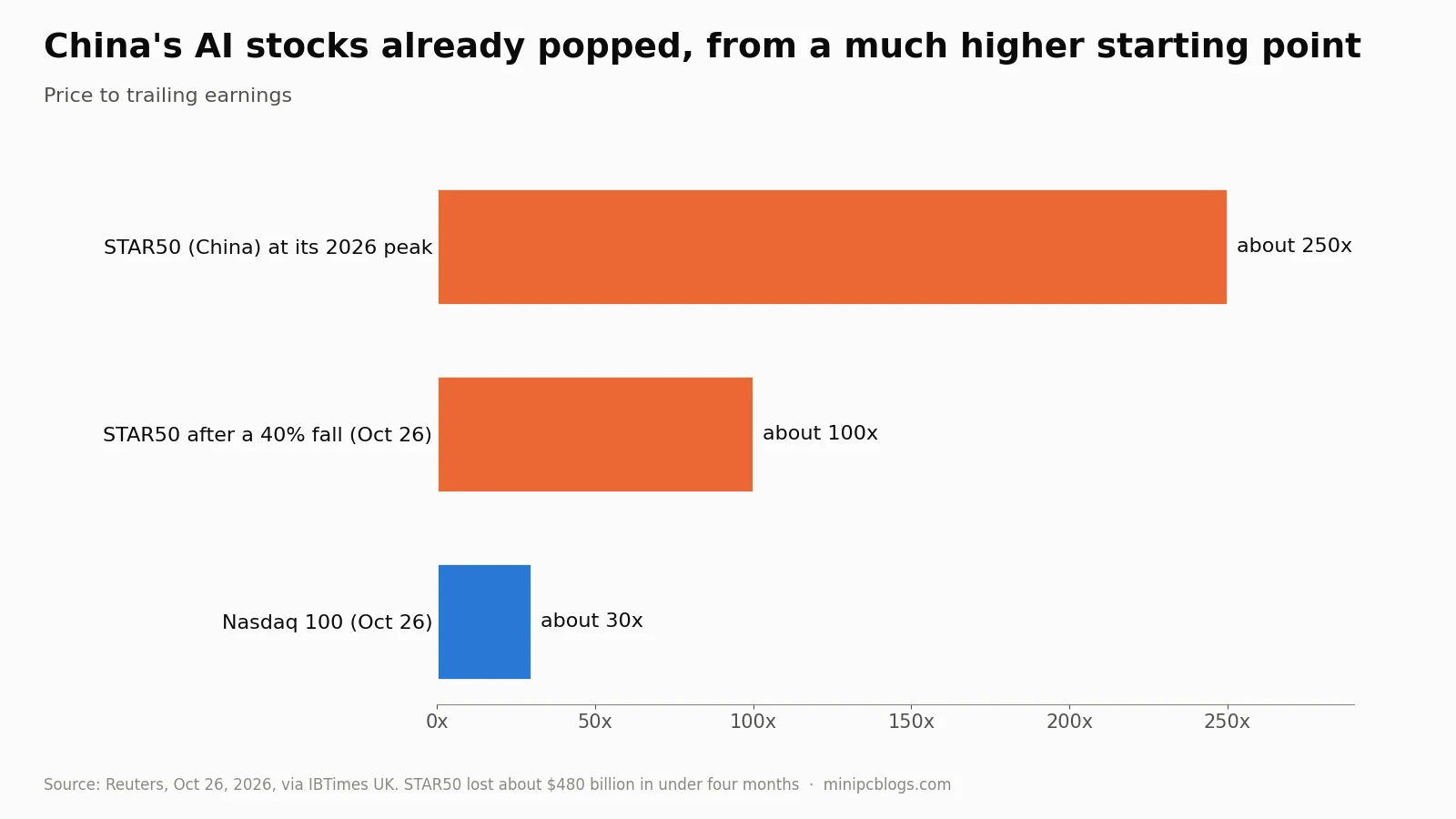
And yet China’s economy grew 4.5% in the third quarter, carried by exports. The AI build-out there is directed by the state and is small relative to the economy, so a stock crash hurts investors more than it hurts growth. China’s lesson for the US is about what happens to returns when everyone builds at once: prices fall, utilization falls, and the companies that borrowed to build are the ones left holding the bill.
Why it looks worse for the US economy
On paper, the US economy is strong. GDP grew at a 3.4% annual rate in the third quarter and unemployment is 4.2%. Look closer and the picture is more fragile.
- AI holds up growth, but less than it seems. Business investment added 1.78 percentage points to growth in Q3, according to CEPR, with information processing equipment up 37.4%. But much of that equipment is imported: the trade deficit subtracted 3.32 points, and inventories added 1.6 points that will not repeat.
- Jobs are cooling. The economy added only 29,000 jobs in September.
- Rates are going up, not down. The Fed raised rates in September for the first time since 2023, held them at 3.75% to 4% on October 28 with two officials voting for another hike, and markets expect one in December. The 10-year Treasury yield is near 5%.
- Oil is a second shock. With the Strait of Hormuz effectively closed since the spring because of the Iran war, Brent crude closed October at about $113 a barrel.
- Wealth is concentrated. The top three stocks are about 22% of the S&P 500, and the richest 10% of households account for somewhere between 28% and 49% of consumer spending depending on the measure. If AI stocks fall, those households spend less, and the slowdown spreads.
The combination is the worrying part. In 2000, the Fed was raising rates and oil prices were climbing when the telecom and internet build-out ran out of buyers. The Nasdaq fell 78% over the following two and a half years and the US entered a recession in 2001. That is not a forecast, but the ingredients rhyme: heavy investment financed by debt, suppliers financing their customers, rising rates and an oil shock.
The IMF’s October outlook models a sharp pullback in AI spending that would cut US output by 1.8% by 2028. The leases and guarantees in the filings are the channel through which that pullback would reach the rest of the economy.
What could come next
No one can put a date on a bubble. These are the scheduled events that could move it:
| When | Event | Why it matters |
|---|---|---|
| November 3 | US midterm elections | Policy on chips, tariffs and energy |
| November 6 | October jobs report | Shows whether the slowdown spreads |
| November 17 to 18 | Nvidia earnings | The bellwether for AI demand |
| Coming weeks | Anthropic IPO | First test of public appetite for an AI lab |
| December 8 to 9 | Fed meeting | A second hike would raise borrowing costs again |
| 2027 to 2030 | Leases start | The $1.3 trillion begins to land on balance sheets |
| By 2028 | OpenAI runway, per the FT | Its counterparties’ guarantees depend on its funding |
Signals that would mean the problem is getting worse: a big five company cuts 2027 capex, AI bond spreads keep widening, an AI lab misses a lease payment, or GPU rental prices start to fall the way they did in China. Signals that would ease it: AI revenue growing faster than commitments, OpenAI earning an investment-grade rating, and the Fed pausing.
What it means if you buy hardware
For readers of this site, the build-out has already been costly: it is a big reason memory prices jumped this year, as we explained in Consumers are paying for the RAM crisis. A correction would likely bring cheaper RAM, SSDs and used GPUs as data centers slow down. Until then, a mini PC that runs AI models locally is still one of the few ways to use AI without depending on this financial chain.
Verdict
The AI boom is not a fraud. Demand is real, AWS is growing 39% a year, and Anthropic is close to break-even on operations. But the filings show commitments growing far faster than the cash that has to pay for them: $1.3 trillion in leases that have not hit the balance sheet, more than $200 billion in guarantees for other companies’ bills, negative free cash flow at two of the biggest spenders and buybacks quietly paused. China already showed how an AI investment boom ends when everyone builds at once. The US is attempting the same thing at a larger scale, with more debt, higher rates and an oil shock, which is why a break here would reach far beyond tech stocks.