
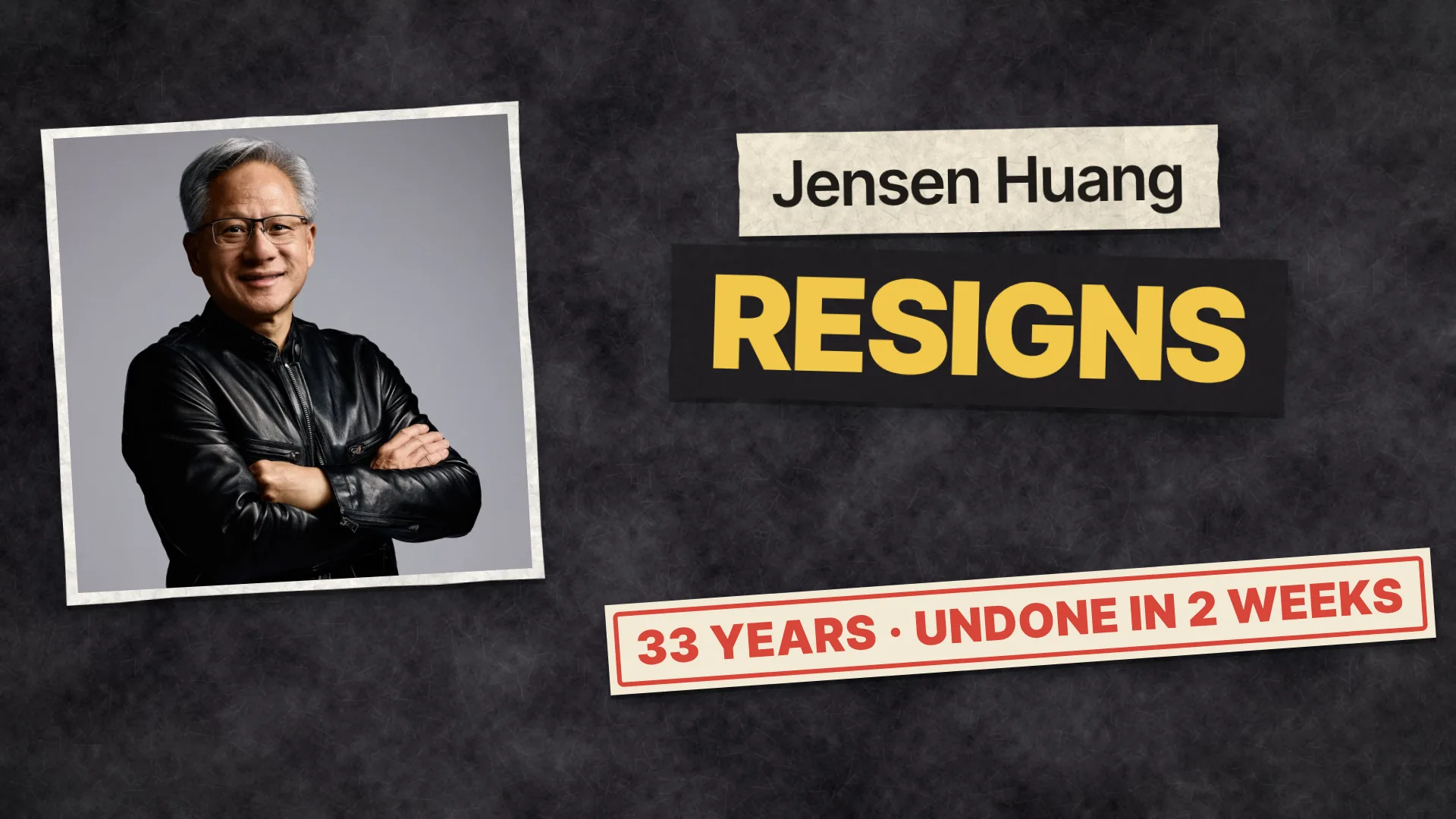
Jensen Huang is no longer the chief executive of NVIDIA. On Thursday, November 12, 2026, the company’s board announced that he “has resigned as President, Chief Executive Officer, and a member of the Board, effective immediately.”
He co-founded NVIDIA in 1993 and was the only chief executive it ever had. Thirty-three years in the job came apart in two weeks, from a New York Times report on October 29 to a board meeting on the night of November 11.
This article walks through those two weeks in order. As in our earlier coverage, we separate what is confirmed or admitted from what is only reported. It is current as of Thursday morning, November 12, and we will update it.
Video: the two weeks that led to the resignation, in about four minutes, also on YouTube. Narration uses a synthetic voice; every claim on screen carries its label and its source.
Our earlier coverage: NVIDIA’s CEO and the Suspected Spy: What Is at Stake (November 8) and Jensen Huang, not 1 but 2 affairs! (November 11).
What NVIDIA confirmed
Everything in this section comes from NVIDIA’s own announcement, “NVIDIA Announces CEO Transition,” and from the Form 8-K it filed with the SEC the same day under Item 5.02, the item companies use for the departure of directors and officers.
- Huang is out of every role. He resigned as President, CEO and board member, effective immediately. The Register, which read the filing, reports that the board accepted the resignation on November 11.
- Colette Kress is interim CEO. She has been NVIDIA’s chief financial officer since September 2013 and keeps that role “until a permanent successor has been named.” Before NVIDIA she spent nearly 25 years in finance at companies including Cisco and Microsoft.
- The board has a chair for the first time. Harvey C. Jones, a former chief executive and executive chairman of Synopsys, was appointed “its first-ever Chair of the Board.” Until now NVIDIA had only a lead independent director.
- A search has started. The board “is initiating a search for a permanent Chief Executive Officer and will consider internal and external candidates.”
- Business as usual, says the board. Jones said the board expects “the company’s operations, customer commitments and product roadmap to continue without interruption.” Third-quarter results stay on the calendar for Tuesday, November 17.
The board’s words about Huang himself are three sentences: “Jensen’s contributions to NVIDIA are profound. NVIDIA is one of the most consequential technology companies in the world. The Board and the company thank Jensen for his immeasurable contributions to the company and the industry.”
What the announcement does not say
Three things are missing, and each matters.
- No reason. The announcement does not say why Huang resigned. It does not mention the affairs, the reports about Chinese intelligence or the board meeting.
- No findings. It does not mention the independent investigation the board opened on November 8, or whether that investigation continues.
- No word from Huang. There is no quote from him in the announcement, and we found no public statement from him as of Thursday morning.
So the cause given below is the sequence of events and what news organizations reported about the board. It is not something NVIDIA has stated.
The two weeks that led to it
| Date | What happened | Status |
|---|---|---|
| October 29 | The New York Times reports that US officials concluded Alice Huang, a former Megaspeed executive close to Jensen Huang, was a Chinese intelligence asset | Reported |
| October 30 | China’s foreign ministry calls the report “groundless speculation.” Around the same days, NVIDIA says his contacts with her were “not unusual or unexpected” | Denied |
| November 4 | Three House committee chairs ask Huang for a closed-door briefing on November 18 | Confirmed |
| November 6 | The Times and the Financial Times report a classified memo; according to the FT, it described a romantic relationship | Reported |
| November 8 | Huang writes to staff: “I was unfaithful to my wife.” The board opens an independent investigation and says it “has confidence in Jensen” | Admitted, confirmed |
| November 9 and 10 | The stock falls 9.5% across the two sessions. The independent directors hire Wachtell, Lipton, Rosen & Katz | Confirmed |
| November 11 | The Times reports a second relationship, with an NVIDIA executive who reports to Huang. The Wall Street Journal reports the board is preparing to oust him. The board meets that night | Reported |
| November 12 | NVIDIA announces the resignation, an interim CEO and its first board chair | Confirmed |
October 29: the first report
The New York Times reported that US officials had concluded that Alice Huang, no relation, was a Chinese intelligence asset who had grown close to NVIDIA’s chief executive. She is a former executive at Megaspeed, a Singapore company that bought billions of dollars of NVIDIA hardware. China called the report groundless, Singapore said it had never investigated her, and no one has been charged. NVIDIA said at the time that Huang’s contacts with her were ordinary business. We covered all of it, with every denial, in our first article.
November 4 to 8: Congress, a memo and a letter
The pressure came from three directions in five days. The Republican chairs of three House committees asked Huang for a closed-door briefing. The Times and the Financial Times reported a classified memo that circulated among senior officials in the spring. Then, on Sunday, November 8, Huang wrote to NVIDIA’s employees: “I was unfaithful to my wife. My actions hurt her and our children. There is no excuse for what I did. I am deeply sorry.” The letter named no one.
The same day, the board announced an independent investigation into reports that Huang had “been the target of a foreign intelligence effort.” It also said it had “no reason to believe that either national security or NVIDIA secrets were compromised,” and that it “has confidence in Jensen and his leadership team.”
November 9 and 10: the first response holds, barely
NVIDIA’s shares fell 9.5% across Monday and Tuesday, according to CNN. The independent directors said they had hired former acting US Attorney Joon H. Kim and the law firm Wachtell, Lipton, Rosen & Katz. CBS News and Al Jazeera reported a shareholder class action against the company and Huang, and CNBC reported that US lawmakers had called for him to resign. President Trump defended him. “I think he’s an honorable guy,” he told reporters on Monday. “He’s done an amazing job for our country.”
At that point, the plan on the record was still the one from Sunday: investigate, and keep the chief executive.
November 11: the second report
On Wednesday, The New York Times reported that Huang had also had a relationship with a senior NVIDIA executive who reports to him. Huang declined to discuss it with the paper. Minutes later, The Wall Street Journal reported that the board was preparing to oust him; two sources confirmed that to CBS News. The stock fell 8.4% in after-hours trading by 6 p.m. Eastern, CNN reported, and the board met that night.
Nothing about the second relationship has been confirmed by Huang, by NVIDIA or by the executive. That has not changed with the resignation.
November 12: the announcement
NVIDIA published its announcement on Thursday morning and filed the Form 8-K, which EDGAR lists as accepted at 8:52 a.m. Eastern.
Why the second report changed everything
NVIDIA has not explained the board’s thinking, so this section is our reading of the public record, with that limit stated.
The first affair was with someone outside the company. It raised a national security question that could take months to answer, and the board chose to investigate while Huang stayed. The second, if it is true, is a different kind of problem: a relationship inside the chief executive’s own reporting line. That is a workplace conflict of interest, and NVIDIA’s own Code of Conduct says “every NVIDIA employee and board member is expected to read, understand, and comply” with it, lists “personal relationships” among the situations that may create a conflict, and says failing to comply may lead to “disciplinary action, up to and including termination of employment or service.”
Analysts read it the same way. Bernstein’s Stacy Rasgon told CNBC that a relationship with a direct report made it “much tougher for the board to leave him in position.” Robert Greifeld, a former chief executive of Nasdaq, put the board’s question in terms of candor: “What the board has to find out in the next days or weeks is, did Jensen lie to them?”
Other boards have ended up in the same place. Intel’s Brian Krzanich resigned in 2018, McDonald’s fired Steve Easterbrook in 2019 and BP’s Bernard Looney resigned in 2023, each over relationships with colleagues. In yesterday’s article we argued that the rule for the founder has to be the rule for every employee. We still do not know what rule, if any, the board found was broken.
The cost so far
All figures are from CNBC and CNN, and Thursday’s are from early trading, so they will change.
| Moment | NVIDIA share price |
|---|---|
| October 6, record close | $239.24 |
| November 6, last close before Huang’s letter | $186.64 |
| November 11, last close before the resignation | $173.73 |
| November 12, early trading | Down another 12% to 13% |
CNBC reports that NVIDIA has lost about $2 trillion in market value since the October peak and that Thursday’s drop took it below $4 trillion. At least six analysts downgraded the stock between Wednesday night and Thursday morning, and Bernstein cut its price target from $400 to $200.
Two cautions. First, not all of that decline is the scandal: the stock fell 9.3% on November 5 alone in the selloff that followed the midterm elections, before Huang’s letter. Second, the business itself has not changed this week. As Rasgon wrote, “the fundamentals of the business (if not the leadership) are clearly still intact.” This is not investment advice.
Who leads NVIDIA now
For the moment, Colette Kress. She has presented NVIDIA’s numbers to investors for 13 years and will present them again on Tuesday, this time as interim chief executive.
The permanent job is open, and that is the board’s own doing. NVIDIA had no named successor. In a Bloomberg interview in mid-October, quoted by NPR, Huang said: “I’m really hoping that the next CEO of the company is already at the company.” Stephen Witt, who wrote a book about NVIDIA, told NPR: “There’s no obvious replacement.” Greifeld was blunter about the directors: “You can’t deny the board has done a horrible job of succession planning.”
Huang also remains one of NVIDIA’s largest individual shareholders, with roughly 3.5% of the company. He has left the board, but he has not left the shareholder register.
What we know and what we don’t
We know that Huang resigned from every role, effective immediately, that Colette Kress is interim CEO, that Harvey C. Jones chairs the board, that a search is under way and that earnings are still set for November 17.
We don’t know:
- Why exactly he resigned, and whether he was asked to.
- What the independent investigation found, and whether it continues.
- Whether the second relationship happened as reported.
- Whether the House briefing requested for November 18 will still take place.
- The terms of his departure. We have not seen any separation terms reported.
- Who will be the permanent chief executive.
A case study, one day later
On Sunday, NVIDIA’s board said it had confidence in its founder. By Thursday, he was out. Whatever was said in that boardroom, the outcome is one that every other board and every HR department will study: a company worth trillions parted with the person who built it, and did so within hours of a report about conduct inside the workplace.
What is still owed to shareholders and employees is the explanation. A resignation with no stated reason and no published findings answers who is in charge. It does not answer what happened.