
On Sunday, November 8, 2026, the chief executive of the world’s second most valuable company sent his employees a letter. “I was unfaithful to my wife,” Jensen Huang wrote. “My actions hurt her and our children. There is no excuse for what I did.”
Hours later, NVIDIA’s board announced an independent investigation “in light of recent reporting that founder and CEO Jensen Huang has been the target of a foreign intelligence effort.” The woman at the center of those reports, according to US officials who spoke to the New York Times and the Financial Times, worked for China’s Ministry of State Security.
That last part has not been proven in public. Nobody has been charged with a crime, the intelligence has not been released, and China denies it. But the story already reaches well beyond one man’s private life: into the White House, into Congress, into US export policy on AI chips, and into the share price of a company that makes up about 7% of the S&P 500.
This article separates what is confirmed from what is reported and what is denied. It is current as of the night of November 8, 2026, before Monday’s market open. We will update it as the investigation moves.
Video: the story in about 11 minutes and 17 chapters, also on YouTube. Narration uses a synthetic voice; every claim on screen carries its label and its source.
This follows our earlier analysis of NVIDIA’s priorities, Jensen Huang Built NVIDIA on Gamers. Now AI Comes First, and our investigation of how AI companies finance each other, The AI Money Circle.
How we label every claim
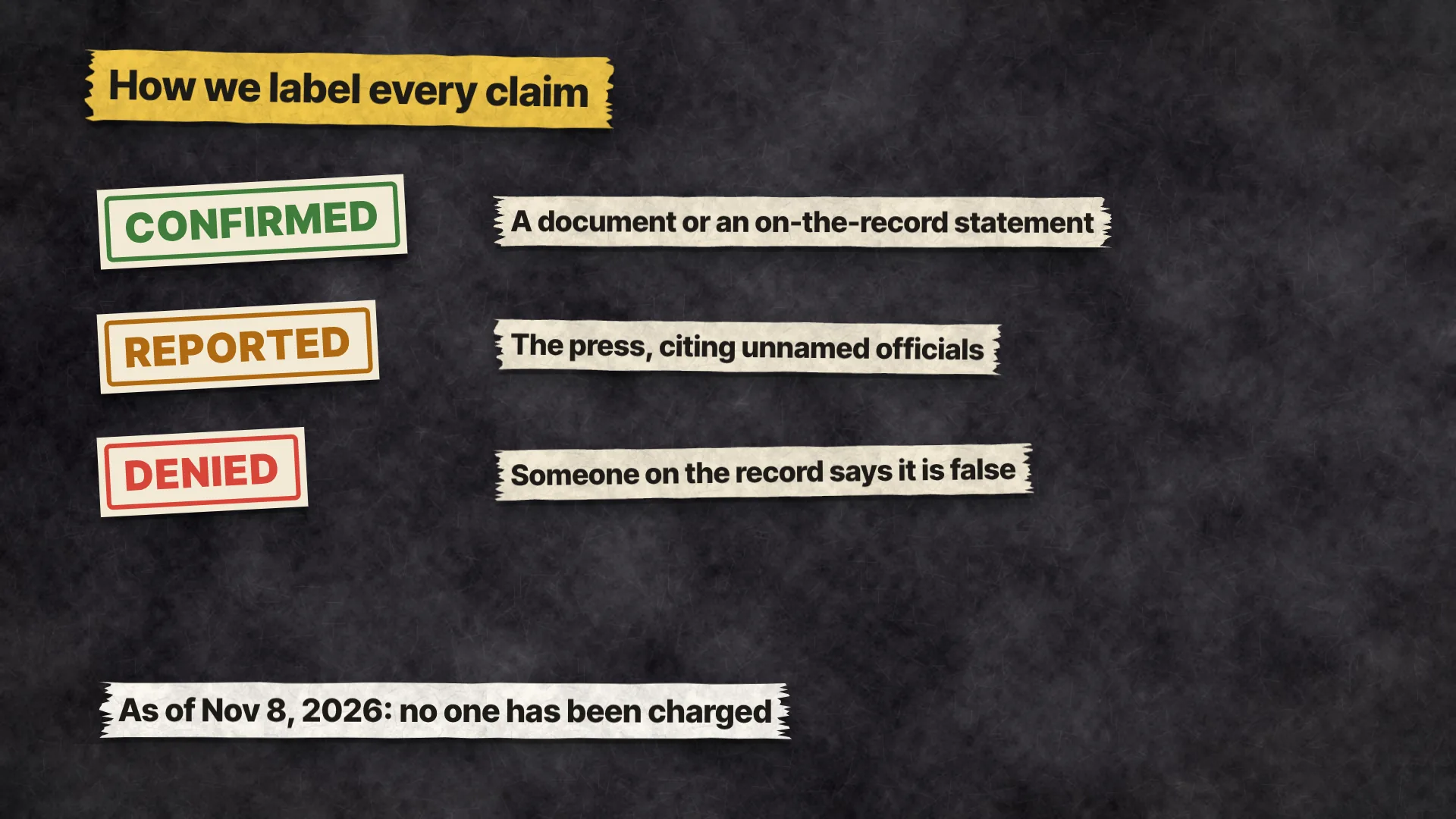
- Confirmed means a document or an on-the-record statement: Huang’s letter, the board’s statement, a government release, a filing.
- Reported means a news organization citing people it does not name. Most of the intelligence side of this story is in this category.
- Denied means someone on the record says it is false.
What is confirmed
- The affair. Huang’s letter to staff says he was unfaithful to his wife, that “there is no excuse,” and that “my family bears no responsibility for my choices. I do.” He also wrote that he is “committed to protecting Nvidia and supporting America’s national security.” The letter does not name the woman and does not address the espionage reports directly. The New York Times reported that he told the board the relationship was with Alice Huang.
- The investigation. “A committee of independent directors, assisted by outside independent counsel, will oversee the investigation,” the board said. It added: “While the Board has no reason to believe that either national security or NVIDIA secrets were compromised, the Board’s inquiry will examine all available information.” The board has not named the directors on the committee or the law firm.
- Huang stays. NVIDIA said: “Today’s news will not slow NVIDIA. Jensen is committed to continuing to lead NVIDIA as CEO without interruption.” The board said it “has confidence in Jensen and his leadership team.”
- No filing yet, and no name. As of November 8, NVIDIA had not filed a Form 8-K with the SEC about the investigation. A full-text search of everything NVIDIA has filed with the SEC since 2024 finds no mention of Alice Huang, Huang Le, Megaspeed or its Malaysian unit Speedmatrix. The closest language is a general risk warning that “reports of diversion of controlled products, even when unsubstantiated and untrue, may negatively impact our business.”
His wife, Lori Huang, has made no public statement that we could find, and neither have their children, Spencer and Madison, who both work at NVIDIA. We are not going to speculate about the family.
Who is Alice Huang, and what is Megaspeed
Alice Huang, who also goes by Huang Le, is a Chinese citizen and no relation to Jensen Huang. An online fund profile describes her as a former reporter for Hunan TV and China’s state broadcaster CCTV who later worked in banking; the New York Times said it “could not find any information to verify that,” and a Hunan TV executive told the New York Post he had never heard of her. Her documented career is in finance. Bloomberg reported that a holding company founded by Huang Le owned 48% of Shanghai Hexi, an investment fund that backs chip and AI companies, until August 2025, and that a 2016 post listed her as a Hexi director.
Her path to Megaspeed, as reported by Bloomberg and the Straits Times from Singapore’s company registry:
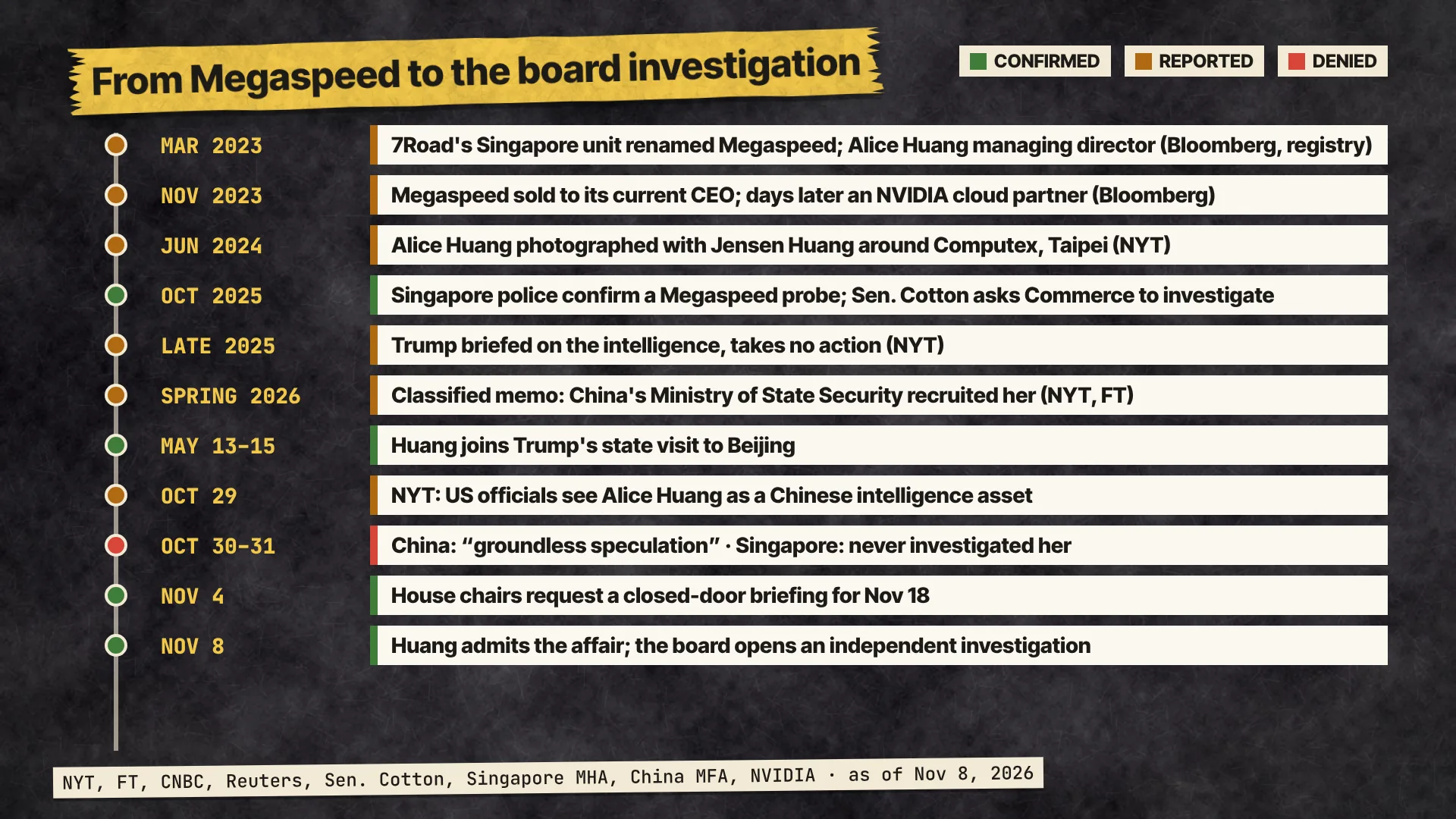
- In March 2023, the Singapore subsidiary of 7Road, a Chinese online-game company, was renamed Megaspeed. The Times describes 7Road as partly owned by China’s central and local governments; its Hong Kong stock exchange filings show it is controlled by its founder, Meng Shuqi. The Singapore company, now Megaspeed International Pte. Ltd., was first registered in 2015 as 7Road International. Its shares passed to Huang Le Ltd., a company in the British Virgin Islands, and Alice Huang became managing director.
- In November 2023, about eight months later, she and another director had resigned and Megaspeed’s shares passed to Swiftdata, a Singapore company owned by its current chief executive, Tan Yong Pong, the Business Times and Straits Times reported. Four days later, according to Bloomberg, Megaspeed became an NVIDIA cloud partner. Megaspeed describes itself that way; NVIDIA’s public list of cloud partners does not include it.
- She later described herself as Megaspeed’s chief executive, the Times reported, though filings dropped her title. A 2024 photo caption in Taipei identified her as Megaspeed’s chairwoman under the name Alice Wong. Her current role, and where she is now, are not known.
Megaspeed is a Singapore company that buys NVIDIA hardware and rents out computing power. In an October 2025 letter to Commerce Secretary Howard Lutnick, Senator Tom Cotton described it as “a spin-off of Chinese government-owned cloud company 7Road” that routed chips through “a subsidiary of Inspur, a sanctioned Chinese company.” He also cited “a Malaysian datacenter where U.S. officials found export-controlled U.S. chips still in boxes.”
How much it bought depends on the period and the source:
- The New York Times reported in October 2025 that Megaspeed bought nearly $2 billion of NVIDIA’s advanced chips through its Malaysian subsidiary.
- Bloomberg reported in December 2025, from customs records, at least $4.6 billion of NVIDIA hardware and about 136,000 GPUs since 2023. Megaspeed called that article misleading.
- The New York Times reported on October 29, 2026, from trade records, that Megaspeed’s Malaysian sister company bought at least $4.8 billion of NVIDIA-based equipment between June 2024 and February 2026.
Even the largest figure is small next to NVIDIA’s sales: about 1% of its revenue over its last three fiscal years. The investigations are about where the chips ended up, not about the amount.
Singapore police confirmed in October 2025 that “investigations are ongoing into Megaspeed for suspected breaches of our domestic laws,” and said in late October 2026 that the probe continues. NVIDIA says it investigated Megaspeed’s deployments and found no evidence of diversion. On November 6, Bloomberg reported that NVIDIA is now requiring cloud partners in Southeast Asia to join its chip-location tracking program.
What is reported
Everything in this section comes from news organizations citing officials they do not name.
- October 29, 2026, New York Times. US officials concluded that Alice Huang was a Chinese intelligence asset feeding information to Beijing and that she had grown close to Jensen Huang. The paper says it is “not clear” what information she passed along or how valuable it was. It reported that Huang never received a defensive briefing, the warning US counterintelligence gives people it believes are being targeted, and that officials initially did not think he knew. Some senior officials doubt that, the Times wrote. It also reported that President Trump was briefed about a year earlier and took no action.
- November 6, 2026, New York Times and Financial Times. A classified memo circulated among senior officials in the spring, before Trump’s state visit to Beijing on May 13 to 15, said China’s Ministry of State Security recruited Alice Huang to gather information on Jensen Huang. According to the FT, the memo described a romantic relationship. Gizmodo, summarizing the reporting, said her task allegedly included persuading him to lobby for shipping advanced GPUs to China.
- November 8, 2026, New York Times. Secretary of State Marco Rubio oversaw the preparation of that memo, which was based on electronic surveillance of Alice Huang.
The Times also reported that the Commerce Department’s investigation of Megaspeed was handed to the Justice Department this year. The Justice Department has not confirmed that.
What is denied
- China. Foreign Ministry spokesman Guo Jiakun said on October 30 that the report “is based on groundless speculation and [is] purely aimed at smearing and slandering China.” The embassy in Washington called the allegations “groundless smears and slanders.”
- Singapore. The Ministry of Home Affairs said on October 31 that “neither the Singapore Government nor its officials said this” and that “there were no such investigations conducted in respect of Alice Huang,” rejecting a Wall Street Journal report. Its police say the separate Megaspeed investigation continues.
- NVIDIA. Before the admission, the company said Huang’s interactions with Alice Huang were “not unusual or unexpected” and that regional cloud customers receive “zero information relevant to national security.” Huang told Bloomberg in late October that his dealings were “related to Megaspeed, and it was all completely normal and not unusual.” NVIDIA has not denied the affair; Huang admitted it.
- Megaspeed. It told the Times that “outside counsel has been retained to conduct a thorough internal investigation.”
- Alice Huang has not commented publicly, and no lawyer for her has been identified.
Washington: Congress and the White House
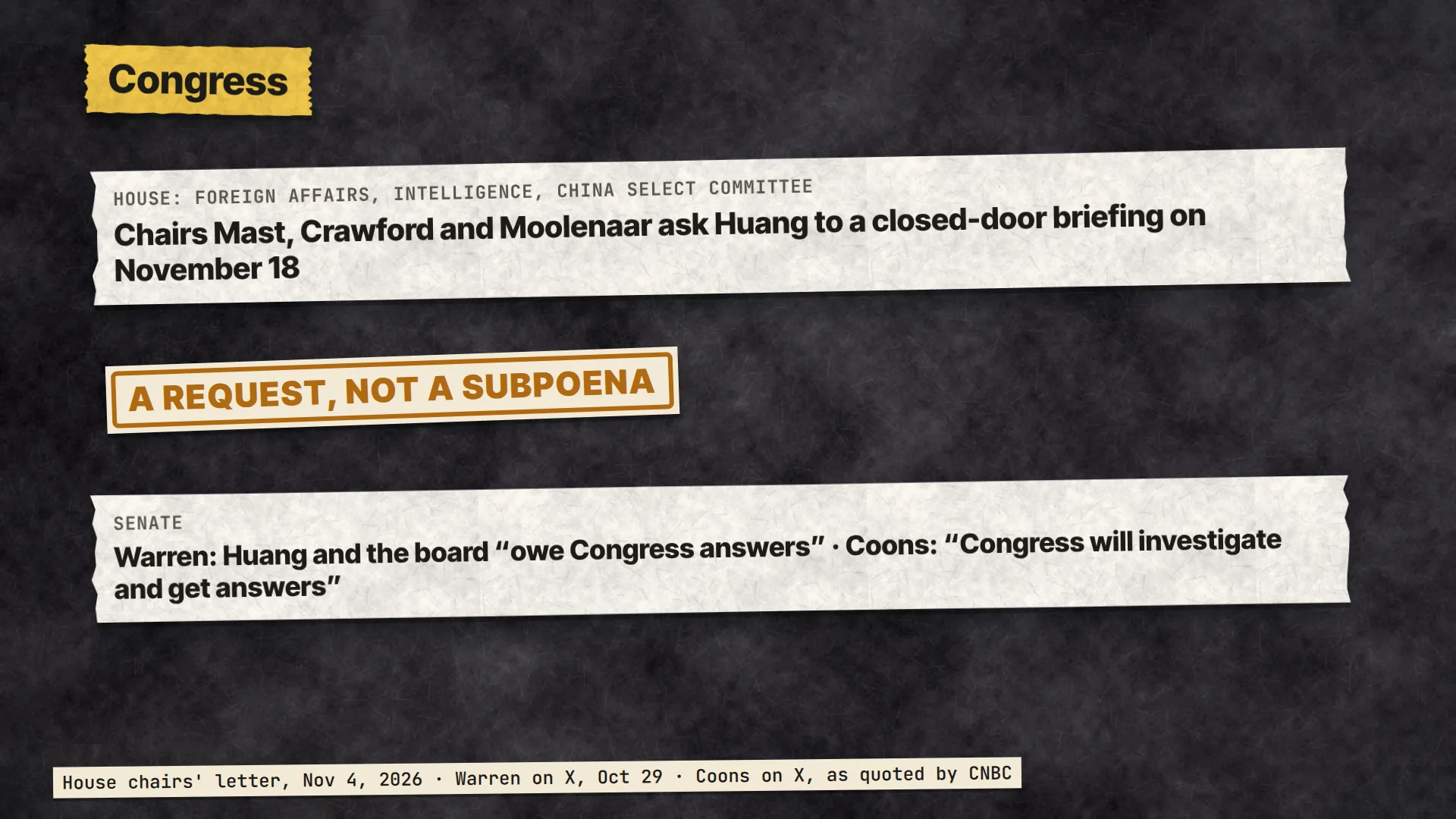
Congress. In a letter dated November 4, the Republican chairs of the House Foreign Affairs Committee (Brian Mast), the Intelligence Committee (Rick Crawford) and the Select Committee on the Chinese Communist Party (John Moolenaar) asked Huang to attend a closed-door joint briefing on November 18 about his interactions with Alice Huang and NVIDIA’s “security protocols against foreign adversary espionage.” “It is vital that Congress determines the extent to which U.S. national security has been placed at risk,” they wrote. It is a request, not a subpoena. NVIDIA has not said whether he will attend.
Democrats pressed too. Senator Elizabeth Warren wrote on October 29 that “Huang and NVIDIA’s board owe Congress answers,” and on November 8 told CBS she is on “bipartisan bills” to restrict chip exports to China. Senator Chris Coons, expected to chair the Senate Foreign Relations Committee in January, wrote: “Congress will investigate and get answers.” Representative Seth Magaziner asked for Commerce Secretary Lutnick to testify alongside Huang. Senator John Cornyn called a related Times report on Commerce’s approval of a Chinese chip assembler, New Matrix, “outrageous.”
The White House. This is where the open questions are sharpest:
- The Times reported that Trump was briefed on the intelligence about a year ago and did not act.
- On October 31, Trump said: “I have a lot of respect for Jensen. I didn’t know about the specific thing, but I hope he’s going to be OK,” and “We’re going to check it out very closely.”
- On November 8, NBC News reported, Trump called Huang “an honorable guy” who should remain CEO, and said he did not wish he had acted on the intelligence. Asked whether Huang would join him at the APEC summit in China, he said he was not sure but would take him, and that he had not spoken to Huang about the matter.
- Rubio told reporters he could not comment “because of the nature of it,” calling it “an internal corporate matter.”
No source we found says Trump personally saw the spring memo, and the Times’ account of a briefing a year ago sits uneasily with his October 31 remark. Huang sits on the President’s Council of Advisors on Science and Technology and joined Trump’s delegation to Beijing in May.
Why it matters: chips, China and export controls
Huang has been a leading voice in Washington for selling American AI chips to China. Chris McGuire, a senior fellow at the Council on Foreign Relations and a former Biden administration official, wrote that “Jensen Huang has repeatedly lobbied the U.S. government to loosen export controls.” The reported purpose of the alleged operation, to influence that lobbying, is why this story is about policy and not only about a marriage.
The policy record:
- In August 2025, NVIDIA and AMD agreed to give the US government 15% of revenue from licensed China sales of the H20 and MI308.
- In December 2025, Trump allowed H200 sales to approved Chinese customers, with 25% going to the US. Blackwell and Rubin chips were excluded.
- In July 2026, a senior Commerce official told Congress there had been “minimal exports of any H200s to China so far.”
- NVIDIA’s own filing for the quarter to July 26, 2026 says licensed H200 shipments were less than 1% of its data center revenue and that sales were “restricted by the PRC government.” Customers headquartered in China were 8.2% of total revenue that quarter.
The China business at stake today is small. The policy risk is larger. Analyst Patrick Moorhead of Moor Insights said the episode makes it “likely that some form of export control legislation will pass.” Dan Ives of Yorkville Ives said it “will also increase major scrutiny regarding selling chips to China, which remains a key battleground issue in DC.” NVIDIA itself warns in its filings that proposed rules on cloud access by Chinese companies and on shipments through third countries could be material. The GAIN AI Act, which the Senate passed in October 2025, is one example NVIDIA cites. The final status of most related bills was not clear when we checked.
The international picture
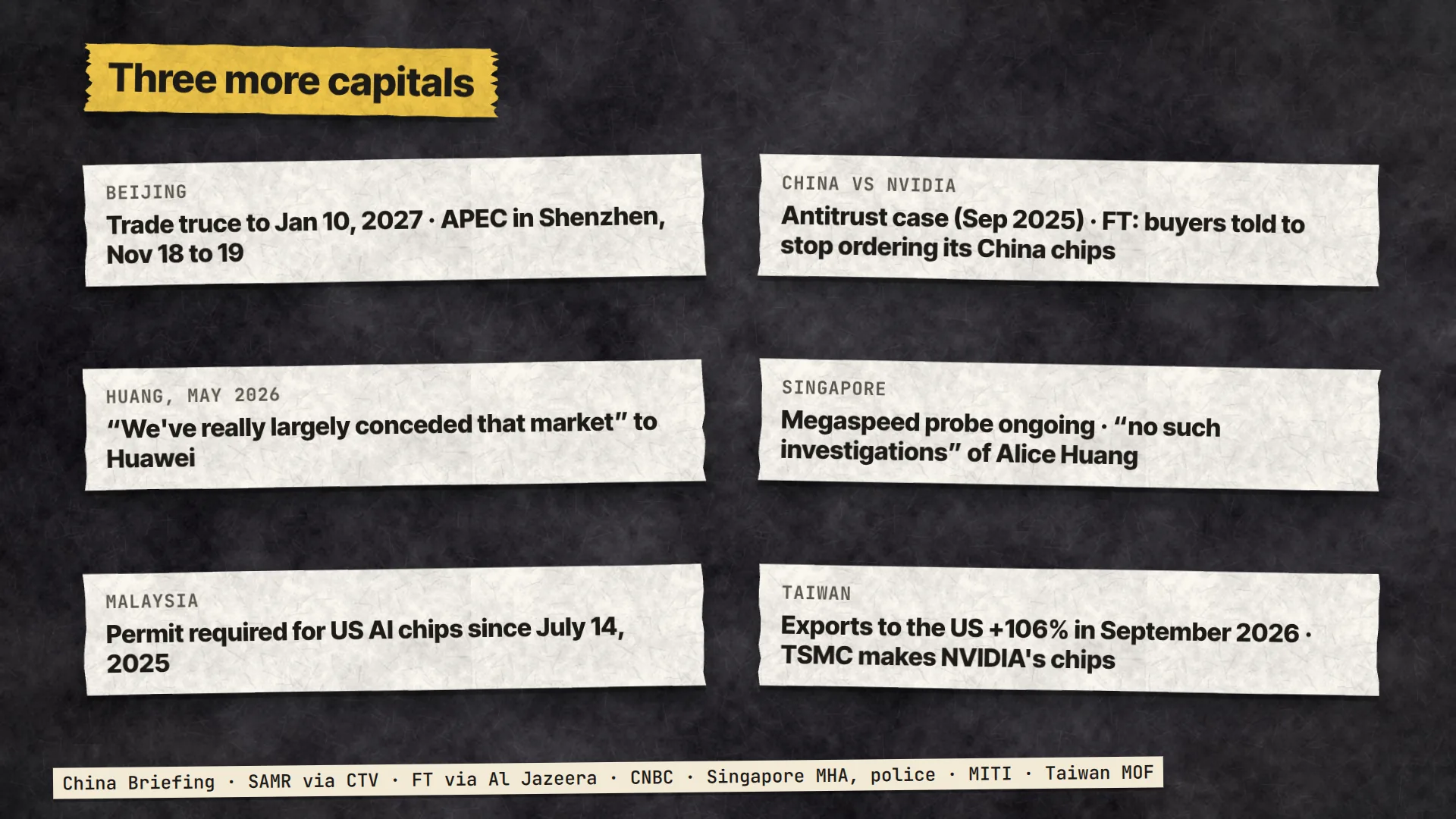
China. The reports land in the middle of a US-China trade truce, extended in September to January 10, 2027, and days before Asia-Pacific leaders meet at the APEC summit in Shenzhen on November 18 and 19, the same day as the requested House briefing. Beijing has its own record of pressure on NVIDIA: its cyberspace regulator summoned the company over the H20 in July 2025, its market regulator issued a preliminary finding in September 2025 that NVIDIA violated antitrust law over its Mellanox acquisition, and the FT reported that regulators told big buyers to stop ordering NVIDIA’s China-specific chips. In May 2026, Huang told investors: “We’ve really largely conceded that market” to Huawei. We found no Chinese government reaction to Huang’s admission itself by Sunday night.
Singapore and Malaysia. Singapore is in an awkward position: its police are investigating Megaspeed, while its government denies investigating Alice Huang. A separate Singapore fraud case over server purchases, involving a company called A-Speed Infotech, has no reported link to Megaspeed; the names are easy to confuse. Malaysia, where Megaspeed’s chips were housed, has required a Strategic Trade Permit for US-origin AI chips since July 14, 2025.
Taiwan. Huang was born in Taiwan, and TSMC, which makes NVIDIA’s chips, is its largest company. The AI boom shows up in Taiwan’s trade: September exports hit a record $87.2 billion, and exports to the United States more than doubled from a year earlier.
The stock: what moved, and why
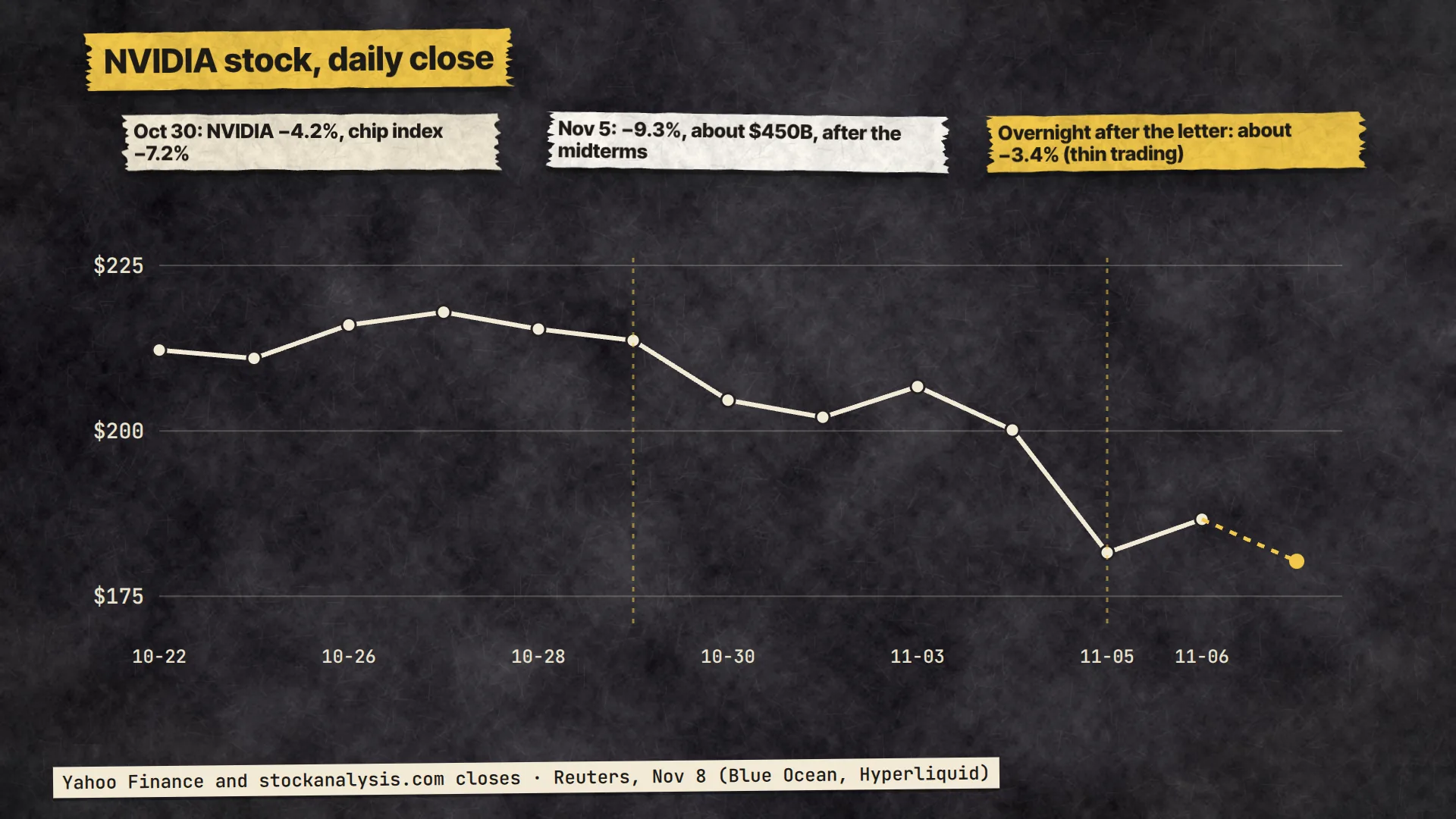
The scandal did not cause every red day on the chart.
- October 30, the day after the first Times report, NVIDIA fell 4.2%. The Philadelphia semiconductor index fell 7.2% the same day, in a broad selloff of AI stocks.
- November 5, NVIDIA fell 9.3% and lost about $450 billion of market value, its worst day since the DeepSeek selloff. That was the market’s reaction to the midterm elections; the S&P 500 fell 4.4%.
- November 6, it closed at $186.64, up 2.8% on the day, about 22% below its record close of $239.24 on October 6 and roughly flat for the year.
- After the letter, on the night of November 8, Reuters reported NVIDIA at about $180.30, 3.4% lower, on the Blue Ocean after-hours system and Hyperliquid perpetual futures. Stocktwits reported a drop of 4.2%. These overnight markets are thin; Monday’s regular session is the first real test.
What the stock could do next
Nobody knows, and we do not give investment advice. Three things help frame the range.
The latest price. At 11:30 p.m. Eastern on Sunday, NVIDIA’s perpetual futures contract on the Hyperliquid exchange was at about $179.15, 4% below Friday’s close, according to the exchange’s market data; The Block reported a low near $178 earlier in the evening. US stock index futures were up about 0.5% at the same time, so the market as a whole was not falling with NVIDIA. Monday’s regular session opens at 9:30 a.m. Eastern.
What options were pricing. Before the news, on Friday, options implied a move of about 3.6% in either direction for Monday alone and about 10.6% through November 18, which includes the November 17 earnings report. Those figures are our calculation from Cboe option prices at Friday’s close. Implied volatility was already near the top of its one-year range after the post-election selloff.
What happened in similar cases. Past exits of chief executives over relationships moved stocks less than people expect. These are context, not predictions:
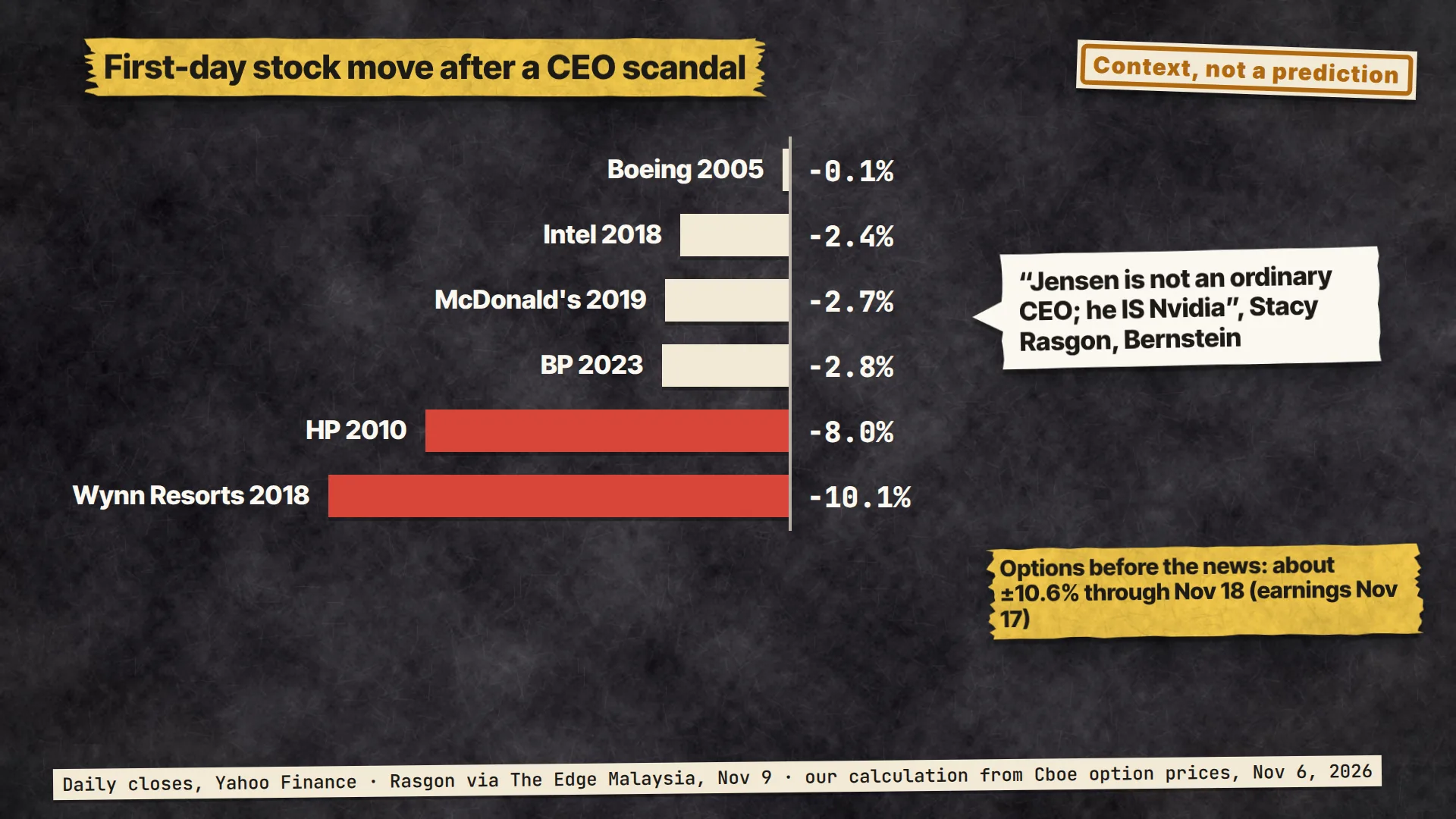
| Company | Event | First day | One month later |
|---|---|---|---|
| Boeing | CEO Harry Stonecipher forced out over an affair with an executive, 2005 | −0.1% | −0.1% |
| Intel | CEO Brian Krzanich resigns after a relationship probe, 2018 | −2.4% | −2.9% |
| McDonald’s | CEO Steve Easterbrook removed, 2019 | −2.7% | −0.4% |
| BP | CEO Bernard Looney resigns, 2023 | −2.8% | −0.5% |
| HP | CEO Mark Hurd resigns after an expenses probe tied to a relationship with a contractor, 2010 | −8.0% | −13.8% |
| Wynn Resorts | Misconduct report on founder Steve Wynn, 2018 | −10.1% | −15.8% |
| Tesla | SEC sues Elon Musk seeking his removal, 2018 | −13.9% | +7.6% |
| Tesla | Musk settles and stays CEO, 2018 | +17.4% | +26.5% |
Moves calculated from daily closing prices. The pattern: when a hired executive left a large company, the stock barely moved. When the founder was the franchise, or the conduct was more serious, the drop was larger and kept going. When the threat to the founder was lifted, the stock jumped. NVIDIA fits none of these cleanly. Its founder is not leaving, and the open question is national security, not workplace policy.
Analysts frame the risk in those terms. Bernstein’s Stacy Rasgon highlighted “the considerable key man risk that Nvidia faces,” adding: “Jensen is not an ordinary CEO; he IS Nvidia.” No analyst we found has put a number on that risk or named a likely successor.
Earnings on November 17. NVIDIA guided to third-quarter revenue of $108.0 billion, plus or minus 2%, and assumes no data center compute revenue from China. Analysts on average expect slightly more, about $108.8 billion. Any comment on the investigation, or its absence, will be watched as closely as the numbers.
In Asia on Monday, chip stocks rose: TSMC gained about 6% and SK hynix almost 4% in early trading. But Taiwan began restrictions on short selling and a stabilization fund the same day. Homin Lee, a strategist at Lombard Odier, said those measures “are overpowering any impact from the Jensen Huang development,” Bloomberg reported.
Leadership: the question investors care about most
Huang co-founded NVIDIA in 1993 and has been its only chief executive. He owns about 3.5% of the company, a stake worth roughly $150 billion to $160 billion at Friday’s price, but there are no special voting shares. The board has ten members, nine of them independent, with Stephen Neal as lead director and no chair.
NVIDIA’s annual report warns that “we are highly dependent on the services of our longstanding executive team” and that poor succession planning “could hinder our strategic planning, execution, and long-term success.” No successor has been named. Bloomberg reported in January that NVIDIA “lacks clear successor.”
Precedents exist. Boeing forced out Harry Stonecipher in 2005 over a relationship with an executive. Intel’s Brian Krzanich resigned in 2018 after an investigation found he broke a non-fraternization policy. McDonald’s fired Steve Easterbrook in 2019. BP’s Bernard Looney resigned in 2023 after admitting he had not been fully transparent about past relationships. All four involved colleagues inside the company. This case involves an executive at a customer, and a national security question, so the comparison only goes so far.
Analysts disagree:
- Dan Ives: “This is a black eye moment for Jensen and will spark multiple congressional inquiries at a minimum,” and “there is clearly risk that Jensen could be removed as CEO depending on the Board investigation.”
- Gary Black of The Future Fund: “I doubt Jensen Huang will be able to remain as $NVDA CEO.” He added that Huang “has no natural successor within the company.”
- Rob Enderle of the Enderle Group: “It certainly is going to put a cloud over Jensen and Nvidia for a while.”
- Ray Wang of Constellation Research put the key question this way: “The issue here is if the extortion resulted in Nvidia making policies or the CEO making policies.” No evidence of extortion has been reported; Wang was describing what investigators would need to rule out.
- Semafor reported that removal looks unlikely for now, and Sequoia’s Shaun Maguire called Huang “irreplaceable for America’s AI leadership.”
As of Sunday night, TipRanks listed 33 analysts rating the stock a buy, and we found no price target change tied to the admission.
Who depends on NVIDIA
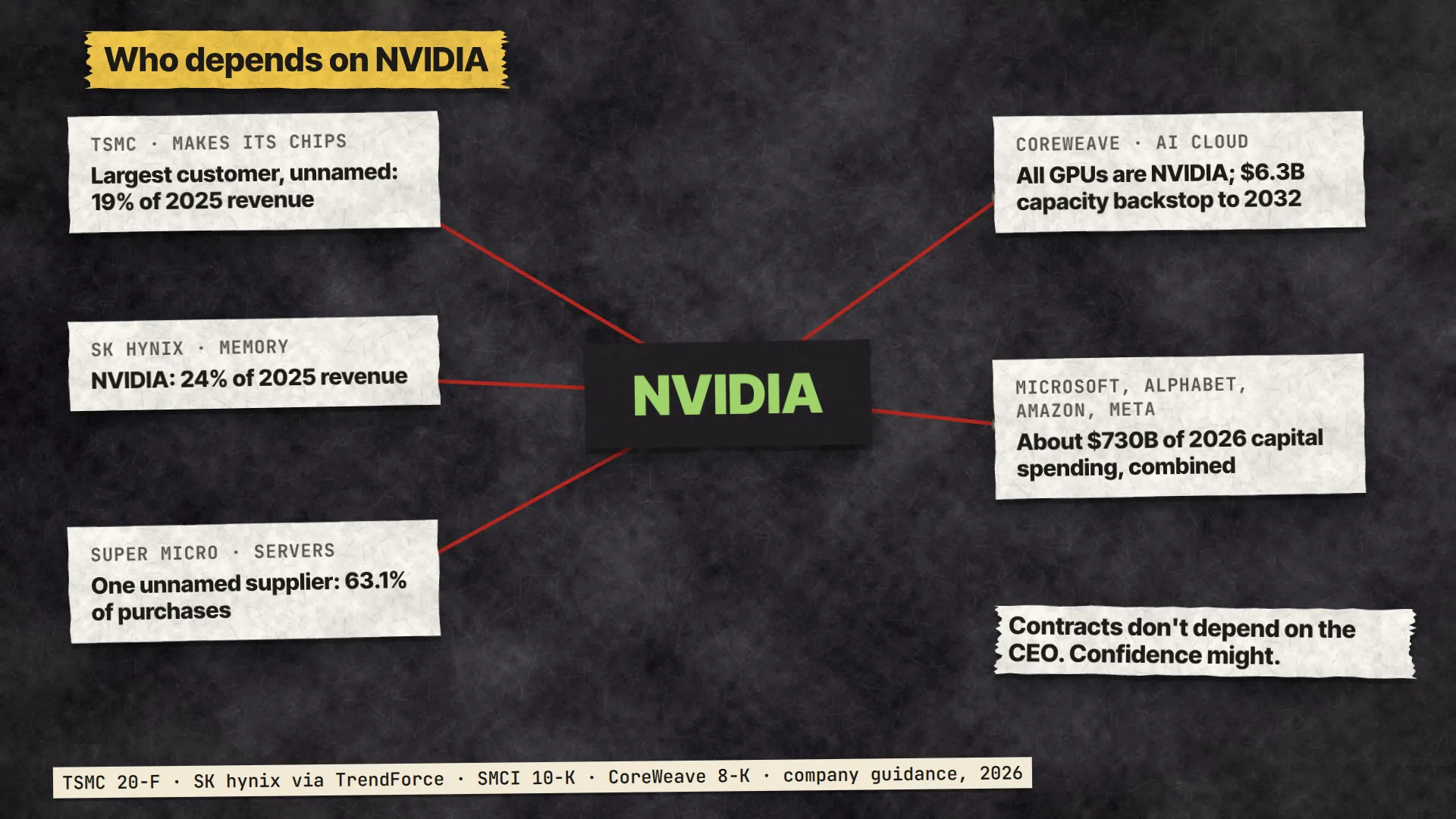
NVIDIA sits at the center of a supply chain and a customer base worth trillions of dollars. The figures below are each company’s own disclosure. They measure different things and should not be compared with each other directly.
| Company | Role | What it discloses | Period |
|---|---|---|---|
| TSMC | Makes NVIDIA’s chips | Largest customer, which it does not name: 19% of revenue | 2025 |
| SK hynix | High-bandwidth memory | NVIDIA: 24% of revenue (13.35% in the first half of 2026) | 2025 |
| Super Micro | AI servers | One supplier it does not name: 63.1% of purchases | Fiscal 2026 |
| Wistron | Server assembly | AI infrastructure: 79% of revenue (NVIDIA and custom chips combined) | Q1 2026 |
| Dell | AI servers | $95 billion AI backlog | Quarter to July 2026 |
| CoreWeave | AI cloud | All of its GPUs are NVIDIA; NVIDIA must buy its unsold capacity, up to $6.3 billion, through April 2032 | 2025 to 2026 |
| Microsoft, Alphabet, Amazon, Meta | Cloud and AI | About $720 billion to $745 billion of combined 2026 capital spending, on buildings, power and chips, NVIDIA’s among them | 2026 |
Two points matter. First, NVIDIA’s contracts, guarantees and backstops are obligations of the company, not of its chief executive. A change at the top does not cancel CoreWeave’s backstop or the up to $105 billion of lease guarantees NVIDIA gave for OpenAI’s data center site in Ohio. Second, confidence is a different matter. Seoul Economic Daily wrote that memory suppliers’ plans are “unlikely to change immediately” even if the CEO is replaced, but that a new chief executive reviewing next-generation memory purchases could change volumes later. We found no analyst who quantified supplier revenue at risk from the investigation, and none who said rivals such as AMD, Broadcom or Marvell stand to gain from it.
Your money and the wider economy
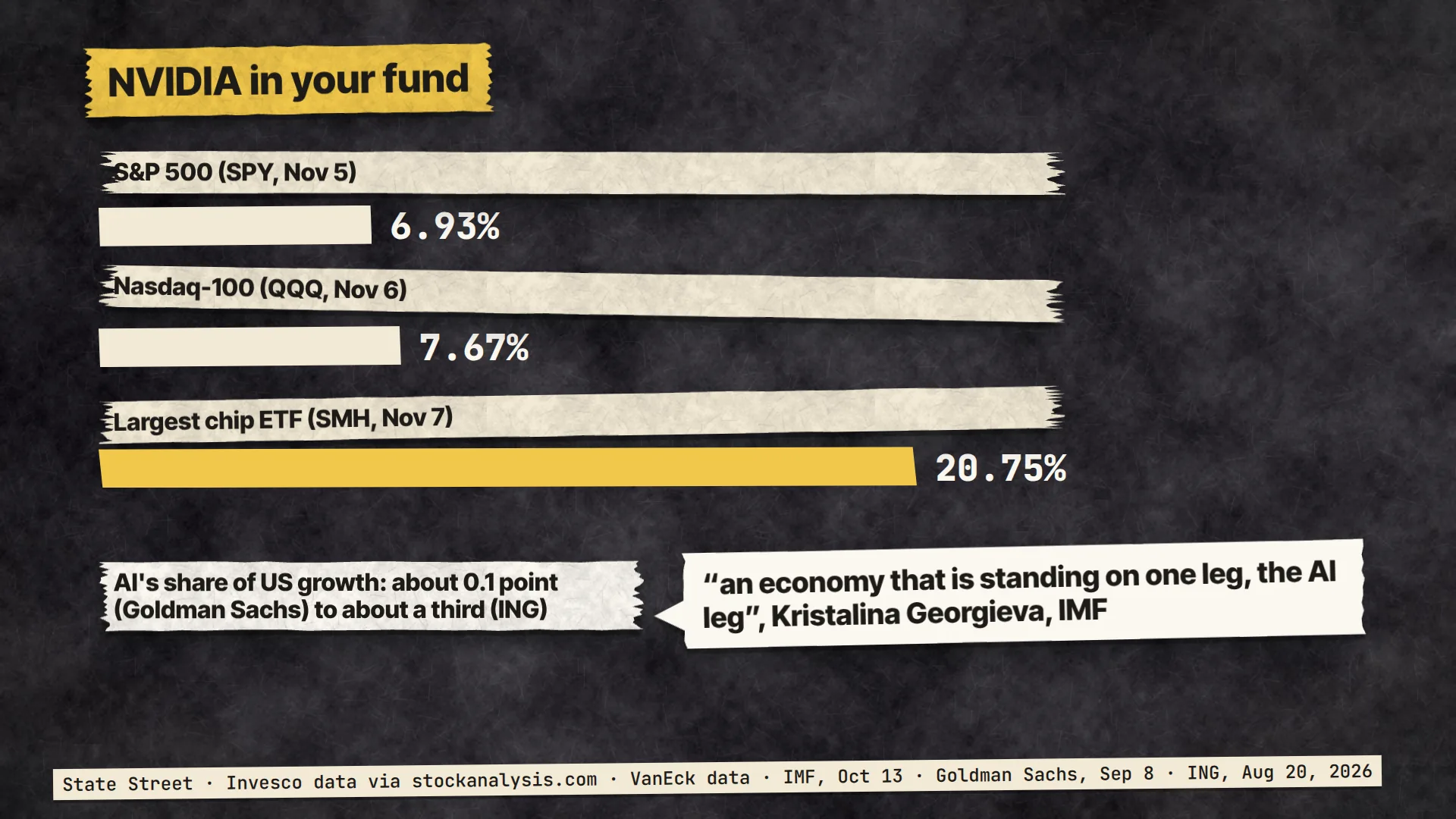
You do not need to own NVIDIA shares to be exposed to it. It is 6.93% of the SPY fund that tracks the S&P 500 and 7.67% of the QQQ fund that tracks the Nasdaq-100, second only to Apple in both. In the largest semiconductor fund, SMH, it is 20.75%. Index funds and target-date retirement funds hold it at those weights automatically. As a rough rule, a 3.4% fall in NVIDIA alone takes about a quarter of a point off the S&P 500, all else being equal.
The AI build-out NVIDIA supplies has also become a pillar of the economy. US output grew at a 3.4% annual rate in the third quarter, led by information processing equipment, according to the Bureau of Economic Analysis. “We now have an economy that is standing on one leg, the AI leg,” IMF managing director Kristalina Georgieva said in October. Economists disagree on the size of that leg once imports are counted: Goldman Sachs estimates AI’s net contribution to measured US growth at about 0.1 percentage point, while ING estimates about a third of this year’s growth. The IMF warned in October that weaker AI investment “could lead to a correction,” amplified by “concentrated exposures.”
When one company carries this much weight, a governance problem there reaches people who never chose to buy its shares.
The counterintelligence angle
Western security services have long warned about this kind of approach. A 2008 MI5 briefing for British businesses said “Chinese intelligence services have also been known to exploit vulnerabilities such as sexual relationships,” The Register reported. China’s own Ministry of State Security warns its students that foreign spies pose as “handsome guys” or “beautiful women.” Representative Michael McCaul told the Times the alleged operation was “a classic move from the CCP’s playbook.” No former FBI or CIA official has publicly assessed the evidence about Alice Huang, which remains classified. Past cases show how these usually end, and it is rarely in court:
- Eric Swalwell. A suspected Chinese operative, Christine Fang, cultivated California politicians between 2011 and 2015. The FBI gave Swalwell a defensive briefing in 2015 and he cut ties. A House ethics review closed in 2023 with no action.
- Christine Lee. In 2022, Britain’s MI5 publicly named the lawyer as acting for China’s United Front Work Department. She was never charged.
- Katrina Leung. An FBI asset in Los Angeles who had a relationship with her handler for nearly two decades. The espionage case collapsed; she later pleaded guilty to lesser charges.
The key difference here, according to the Times, is that Huang never received a defensive briefing. Why not, and who decided, is one of the questions Congress is likely to ask.
What she allegedly wanted, and how the US found out
All of this comes from the New York Times and the Financial Times, citing officials who have seen the intelligence. None of it has been published by the US government.
- The goal. The memo says she was recruited “to collect intelligence on Jensen Huang,” the Times reported, as part of an effort “to learn more about American A.I. chips and potentially influence the company to push for its most advanced chips to be made available to China.” When she was recruited, and what if anything she passed on, has not been reported.
- How it was found. US agencies conducted electronic surveillance of Alice Huang, which began more than a year ago as part of the Megaspeed export inquiry, the Times reported. The person she was in contact with was identified as Jensen Huang through “unmasking,” the process by which officials can request the name of an American who appears in intelligence reports. Since 2018 those requests must be documented and approved under intelligence-community rules.
- No warning. Huang never received a defensive briefing. The Times reported that telling him could have alerted her. No official has explained the decision on the record.
- The Beijing trip. Huang was initially left off the list of executives invited on Trump’s May trip to Beijing, the Times reported on November 8; it is not clear whether that was related to the memo. Trump later invited him himself.
- Her circle. According to the Times, investors around her used ties to Shanghai officials to move from mobile games into AI data centers, invested in a cybersecurity subsidiary of China Electronics Technology Group, a major maker of military technology, co-invested with the Chinese government in data centers in China, and boasted of her relationship with Jensen Huang when raising money. She also has relationships with the leaders of Gigabyte, a major assembler of NVIDIA systems, according to people who met her; no wrongdoing by Gigabyte is alleged.
NVIDIA says its cloud partners “do not ask us to seek changes in US law or advocate for sales to China,” and an NVIDIA spokesperson said Huang will not oversee the board’s inquiry.
The legal frame. No one has been charged. The US law against acting as an unregistered agent of a foreign government, 18 U.S.C. 951, applies to conduct “in the United States,” and no report places Alice Huang in the US; the meetings described took place in Taipei. Nobody has alleged that Jensen Huang committed a crime. NVIDIA’s Code of Conduct lists “investments or personal relationships” among possible conflicts of interest and says employees should step back from related decisions; it does not specifically address relationships with a customer’s executives, and no report says whether Huang disclosed the relationship. Whether any internal rule was broken is for the board’s investigation to decide.
What happens next
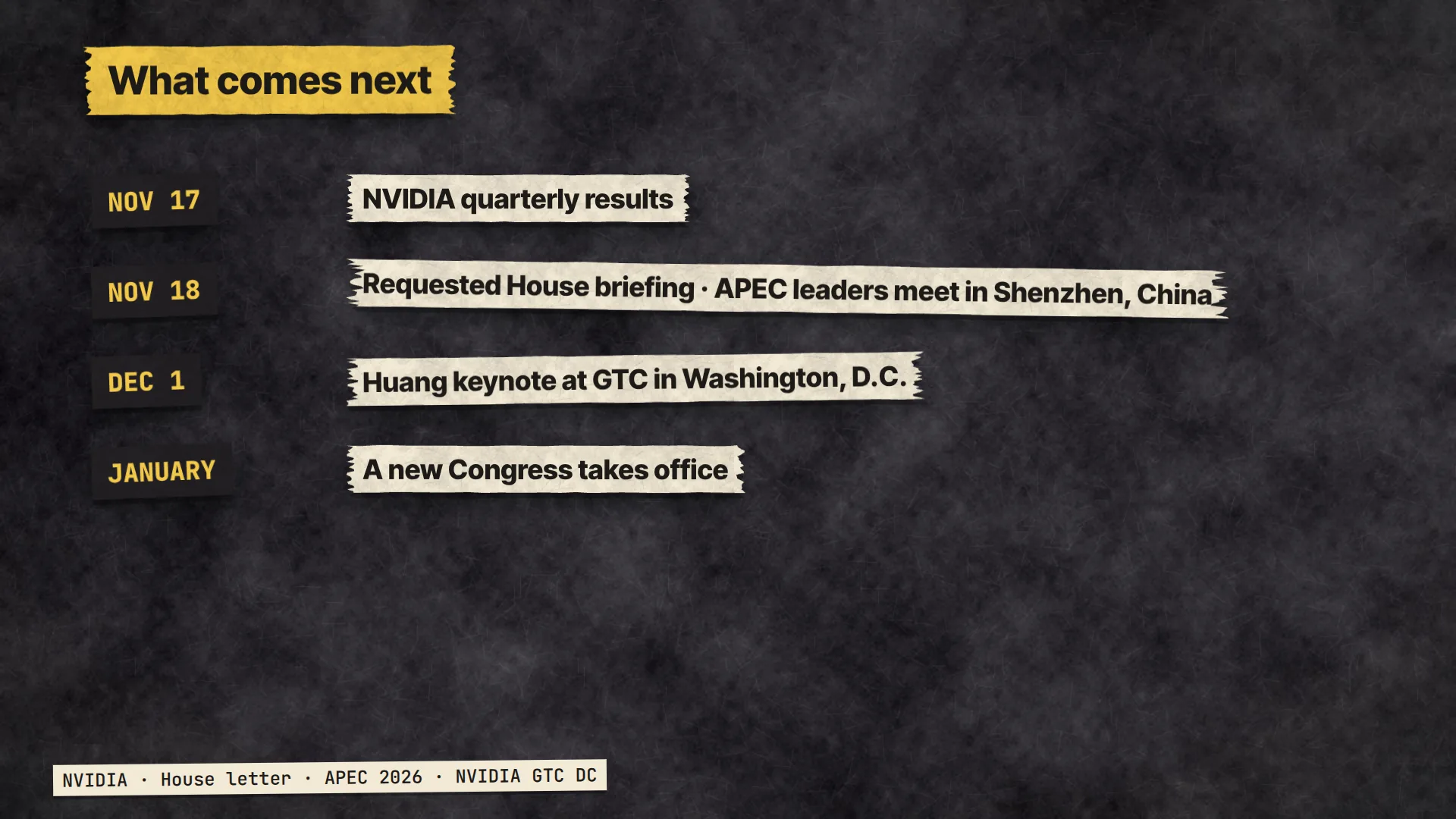
- November 17: NVIDIA reports results for its third fiscal quarter. Analysts will listen for any word on the investigation.
- November 18: the requested closed-door House briefing. The same day, APEC leaders meet in Shenzhen.
- December 1: Huang is scheduled to give the keynote at NVIDIA’s GTC conference in Washington, D.C.
- January 2027: a new Congress takes office, and the US-China truce expires on January 10.
What we know and what we don’t
We know there was an affair, admitted in writing, and that NVIDIA’s board is investigating with outside counsel. We know US officials have described to reporters an intelligence finding that has not been made public.
We do not know whether anything of value reached Beijing, whether Huang knew who Alice Huang allegedly worked for, or whether his lobbying on China was influenced. The board says it has “no reason to believe” secrets were compromised. Until its investigation reports, or the government releases what it has, that is where the facts stop.
How we researched this: we read the reporting of more than 40 outlets, NVIDIA’s SEC filings and statements by governments and lawmakers, and separated on-the-record facts from anonymous claims. The research was done with AI tools, including Claude, made by Anthropic; Anthropic buys computing power that runs on NVIDIA chips, among others. We have no financial position in NVIDIA. This is not investment advice.