
What it is
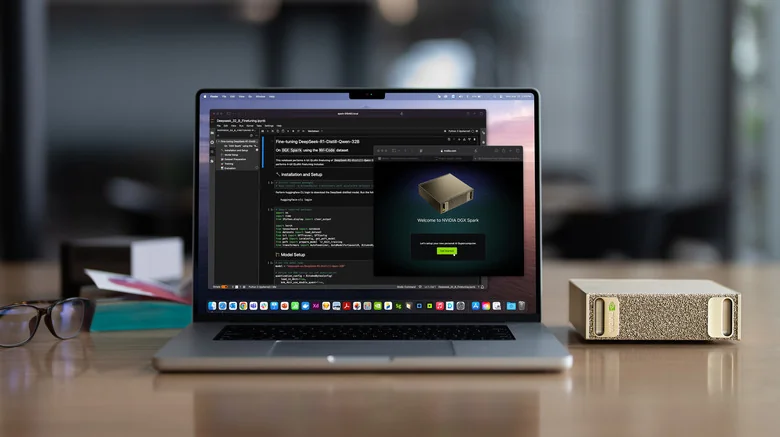
The NVIDIA DGX Spark is a personal AI supercomputer the size of a thick paperback: a 150 mm aluminum cube built around NVIDIA’s GB10 Grace Blackwell Superchip. It pairs a 20-core Arm CPU with a Blackwell GPU on a single package, hangs 128 GB of unified memory off it, and runs NVIDIA’s own DGX OS so the full CUDA stack works out of the box. At $3,999 (now closer to $4,699 after early-2026 memory pricing), it is not a mini PC in any normal sense. It is a developer workstation for running and fine-tuning large language models on your desk instead of renting cloud GPUs.
This is the reference GB10 box, the Founders Edition every other vendor’s variant is measured against. If you are cross-shopping the ASUS Ascent GX10 or any other Grace Blackwell desktop, this is the baseline. It is also the on-sale sibling of the upcoming consumer ASUS ProArt RTX Spark mini PC, which respins the same GB10-class silicon for a different audience.
What it’s good for: local AI and LLM development
The DGX Spark exists for one job, and it does it well: running large models locally, without a cloud account.
- Local LLM inference. 128 GB of unified memory means you can load models up to roughly 200B parameters (quantized) entirely on-device. A 70B model at 4-bit sits comfortably in memory with room for a long context window.
- Fine-tuning and prototyping. LoRA and QLoRA fine-tuning runs that would otherwise need a rented A100 fit on this box. It is a true CUDA development environment, not an emulation layer.
- CUDA-native from day one. Unlike an Apple Mac Studio or an AMD Ryzen AI Max box, the DGX Spark runs the exact same CUDA, cuDNN, TensorRT, and NIM stack you deploy to in production. Code written here moves to a DGX server unchanged.
- Light creator and office use. DGX OS is a desktop Linux, so it handles a browser, a terminal, and creative tooling, but treat that as a bonus, not the point.
Tom’s Hardware framed it neatly: a jack-of-all-trades AI sandbox that beats AMD’s Ryzen AI Max+ 395 in the workloads that matter to developers.
The GB10 superchip and unified memory
The GB10 Grace Blackwell Superchip is the whole story. NVIDIA glued a Grace-class CPU (10× Cortex-X925 performance cores + 10× Cortex-A725 efficiency cores) to a Blackwell GPU using NVLink-C2C, a coherent interconnect far wider than PCIe. The GPU carries 5th-gen Tensor Cores and 4th-gen RT cores and delivers 1 PetaFLOP of FP4 compute (1,000 TOPS).
Because CPU and GPU share one 128 GB LPDDR5x coherent memory pool, there is no copying tensors across a PCIe bus and no splitting your model between VRAM and system RAM. The GPU addresses all 128 GB directly. That unified pool is exactly why a sub-2-liter box can hold a 200B-parameter model that would need multiple discrete GPUs to fit elsewhere.
Build, connectivity, and clustering
The chassis borrows the gold “cheese-grater” front of the big DGX Station, shrunk to 1.2 kg. It runs horizontally or vertically and pulls from a 240 W external supply (GB10 itself is rated 140 W TDP).
Connectivity is where the developer intent shows:
- ConnectX-7 NIC with 2× 200 Gbps QSFP ports, the headline feature. You can directly link two DGX Sparks into a 256 GB cluster and run models too large for a single unit.
- 10 GbE RJ-45, Wi-Fi 7, Bluetooth 5.4
- 4× USB-C, 1× HDMI 2.1a, up to 3× DisplayPort over USB-C
- 4 TB self-encrypting NVMe: fast, secure, but soldered-class (not a user-swappable bay)
Can you cluster two DGX Sparks?
Yes. The ConnectX-7 dual-200GbE fabric is purpose-built for it. Two units bonded give you 256 GB of unified memory for models in the 400B-parameter range. This is the single biggest reason to buy NVIDIA’s box over a Mac Studio: the clustering path is native, not a hack.
Memory bandwidth: the real-world ceiling
Here is the honest part. The DGX Spark’s memory bandwidth is ~273 GB/s, and that, not compute, is the limiter.
Token-generation speed for LLMs scales almost linearly with memory bandwidth. A Mac Studio’s ~546 GB/s is nearly double the Spark’s, which means higher tokens-per-second on the same model. An RTX 5090’s GDDR7 is in another league entirely. So while the DGX Spark can hold a 200B model that a 5090 cannot, the 5090 will generate tokens faster on any model that fits its smaller VRAM.
The takeaway: the DGX Spark is optimized for capacity and CUDA fidelity, not raw throughput. It is the machine for “can I run and iterate on this huge model at all,” not “what’s the fastest interactive chatbot on my desk.” Reviewers across Tom’s Hardware and ServeTheHome reached the same conclusion: bandwidth is the Achilles heel, and you should buy it knowing that.
Pricing and where to buy
The DGX Spark launched at $3,999 in October 2025. A global memory shortage pushed street pricing up through early 2026, so budget a $3,999–$4,699 range depending on availability. It is sold through NVIDIA partners and listed on Amazon; the affiliate listing carries the Founders Edition.
At that price you are buying NVIDIA’s silicon, NVIDIA’s OS, and NVIDIA’s clustering fabric as a single supported package. Partner variants like the ASUS Ascent GX10 sometimes undercut it. They are worth comparing if cooling and SSD generation matter more to you than the Founders branding. Related: our GIGABYTE AI TOP ATOM review, our MSI EdgeXpert MS-C931 review, and our look at DGX Spark 64GB pricing.
What we’d flag
A fair review of an excellent-but-specialized machine:
- 273 GB/s bandwidth caps token speed. For interactive single-user inference, a high-VRAM discrete GPU or a Mac Studio may feel faster on models that fit them.
- DGX OS is Arm Linux, not Windows. This is a CUDA developer environment. If you want a general-purpose desktop, this is the wrong product.
- No user-upgradable memory or storage. 128 GB and 4 TB are what you get. Plan the config up front.
- Price volatility. The post-launch markup means you may pay several hundred over MSRP. Watch listings.
NVIDIA DGX Spark verdict
The NVIDIA DGX Spark is the most coherent personal AI supercomputer you can buy right now, if you understand what it is. The GB10 Grace Blackwell superchip, 128 GB of unified memory, native CUDA, and dual-200GbE clustering make it a genuine local home for running and fine-tuning models up to 200B parameters, with a clean upgrade path to a cloud DGX deployment.
Go in clear-eyed about the 273 GB/s memory bandwidth: this is a capacity-and-compatibility machine, not a throughput champion. For AI developers, researchers, and ML engineers who live in CUDA, that trade is exactly right, and the DGX Spark earns a confident recommendation. For anyone who wants a fast general-purpose desktop or maximum tokens-per-second for a single chat session, look elsewhere. And if you want the same silicon, compare the ASUS Ascent GX10 before you commit.