
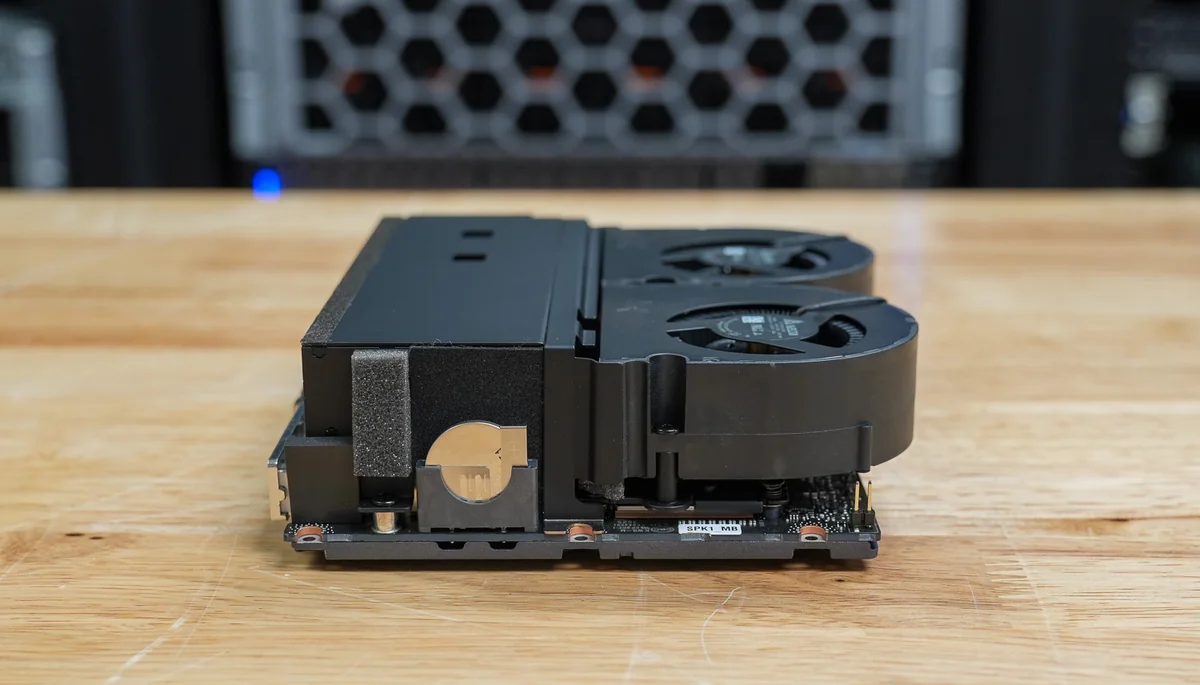
What the GIGABYTE AI TOP ATOM is
The GIGABYTE AI TOP ATOM is a roughly one-liter desktop built around NVIDIA’s GB10 Grace Blackwell Superchip, the same Grace-Arm-plus-Blackwell-GPU silicon that powers NVIDIA’s own DGX Spark and the ASUS Ascent GX10. It is not a general-purpose mini PC. It is a personal AI workstation, sold for $3,499 to $3,999 depending on SSD configuration, designed to do one thing very well: run and fine-tune large language models locally, on your desk, without renting cloud GPUs.
GIGABYTE’s contribution is the box around the chip. NVIDIA defines the GB10 platform (20-core Arm CPU, Blackwell GPU, 128 GB of unified LPDDR5x, the NVIDIA AI software stack), so every GB10 “Spark-class” machine ships with effectively identical compute. What partners differentiate on is cooling, SSD generation, networking, price, and support. ServeTheHome, which tested several of these boxes, called the AI TOP ATOM “the fastest Spark yet”, a meaningful nod given how little room vendors have to move the needle.
What it’s good for (local AI / LLM dev)
The headline number is 128 GB of unified memory. Because the Grace CPU and Blackwell GPU share one memory pool over NVLink-C2C, the GPU can address the full 128 GB, enough to hold a 200-billion-parameter model in memory, or a 405B model split across two ATOMs linked by ConnectX-7. That is the whole pitch: a model that would need multiple discrete data-center GPUs fits in a box you can carry under one arm.
Concretely, the AI TOP ATOM is built for:
- Local LLM inference and prototyping: running 70B-class models comfortably, and 100B–200B models that simply will not load on a 24–32 GB consumer GPU.
- Fine-tuning and LoRA work on mid-sized models without cloud egress or per-hour billing.
- AI development against the real CUDA stack: the same drivers, containers, and libraries you’d deploy to a DGX or cloud H100, so your code moves up without a rewrite.
- Creator and office tasks as a secondary role: it runs Arm Linux desktop apps fine, but that is not why you buy it.
If your interest is running 7B–13B models on a cheaper, Windows-friendly machine, a Strix Halo box like the GMKtec EVO-X2 or even a Mac mini M4 Pro is the saner spend. The ATOM earns its price only when you genuinely need the 128 GB ceiling. Our NPU vs iGPU vs CPU breakdown covers where that line falls.
The GB10 superchip & unified memory
The GB10 pairs a 20-core Arm CPU (10× Cortex-X925 performance cores + 10× Cortex-A725 efficiency cores) with a Blackwell GPU, joined by NVLink-C2C so there is no PCIe bottleneck between them. NVIDIA rates the platform at 1 PetaFLOP (1,000 TOPS) of FP4 compute, the sparse low-precision math format that modern inference engines lean on.
That FP4 figure is real, but read it correctly: it describes peak matrix throughput, not how fast tokens come out. For inference, the binding constraint is almost always memory bandwidth, and that’s the subject of its own section below.
Build, connectivity, and clustering
The chassis is minimalist to the point of austere: a black ~1-liter block (roughly 150 × 150 × 51 mm, about 1.2 kg) with no front ports at all (even the power button sits on the back) and a clean front-to-back airflow path. Reviewers consistently note the ATOM runs cool and quiet, which is the main reason ServeTheHome handed it the “fastest Spark” line: better thermals mean the GB10 holds clocks longer under sustained load.
Rear connectivity is networking-first:
- Dual 200GbE ConnectX-7 (QSFP): the marquee feature, used to lash two ATOMs together for that 405B-parameter dual-system mode.
- 10GbE copper for normal LAN, plus Wi-Fi 7 and Bluetooth 5.3.
- 4× USB-C (USB 3.2 Gen2x2, 20 Gbps, with DisplayPort alt-mode) and HDMI 2.1a for display out.
One caveat worth knowing: ServeTheHome flagged that the ConnectX-7 NIC hangs off the GB10 as two PCIe x4 links rather than a single x8, so the dual-port 200GbE behaves more like segmented interfaces than one fat 400G pipe. For most single-box buyers this is academic; for anyone planning tight two-node clustering, it’s worth understanding before you architect around it.
Memory bandwidth: the real-world ceiling
This is the number that matters most and the one the marketing buries. The 128 GB of LPDDR5x delivers roughly 273 GB/s of bandwidth. That is excellent for a one-liter machine, but it is a fraction of what a discrete GPU offers. An RTX 5090 moves well over 1.7 TB/s.
Because token generation is bandwidth-bound, the ATOM’s throughput on large models is modest in absolute terms. It will load and run a 120B model that a 5090 physically cannot, but it will emit tokens at a more deliberate pace than the FP4 PetaFLOP headline might lead you to expect. The right mental model: the GB10 trades raw speed for capacity. You buy it to run models that won’t fit anywhere else at this size and price, not to beat a gaming GPU on tokens-per-second for models that fit in 32 GB. That capacity-over-speed trade is the same reason discrete-GPU mini PCs remain faster for small models but cap out early on big ones.
Pricing and where to buy
GIGABYTE sells the AI TOP ATOM in three configurations, all sharing the same GB10 and 128 GB of memory; only the SSD differs:
- $3,499: 1 TB PCIe Gen4 NVMe
- $3,899: 4 TB PCIe Gen4 NVMe
- $3,999: 4 TB PCIe Gen5 NVMe
It is listed on Amazon (the 4 TB configuration is the verified listing), so the affiliate link below points to a live US listing. At these prices the ATOM typically undercuts NVIDIA’s own DGX Spark (which has drifted upward toward ~$3,999–$4,699 amid DRAM pricing swings), making GIGABYTE’s box one of the better-value entries in the GB10 lineup. Differentiation across vendors is thin, so support matters: GIGABYTE partners with AVADirect for next-business-day on-site repair in the US. Related: the MSI EdgeXpert MS-C931 and Acer Veriton GN100 are other GB10 machines in the same lineup.
What we’d flag
- Bandwidth, not compute, is the limiter. 273 GB/s means token-generation throughput on big models is steady, not blazing. Set expectations accordingly.
- DGX OS is a developer environment, not a desktop. This is Arm Linux with NVIDIA’s stack, superb for AI work, but it is not a Windows machine and not a general productivity PC.
- Soldered everything. 128 GB memory is fixed; only the SSD is a configuration choice, made at purchase. There is no upgrade path later.
- Segmented ConnectX-7 lanes. The dual 200GbE NIC runs as 2× x4, which constrains the cleanest two-node clustering story.
- Niche by design. At $3,499+, this only makes sense if you specifically need the 128 GB unified-memory ceiling. For 7B–13B models, far cheaper hardware wins.
Verdict
The GIGABYTE AI TOP ATOM is a well-executed GB10 machine, arguably the best-cooled and best-priced of the current Spark-class boxes, which is exactly what ServeTheHome’s “fastest Spark yet” verdict reflects. It does the one job it exists for honestly: it puts a 200-billion-parameter model on your desk, in silence, for under four thousand dollars.
Just buy it for the right reason. If you are an AI developer or researcher who needs to run, fine-tune, and iterate on models too large for any consumer GPU, and you want NVIDIA’s real CUDA stack rather than a compatibility layer, the ATOM is a confident recommendation, and the value pick among its GB10 siblings. If you mostly run small models, or you wanted a fast general-purpose desktop, this is the wrong tool, and a Strix Halo mini PC or Framework Desktop will serve you better for less.