
What it is
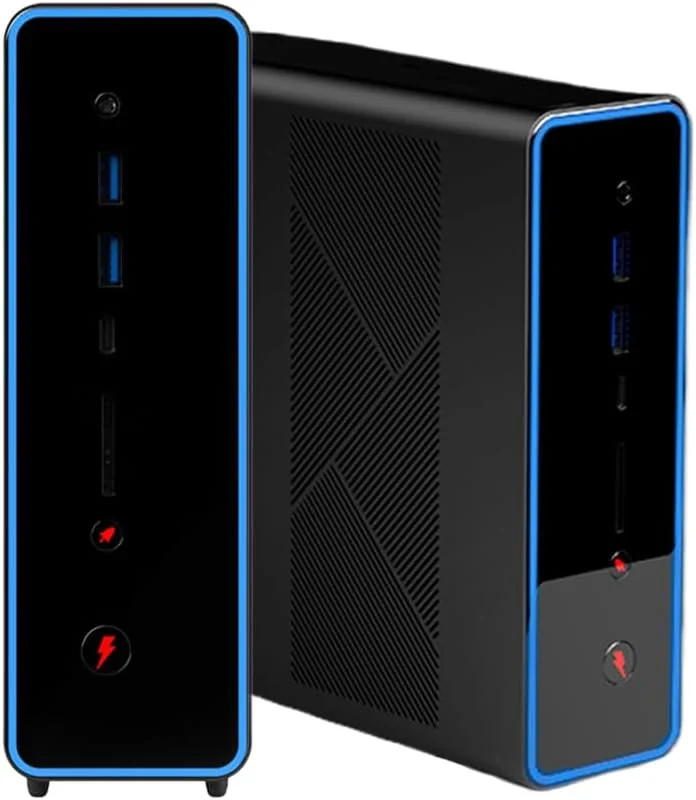
The OneXPlayer ONEXStation is a Ryzen AI Max+ 395 mini PC from a company better known for handhelds. OneXPlayer (One-Netbook) has shipped Strix Halo in the ONEXFLY Apex and the Super X tablet; the ONEXStation puts the same 16-core Zen 5 APU, the 40-CU Radeon 8060S and 128 GB of LPDDR5X-8000 into a 2.2-liter aluminum tower with a light strip around the front bezel.
The pitch is two jobs in one box: run 70B-class language models locally, and play AAA titles at 1080p when the model is idle. The chip can do both. The question is whether OneXPlayer’s chassis, cooling and pricing make it the right Strix Halo box, given that the same silicon ships from Bosgame, GMKtec, Framework, HP and Corsair.
Announcement coverage landed in April 2026 at $2,999 for the 128 GB / 1 TB configuration. Since then the list price on OneXPlayer’s store has moved to $3,599, with the 1 TB build discounted to $3,199 and a 2 TB build at $3,499.
What is the ONEXStation good for?
Local AI. With 96 GB of the 128 GB pool assignable to the GPU, the ONEXStation loads quantized 70B models entirely in memory, which a 24 GB or 32 GB discrete card cannot do. OneXPlayer quotes support for models up to 100B parameters. The 256-bit LPDDR5X bus delivers roughly 256 GB/s, so token generation is bandwidth-bound and sits well below a desktop RTX 5090; what you gain is capacity, not raw speed. Our Strix Halo 70B model guide covers what that looks like in practice on identical silicon.
Gaming. The Radeon 8060S is the fastest integrated GPU AMD has shipped. OneXPlayer’s own numbers are a 3DMark Time Spy graphics score of 11,130 and 80+ fps in Black Myth: Wukong at 1080p max settings (vendor figures, almost certainly with FSR frame generation). Independent testing of the same APU in other boxes lands in RTX 4060 laptop territory at 1080p and comfortable 1440p with upscaling.
Creator work. Sixteen Zen 5 cores, a front UHS-II SD slot and two USB4 ports make it a plausible photo and video ingest station, and 128 GB means Resolve or a large Lightroom catalog never touches swap.
Build and connectivity
The chassis is CNC-machined aluminum, 186 x 193 x 62 mm, standing upright on rubber feet with a side-mounted intake grille. Cooling is a three-heat-pipe stack with two turbo fans plus a third downward-blowing fan, which is more airflow hardware than most Strix Halo mini PCs carry. The APU runs at 55 W, 85 W or 120 W, selectable in software or via a dedicated turbo button on the front panel. A 240 W external brick feeds the DC barrel jack.
Port layout, from the official diagram:
- Front: 2x USB 3.2 Gen 2 Type-A, 1x USB4 Type-C, UHS-II SD 4.0 reader, 3.5 mm combo jack, turbo button, power button
- Rear: DC input, 3.5 mm combo jack, 2.5 GbE RJ45, 1x USB 3.2 Type-A, 1x USB4 Type-C, DisplayPort, HDMI, 2x USB 2.0 Type-A
- Wireless: Wi-Fi 7 and Bluetooth 5.4 on a replaceable M.2 card
Both USB4 ports carry DisplayPort 1.4 Alt Mode, which should allow four displays (HDMI, DP, plus two Type-C). OneXPlayer’s diagram notes that neither USB4 port supports Power Delivery input, which is expected for a 120 W desktop but worth knowing if you planned to run it from a USB-C dock’s PSU.
The RGB strip frames the front panel and offers 16 effects. It is a design choice carried over from a gaming brand, not a functional feature.
Memory, storage, and upgrades
The 128 GB of LPDDR5X is soldered, as on every Strix Halo system, because the 256-bit bus needs the memory on the package carrier. There is no upgrade path and no 64 GB or 96 GB variant listed; the ONEXStation ships only in the 128 GB configuration. If your budget is tighter, the Bosgame M5 offers a 96 GB option.
Storage is the upgrade story. The stock drive is a 1 TB PCIe 4.0 x4 NVMe SSD in a 2280 slot, and a second 2280 slot sits next to it. OneXPlayer rates the pair at 8 TB combined and describes the second slot as easily accessible, with no proprietary carriers involved.
Pricing and where to buy
- OneXPlayer store: $3,599 list; currently $3,199 (128 GB / 1 TB) and $3,499 (128 GB / 2 TB), with a bundled wireless keyboard and mouse during the launch promotion.
- Amazon US: listed under ASIN B0GX1SHL92 at $3,798.99 when we checked, but showing as currently unavailable. A third-party reseller (WEELIAO) also lists the 128 GB / 1 TB build.
At $3,199 the ONEXStation costs roughly $1,200 more than a Bosgame M5 at 128 GB / 2 TB, and sits just under the GMKtec EVO-X3 at $3,600. LPDDR5X pricing has pushed every Strix Halo box up through 2026, so compare on the day rather than against launch quotes.
What we’d flag
No OCuLink. For a product sold by a handheld company with its own ONEXGPU eGPU line, the omission is odd. The EVO-X3 ships OCuLink for a discrete GPU; the ONEXStation only offers USB4 at 40 Gbps, which loses 15 to 25 percent against a PCIe 4.0 x4 link on the same card. A USB4 eGPU dock still works, but this is not the box to buy if a future RTX 5080 is part of the plan.
Single 2.5 GbE. One network port at 2.5 Gbps is standard for the category but thin for a machine marketed as a remote AI server. Moving a 40 GB model checkpoint takes over two minutes; a 10 GbE USB4 adapter fixes it for another $150 to $200.
Price above the field. The cooling stack and CNC chassis justify some premium over Bosgame and cheaper Chinese boxes, but not $1,200 worth. The $2,999 launch figure was the honest price for this hardware; $3,599 list is not.
No independent thermal data yet. Every published article so far, including the one titled as a review in our sources, is a spec rundown. Nobody has measured sustained clocks or noise at 120 W. The extra fan and chassis volume suggest it will hold 120 W better than flatter boxes, but that is inference, not measurement.
Is the ONEXStation good for gaming?
Yes for 1080p, and 1440p with FSR. The Radeon 8060S is the same GPU as the ONEXFLY Apex handheld with a far larger power budget, so expect 60+ fps in most current titles at 1080p high. It is not a substitute for a desktop RTX 4070 at 4K.
Can the ONEXStation run a 70B LLM?
Yes. A Q4 70B model needs around 40 to 45 GB of memory, which fits comfortably in the 96 GB VRAM allocation with room for context. Expect single-digit tokens per second; the memory bus, not the GPU, is the ceiling.
ONEXStation vs Bosgame M5: which should you buy?
Same APU, same 128 GB memory, same 2.5 GbE limitation. The ONEXStation adds a third fan, a CNC aluminum shell, a front SD slot and RGB; the M5 costs far less. Unless cooling headroom or looks matter to you, the M5 is the rational pick.
OneXPlayer ONEXStation verdict
The OneXPlayer ONEXStation is a well-built, over-cooled take on the Ryzen AI Max+ 395 platform, with a genuinely useful port layout and a second M.2 slot. Its weaknesses are the ones the whole category shares (soldered memory, one 2.5 GbE port, no discrete GPU path) plus a price that drifted upward after launch.
If you find it at or near $2,999, it is one of the better Strix Halo boxes for a combined local-AI and gaming desk, and we recommend it. At $3,599 list, buy the Bosgame M5 and put the difference toward a second SSD. For a smaller Ryzen AI box without the 128 GB ambition, the AOOSTAR G-Flip covers the HX 370 tier at a fraction of the price.