
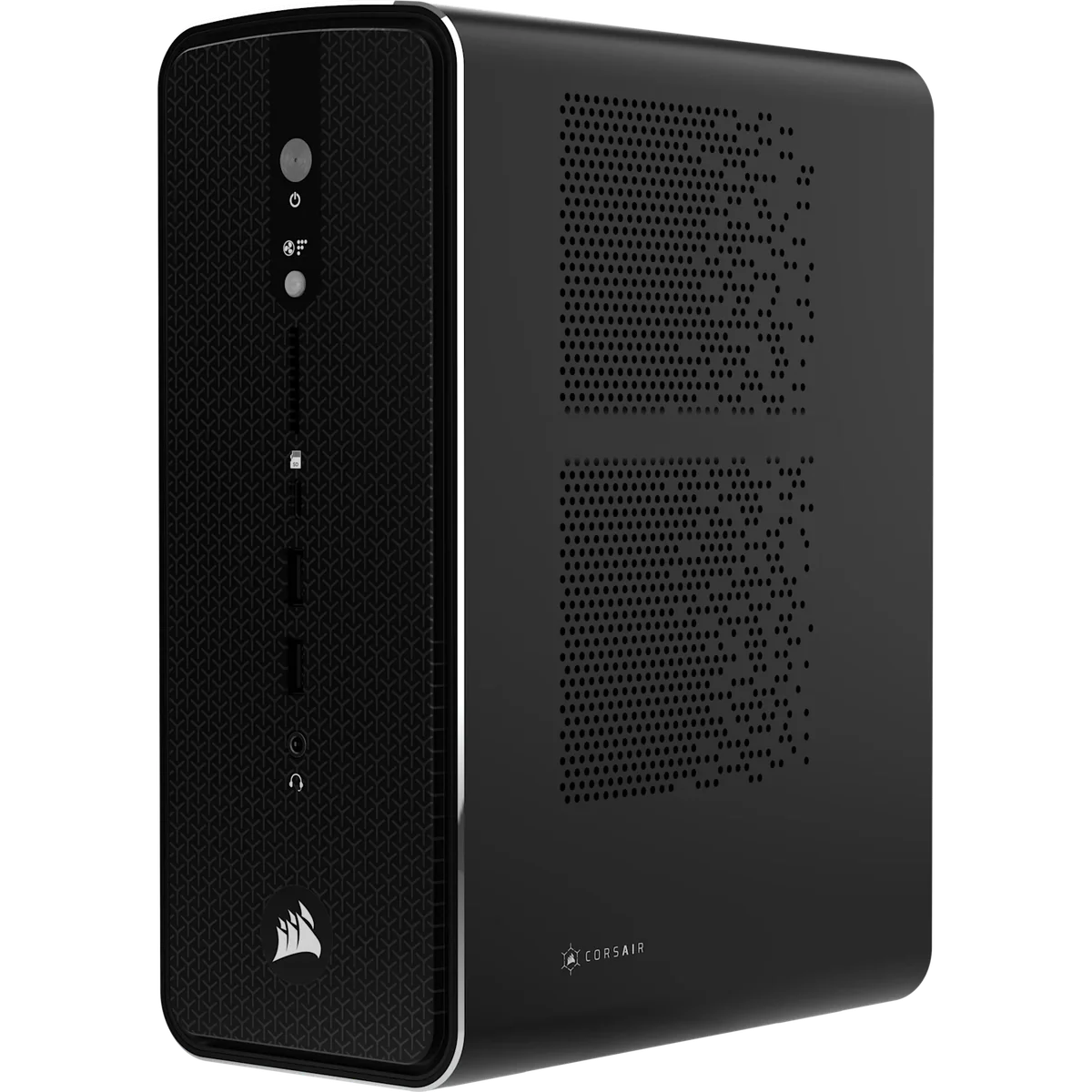
What it is
The Corsair AI Workstation 300 is Corsair’s first small-form-factor AI workstation: a 4.4-liter black aluminum tower built around AMD’s Ryzen AI Max+ 395 (Strix Halo), the Radeon 8060S iGPU and 128 GB of LPDDR5X-8000, of which up to 96 GB can be handed to the GPU as VRAM. A cheaper Ryzen AI Max 385 / 64 GB SKU exists too. It launched at the end of July 2025 as one of the more polished ways to run 70B-class local LLMs on x86 hardware.
What has changed since launch is the sticker. The 128 GB / 1 TB model sold for $1,999.99 at launch; on 12 September 2026 Corsair’s own store lists it at $4,699.99, backordered until late October. That drift, not the silicon, is the thing you need to understand before buying.
What the Corsair AI Workstation 300 is good for
This is a local-AI and creator box first, a desktop second, and a gaming PC a distant third.
- Local LLM inference. With 96 GB allocatable to the 8060S, it runs Llama 3.x 70B quantized, gpt-oss-120b (roughly 60 GB) and Qwen3-30B-A3B entirely in memory. BabelTechReviews measured 20 to 50+ tokens/s on gpt-oss-120b in LM Studio depending on reasoning effort.
- Image generation and creative work. ComfyUI, Blender and DaVinci Resolve run natively under Windows 11, or under Ubuntu 24.04 with ROCm on the second M.2 slot, an install Tom’s Hardware called straightforward.
- General-purpose x86 compute. The 16 Zen 5 cores beat the DGX Spark’s Arm CPU by about 11% in Geekbench 6 multithread (Tom’s Hardware), useful if compiling or containers share the box with inference.
- Casual gaming. Native Windows means no FEX emulation layer. Expect 1080p at medium to high settings; ray tracing is off the table.
If you only want the AI half of that list and can live with Arm Linux, our NVIDIA DGX Spark review and ASUS Ascent GX10 review cover the GB10 alternatives that Tom’s Hardware found faster and more stable for CUDA-first workflows.
Build and connectivity
The shell is anodized aluminum, the motherboard-and-cooler assembly slides out the front after removing the rear screws, and there is a 300 W Flex ATX power supply inside the case. No brick, one IEC cable. At 248.5 x 188.4 x 97.5 mm and 4 kg it stands like a small tower or lies flat on a shelf.
Cooling is generous for the class: two blower fans over a three-heatpipe fin stack for the SoC, a slim fan for the SSDs, and a tiny fan in the PSU. Tom’s Hardware measured 39 dBA at 46 cm in Balanced mode during ComfyUI image generation and 43.4 dBA in Max mode, silent at idle but audible under light load.
Ports are practical rather than exotic:
- Front: 1x USB4 Type-C, 2x USB 3.2 Gen 2 Type-A, SD 4.0 card reader, headphone/mic jack, power-mode button
- Rear: 1x USB4 Type-C (DP Alt Mode), 1x USB 3.2 Gen 2 Type-A, 2x USB 2.0 Type-A, HDMI 2.1, DisplayPort 1.4, 2.5 GbE, headphone/mic jack
- Wireless: Wi-Fi 6E and Bluetooth 5.2 on a MediaTek module
What does the front power-mode button do?
It cycles through three firmware TDP profiles: Balanced (~85 W, default), Max (~120 W) and Quiet (~55 W), in that order. Windows shows a brief on-screen toast; Linux shows nothing, the setting persists across reboots, and there is no LED indicator, so a stray press can leave you in Quiet mode unnoticed. Tom’s Hardware found Max mode added noise but barely changed ComfyUI completion times, so Balanced is the sensible daily setting.
Memory, storage and upgrades
The 128 GB of LPDDR5X-8000 is soldered, as on every Strix Halo system. You choose 64 GB or 128 GB at checkout and never again. Inside there are two M.2 2280 PCIe 4.0 slots; the 1 TB config ships with one populated, and the 4 TB launch config used two 2 TB drives. That second slot is the practical upgrade path and the easy way to dual-boot Linux.
Pricing and where to buy
This section will age fastest, so here is the documented trail:
- Launch, July 2025: $1,599.99 (Max 385 / 64 GB / 1 TB), $1,999.99 (Max+ 395 / 128 GB / 1 TB), $2,299.99 (Max+ 395 / 128 GB / 4 TB), per TechPowerUp and VideoCardz.
- Post-launch deals: Slickdeals logged the 128 GB / 1 TB model (CS-9080002-NA) at $1,899.99 direct from Corsair, and later from Origin PC.
- February 2026: Tom’s Hardware’s review noted the top config had risen to around $3,000 from a street price near $2,000 during testing.
- April 2026: Tom’s Hardware’s “RAMpocalypse” report: $3,399.99 for 128 GB / 4 TB, $2,699 for 128 GB / 1 TB (out of stock), $1,699.99 for the 64 GB SKU.
- 12 September 2026: Corsair.com lists the 128 GB / 1 TB unit at $4,699.99 (marked down from $4,799.99), backordered with a late-October ship window. The 64 GB model shows $1,699.99 and out of stock.
Corsair has not announced any of these changes; the DRAM and NAND shortage is the obvious driver. Amazon carries the Max 385 / 64 GB configuration; the 395 / 128 GB unit is sold direct. Check the live price first, because the same box has been a great deal and a poor one within twelve months.
What we’d flag
- Price volatility. At $2,000 this was the friendliest Strix Halo box on the market. At $4,699 it costs more than a DGX Spark Founders Edition with faster AI throughput. Nothing in the hardware justifies that gap.
- Windows 11 Home, not Pro. No BitLocker management, no Remote Desktop host, no domain join. For a product with “workstation” in the name and “security” in the press release, that is a strange omission.
- No OCuLink, no 10 GbE. The Bosgame M5 at least carries an OCuLink header on its board and the Minisforum MS-S1 Max ships dual 10 GbE; Corsair gives you a single 2.5 GbE port and USB4. For a shared inference server feeding several clients, that is the bottleneck.
- ROCm maturity. Tom’s Hardware hit HIP errors that crashed ComfyUI and the GNOME desktop while testing LTX-2. That is AMD’s problem, but you inherit it.
Corsair AI Workstation 300 vs Framework Desktop vs HP Z2 Mini G1a
All three use the same Ryzen AI Max+ 395 and 128 GB LPDDR5X, so performance is close to identical. The Framework Desktop launched cheaper on the same silicon and is the tinkerer’s pick with its swappable front tiles and standard mainboard. The HP Z2 Mini G1a is the corporate pick: Windows 11 Pro and enterprise support contracts. The Corsair sits between them: prettier than the Framework, less bureaucratic than the HP, with a 2-year warranty and advance replacement that most import mini-PC brands, typically limited to one year, cannot match.
Is the Corsair AI Workstation 300 good for gaming?
Fine, not great. The 8060S lands within a few percent of the DGX Spark in Unigine Superposition and runs modern titles at 1080p, but any desktop with a midrange discrete GPU is far faster for far less money.
Verdict
The Corsair AI Workstation 300 is one of the best-built Strix Halo systems available: an internal PSU, a genuinely useful power-mode button, quiet idle behavior, two M.2 slots and a two-year warranty backed by an established US brand. If you can find the 128 GB model anywhere near its $2,000 to $2,700 historical band, we recommend it over most competing Ryzen AI Max+ 395 boxes for local LLM work and creator duty.
At the $4,699.99 Corsair is asking today, we do not. That money buys a GB10 system with a mature CUDA stack, or a Framework Desktop plus a discrete GPU tower. Watch the price, not the spec sheet.