
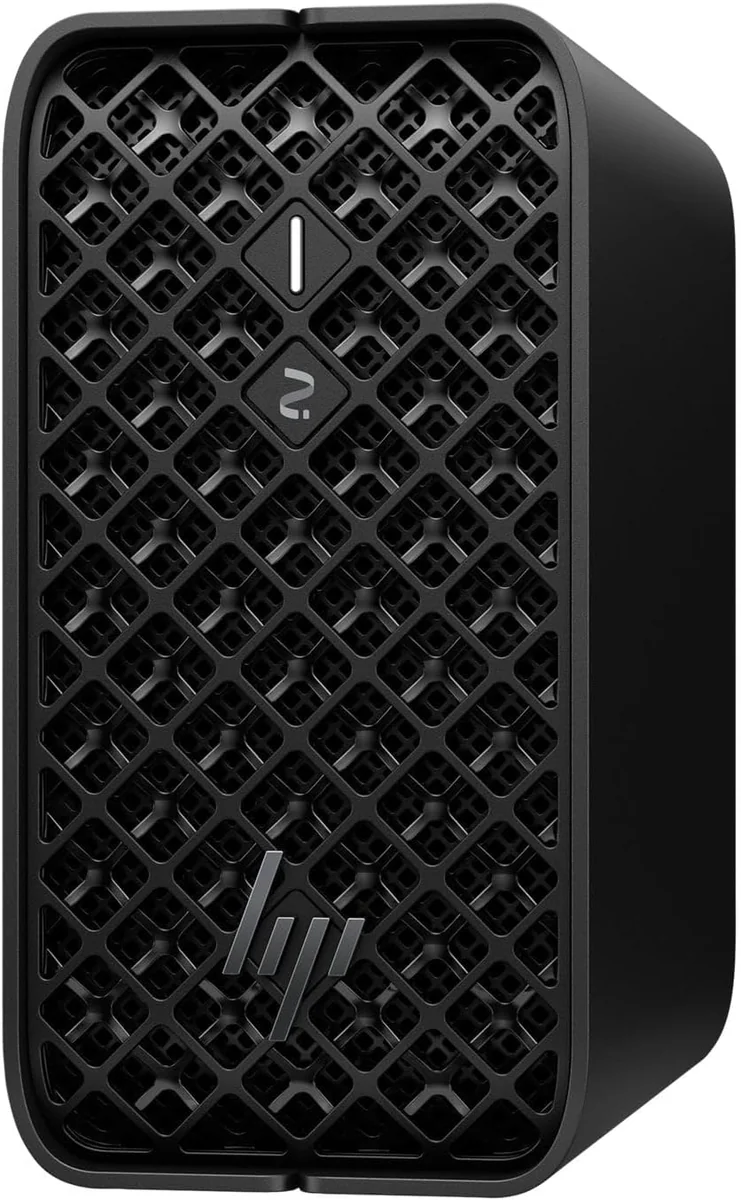
What it is
The HP Z2 Mini G1a is a 2.3-liter workstation built around AMD’s Strix Halo platform, specifically the Ryzen AI Max+ PRO 395, a 16-core, 32-thread Zen 5 processor paired with a 40-CU Radeon 8060S iGPU and a 50-TOPS XDNA 2 NPU on the same package. Memory is soldered LPDDR5x, configurable up to 128 GB, and up to 96 GB of that pool can be exposed to the iGPU as VRAM through AMD’s unified-memory addressing.
That hardware is now showing up in roughly a dozen mini PCs from the usual brands. What separates the Z2 Mini G1a from all of them is what surrounds the silicon: a Tier 1 OEM warranty, on-site service options, HP’s manageability stack (HP Sure Start, Sure Recover, Wolf Pro Security), and, most importantly for the buyers HP is actually targeting, ISV certification for SolidWorks, Autodesk (Revit, Maya, 3ds Max, Inventor), and Adobe Creative Cloud. No other Strix Halo mini PC shipping today carries that certification list.
What it’s good for
The Z2 Mini G1a is a workstation, and the use cases that justify its price are workstation use cases. Three stand out.
First, local AI inference and development. With up to 96 GB of iGPU-addressable memory, the Z2 Mini G1a can run large language models that simply will not fit on a 24 GB or 32 GB discrete GPU. StorageReview was able to run GPT-OSS 120B on this machine without a discrete card, something that ordinarily requires a multi-GPU server. For local LLM tinkering, on-device RAG, or fine-tuning experiments, this is the cheapest way into 96 GB of fast unified memory short of an Apple Mac Studio with M3 Ultra.
Second, CAD, BIM, and DCC work. ISV certification is not marketing. It means HP and the software vendors have validated the driver stack against the application, so when SolidWorks crashes on a complex assembly, you have a support path that consumer-brand boutique mini PCs cannot offer. For shops billing $200/hour, that warranty matters.
Third, content creation under power and acoustic constraints. The Z2 Mini G1a is near-silent under sustained load, sips power compared to a tower workstation, and slides under a monitor arm. For editors, motion designers, and architects who travel between offices, that combination is hard to find elsewhere.
It is not a gaming PC. The Radeon 8060S is genuinely strong for an iGPU (comparable to a desktop RTX 4060 in many titles), but HP is not selling it on that. If gaming is your primary use case, look at the consumer-brand Strix Halo options (GMKtec, Beelink, Framework) that cost meaningfully less.
Build and connectivity
The chassis is HP’s standard Z Mini form factor: roughly 3.4 × 6.6 × 7.9 inches (87 × 168 × 200 mm), 2.3 kg, all-metal, with a removable top panel for tool-less access. Build quality is what you would expect from HP’s Z line: there is no creak, the seams are tight, and the unit will sit cleanly on or under a desk for a decade.
Connectivity is generous for the size: two Thunderbolt 4 ports (USB-C, 40 Gbps, with DisplayPort 2.1 alt mode), four USB-A (two at 10 Gbps, two at 480 Mbps), one additional USB-C 10 Gbps on the side, two Mini DisplayPort 2.1 outputs, a 2.5 GbE jack, Wi-Fi 7, and Bluetooth 5.4. With the two Mini DPs and the Thunderbolt outputs, you can drive four 4K displays directly without dongles. The 2.5 GbE is appreciated but feels conservative. At this price, a 10 GbE option would have been the right move.
The PSU is internal, which is the right choice for a workstation. No power-brick clutter behind the monitor.
Memory, storage, and upgrades
Here is where the Strix Halo platform forces a compromise, and HP is honest about it: the LPDDR5x is soldered. Whatever configuration you buy is what you keep. The 32 GB, 64 GB, and 128 GB SKUs are all separate part numbers. There is no upgrade path. For a workstation with a five- to seven-year service life, that means you buy the 128 GB version if there is any chance you will want it later. The price gap is large at purchase but the gap to replacement is the entire machine.
Storage is more flexible. The chassis has two M.2 2280 NVMe slots, supports RAID 0 and RAID 1, and can be configured up to 8 TB total. Both slots are user-accessible after removing the top panel. For most CAD and DCC workflows, RAID 0 across two fast NVMe drives is a meaningful productivity win.
The NPU is fixed at 50 TOPS via the XDNA 2 block on the APU. No add-in card option, no upgrade. That is the same constraint every Strix Halo system faces.
Pricing and where to buy
Pricing reflects what you are buying. A 32 GB / 1 TB configuration with the Ryzen AI Max PRO 385 starts around $2,200. The headline 128 GB / 2 TB Ryzen AI Max+ PRO 395 configuration most reviewers tested lists around $5,000–$5,600 at HP direct, with B&H Photo and Micro Center routinely offering the same configuration in the $3,350–$3,700 range when in stock. The fully loaded 128 GB / 4 TB / 3-year on-site warranty SKU pushes past $6,700.
HP sells the Z2 Mini G1a primarily through its enterprise channel and direct storefront. B&H Photo, Micro Center, Staples Business, and CDW carry it. Amazon US listings exist (multiple ASINs across configurations) but the price/availability picture there is volatile. For the best price on the configuration you actually want, HP direct, B&H, or Micro Center are usually the better routes, and they preserve the full Tier 1 warranty path.
What we’d flag
A few honest caveats:
- Soldered LPDDR5x means no memory upgrades. Spec the 128 GB SKU at purchase if you can justify it; you cannot add later.
- Premium over consumer-brand Strix Halo is real. Expect to pay roughly 1.5–2× what a GMKtec, Beelink, or Framework Strix Halo mini PC costs at the same memory tier. You are paying for ISV certification, on-site warranty, and HP’s manageability stack, not faster silicon.
- Consumer buyers may need to go direct to HP. Amazon listings exist but availability is inconsistent. For the cleanest warranty path and the right configuration, HP direct or B&H Photo is usually the better order route.
- 2.5 GbE only. At this price tier, an SFP+ or 10 GbE option would have been appropriate. None is offered.
- Not a gaming machine. The iGPU is excellent for an iGPU, but if gaming is the primary use case, the consumer-brand Strix Halo SKUs deliver the same silicon for meaningfully less.
HP Z2 Mini G1a verdict
The HP Z2 Mini G1a is the only Strix Halo mini PC shipping today with Tier 1 OEM support, on-site warranty, HP’s full security and manageability stack, and ISV certification for the workstation applications that actually require it. If you are buying a mini PC for SolidWorks, Revit, Maya, Adobe Premiere Pro at scale, or for 70B–120B-parameter local LLM work backed by an enterprise warranty, pay the premium. There is no equivalent.
If you are buying a Strix Halo mini PC for personal use, gaming, or a homelab where you can absorb your own warranty risk, the consumer-brand alternatives will give you the same APU and the same 128 GB unified memory for less money. HP is not trying to win that buyer, and the price reflects it.
Recommended for: professional CAD/BIM/DCC users, local AI developers who need 96 GB of GPU-addressable memory under warranty, and IT departments deploying mini-form-factor workstations at fleet scale. Pass for casual users: the consumer Strix Halo SKUs are the better value.