
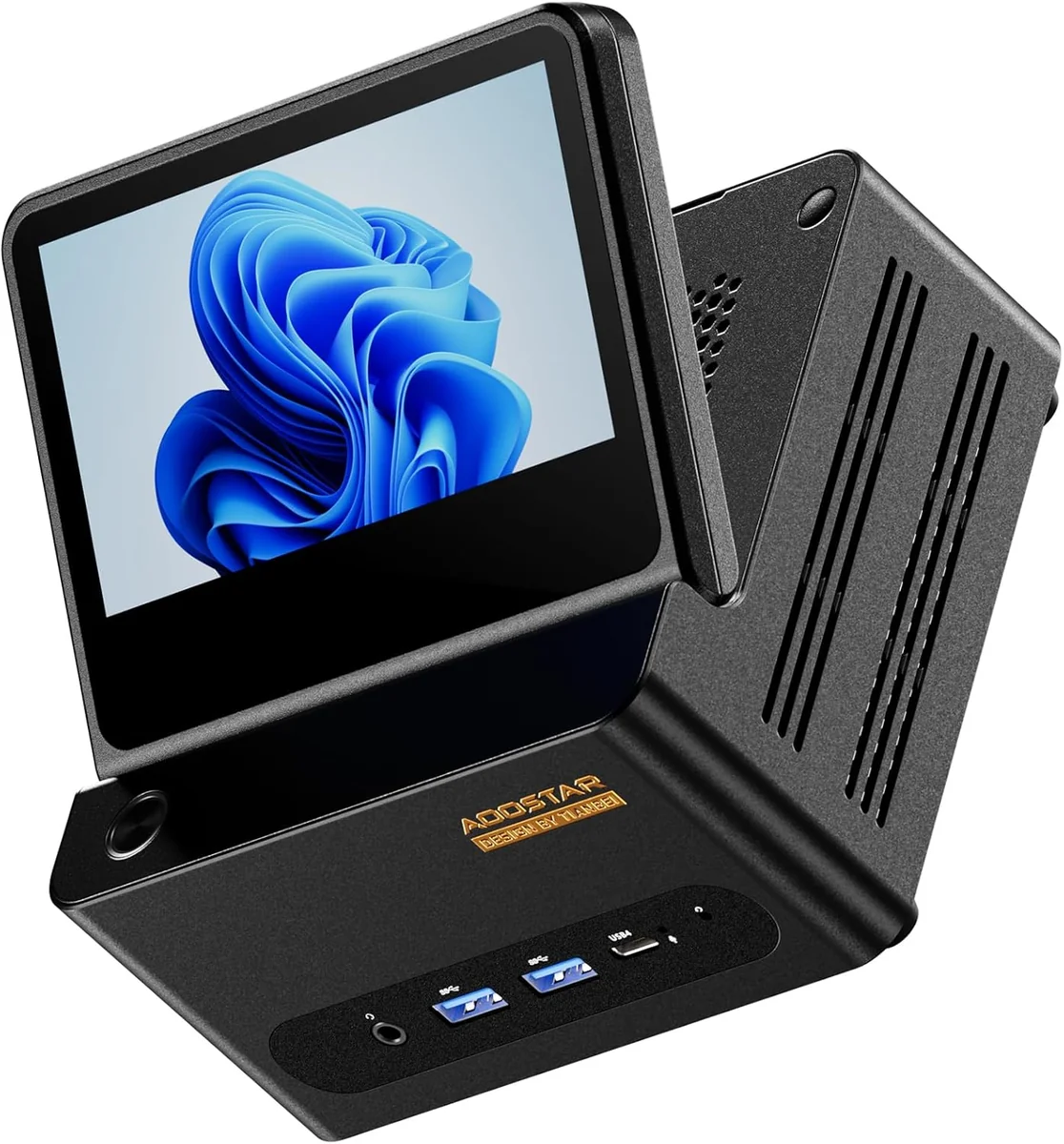
What it is
The AOOSTAR G-FLIP AI370 is a small-form-factor mini PC built around AMD’s Ryzen AI 9 HX 370, a 12-core, 24-thread Strix Point part combining four Zen 5 and eight Zen 5c cores, the Radeon 890M iGPU with 16 RDNA 3.5 compute units, and an XDNA 2 NPU rated at 50 TOPS. It’s the same silicon Microsoft and AMD have been positioning as the Copilot+ AI workhorse of 2025–2026.
What makes the G-FLIP unusual isn’t the chip (at this point a half-dozen vendors ship HX 370 mini PCs) but two specific design choices: it pairs OCuLink with an actual pair of DDR5 SODIMM slots, and it ships with a 5-inch flip-up secondary display hinged above the chassis. The SODIMM decision in particular is a real differentiator. Most HX 370 boxes (including AOOSTAR’s own GT37 and GEM10 370 siblings) use soldered LPDDR5X, which is faster in theory but capped at whatever the vendor solders in.
A note on naming: AOOSTAR’s HX 370 line includes the GEM10 370, the GT37, and the G-FLIP AI370. The unit described here (HX 370 + OCuLink + SODIMM expandable memory) is the G-FLIP AI370. If you’ve seen this device referenced under a different model name in a marketplace listing, that’s the same hardware.
What it’s good for
Home use and office work. With 12 cores and the option to populate it with up to 128 GB of DDR5, this is comfortably overspecced for any normal productivity workload. Twenty browser tabs, a couple of Teams or Zoom calls, an IDE running in the background: it disappears.
On-device AI. This is one of the few mini PCs where the 50-TOPS NPU and 128 GB RAM ceiling actually compound. Running 13B-class language models locally on CPU+iGPU is reasonable; with USB4 or OCuLink and a discrete GPU enclosure, you can step up to 30B+ class models without rebuilding the workstation. The XDNA 2 NPU handles Windows Studio Effects, Adobe Sensei’s local path, and the Copilot+ feature set out of the box.
Light to moderate gaming. The Radeon 890M is roughly in the RTX 3050 mobile performance band: 1080p Medium/High on most modern titles in the 50–70 fps range, esports titles well above 100 fps. If you want more, the OCuLink port is the cleanest path to an eGPU short of full-tower replacement.
Creator workflows. Photoshop, Lightroom, 1080p Premiere or Resolve editing: all comfortable. 4K editing is workable with proxies. The flip-up secondary display is genuinely useful here as a dedicated palette / timeline / monitoring window.
Build and connectivity
The G-FLIP’s signature design feature is its 5-inch 1920×1080 flip-up touchscreen, which hinges from flat against the chassis up to roughly 65 degrees. It’s not a gimmick: it gives you a small dedicated panel for system stats, a music player, a chat window, or whatever else you want off your main monitors. The screen runs over the internal display path, not a USB peripheral, so it appears to Windows as a normal third display.
Port layout is dense for the size:
- OCuLink (rear): the eGPU lane the HX 370 deserves
- USB4 (40 Gbps): DisplayPort Alt Mode, eGPU, or Thunderbolt-4-class docks
- USB-A 3.2 Gen 2 ×2 (front)
- USB-A 2.0 ×2 (rear)
- HDMI 2.1 + USB-C DisplayPort for external displays alongside the internal screen
- 2 × 2.5 GbE: meaningful for home-lab and pfSense/OPNsense use
- 3.5 mm combo audio
- Wi-Fi 7 and Bluetooth 5.4 via a MediaTek module
The chassis is metal with a perforated top section over the cooling stack. Cooling is a VC (vapor chamber) heatsink with twin blower fans, the kind of solution AOOSTAR has been iterating on across the GT37 / GEM10 / G-FLIP family.
Memory, storage, and upgrades
This is where the G-FLIP earns its place on a shortlist. Two SODIMM slots accept DDR5-5600 up to 128 GB total. Two M.2 2280 NVMe slots accept PCIe 4.0 SSDs up to 8 TB combined. Both are accessible from the bottom of the unit with the screws AOOSTAR ships in the package: no proprietary tools, no warranty-void stickers across the chassis seam in the units we’ve seen reviewed.
The trade-off versus soldered LPDDR5X-8000 (as on AOOSTAR’s GT37) is real: SODIMM DDR5-5600 has lower theoretical bandwidth, which costs a few percentage points on iGPU gaming workloads. For most other use cases (CPU-bound work, local LLM inference where you want the RAM ceiling, multi-VM home-lab setups), the upgradeable capacity is a far bigger deal than the bandwidth delta.
Pricing and where to buy
The barebone configuration (no RAM, no SSD, no OS) sells for $629 on AOOSTAR’s official store and in the same range on Amazon US under ASIN B0FQMSXW5N. Pre-configured units with 32 GB RAM + 1 TB NVMe + Windows 11 typically land in the $800–$899 band depending on stock and promotion.
For comparison: AOOSTAR’s GT37 (the same HX 370 silicon, soldered LPDDR5X-8000, no flip display) retails around $829–$879 fully configured. Minisforum’s EliteMini AI370 is in a similar price tier with similar specs but without the SODIMM expandability or the flip-up display.
Amazon US is the most practical default for buyers in the US: same warranty, normal return window, and AOOSTAR is the seller of record on their listings.
What we’d flag
This is a positive review, but a fair one. The unit itself is well-built; the items below are honest trade-offs and brand-level context worth knowing before you commit.
- AOOSTAR is a smaller brand than Beelink or Geekom. Their support and RMA track record is shorter and less battle-tested at scale. Owner reports we surveyed are mostly positive, but the sample size is meaningfully smaller than for the established mid-tier brands. If you need a name with a long warranty paper trail and a US-based support presence, that’s a real factor, though notably better than the Minisforum brand-history pattern (BIOS bricks, VRM fires, support unresponsiveness) we’ve documented elsewhere on this site.
- SODIMM DDR5-5600 trails LPDDR5X-8000 on memory bandwidth by roughly 30%, which costs a few percent on iGPU gaming benchmarks. If pure 1080p-Medium frame rate is your primary metric and you don’t care about RAM upgradability, the GT37 is the better-tuned variant of essentially the same machine.
- Barebone-by-default. Most listings ship without RAM, SSD, or OS. Budget for the parts you need (a 32 GB DDR5-5600 SODIMM kit + a 1 TB PCIe 4.0 NVMe puts you well under a configured competitor). Reviewers who didn’t read the listing carefully have been surprised by this.
- Fan noise under sustained load. The dual-blower cooler is audible at 100% CPU. Not loud, but present: comparable to a quiet gaming laptop. Idle and light load are essentially silent.
AOOSTAR G-FLIP AI370 verdict
The AOOSTAR G-FLIP AI370 is a strong value option in the HX 370 mini-PC class, if you understand the trade-off. You’re getting a genuinely well-built unit with a feature combination (OCuLink + SODIMM-expandable DDR5 + a useful secondary display + Wi-Fi 7 + dual 2.5 GbE) that none of the bigger brands currently match at this price. The compromise is a brand with a shorter support history than Beelink or Geekom, and a memory subsystem that’s a few percent slower for iGPU gaming than soldered LPDDR5X alternatives.
For a home or small-office workstation, a local-AI sandbox, a creator’s second machine, or a flexible base for OCuLink-driven gaming, this is one of the most interesting mini PCs of the generation. Pair it with 64 GB of DDR5-5600 and a 2 TB PCIe 4.0 SSD and you have a machine that should age well past the typical two-year mini-PC obsolescence window, precisely because the parts that matter most are user-replaceable.
Recommended for buyers who want the spec sheet and are comfortable with a smaller brand. If brand pedigree is non-negotiable, the Geekom A8 Max (Ryzen 9 8945HS, three-year warranty) is the safer adjacent pick at a similar price point.