
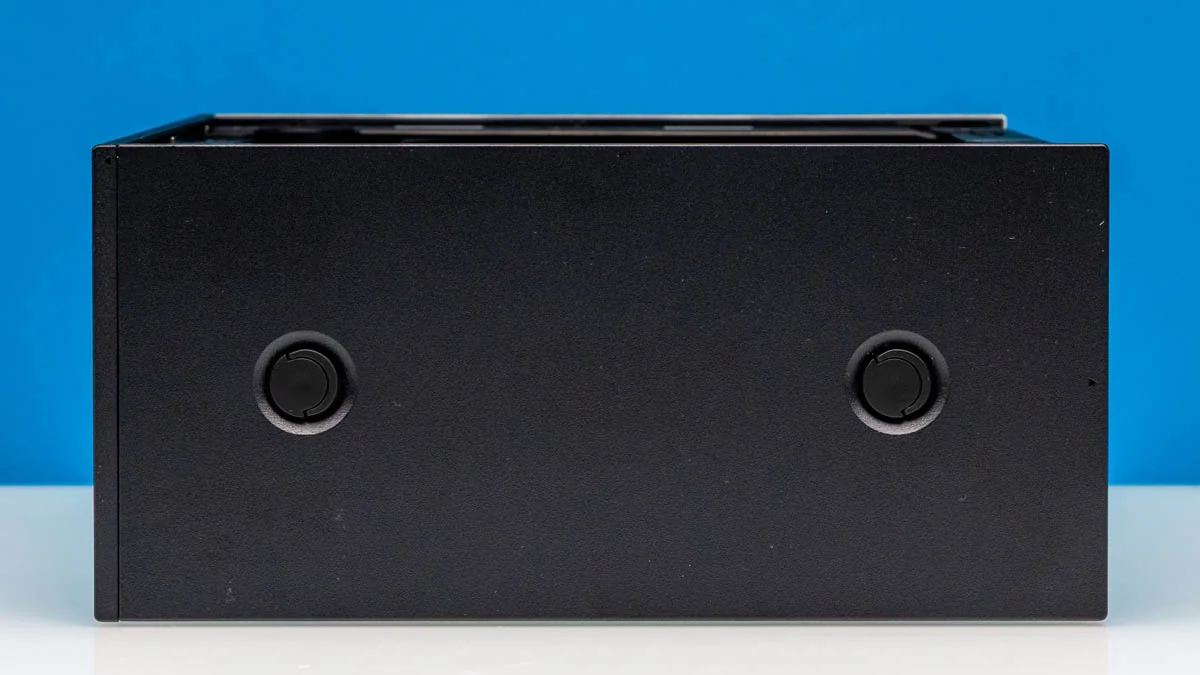
What the Framework Desktop is
The Framework Desktop is a 4.5-liter mini-ITX system built around AMD’s Strix Halo APU, sold as the Ryzen AI Max+ 395 in its top configuration, with the Radeon 8060S integrated GPU and up to 128 GB of unified LPDDR5x-8000 memory. It is Framework’s first desktop product, and it ships in two forms: a barebones DIY kit and a fully configured pre-built.
What sets it apart from the dozen other Strix Halo mini PCs on the market in 2026 is the motherboard. It’s a standard mini-ITX board (160 × 160 mm, with ATX power headers, a PCIe x4 slot, and a Flex ATX PSU) that Framework sells separately so you can drop it into any mini-ITX case you like. The chassis Framework ships is just one option. The board is the product.
That decision is the whole hook. The memory is soldered (it has to be, for Strix Halo’s 256-bit LPDDR5x bus), but everything Framework can keep modular, they kept modular: the PSU is a standard FSP Flex ATX unit, the Wi-Fi card is a swappable M.2 module, the SSDs are off-the-shelf NVMe, and the front I/O uses Framework’s Expansion Card system inherited from the laptop line.
What it’s good for
On-device AI. This is the headline use case. The Ryzen AI Max+ 395 has 16 Zen 5 cores, a 40-CU Radeon 8060S, and, critically, 128 GB of unified memory shared between CPU and GPU. AMD’s Adrenalin driver lets you allocate up to 96 GB of that to VRAM, which means you can run 70B-class quantized language models entirely on a single integrated GPU at a price point well below a discrete H100 or even a single RTX 5090. For local LLM inference, image generation, and small-team AI experimentation, the Framework Desktop is one of the best dollar-per-VRAM machines you can buy in 2026.
Linux homelab and DIY builds. Because the motherboard is standard mini-ITX with the right headers, it slots cleanly into custom builds, NAS chassis, and any of the SFF cases that already populate the homelab ecosystem. The Wi-Fi 7 module uses an AMD RZ717 that has good Linux support, and Framework has been clear from launch that they expect a meaningful share of these units to run Linux or Bazzite-style immutable distros.
Creator workflows that benefit from a big iGPU. DaVinci Resolve, Blender’s Cycles HIP backend, and Adobe Premiere all benefit from the Radeon 8060S in this class of work. It is not an RTX 5080, but for 4K timeline editing and the GPU-accelerated stages of compositing it punches well above the typical integrated graphics line.
Home use, with one caveat. It is a perfectly competent home machine: silent at idle, capable at 1080p gaming, with enough headroom for any productivity workload. The caveat is price: at $1,599 for the mid-tier and roughly $2,500 fully built, it is not a casual home-PC purchase.
Build and connectivity
The chassis is co-designed with Cooler Master (heatsink) and Noctua (fan), and reviewer noise measurements have come back consistently low even under sustained load. The 400 W Flex ATX PSU is semi-custom (FSP), 80 Plus Gold on 110 V and Silver on 230 V, and is, unusually for this segment, actually replaceable with a standard part if it fails.
Rear I/O, on the chassis Framework ships:
- 2× USB4 (40 Gbps)
- 2× DisplayPort 2.1, 1× HDMI 2.1
- 2× USB-A 10 Gbps
- 1× 5 GbE Ethernet
- 3.5 mm headphone jack
The front panel uses the Framework Expansion Card system (the same modular USB-C dongles used on the Framework Laptop 13 and 16), letting you pick two ports from a catalog of USB-A, USB-C, HDMI, DisplayPort, microSD, and Ethernet modules. It’s gimmicky on a desktop the same way RGB is gimmicky on a desktop, which is to say: some buyers will love it.
Wi-Fi 7 and Bluetooth 5.4 come via the user-replaceable RZ717 M.2 module.
Memory, storage, and upgrades
Memory is soldered LPDDR5x running at 8000 MT/s across a 256-bit bus. You pick your capacity at order time (32 GB, 64 GB, or 128 GB) and you live with it. This is the same constraint every Strix Halo product faces; the memory controller demands it. Framework has been transparent about this from the launch announcement, and to their credit they ship the board separately so that if a future Strix Halo refresh adds CAMM2 support, you can swap the board without replacing the case.
Storage is genuinely upgradable. Two M.2 2280 NVMe slots, both PCIe 4.0, support up to 16 TB combined. The board also exposes a PCIe x4 slot, which on a 4.5 L mini-ITX chassis is a real differentiator: you can drop in a 10 GbE NIC, a Coral TPU, or an additional NVMe carrier.
Pricing and where to buy
Framework sells the desktop direct from frame.work. DIY barebones starts at $1,099 for the Ryzen AI Max 385 with 32 GB; the Ryzen AI Max+ 395 with 64 GB runs $1,599; and the 128 GB Max+ 395 configuration is $1,999. A typical fully built unit with storage, OS, and the translucent side panel lands near $2,500.
You will not find this on Amazon. Framework’s distribution is direct-only, and that is part of the trade-off. There is no Prime shipping, no 30-day Amazon-return path, and lead times have run multi-week as batches sell out. TechRadar reported the Desktop selling out seven times in its first two months. Framework’s own return and warranty terms apply; they are reasonable, but they are not Amazon’s.
What we’d flag
This is a positive review, but the unit is not the right fit for every buyer.
- Soldered memory. Every Strix Halo product has this constraint, but it’s worth saying plainly: you cannot upgrade the RAM later. Buy the 128 GB tier if you might ever want it for AI work; you can’t bolt it on in two years.
- No Amazon channel. Direct-only sales mean longer lead times (often weeks), no Prime shipping, and no third-party seller arbitrage. For office buyers used to next-day delivery and easy returns, this is a real friction point.
- USB4 + mDP flakiness on some units. ServeTheHome’s review documented intermittent issues driving two monitors with one HDMI plus one DisplayPort connection. Framework has acknowledged the report and is iterating on firmware; verify your display setup early in the return window.
- Windows-first buyers see less of the value. Most of what makes this machine special (the modular board, the swappable Wi-Fi, the Linux-friendly choices, the 96 GB-of-VRAM trick) is software-side and skews heavily toward Linux, homelab, and AI workloads. A Windows office buyer is paying a premium for ideology they will never use.
- Price. At $1,599–$2,500, this is not a budget machine. The same Strix Halo chip ships in the GMKtec EVO-X2 and the HP Z2 Mini G1a at different price points and trade-offs.
Verdict
The Framework Desktop is the right buy for tinkerers, Linux users, homelabbers, and on-device AI builders. The modular mini-ITX board, the standard Flex ATX PSU, the swappable Wi-Fi card, the PCIe x4 slot, the two M.2 bays, and the 128 GB of unified memory together describe a machine that takes Strix Halo’s strengths seriously and refuses to compromise the ones it can keep.
It is the wrong buy for a Windows-first office shopper who expects Amazon Prime delivery, easy returns, and a system they can pull out of the box and forget about. That buyer should look at the Beelink GTR9 Pro, the HP Z2 Mini G1a, or, if the workload is lighter, a Ryzen 8945HS-class mini PC at a third the price.
For the buyer who reads the spec sheet and notices that the motherboard is sold separately, the Framework Desktop is one of the most genuinely interesting small computers of this generation. It is also one of the few that lives up to its own marketing.