
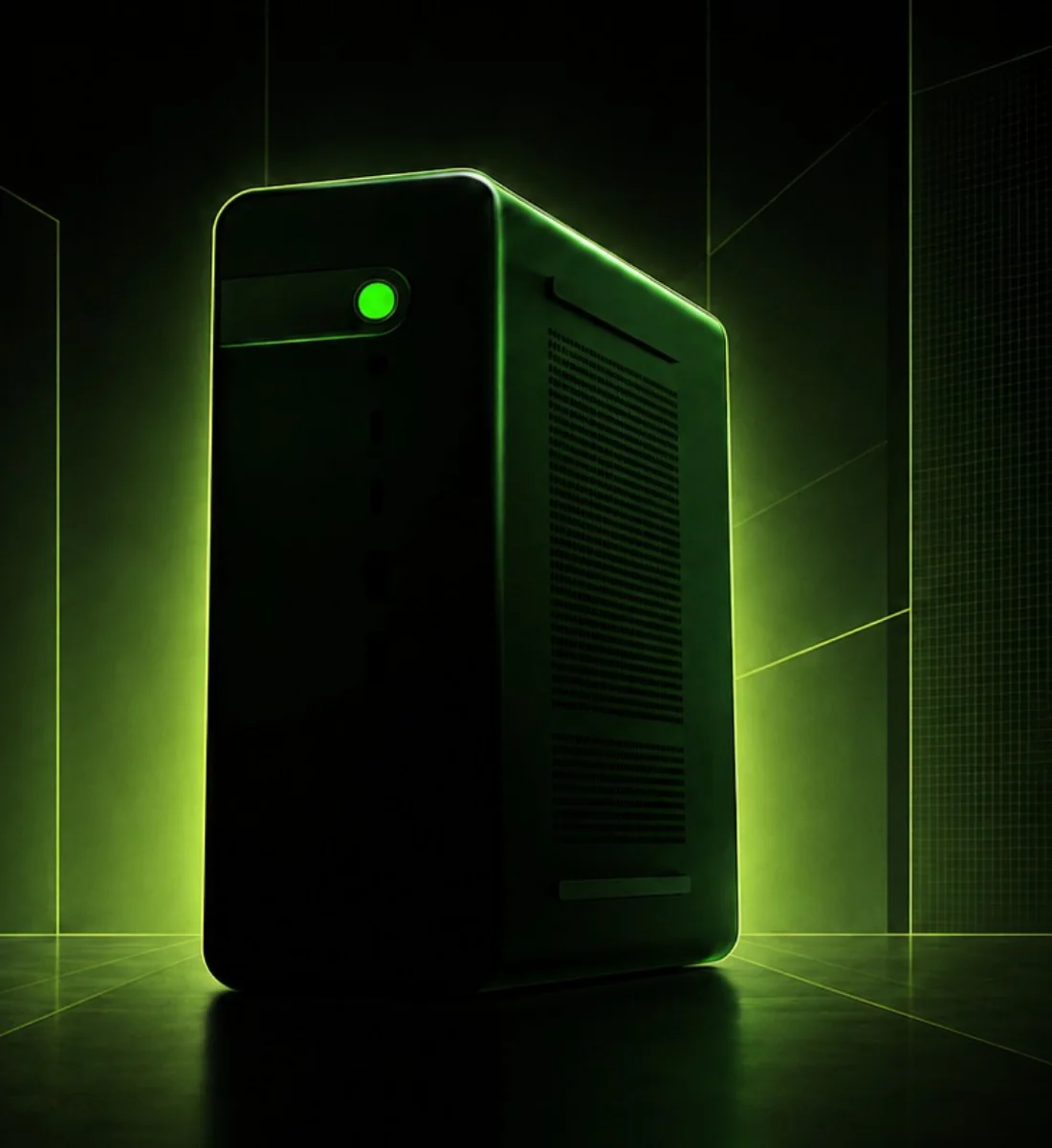
The GMKtec EVO-X5 Pro is GMKtec’s first Ryzen AI Max+ PRO 495 mini PC, unveiled on stage with AMD at IFA 2026 in Berlin on September 5. It is the “Gorgon Halo” follow-up to the GMKtec EVO-X3: the same 16 Zen 5 cores and 40-CU Radeon graphics, but with up to 192GB of LPDDR5X-8533 unified memory, up to 160GB of it usable as VRAM, and a headline claim that it runs a 300-billion-parameter LLM entirely offline. Launch is slated for October 2026. There is no price yet.
This is a launch report, not a review. We have not touched a unit, and GMKtec has not published a full spec sheet.
What is the GMKtec EVO-X5 Pro?
GMKtec calls it an “Agentic PC” and a “desktop AI supercomputer”, marketing shorthand for a compact workstation that holds very large language models in unified memory instead of on a discrete GPU. The chassis is a CNC-machined all-metal tower with a front smart function key, cooled by a vapor chamber and three fans with three selectable power profiles. GMKtec says the platform is validated for 24/7 operation, and the unit took two “Best of IFA 2026” innovation awards (PCWELT and SmartZone).
A note on the name. In June, VideoCardz and Liliputing reported that the PRO 495 with 192GB would arrive as a variant of the EVO-X3. What actually reached IFA is branded EVO-X5 Pro, in a redesigned vertical chassis; the “EVO-X3 PRO 495” never shipped under that name. A plain “EVO-X5” with 128GB also surfaced in a Geekbench entry on August 15, and GMKtec has only formally announced the Pro so far.
What’s confirmed: EVO-X5 Pro specs and architecture
From GMKtec’s IFA announcement, cross-checked against NotebookCheck, Gizmochina and VideoCardz:
- CPU: AMD Ryzen AI Max+ PRO 495, 16 Zen 5 cores / 32 threads, up to 5.2GHz
- GPU: Radeon 8065S, RDNA 3.5, 40 compute units, hardware ray tracing
- NPU: XDNA 2, up to 55 TOPS (131 TOPS for the whole chip, per AMD)
- Memory: up to 192GB LPDDR5X-8533 unified, roughly 273GB/s
- VRAM: up to 160GB of the pool allocatable to the iGPU
- Storage: up to 24TB (slot count and PCIe generation not published)
- Ports: two front USB4, two rear USB4 V2, 8K display output, dedicated RJ45 for AMD DASH
- Expansion: eGPU over USB4, plus linking multiple units into a cluster (NotebookCheck reports up to four)
- Security and management: discrete dTPM 2.0, AMD DASH out-of-band management (remote power, KVM, BIOS configuration, re-imaging, disk erase)
- Launch: October 2026 per Gizmochina; no price announced
DASH and dTPM are the tell for who this is aimed at. GMKtec’s launch copy names government, healthcare, finance and legal buyers, meaning IT departments that need models on-premises and a way to manage a fleet of boxes with no OS running.
What’s improved over the Ryzen AI Max+ 395 version
The EVO-X3 (and the EVO-X2 before it) used the Ryzen AI Max+ 395 “Strix Halo”. The PRO 495 is a refresh of that silicon, not a new architecture, so the honest framing is “more memory, slightly higher clocks, enterprise features”, not a generational leap.
| EVO-X3 (Ryzen AI Max+ 395) | EVO-X5 Pro (Ryzen AI Max+ PRO 495) | |
|---|---|---|
| CPU | 16C/32T Zen 5, up to 5.1GHz | 16C/32T Zen 5, up to 5.2GHz |
| iGPU | Radeon 8060S, 40 CU, up to 2.9GHz | Radeon 8065S, 40 CU, up to 3.0GHz |
| NPU | XDNA 2, ~50 TOPS (126 TOPS total) | XDNA 2, 55 TOPS (131 TOPS total) |
| Max memory | 128GB LPDDR5X-8000 | 192GB LPDDR5X-8533 |
| Memory bandwidth | ~256GB/s | ~273GB/s |
| Max VRAM allocation | 96GB | 160GB |
| Largest model claim | 200B+ class, quantized | 300B class at INT4 |
| eGPU path | OCuLink (PCIe 4.0 x4) + USB4 | USB4 / USB4 V2, OCuLink not mentioned |
| Remote management | None | AMD DASH + dTPM 2.0 |
| Chassis | Flat console-style, 140W performance mode | Vertical tower, vapor chamber, power limits not disclosed |
Three rows matter. The rest are footnotes.
192GB and 160GB of VRAM is the real upgrade. The 395 caps at 128GB, and Windows lets you hand about 96GB of that to the GPU. Adding 64GB to both numbers is what moves the ceiling from “roughly 200B quantized” to “300B at INT4”: a 300B-parameter model at 4-bit is about 150GB of weights before KV cache, which is why GMKtec keeps repeating 160GB.
Bandwidth barely moved. LPDDR5X-8533 on the same 256-bit bus is a 6.7% gain over LPDDR5X-8000, and bandwidth is what decides tokens per second on a dense model. It is also nearly identical to the ~273GB/s of the NVIDIA DGX Spark. Bigger models fit; they do not get faster.
USB4 V2 replaces OCuLink, at least in the announcement. The EVO-X3’s OCuLink port was its best feature for anyone adding a discrete GPU for prompt processing. GMKtec’s EVO-X5 Pro materials list only USB4 and USB4 V2 for eGPU and clustering. USB4 V2 is faster on paper, but enclosures for it are scarce today while OCuLink docks are cheap and plentiful. We will not call OCuLink removed until a spec sheet says so.
Can the GMKtec EVO-X5 Pro really run a 300B model locally?
Fit, yes. Usefully, it depends on the model. Loading 150GB of INT4 weights is a capacity question and 160GB answers it. Generating tokens is a bandwidth question, and 273GB/s puts a dense 300B model at low single-digit tokens per second: a demo, not a workflow. NotebookCheck saw a Qwen-family model at the booth producing “well into double-digit” tokens per second, a pace consistent with a mixture-of-experts model where only a fraction of the parameters fire per token. Read the claim as “300B-class MoE models run interactively, dense 300B models load”, and wait for published llama.cpp numbers before planning a purchase around it.
What’s still unknown
- Price. Nothing from GMKtec. The EVO-X3 launched at $3,600 for 128GB/2TB, and 192GB of LPDDR5X-8533 costs more. Minisforum teased its own PRO 495 workstation above 7,000 euros, which marks the upper bracket.
- Exact launch date and regions. “October 2026” from Gizmochina is the only timing on record.
- Power limits. AMD rates the PRO 495 at 45W to 120W configurable. The EVO-X3 ran the 395 at 140W in Performance mode; GMKtec has not said what the three EVO-X5 Pro profiles are.
- Storage layout. “Up to 24TB” suggests three M.2 slots, but count and PCIe generation are unpublished.
- Networking. NotebookCheck saw two RJ45 ports, one of them 10GbE. GMKtec confirms only the DASH port. Wi-Fi 7 is likely, unconfirmed.
- OCuLink, lower-memory SKUs, dimensions, weight, noise. None published.
What it means for mini PC buyers
The EVO-X5 Pro is the first of a wave. Chuwi, Acemagic, Colorfire, AOOSTAR and Minisforum have all shown Ryzen AI Max+ PRO 495 boxes with 192GB, and we covered the platform shift in our AMD Ryzen AI Max 400 “Gorgon Halo” explainer. What sets GMKtec’s entry apart is the enterprise layer: out-of-band management and a discrete TPM are things consumer mini PCs never bothered with, and they signal that GMKtec wants this box on procurement lists, not just on Reddit.
If you already own a 128GB Strix Halo machine, stay put. The 495 adds capacity, not speed, and the models that need 160GB of VRAM are the ones that were already slow on 96GB. If you are buying a first local-AI box, the EVO-X5 Pro versus EVO-X3 decision comes down to whether you need models above roughly 200B parameters. If not, the 395 machines are on sale now and about to get cheaper. Related: GMKtec EVO-X5 Pro price and whether the Ryzen AI Max+ PRO 495 is worth buying.
Is the EVO-X5 Pro replacing the EVO-X3?
Not officially. GMKtec still lists the EVO-X3 and has not called it discontinued. Expect the two to coexist as the 128GB and 192GB tiers, the way the EVO-X2 stayed on sale after the EVO-X3 launched.
Expected timeline and price outlook
GMKtec is pointing at October 2026 for availability. There is no price announced and nothing to pre-order on gmktec.com as of this writing. Given the EVO-X3’s $3,600 start on 128GB and the memory jump, a launch figure north of $4,000 for the 192GB configuration would not surprise us; that is our read of the market, not a leak.
We will review the EVO-X5 Pro when we can get one. Until then, our EVO-X3 launch coverage and EVO-X2 review cover the same lineage and the same bandwidth trade-offs on the 395.
Sources and caveats
Specs come from GMKtec’s official IFA 2026 announcement and post-show recap, cross-checked with NotebookCheck’s on-site report, Gizmochina, Gizchina and VideoCardz. The 395-vs-495 chip figures (5.1 vs 5.2GHz, 2.9 vs 3.0GHz iGPU, 50 vs 55 TOPS, LPDDR5X-8000 vs 8533) are AMD’s published specifications as relayed by VideoCardz and Liliputing. One conflict: NotebookCheck’s CPU database lists the PRO 495 at LPDDR5X-8000, while AMD, GMKtec and every launch partner say 8533; we have gone with 8533 and the 273GB/s that follows from it. EVO-X3 figures are the ones we published in July from GMKtec’s product page. Performance, thermals, noise and price are unverified until units ship.