
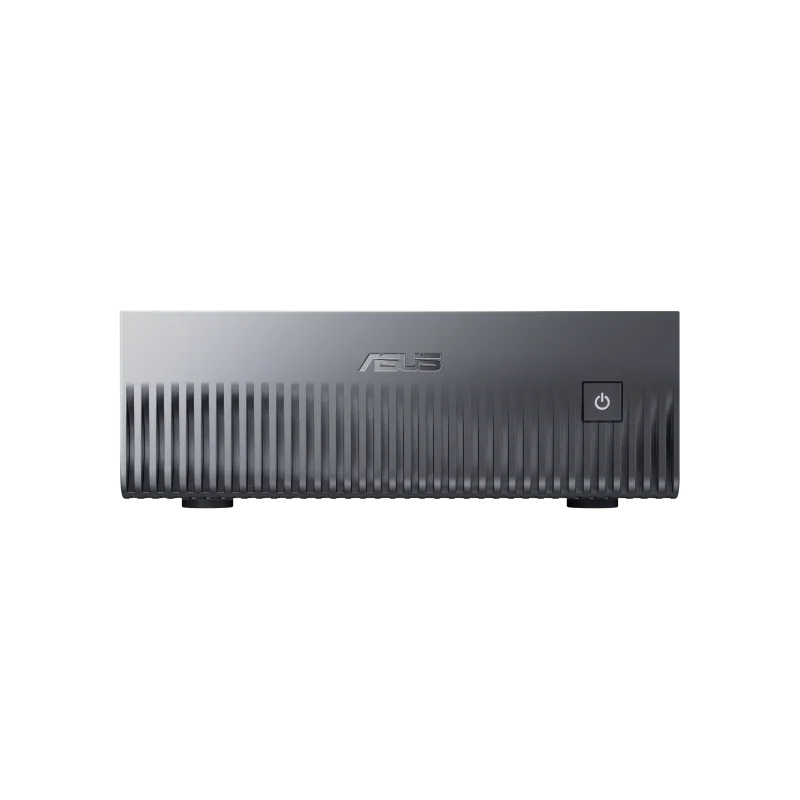
What it is
The ASUS Ascent GX10 is a personal AI supercomputer built around NVIDIA’s GB10 Grace Blackwell superchip, the same silicon that powers NVIDIA’s reference DGX Spark. It pairs a 20-core Arm v9.2 Grace CPU with a Blackwell GPU on a single package, joined by NVLink-C2C, and feeds both from a shared 128 GB pool of LPDDR5x unified memory. In a chassis the size of a hardback book (150 × 150 × 51 mm), ASUS has packed roughly 1 PetaFLOP of FP4 compute and enough memory to load a 200-billion-parameter model locally.
This is not a general-purpose mini PC, and it shouldn’t be shopped like one. It runs NVIDIA DGX OS (an Arm build of Ubuntu Linux), not Windows. Its reason for existing is local AI: fine-tuning, inference, and prototyping models that would otherwise need a cloud GPU instance. What makes the GX10 worth a closer look is price. At $2,999 for the 1 TB configuration, it’s the most aggressively priced entry point into the GB10 class to date, undercutting the reference DGX Spark while adding a metal chassis and better cooling.
What it’s good for: local AI and LLM development
The GX10’s headline trick is fitting large models into a single coherent memory space. With 128 GB of unified LPDDR5x, the CPU and GPU share one pool, so you can load models that would never fit in a consumer GPU’s VRAM:
- Local LLM inference: run quantized models up to ~200B parameters without touching the cloud. In StorageReview’s vLLM testing, GPT-OSS-120B served at roughly 45–680 tokens/sec depending on workload shape, and Llama 3.1 8B FP4 hit up to ~2,750 tokens/sec on prefill-heavy runs.
- Fine-tuning and LoRA work: the 128 GB pool gives you headroom to fine-tune mid-size models that won’t fit on a 24 GB or even 32 GB discrete card.
- AI development environment: DGX OS ships with CUDA, PyTorch, TensorFlow, Jupyter, TensorRT, NVIDIA NIM microservices, and Ollama preloaded. For a developer who wants a CUDA box that lives under the desk instead of on a cloud bill, that out-of-box stack is the real selling point.
- Two-node clustering: the onboard ConnectX-7 NIC lets you cable two GX10 units together over a single 200 Gbps QSFP link and run models up to 405B parameters (Llama 3.1 405B) across the pair.
If your interest is general creator work or office tasks, the GX10 can do it, but you’d be paying supercomputer money to run an Arm Linux desktop. For that audience, an x86 box like the Framework Desktop or a Strix Halo machine running 70B models makes far more sense.
The GB10 superchip and unified memory
The GB10 is the heart of the story. The 20-core Grace CPU handles orchestration and data prep; the Blackwell GPU with fifth-generation Tensor Cores and native FP4 does the heavy lifting at up to 1,000 TOPS. Because the two are joined by NVLink-C2C (NVIDIA quotes roughly five times the bandwidth of PCIe 5.0 between them), there’s no PCIe bottleneck shuttling tensors between CPU and GPU memory. It’s all one coherent address space.
This architecture is why a box this small can claim to run 200B-parameter models when a desktop RTX 5090, with its 32 GB of GDDR7, simply cannot hold them. The trade-off is bandwidth, which we’ll get to below.
Build, connectivity, and clustering
ASUS clearly studied the reference design and improved on it. The GX10 uses an aluminum chassis rather than the DGX Spark’s plastic, adds venting on the bottom and rear, and moves the power button to the front, a small thing until you’re managing a stack of clustered units. Cooling is handled by three fans and a dual vapor chamber with seven-level control, and the unit passed multiple MIL-STD 810H tests. It even picked up a 2026 Taiwan Excellence Award for the design.
Connectivity is geared toward an AI workstation, not a media PC:
- NVIDIA ConnectX-7 NIC: dual 200 Gbps QSFP ports for scale-out clustering, plus 10 GbE LAN
- 4× USB-C (20 Gbps, DisplayPort 2.1 alt mode); one doubles as 180W EPR power-delivery input
- HDMI 2.1b, Wi-Fi 7, Bluetooth 5.4, Kensington lock slot
- 240W USB-C power supply
Memory bandwidth: the real-world ceiling
Here’s the honest part. The GX10’s memory bandwidth measures around 273 GB/s (LPDDR5x at 8533 MT/s). That is enormous compared to a CPU, but it is a fraction of what a discrete GPU delivers: an RTX 5090 pushes well over 1.7 TB/s. For LLM token generation, which is memory-bandwidth-bound, that ceiling is the limiter, not the Blackwell GPU’s compute.
What that means in practice: the GX10 is exceptional at holding a huge model and at prefill/throughput-heavy serving, but interactive single-stream token generation on large models will feel modest next to a high-end discrete GPU running a model small enough to fit its VRAM. The GX10 wins when the model is too big to fit anywhere else; it does not win a tokens-per-second race against a 5090 on a model that fits in 32 GB. StorageReview found the GX10 tracked closely with every other Spark-class system, since they all share identical core silicon; differences between vendors come down to chassis, cooling, SSD, and price, not raw speed.
ASUS Ascent GX10 vs NVIDIA DGX Spark
They run the same GB10 superchip, the same 128 GB unified memory, and the same 273 GB/s bandwidth, so AI performance is effectively identical. The GX10’s case for itself is everything around the chip: a metal chassis, a more elaborate three-fan/vapor-chamber cooler, front-mounted power, and, most importantly, a lower entry price. If you’re choosing between Spark-class boxes, you’re choosing on build quality, storage tier, and cost. Related: our reviews of the MSI EdgeXpert MS-C931 and the GIGABYTE AI TOP ATOM.
Pricing and where to buy
The Ascent GX10 sells in three tiers, separated by storage:
- $2,999: 1 TB PCIe Gen4 NVMe (the value pick, ~$333/TB at the entry)
- $3,499: 2 TB PCIe Gen4 NVMe
- $3,999: 4 TB PCIe Gen5 NVMe
All three carry the same GB10 superchip and 128 GB of memory; you’re only paying for SSD capacity and, at the top tier, a faster Gen5 drive. For most buyers the 1 TB model at $2,999 is the smart entry: it’s the cheapest way into the GB10 ecosystem, and models stream from storage fast enough that the Gen4 drive rarely bottlenecks inference. The 4 TB Gen5 tier makes sense only if you’re juggling many large model checkpoints locally.
What we’d flag
This is a strong product for its niche, but it earns a few honest caveats:
- It’s a Linux developer appliance, not a desktop. DGX OS is Arm Ubuntu. If you expect a Windows machine, this isn’t it.
- 273 GB/s is the bottleneck. Token generation on large models is bandwidth-limited; don’t expect discrete-GPU interactivity. Buy it for capacity, not raw speed.
- The 1 TB model ships a Gen4 SSD with relatively slow write speeds. That’s fine for inference, less ideal if you’re constantly writing large checkpoints.
- Thermals run warm in bursts. StorageReview saw the CPU peak at 87.3°C and the GPU at 82°C during prefill-heavy spikes, though it stabilized under sustained load. The three-fan cooler handles it, but this is a hot little box under stress.
- It’s a single-purpose investment. At $3,000+, this only makes sense if local AI is genuinely your workload. If you’re curious about local LLMs more casually, a Strix Halo mini PC, a Mac mini M4 Pro, or even the NPU/iGPU options we’ve profiled are far cheaper starting points.
ASUS Ascent GX10 verdict
The ASUS Ascent GX10 is the most sensible way to buy into NVIDIA’s GB10 Grace Blackwell platform right now. It runs the same silicon as the DGX Spark, fits 128 GB of unified memory and a full CUDA developer stack into a book-sized aluminum box, and clusters to a second unit for 405B-parameter work, all starting at $2,999, the lowest entry price in its class.
Just buy it for the right reason. Its value is the ability to hold and develop against very large models locally, with a turnkey NVIDIA software stack and clustering built in. It is not a speed demon for interactive generation (the 273 GB/s memory bandwidth sees to that), and it is not a general-purpose PC. But if you’re an AI developer, researcher, or creator who wants a personal Grace Blackwell workstation without renting cloud GPUs, the GX10 is the GB10 box to put at the top of the list.