
For most of the last decade, building a local AI workstation meant accepting one of two trade-offs. You bought a mid-tower with an RTX 4090 (a card that alone costs more than $1,600) and then surrounded it with a motherboard, PSU and chassis that pushed the build past $2,500 before the first watt of compute was used. Or you bought a 192 GB Mac Studio for $5,599 and accepted that anything outside the Apple toolchain would be a porting exercise. Mini PCs, the third category, were excluded from the conversation entirely. They had iGPUs, the iGPUs had no usable VRAM, and that was the end of the discussion.
In 2025 and 2026, two products quietly broke that ceiling, from opposite ends. ASUS put a real RTX 4070 mobile GPU inside a 2.5-liter chassis. Beelink let buyers bolt a desktop RTX 4070 onto a mini PC through an external PCIe x8 dock. Both ship today, both run the same local AI software stack, and both deserve to be evaluated on what they enable rather than what they replace.
ASUS ROG NUC 14 Performance: a real dGPU inside a 2.5-liter box
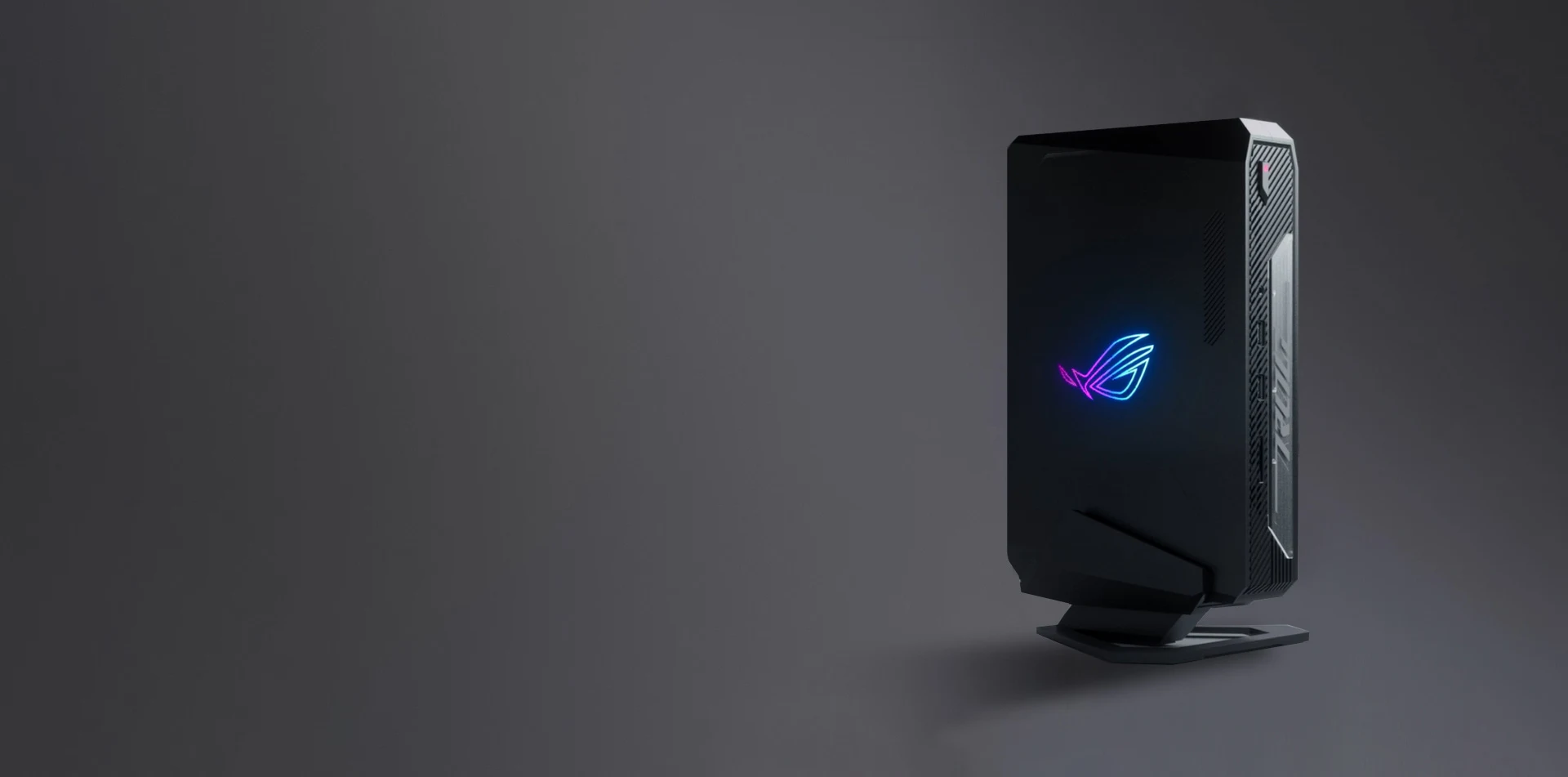
The ROG NUC 14 Performance is the more conservative engineering bet, and the more astonishing one to actually pick up. According to ServeTheHome’s review, the top configuration ships with an Intel Core Ultra 9 185H, 32 GB of DDR5-5600, a 1 TB NVMe SSD and an “NVIDIA GeForce RTX 4070 8GB notebook GPU built-in.” The chassis is 2.5 liters: bigger than a classic NUC, smaller than almost anything else with a discrete GPU.
NotebookCheck’s measurements confirm the GPU runs at the full mobile TGP envelope: “The NVIDIA GeForce RTX 4070 laptop GPU comes with 8 Gbytes of GDDR6 VRAM and a TDP of 140 watts.” That 140 W figure matters. It is the top of the 4070 mobile spec, not a throttled variant, and it is what separates the ROG NUC from the long history of mini PCs that nominally had a “discrete GPU” but actually shipped a 35-W version of one.
Pricing per Tom’s Hardware is $1,629 for the entry RTX 4060 SKU and $2,199 for the Ultra 9 / RTX 4070 / 32 GB / 1 TB configuration. That is roughly the price of a similarly-specced gaming laptop, with the screen and battery removed and the cooling headroom restored.
The catch sits in one number: 8 GB of VRAM. The mobile RTX 4070 carries less memory than its desktop sibling, which means that for local LLM work, the ROG NUC is comfortable up to roughly the 8 B parameter range at Q4_K_M quantization, with smaller context windows. APXML’s RTX 40-series LLM guide notes that 13 B-class models can be run with partial CPU offload via llama.cpp, but throughput drops sharply once layers spill out of VRAM. For Stable Diffusion XL, ComfyUI and Whisper, 8 GB is workable but tight; SDXL at 1024×1024 with refiner stages will swap.
Beelink GTi14 Ultra + EX dock: the desktop GPU side door
The Beelink approach is louder, larger and more flexible. The GTi14 Ultra base unit (same Core Ultra 9 185H silicon, but no internal dGPU) sits at roughly $999 in the standalone configuration. The interesting part is the EX Pro docking station: a separate enclosure with a built-in 600 W PSU, a PCIe x16 mechanical slot wired electrically as PCIe 4.0 x8, and a proprietary connector that mates to the bottom of the GTi14.
PC Gamer’s review of the earlier GTi 12 + EX combination tested it with a desktop RTX 4070 Ti and concluded the “eight-lane PCIe 4.0 interface grants ample data-bandwidth for the RTX 4070 Ti to work at full tilt,” with near-parity to a full PCIe x16 desktop machine and only a “few frames per second” gap. NotebookCheck reached similar conclusions on the GTi12 generation, and the GTi14 Ultra inherits the same dock socket.
For a buyer who already owns or plans to buy a desktop RTX 4070, this changes the math. A retail desktop RTX 4070 (12 GB of GDDR6X, full 200+ W TGP, 504 GB/s memory bandwidth) slotted into the EX dock gives the mini PC a GPU with 50 % more VRAM than the ROG NUC’s mobile part and meaningfully higher sustained power. For SDXL at 1024×1024, for 13 B LLMs at Q5 with comfortable context, and for small fine-tuning runs (LoRA / QLoRA at 7 B), 12 GB is the cliff edge that 8 GB sits below.
The trade-off is physical. The EX dock is its own box. Together with the GTi14 Ultra it is no longer a “mini PC” in the desk-real-estate sense; it is a two-chassis system that happens to be smaller than a tower. The desktop GPU is not included. Buyers source one separately, which means total cost depends entirely on what GPU they choose. A used desktop 4070 plus the bundle pushes the system past $1,800 and below $2,200, landing in the same price band as the ASUS, but with more VRAM and a path to upgrade later.
What both unlock that mini PCs could not do before
The substantive change is not benchmarks. It is the existence of the category. Until these two products, a developer who wanted to run Llama 3.1 8 B locally for inference, generate SDXL images in ComfyUI, transcribe meetings with Whisper large-v3, and run a small LoRA fine-tune on the side had three options: a desktop tower, a $5K+ Mac Studio, or a gaming laptop running hot on a desk. The ROG NUC and the Beelink + EX combination put a real CUDA-capable GPU on a small desk for roughly $2,000, with the same NVIDIA driver stack, the same llama.cpp / vLLM / TensorRT-LLM tooling, and the same upgrade path the rest of the LLM ecosystem assumes.
Per NVIDIA’s own LM Studio benchmarks, TensorRT-LLM on RTX laptop GPUs runs Llama 3.1 8 B roughly 30 % faster than llama.cpp on the same silicon, meaning a tuned ROG NUC reaches throughput numbers that, two years ago, required a desktop 3090. Tom’s Hardware’s Stable Diffusion roundup places a 12 GB RTX 4070 in the upper-middle of consumer image-generation throughput. None of this is record-setting performance against an RTX 4090. It does not need to be. It is enough performance to do real local AI work, in a chassis that fits behind a monitor.
Related: how Ryzen 8845HS mini PCs run 7B to 13B LLMs without a dGPU and the best eGPU adapters for mini PCs.
The takeaway
Treat these as two answers to the same question, not as competitors. If portability and a single tidy box matter (moving the machine to a client site, slotting it into a media-center shelf), the ASUS ROG NUC 14 Performance gets the dGPU into 2.5 liters and is the more disciplined engineering achievement. If VRAM headroom and the option to swap GPUs later matter (fine-tuning, SDXL at full resolution, eventual move to a 16 GB or 24 GB card), the Beelink GTi14 Ultra plus EX dock is the better long-term platform, at the cost of a second chassis on the desk. The category that did not exist three years ago now has two credible entries. For local AI on a small footprint, that is the news.