
What it is
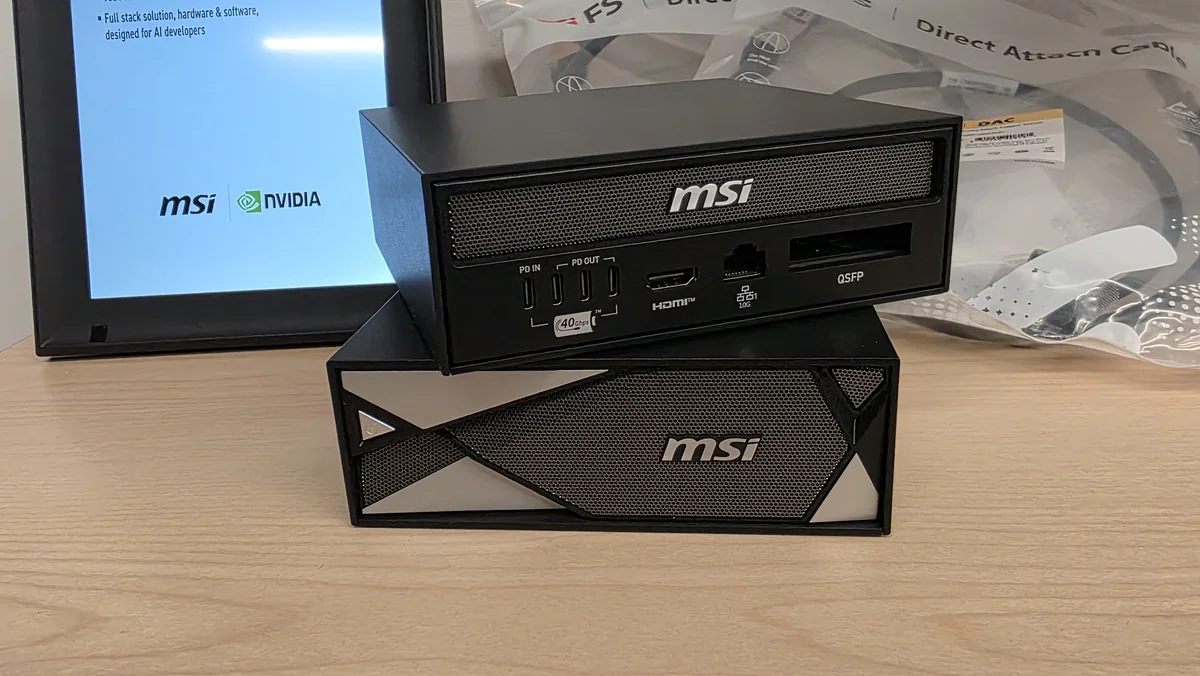
The MSI EdgeXpert MS-C931 is MSI’s take on the NVIDIA DGX Spark formula: a roughly 1.2-liter desktop built around the GB10 Grace Blackwell Superchip, with 128 GB of unified memory and a claimed 1 PetaFLOP of FP4 compute. It is not a general-purpose mini PC. It is a personal AI supercomputer aimed at developers and researchers who want to fine-tune and run large language models locally instead of renting cloud GPUs. It is the same class of machine as the NVIDIA DGX Spark and the ASUS Ascent GX10, priced at around $3,999 for the 4 TB configuration.
What sets MSI’s box apart on paper is thermal engineering. Where the reference DGX Spark relies on a conventional cooler, the EdgeXpert MS-C931 uses a vapor chamber plus a three-heatpipe array, and MSI markets the result as roughly 10% faster sustained inference than the reference design. Treat that number as a vendor claim: MSI has not published independently reproduced benchmarks, and we have not verified it.
What it’s good for (local AI / LLM dev)
The MS-C931 exists for one job: running and tuning AI models on your desk, offline. The 128 GB of unified memory is the headline feature: because the 20-core Arm CPU and the Blackwell GPU share one pool, the entire allocation can hold model weights. That is enough to load models up to roughly 200 billion parameters locally (quantized), or to fine-tune mid-sized models without spilling to slower storage.
Concretely, it suits:
- Local LLM inference: running 70B–120B-class models at usable speeds, or experimenting with 200B-class models that simply won’t fit on a 24–32 GB consumer GPU.
- Model fine-tuning and prototyping: LoRA/QLoRA runs, RAG pipelines, and agent development against the full CUDA stack without cloud egress or per-token billing.
- Creator and research workloads that lean on the NVIDIA software ecosystem: diffusion models, local transcription, and inference-heavy creative tooling.
- Light desktop/office use as a secondary benefit, though DGX OS is an Arm Linux developer environment, not a Windows desktop. If you want a daily-driver PC, this isn’t it.
The GB10 superchip & unified memory
The GB10 Grace Blackwell Superchip pairs a 20-core Arm CPU (10× Cortex-X925 performance cores + 10× Cortex-A725 efficiency cores) with a Blackwell GPU carrying 6,144 CUDA cores and 5th-generation Tensor Cores. CPU and GPU are joined by NVLink-C2C, a coherent high-bandwidth link that lets both processors address the same 128 GB of LPDDR5X without copying data back and forth.
That unified design is the whole point. On a traditional PC, a 120B model has to be sharded across system RAM and a discrete GPU’s limited VRAM, with PCIe as the bottleneck. Here, the model lives in one address space the GPU can reach directly. The headline figures (1 PetaFLOP FP4 / 1,000 AI TOPS) describe the Blackwell GPU’s peak throughput at the lowest precision, and they are genuinely datacenter-class for a desktop wedge.
Build, connectivity, and clustering
Physically the MS-C931 is a compact black box (roughly 151 × 151 × 52 mm and ~1.2 kg) with a perforated front panel and MSI/NVIDIA branding. Front I/O includes USB4 Type-C, HDMI, and an SD card slot; the rear carries additional USB-C and display output.
The networking is where these GB10 boxes earn the “supercomputer” label:
- ConnectX-7 dual-QSFP networking rated for up to 200GbE. This is the clustering fabric. Two EdgeXpert units can be lashed together to pool memory and run a single model larger than 200B parameters across both.
- Dual 10 GbE standard Ethernet for normal connectivity.
- Wi-Fi 7 and Bluetooth 5.3.
The cooling is MSI’s differentiator. A vapor chamber feeding three heatpipes is a more aggressive thermal solution than the reference Spark, and the argument is straightforward: GB10’s sustained inference throughput is partly thermally bound, so better heat removal should hold clocks higher for longer. Plausible. But, again, MSI’s ~10% advantage is a marketing figure, not a verified one.
Memory bandwidth: the real-world ceiling
Here is the honest caveat every GB10 buyer needs. The limiter on token-generation speed is not the 1 PetaFLOP of compute. It’s memory bandwidth, at roughly 273 GB/s. Large-language-model decoding is memory-bound: every generated token requires streaming the model’s weights through the memory system. A discrete card like an RTX 5090 pushes well past 1.7 TB/s, so for models that fit in 32 GB of VRAM, the 5090 will generate tokens far faster.
What the EdgeXpert buys you is capacity, not raw speed: it runs models that a 5090 physically cannot load. So token throughput on a 120B-class model will feel modest: usable for development and batch work, not the instant wall-of-text you get from a small model on a flagship gaming GPU. If your workloads fit comfortably in 24–32 GB, a desktop with a 5090 is both cheaper and faster. If they don’t, this is one of the few desktops that can run them at all. Set expectations accordingly.
Pricing and where to buy
The 4 TB EdgeXpert MS-C931 lists at around $3,999 on Amazon, placing it above the $2,999–$3,000 reference DGX Spark and roughly in line with other premium GB10 boxes. MSI sells several variants (Gen4 vs Gen5 NVMe, 4 TB vs 8 TB storage, and 2026-refresh SKUs), so confirm the exact storage generation and capacity before buying, as pricing scales with it. A 3-year warranty is included, which is a meaningful edge over some competitors in this category.
For most buyers the premium over the reference Spark only makes sense if you specifically value the heavier cooling, the larger/faster storage options, or MSI’s warranty channel. Related: the other GB10 desktops we have reviewed include the GIGABYTE AI TOP ATOM and the Acer Veriton GN100.
What we’d flag
- Memory bandwidth caps token-generation speed. 273 GB/s is the real ceiling. Don’t expect 5090-class output rates on large models.
- The ~10% faster-than-Spark claim is unverified. It’s an MSI marketing figure tied to cooling; we found no independent reproduction.
- DGX OS is Arm Linux, not Windows. This is a CUDA developer appliance. Plan for a Linux workflow.
- It costs ~$1,000 more than the reference Spark. You’re paying for cooling, storage, and warranty. Make sure those matter to you.
MSI EdgeXpert MS-C931 verdict
The MSI EdgeXpert MS-C931 is a credible, well-built entry in the GB10 Grace Blackwell class. Its 128 GB of unified memory makes it one of the few desktops that can hold and tune ~200B-parameter models locally, its ConnectX-7 fabric lets two units cluster into something larger, and its vapor-chamber cooling is a genuinely thoughtful upgrade over the reference design, even if MSI’s specific performance claim remains unverified.
Buy it if you are an AI developer who needs large-memory local inference and values the heavier cooling, faster storage, and 3-year warranty enough to pay a premium over the NVIDIA DGX Spark or ASUS Ascent GX10. Just go in clear-eyed about the 273 GB/s bandwidth ceiling: this machine is about capacity, not the raw token-per-second speed of a discrete flagship GPU. For the right buyer, that trade is exactly the point.