
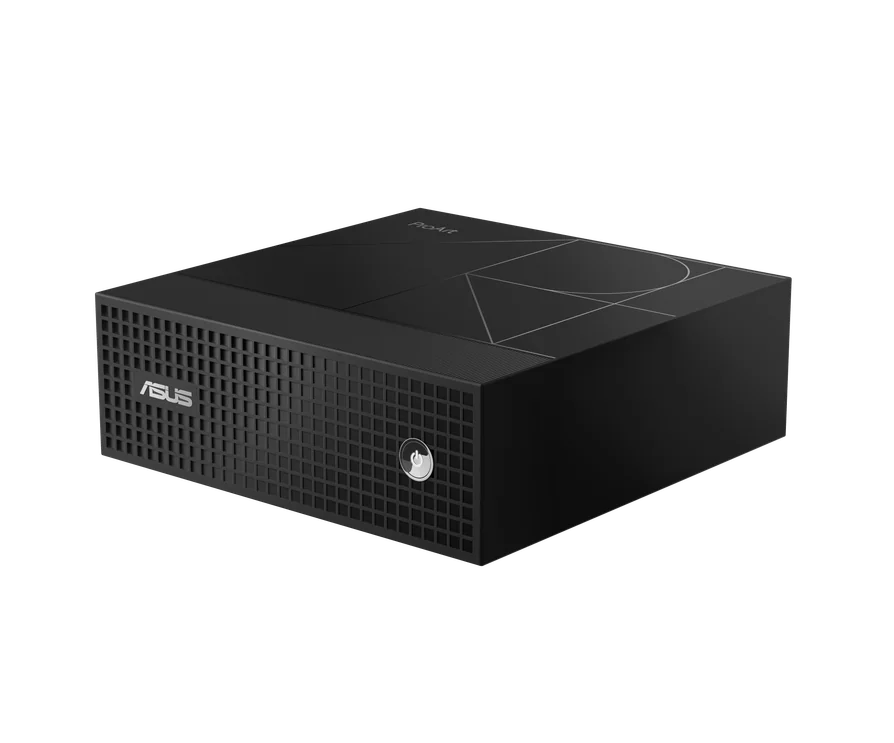
What is the ASUS ProArt Mini PC?
The ASUS ProArt Mini PC is a forthcoming small-form-factor AI workstation powered by NVIDIA’s RTX Spark superchip, announced at Computex 2026 on June 1. ASUS showed it alongside the ProArt P16 and P14 laptops, but the Mini PC is the one mini-PC buyers should care about: it packs a full Grace Blackwell-class chip into a chassis measuring just 150 × 150 × 51 mm, the same book-sized footprint as the GB10 desktops already on sale.
To be clear up front, this is an announcement, not a shipping product. ASUS has committed to a Fall 2026 launch in select regions, but it has not disclosed pricing or final memory configurations. Below we separate what’s confirmed from what’s still up in the air, and explain where the RTX Spark chip actually sits in NVIDIA’s lineup, because there’s a fair amount of confusion about that.
What’s confirmed: ASUS ProArt Mini PC specs
ASUS’s press release and hands-on coverage from ServeTheHome and PCWorld line up on the core specifications:
- NVIDIA RTX Spark superchip: a 20-core Arm-based NVIDIA Grace CPU joined to a Blackwell GPU with 6,144 CUDA cores and fifth-generation Tensor Cores (FP4), linked by NVLink-C2C.
- Up to 128 GB unified memory: a single coherent pool shared by CPU and GPU, the same architecture that lets GB10 boxes load very large models locally.
- ~1 petaflop of AI performance (FP4), the headline figure NVIDIA quotes for this class of chip.
- M.2 PCIe Gen 5 x4 storage, user-expandable. ASUS is positioning this as scalable high-speed storage rather than a soldered SSD.
- 10 GbE wired networking for moving large datasets and model checkpoints.
- Up to 140 W of thermal headroom: notably higher than Microsoft’s 100 W Surface RTX Spark dev box, which should help the ProArt sustain clocks under long generative-AI and 3D-rendering loads.
- 150 × 150 × 51 mm chassis in a matte-black ProArt finish.
ASUS frames it as a “compact AI powerhouse” for creators, developers, and AI enthusiasts running local large language models and generative-AI workloads, and NotebookCheck reasonably reads it as a pro-grade Mac Studio rival.
Is RTX Spark the same as the GB10 in DGX Spark?
This is the part worth getting right. RTX Spark is the consumer / Windows-on-Arm respin of the same Grace Blackwell die family as NVIDIA’s GB10, the silicon inside the NVIDIA DGX Spark and the ASUS Ascent GX10. It is not a “GB10 v2” or a next-generation chip. Think of it as the lower-tier N1-class member of the same family, tuned for a consumer Windows-on-Arm experience rather than the DGX OS Linux developer appliance the GB10 boxes ship with. Same architecture, same 128 GB unified-memory trick, different software target.
What’s still unknown
ASUS left several important blanks, and we won’t guess at them:
- Price. Not disclosed. The on-sale GB10 siblings start around $2,999–$3,000, so that’s the rough neighborhood to anchor expectations. But ASUS has confirmed nothing.
- Exact memory tiers. “Up to 128 GB” implies smaller configurations may exist, but ASUS hasn’t published the ladder.
- Memory bandwidth. ASUS hasn’t stated a figure. The GB10 boxes land around 273 GB/s, and that bandwidth (not raw compute) is the real ceiling on token-generation speed. Expect the ProArt to be in the same ballpark until ASUS says otherwise.
- Full port layout, OS image, and warranty terms are still to come; ASUS says additional specs and configurations will be announced later.
What it means for mini PCs
The ProArt Mini PC is a sign that the GB10-class “personal AI supercomputer” is graduating from a niche developer appliance into a mainstream creator product line. ServeTheHome counted RTX Spark SFF systems from ASUS, Dell, Lenovo, and MSI at the same show, with NVIDIA touting 10-plus desktops on the way. The competition should push prices down and software polish up.
The 140 W thermal envelope is the most interesting differentiator here. A book-sized box that can actually feed a Blackwell GPU 140 W of headroom (rather than throttling it into a laptop-grade power budget) is exactly what separates a serious local-AI workstation from a demo. If ASUS pairs that cooling with a sane price, the ProArt could be the most desirable consumer-facing Spark box yet.
Expected timeline and price outlook
Availability: Fall 2026, select regions. Price: no figure announced. Until ASUS publishes configurations and a US price, treat any number you see as speculation. Given where the ASUS Ascent GX10 and NVIDIA DGX Spark sit today, a starting price in the low-$3,000s would be unsurprising, but that’s our read, not ASUS’s word.
Sources & caveats
Everything above is drawn from ASUS’s official Computex 2026 press release plus hands-on coverage from ServeTheHome, PCWorld, and NotebookCheck (linked below). Specs are pre-production and could change before the Fall 2026 launch; pricing and memory tiers are unconfirmed.
We’ll review the ProArt Mini PC properly once it ships and we can run it. In the meantime, if you want the same Grace Blackwell capability you can actually buy today, read our on-sale GB10 reviews of the NVIDIA DGX Spark and the more aggressively priced ASUS Ascent GX10. Both run the silicon the RTX Spark is descended from.