
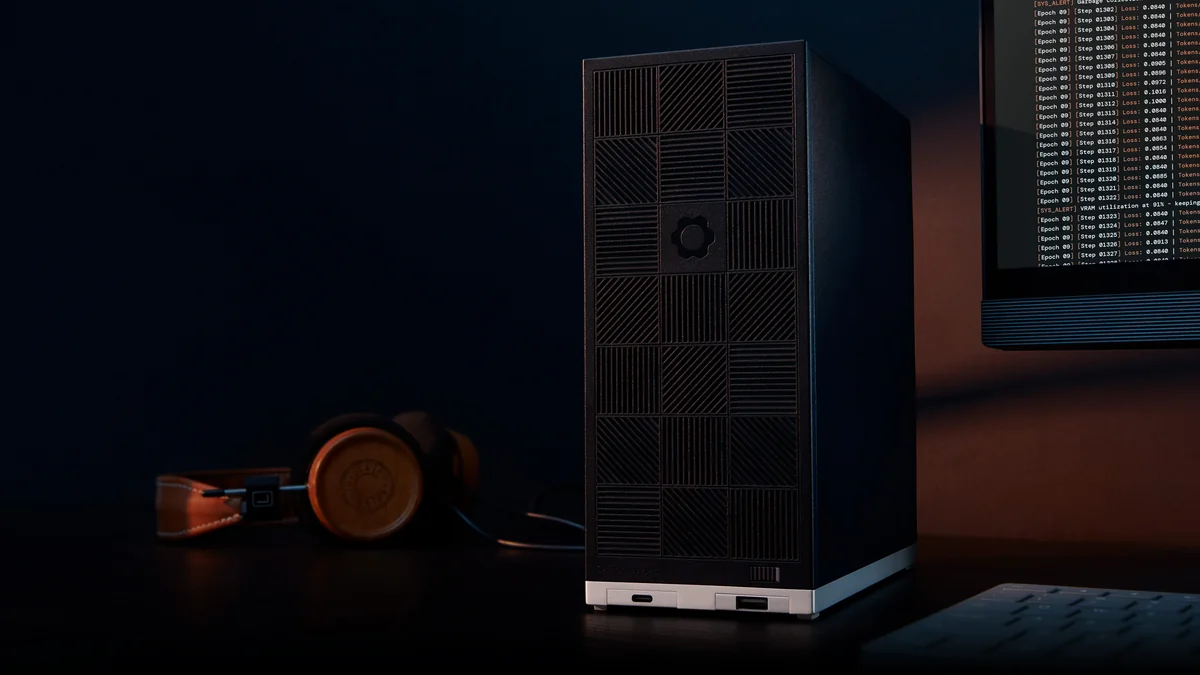
What is the Framework Desktop with Ryzen AI Max+ PRO 495?
The Framework Desktop with Ryzen AI Max+ PRO 495 is the 192GB follow-up to the Strix Halo mini-ITX box Framework has sold since 2025. Framework previewed it at AMD’s Advancing AI event on 22 July 2026 with careful wording: “the first (as far as we know) 192GB system with AMD Ryzen AI Max+ PRO 495.” NotebookCheck called it the first mini-ITX desktop built around the chip.
The pitch is narrow. This is a 4.5-liter Gorgon Halo mini PC for running a 200B-plus parameter model on one desk, and Framework’s headline claim is that 192GB loads DeepSeek-V4-Flash at Q8 on a single machine “with room to spare for context length.”
As of 12 September 2026 the product page still says “coming soon.” No price, no order date, no unit on any reviewer’s bench. Below, what is on the record is kept separate from what is still open.
What’s confirmed: Ryzen AI Max+ PRO 495 specs
From Framework’s product page, its Advancing AI preview, and AMD’s Gorgon Halo disclosure (reported by VideoCardz and NotebookCheck):
- CPU: AMD Ryzen AI Max+ PRO 495, 16 Zen 5 cores / 32 threads, boost up to 5.2 GHz
- GPU: Radeon 8065S, 40 RDNA 3.5 compute units, up to 3.0 GHz
- NPU: XDNA 2, rated at 55 TOPS; Framework lists 131 TOPS of combined AI compute for the platform
- Memory: 192GB unified LPDDR5X-8533 on a 256-bit bus, soldered, 273 GB/s theoretical bandwidth
- Expansion: PCIe x4 slot, now open-ended so longer cards fit physically (still four lanes electrically)
- Board: standard mini-ITX mainboard and FlexATX PSU, the same repairable layout as the current Desktop
- OS: Windows or a new Linux pre-load option on the prebuilt
- Chassis: Framework’s 4.5-liter case, or buy the mainboard alone and drop it into any mini-ITX chassis
Framework also showed a demo the spec sheet does not cover: two 192GB systems linked through 50GbE RoCE adapters in the PCIe slot, with tensor parallelism addressing 384GB across the pair. CEO Nirav Patel wrote on Hacker News that latency, not throughput, is the bottleneck for distributed inference, and that the slot exists partly to take RoCE-capable NICs like the Intel E810. Proof of concept, not a shipping feature.
What’s improved over the Ryzen AI Max+ 395 version
The honest framing is that Gorgon Halo is a refresh, not a new chip. Same 4nm silicon, same Zen 5 cores, same RDNA 3.5 iGPU, same XDNA 2 NPU. The differences that matter for a buyer looking at our Framework Desktop review of the 395 model:
| Framework Desktop (Max+ 395) | Framework Desktop (Max+ PRO 495) | |
|---|---|---|
| CPU boost | 5.1 GHz | 5.2 GHz |
| iGPU | Radeon 8060S, 40 CU, 2.9 GHz | Radeon 8065S, 40 CU, 3.0 GHz |
| NPU | 50 TOPS | 55 TOPS |
| Memory | up to 128GB LPDDR5X-8000 | 192GB LPDDR5X-8533 |
| Bandwidth | 256 GB/s | 273 GB/s (+6.6%) |
| PCIe x4 slot | closed | open-ended |
| Linux preload | no | yes (prebuilt option) |
| Price | $3,449 (128GB, today) | not announced |
Read the table this way:
- Capacity is the real upgrade. 128GB to 192GB is a 50% jump, and it is the difference between a Q4 and a Q8 quant of a large MoE model. DeepSeek-V4-Flash is 284B total parameters (13B active); a Q8 GGUF weighs roughly 162GB, which does not fit in 128GB at all.
- Bandwidth barely moves. 273 GB/s is a 6.6% bump, and it is the exact figure NVIDIA quotes for the DGX Spark. Token generation will feel like the 395 with a little headroom, not like a discrete GPU.
- CPU and NPU gains are cosmetic. 100 MHz and 5 TOPS will not change a benchmark you care about.
If you own a 128GB Framework Desktop, this is not an upgrade path. If you held off because your target model would not fit, this is the first box in the family that closes the gap.
What’s still unknown
- Price. Nothing official. See the outlook below.
- Ship date. “Coming soon” since 22 July. GMKtec, ACEMAGIC and Chuwi showed PRO 495 boxes at IFA in early September; Framework has not announced an order window.
- Other PRO 495 tiers. Only 192GB is listed. No 64GB or 128GB PRO 495 option has been mentioned.
- Cooling. Framework has said nothing about changes to the Cooler Master and Noctua thermal design. Assume the same heatsink and 120mm fan until told otherwise.
- Sustained performance. No independent testing of the PRO 495 in this chassis exists yet.
- Networking. The onboard 5GbE NIC is unchanged, per Framework staff on the community forum; a 10GbE expansion card is listed separately as “coming soon.”
What it means for mini PCs
192GB of unified memory in a 4.5-liter box moves the local-LLM ceiling from roughly “70B dense at Q8, or 200B MoE at Q4” to “280B MoE at Q8.” That matters if you care about quantization quality, not just whether the model loads. Our Strix Halo local LLM testing on the EVO-X2 is the baseline these boxes start from.
Framework is not alone: GMKtec has confirmed a PRO 495 / 192GB unit, ACEMAGIC is squeezing the chip into 2 liters, and AMD’s Ryzen AI Max 400 “Gorgon Halo” roadmap makes 192GB the new top tier for the category. Framework’s differentiator is unchanged from the 395: a standard mini-ITX board you can move to another case, a standard FlexATX PSU, a PCIe slot that now takes full-length cards, and a company that answers questions on its own forum.
Is the Framework Desktop PRO 495 better than the DGX Spark for local AI?
On capacity, yes: 192GB vs 128GB. On bandwidth they are level at 273 GB/s. The DGX Spark ships with CUDA and ConnectX-7 200GbE clustering; Framework offers ROCm/Vulkan on Linux and a PCIe slot you fill yourself. The answer depends on whether your stack needs CUDA.
Can it run DeepSeek-V4-Flash locally?
That is Framework’s claim: Q8, one box, context to spare. Nobody outside Framework has published throughput, and at 273 GB/s expect generation speeds in the same neighborhood as the 395 on smaller models. We will measure it when we get a unit.
Expected timeline and price outlook
No price has been announced. On the record, Framework has said the 192GB unit will be a “pretty substantial jump” over 128GB pricing (as quoted by NotebookCheck), and Nirav Patel wrote on Hacker News that Framework sees “no indication of memory pricing coming down in the next year,” with LPDDR5X expected to keep rising. Pricing will be shared “before we open orders.”
For context, the 128GB Ryzen AI Max+ 395 Framework Desktop launched at $1,999 in February 2025 and lists at $3,449 today, purely because of DRAM costs. NotebookCheck’s estimate is “over $4,000”; Digital Trends guesses it crosses $4,500. Both are estimates, not leaks, and neither comes from Framework. Related: our take on whether the Ryzen AI Max+ PRO 495 is worth buying.
On timing, Framework has not committed to a quarter. After the IFA wave of PRO 495 systems, an order window before year-end is plausible, but that is our read, not an announcement.
Sources and caveats
Specs come from Framework’s product page and its 22 July preview, cross-checked against VideoCardz (July and August pieces), NotebookCheck, Fudzilla and Digital Trends. CEO quotes are from Hacker News. One conflict: NotebookCheck’s July piece calls the chassis 4.1 liters; Framework’s page and every other outlet say 4.5, so we use 4.5.
We have not handled a PRO 495 unit. The DeepSeek-V4-Flash claim, the RoCE demo and the 131 TOPS figure are Framework’s numbers. We will review the Framework Desktop PRO 495 when it ships; until then the 128GB Framework Desktop is the version you can actually buy.