
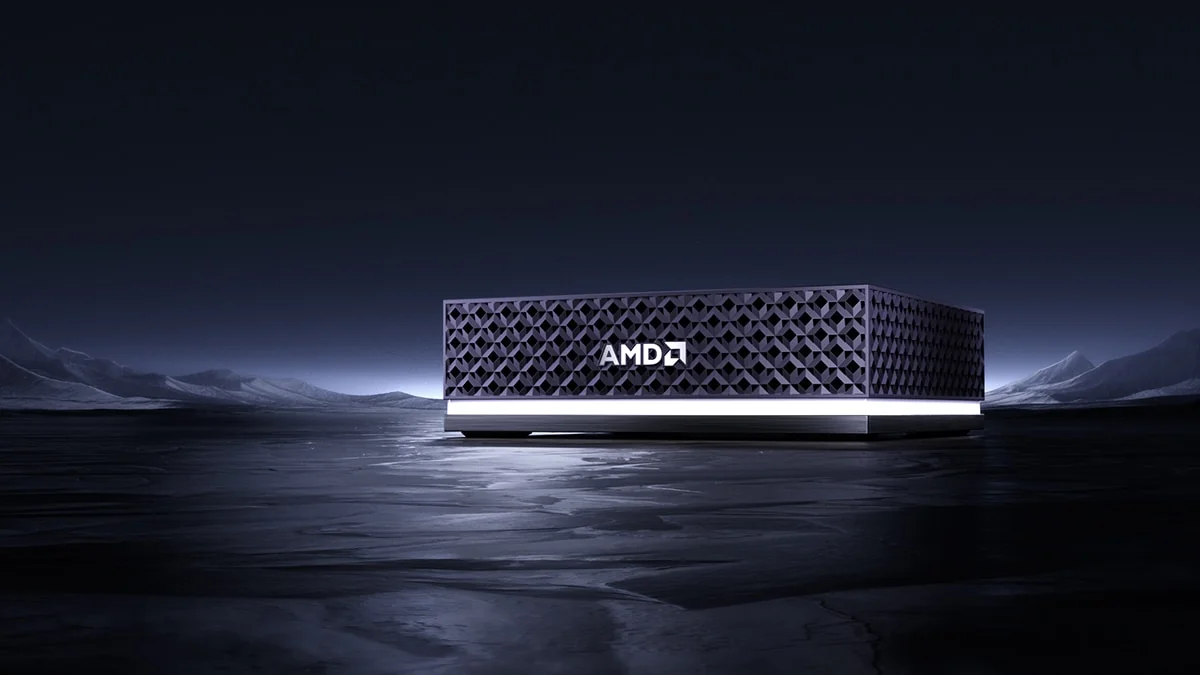
AMD is now selling a mini PC under its own name. The AMD Ryzen AI Halo Developer Platform, a $3,999 box built around the Ryzen AI Max+ 395 with 128 GB of unified memory, opened for pre-orders on June 8, 2026, exclusively at Micro Center in the US, with in-store availability expected around July 10, 2026. For a company that has always left system-building to its OEM partners, a first-party Strix Halo mini PC is genuinely new territory, and it lands as a direct answer to NVIDIA’s DGX Spark.
What is the AMD Ryzen AI Halo Developer Platform?
It is a compact AI development workstation (roughly 150 × 150 × 43 mm and just over a kilogram) that AMD is positioning as the reference machine for local LLM work on its hardware. Two SKUs exist at Micro Center: 711961 ships with Ubuntu Linux, 711962 with Windows 11 Pro. The hardware is identical; only the operating system differs, and both cost $3,999.
That framing matters for the whole category. Beelink, GMKtec, Framework and HP have been shipping Ryzen AI Max+ 395 boxes for over a year, but every one of them made its own cooling, port, and firmware choices. The Ryzen AI Halo is the box AMD itself thinks this silicon deserves: the reference point every Strix Halo mini PC like the Beelink GTR9 Pro will now be measured against.
What’s confirmed: specs and software
From AMD’s product page and the Micro Center listings:
- CPU: Ryzen AI Max+ 395, 16 Zen 5 cores / 32 threads, up to 5.1 GHz, 80 MB total cache
- GPU: Radeon 8060S integrated graphics, 40 RDNA 3.5 compute units
- NPU: XDNA 2 rated at ~50 TOPS, with AMD quoting ~126 TOPS for the platform overall
- Memory: 128 GB unified LPDDR5x-8000 (soldered; this is a Strix Halo constant, not a vendor choice)
- Storage: 2 TB PCIe Gen 4 SSD
- Connectivity: 4× USB-C, HDMI 2.1, 10 Gigabit Ethernet, Wi-Fi 7, Bluetooth 5.4
- AI pitch: AMD says the 128 GB pool can hold quantized local models up to roughly 200 billion parameters
On the software side, ServeTheHome notes the real differentiation is the stack: an AMD Ryzen AI Development Center package manager, pre-loaded playbooks, and validated model support. It is a deliberate mirror of NVIDIA’s DGX Spark developer experience, on either Linux or Windows.
One naming caution: this machine uses the 300-series Ryzen AI Max+ 395, not the newer Ryzen AI Max 400 “Gorgon Halo” refresh with its 192 GB ceiling. Marketplace listings and headlines are already blurring the two; they are different chips.
What’s still unknown
- Power supply. Reporting points to a roughly 120 W external PSU, but AMD’s spec sheet does not confirm a wattage; treat that figure as approximate until units ship.
- USB-C data rates. AMD lists four USB-C ports without specifying which, if any, are USB4/40 Gbps.
- Sustained thermals. A 1-litre-class chassis around a chip that can pull 120 W is exactly where third-party Strix Halo boxes have struggled; nobody has published long-run thermal data on AMD’s own cooling yet.
- Wider availability. Nothing has been said about sales beyond Micro Center’s in-store-pickup exclusive, or about international launch plans.
AMD Ryzen AI Halo vs NVIDIA DGX Spark: which is the better buy?
The NVIDIA DGX Spark launched at the same $3,999 but has since climbed to roughly $4,700 amid LPDDR5X and NAND supply constraints, handing AMD a ~$700 price advantage. The Spark counters with far stronger tensor hardware and the CUDA ecosystem (Tom’s Hardware’s early testing finds the Ryzen AI Halo trails GB10 boxes on raw inference throughput), while AMD counters with x86 compatibility and a genuine Windows 11 option, which no GB10 machine offers. Same memory capacity, different trade-off: ecosystem versus price and OS flexibility.
What it means for mini PC buyers
For most people, the interesting consequence isn’t this box; it’s the pressure it puts on the field. At $3,999, AMD has set a first-party price anchor well above what OEMs charge for the same silicon: comparable 128 GB Max+ 395 machines like the GMKtec EVO-X3 sell for substantially less. What you’re paying AMD’s premium for is the curated software stack, 10GbE, and the assurance of the platform vendor’s own validation. If you just want Strix Halo hardware for local 70B–200B-class models, the OEM boxes remain the value play; if you want the canonical developer target, this is now it. Related: how 70B-class models run on the GMKtec EVO-X2 and what the NPU, iGPU and CPU each do for local LLMs.
Timeline and price outlook
Pre-orders opened June 8, 2026; Micro Center lists in-store pickup availability around July 10, 2026, effectively this week. Price is a confirmed $3,999 for either OS SKU. We’ll publish a full review once we can put retail hardware through sustained-load and local-inference testing; until then, treat performance claims (ours included) as preliminary.