
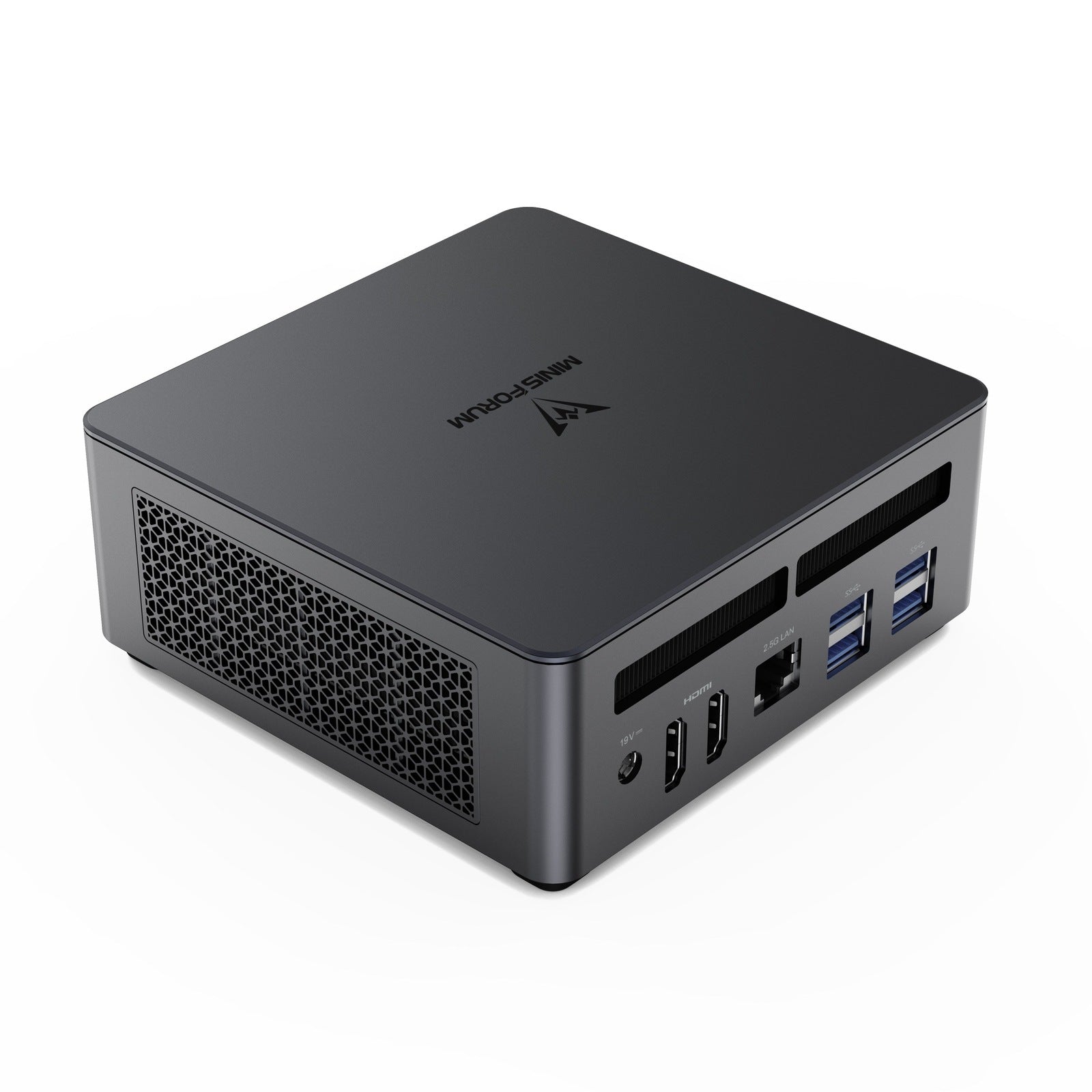
The UM790’s industrial design is, on paper, a selling point. Milled aluminium, a matte finish that doesn’t smudge, a thermal mass that helps passive dissipation, and a physical weight that signals the kind of build quality that plastic-shelled competitors from Beelink or GMKtec don’t try to match. Minisforum’s product photography leans into it. Reviewers routinely highlight the chassis as evidence that the company is paying attention to the parts of the product experience that normally get neglected in this price range.
It is therefore remarkable, and telling, that the same chassis is the part of the product Minisforum ended up silently apologising for with an in-box accessory.
Why the Minisforum UM790 Pro’s metal case blocks WiFi
A 2.4 GHz or 5 GHz WiFi signal is an electromagnetic wave, and electromagnetic waves do not pass through metal enclosures well. Any product that wraps a wireless radio in a continuous metal housing has to solve the antenna-routing problem deliberately: routing the antenna cable to an externally-exposed antenna, or using a chassis window that keeps the metal out of the RF path, or both. These are known engineering problems with known solutions. They are not exotic.
The UM790’s solution, from the evidence in Sagar Behere’s detailed teardown blog, is to route the factory antenna to a position inside the chassis where it is attenuated by the metal shell it is sitting behind. Behere documents that relocating the same antenna cable to the top of the chassis (an unofficial modification taking about fifteen minutes with basic tools) produced an approximately threefold improvement in WiFi throughput. That is not a marginal gain. It is the difference between “unreliable even at short range” and “ordinary WiFi behaviour.”
The Minisforum BBS thread titled Weak Wifi Reception? contains owner after owner reporting the same pattern: UM790 units connecting at 802.11n speeds within two metres of a current-generation router that a $50 Chromebook would connect to at 802.11ac or Wi-Fi 6. The Replacement wi-fi antenna thread catalogues the workarounds: re-seating the antenna connectors, swapping the shipped antenna for an aftermarket one, routing cables along different chassis paths.
Minisforum’s fix
Rather than address the antenna routing at the product-design level, Minisforum’s response, as documented across multiple BBS threads and corroborated in the Linus Tech Tips UM790 Pro owner discussion, has been to ship affected customers a USB WiFi dongle. A small plastic adapter that plugs into one of the UM790’s USB-A ports and provides wireless connectivity from a position outside the metal enclosure, which is, physically speaking, the correct solution to the attenuation problem.
It is also an admission. The dongle solution says, unambiguously, that the internal radio cannot deliver acceptable performance inside the shipped chassis. If Minisforum believed the internal radio was working as designed, the fix would be a driver update or a replacement antenna cable. The fix they actually provided tacitly concedes that the design choice (premium aluminium shell, internal antenna, no chassis window) produced a product that can’t hit its own spec sheet for wireless.
The cost the customer pays
The dongle looks free. It is not free. A customer who installs it pays in three ways. First, one USB-A port on the UM790 is now occupied permanently. For a product marketed as a compact desktop with a modest port count, losing a port to work around a built-in deficiency is a material downgrade. Second, the dongle adds a visible plastic appendage to a product whose aesthetic positioning was premium solid aluminium. Third (and this is the longest-tailed cost), the customer’s support experience becomes longer. When Wi-Fi goes flaky six months later, the troubleshooting path involves both the internal radio (which the customer was supposed to be using) and the dongle (which they were supposed to be using instead), and the answer to “which one is broken?” becomes harder to answer.
Related: the UM790 Pro batch Minisforum never formally recalled, what Gamers Nexus found behind the HX90 liquid metal claim, and Minisforum’s support portal problems.
The lasting critique
This is the specific flavour of Minisforum issue that is most frustrating, because it has the smallest engineering cost to fix and the largest cumulative cost of not fixing. A chassis revision that places a small RF-transparent window near the antenna (or relocates the antenna to a chassis-exterior position) would eliminate the problem on the next production run. The cost in tooling is trivial. The cost in bill-of-materials is negative, because the dongle goes away.
Instead, the decision on the UM790 was to ship the dongle, leave the chassis design unchanged, and let customers make their peace with a work-around that the vendor is fully aware of. That decision saves money per unit at the factory and costs trust per unit in the field. A premium-chassis product that needs a plastic accessory to hit baseline WiFi is not a premium product. It is a well-finished aluminium shell wrapped around a compromise the customer was never told about, and the dongle in the box is the proof that Minisforum knew.