
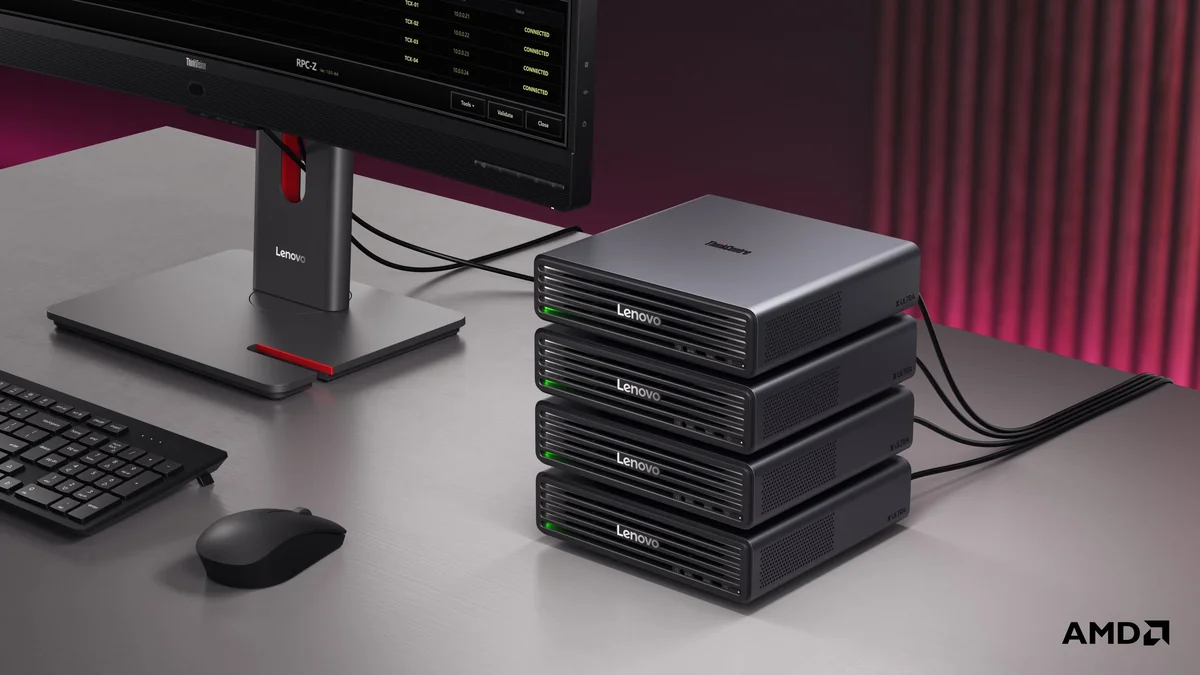
What is the Lenovo ThinkCentre X Ultra?
The Lenovo ThinkCentre X Ultra is a 1.6-liter business mini PC built around AMD’s Ryzen AI Max+ PRO 495, the flagship of the Gorgon Halo refresh. Lenovo announced it on 3 September 2026 at IFA in Berlin, pitched it at “the agentic AI era”, and put a November 2026 ship date on it. It is one of the first Tier 1 OEM mini PCs announced with the PRO 495, and the first ThinkCentre Lenovo sells as a four-node local AI cluster.
The box measures 183 x 183 x 51 mm and starts at 2 kg: a square footprint about two inches wider than a Mac mini on each side, but thinner than most Strix Halo mini PCs. The obvious rival is HP’s Z2 Mini G1a, which puts the previous-generation Ryzen AI Max+ PRO 395 into a 2.3-liter chassis with ISV certification. Same corporate buyer, one generation newer silicon, smaller box.
This is a news piece, not a review. Where a number comes from Lenovo’s spec table or AMD’s product page we say so; where the press is guessing, we say that too.
What’s confirmed: ThinkCentre X Ultra specs
Lenovo published a full technical table with the press release. The headline items:
- CPU: up to AMD Ryzen AI Max+ PRO 495, 16 Zen 5 cores / 32 threads, 3.1 GHz base, up to 5.2 GHz boost, 45–120 W configurable TDP (AMD spec page)
- GPU: integrated Radeon 8065S, 40 RDNA 3.5 compute units at up to 3.0 GHz, with up to 96 GB of unified memory assignable as graphics memory
- NPU: XDNA 2, up to 55 TOPS; AMD rates the whole chip at up to 131 TOPS
- Memory: onboard LPDDR5X-8533, up to 4-channel (256-bit), up to 128 GB. Soldered, not upgradeable
- Storage: 2x M.2 2280 slots, up to 2x 4 TB (8 TB total)
- Rear I/O: 2x Thunderbolt 4 (40 Gbps), DisplayPort 2.1 UHBR10, HDMI 2.1 FRL, 2x USB-A 10 Gbps, 10GbE RJ-45, and a configurable punch-out port (VGA, DP 2.1, HDMI 2.1, serial, or a second 10GbE)
- Front I/O: 2x USB-C 10 Gbps with 5V/3A charging, 3.5 mm combo jack
- Wireless: Wi-Fi 7 (MediaTek MT7925 or Realtek RTL8922AE) + Bluetooth 5.4
- OS options: Windows 11 Pro/Home, Linux AMD AI OS, certified Ubuntu, or no preload
- Enterprise bits: discrete TPM 2.0, ThinkShield, AMD PRO with DASH manageability, TÜV Rheinland Ultra Low Noise, MIL-STD-810H
- Software: ships with the AMD Ryzen AI Developer Center, a preconfigured bundle of models, tools and workflows for Windows and Linux
Two Thunderbolt 4 ports on an AMD platform is unusual, and onboard 10GbE is rare at this size.
Is the ThinkCentre X Ultra SSD PCIe Gen4 or Gen5?
Early coverage split on this. NotebookCheck and Tom’s Hardware list a “Gen5 Performance SSD”; VideoCardz lists the slots as PCIe Gen4 x4. Lenovo’s own table settles it: the drive is a Gen5 part, but the next line reads “Platform-only support for Gen 4”, and the expansion-slot row says 2x M.2 2280 PCIe Gen4 x4. AMD’s spec page confirms the PRO 495 has a PCIe 4.0 controller, same as the 395. Any Gen5 SSD in this box runs at Gen4 speed, roughly 7 GB/s at best.
Clustering: four units, 512 GB, 524 TOPS
Lenovo’s press release says the “cluster-ready architecture connects up to four systems in a unified platform”. NotebookCheck’s report from the briefing puts numbers on it: four units, 512 GB of combined memory, 524 TOPS. Those are sums of four boxes, not one coherent memory space. Lenovo has not said how the nodes link (10GbE and Thunderbolt 4 are the candidates), what bandwidth the fabric has, or what software schedules a model across them. TechRadar flagged the same gap. Treat 512 GB as capacity, not a performance claim.
What’s improved over the Ryzen AI Max+ 395 version
HP’s Z2 Mini G1a and every 128 GB Strix Halo mini PC sold this year use the Ryzen AI Max+ 395 (or PRO 395). The PRO 495 is the same 4 nm silicon (we covered the Ryzen AI Max 400 “Gorgon Halo” refresh when AMD detailed it): same Zen 5 cores, same 40-CU RDNA 3.5 iGPU, same XDNA 2 NPU, same 256-bit memory bus, same PCIe 4.0. AMD’s own product pages show exactly what moved:
| Spec (AMD official) | Ryzen AI Max+ PRO 395 | Ryzen AI Max+ PRO 495 |
|---|---|---|
| CPU | 16C/32T, up to 5.1 GHz | 16C/32T, up to 5.2 GHz |
| iGPU | Radeon 8060S, 40 CU @ 2.9 GHz | Radeon 8065S, 40 CU @ 3.0 GHz |
| NPU | up to 50 TOPS | up to 55 TOPS |
| Total AI TOPS | up to 126 | up to 131 |
| Memory speed | LPDDR5X-8000 | LPDDR5X-8533 |
| Max memory (platform) | 128 GB | 192 GB |
| PCIe | 4.0, 16 lanes | 4.0, 16 lanes |
| cTDP | 45–120 W | 45–120 W |
The change that matters for local LLM work is memory bandwidth, not the 100 MHz clock bumps. LPDDR5X-8533 on a 256-bit bus works out to roughly 273 GB/s versus about 256 GB/s for LPDDR5X-8000, a 6.7% gain. Token generation on this class of chip is bandwidth-bound, so expect about that much extra throughput at the same model size, and not much more. The 5 TOPS NPU uplift is a rounding error.
The big Gorgon Halo feature, 192 GB of unified memory, is the one Lenovo left on the table. The ThinkCentre X Ultra tops out at 128 GB, the same ceiling as every 395 box. Acemagic, GMKtec and Framework have all previewed PRO 495 desktops at 192 GB (our GMKtec EVO-X3 piece covers that tier). If a 300B-class MoE model in one box is the goal, the X Ultra is not that machine; Lenovo’s answer is the cluster, a different and pricier trade.
What the X Ultra does improve over the 395 crowd sits around the chip: 10GbE where most consumer Strix Halo boxes ship 2.5GbE, Thunderbolt 4 instead of USB4, a 1.6 L chassis versus 2 L or more, and Tier 1 manageability. Whether that thinner chassis holds 120 W under sustained load is the first question for a review unit.
What’s still unknown
- Cluster interconnect and software. No fabric, bandwidth or orchestration details from Lenovo yet.
- Configured TDP. Lenovo has not stated where inside the 45–120 W window the X Ultra runs, or whether it is user-adjustable.
- Entry configuration. The $3,699 / €3,100 starting price almost certainly buys less than 128 GB; Lenovo has not published the SKU ladder.
- Sustained thermals and noise. Lenovo cites a TÜV Ultra Low Noise certification, but no reviewer has run it at full tilt.
- Which 495 variants. The table says “up to” PRO 495, so lower Ryzen AI Max PRO 400 options are likely.
- Warranty and ISV certification. Not mentioned in the launch material, which matters against HP’s Z2 Mini G1a.
What it means for mini PC buyers
The X Ultra shows where the enterprise end of the Strix Halo market is going: a 1.6 L node with 10GbE, sold in multiples, with the vendor’s management stack on top. It also confirms Gorgon Halo is a refresh. Anyone who bought a 128 GB 395 system this year has not been leapfrogged; a 495 box buys about 7% more bandwidth and, on other vendors’ hardware, the 192 GB option.
The interesting collision is in-house. Lenovo is also building an RTX Spark small-form-factor desktop on NVIDIA’s N1x: 128 GB unified memory, up to 300 GB/s, Arm CPU, Windows on Arm with CUDA. That box and the x86 X Ultra with ROCm will land within weeks of each other. For most corporate developers the software stack, not the TOPS figure, will decide it.
Expected timeline and price outlook
- Availability: November 2026 (Lenovo press release)
- US price: from $3,699 (NotebookCheck, TechRadar, Ubergizmo; Tom’s Hardware’s text mentions $3,669 but its own table says $3,699)
- EU price: from €3,100 (Lenovo press release)
- Channels: Lenovo.com and, per NotebookCheck, Lenovo’s Amazon store
At $3,699 the X Ultra lands on top of the HP Z2 Mini G1a’s starting price and well above consumer PRO 495 boxes. A four-node cluster is close to $15,000 before cables and a switch. We will review it when it ships.
Sources and caveats
Specs come from Lenovo’s press release table and AMD’s PRO 495 and PRO 395 product pages. US pricing comes from NotebookCheck, TechRadar and Ubergizmo; Lenovo’s release only lists the euro figure. The 512 GB / 524 TOPS cluster numbers are NotebookCheck’s report of Lenovo’s briefing. No independent benchmarks exist yet, and we have not handled the unit.