
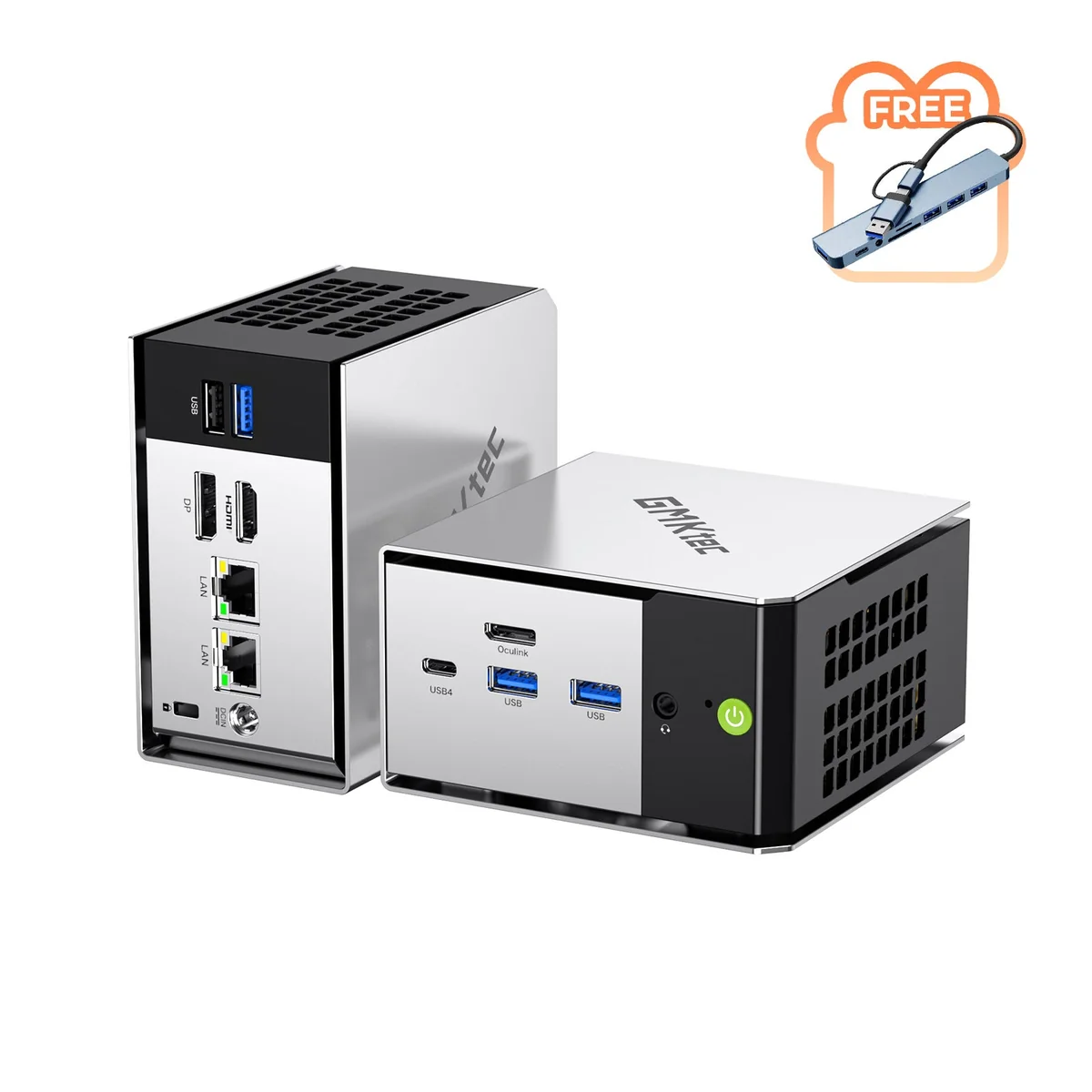
What it is
The GMKtec M8 is an entry-level mini PC built around the AMD Ryzen 5 PRO 6650H, a 6-core, 12-thread Zen 3+ chip that boosts to 4.5 GHz and runs at roughly 40 W in the unit’s performance mode, paired with Radeon 660M integrated graphics and 16 GB of LPDDR5-6400. At its regular ~$480 price it’s a reasonable buy; at its recurring sale price of $360–$390 (PCWorld flagged it as a Prime Day 2026 value pick at $390), it’s one of the strongest budget mini PC deals on the market.
What separates the M8 from the sea of budget boxes is its I/O. Dual 2.5 GbE, Wi-Fi 6E, USB4, and (unusually at this price) a dedicated OCuLink port (PCIe 4.0 ×4) all fit into a 107 × 111 × 63 mm chassis that weighs about 590 grams.
What is the GMKtec M8 good for?
Home and office work. This is the M8’s home turf. Six Zen 3+ cores handle Office, dense browser sessions, video calls, and light photo editing without drama. TechRadar’s review called out its “superb office potential,” and that matches the consensus: for a general-purpose desk PC that disappears behind a monitor, the M8 covers everything most households and small offices actually do.
Home lab lite. Dual 2.5 GbE ports make it a credible candidate for a small router/firewall build, a Proxmox node, or a Plex box, the same appeal that made the GMKtec K11 popular, at a lower price.
Light gaming, with expectations set. The Radeon 660M (6 CUs, RDNA 2) manages esports titles at 1080p low-to-medium (Rocket League, CS2, Valorant are playable), but modern AAA games are out of scope. If gaming matters, the OCuLink port is the escape hatch: an external GPU dock connects at ~63 Gbps of PCIe 4.0 ×4 bandwidth, far beyond what USB4 alone offers.
OCuLink and USB4 at this price: why it matters
Most sub-$400 mini PCs give you neither. The M8 gives you both: USB4 at 40 Gbps with 100 W power delivery, plus OCuLink for near-native eGPU performance. That means an entry-level box you buy for office work today can plausibly drive a discrete GPU next year instead of being replaced.
Build and connectivity
The M8 is compact and light (~590 g) with a conventional blower-cooled layout, and reviewers consistently note that it stays quiet under everyday loads. The port list is far above its weight class:
- 1× USB4 (40 Gbps, PD 100 W, display out)
- 1× OCuLink (PCIe 4.0 ×4)
- 3× USB 3.2 Gen 2 (10 Gbps), 1× USB 2.0
- 1× HDMI 2.0, 1× DisplayPort 1.4
- 2× 2.5 GbE RJ45
- Wi-Fi 6E (MediaTek RZ616) + Bluetooth 5.2
- 3.5 mm combo audio jack
Triple-display setups work via HDMI + DisplayPort + USB4, with high-resolution output over the USB4 port. For a multi-monitor office desk, that’s everything required.
Memory, storage, and upgrades
Here is the M8’s one structural compromise: the 16 GB of LPDDR5-6400 is soldered. There are no SODIMM slots: 16 GB is what you get for the life of the machine. It’s fast memory, and 16 GB is adequate for office and home duty, but heavy multitaskers should factor it in.
Storage is the opposite story. The M8 has two M.2 2280 NVMe slots, each accepting drives up to 8 TB. The stock 512 GB SSD runs at PCIe 3.0 speeds (Lon.TV confirmed this in testing), which is unremarkable but fine for the class, and you can add a second, faster drive without touching the first. A 16 GB/1 TB configuration is also sold if you’d rather skip the first upgrade.
Pricing and where to buy
GMKtec lists the M8 at $479.99, with a standing sale price of $389.99 on its own store. On Amazon, the 16 GB/512 GB configuration typically sits around $480 with frequent coupons and event pricing pulling it into the $360–$390 range. That Prime Day 2026 price is what earned it PCWorld’s value-pick nod, and Wccftech reviewed it at $359 calling it “definitely a good choice” for everyday work with light gaming.
At $480 the M8 is merely decent. At $360–$390 nothing else with USB4 + OCuLink + dual 2.5 GbE really competes. If your budget stretches further, the GMKtec M6 Ultra steps up the platform, and the Geekom A8 Max buys upgradable RAM and a much stronger iGPU at nearly double the price.
What we’d flag
- Soldered 16 GB RAM. The single biggest limitation. No path to 32 GB, ever. Buy it knowing that.
- The Ryzen 5 PRO 6650H is a 2022-era chip. Zen 3+ on 6 nm is efficient and perfectly quick for office work, but it lacks an NPU and trails current Ryzen 7000/8000-series mini PCs in both CPU and GPU performance. TechRadar specifically dinged the graphics.
- HDMI 2.0, not 2.1, and Bluetooth 5.2, not 5.4. Minor, but a sign of the older platform.
- The included 512 GB SSD is PCIe 3.0 and on the small side; most buyers will want to add a second drive within the first year.
None of these are dealbreakers at the sale price: they’re the honest trade-offs that make a $390 USB4 + OCuLink machine possible.
Verdict
The GMKtec M8 is what a budget mini PC should be in 2026: an efficient six-core CPU, fast soldered memory in an adequate quantity, dual NVMe slots, and an I/O loadout (USB4, OCuLink, dual 2.5 GbE, Wi-Fi 6E) that embarrasses machines costing twice as much. The soldered 16 GB ceiling and dated silicon are real, but they’re priced in.
If you need an affordable, quiet, well-connected PC for home or office use, especially if you can catch it at $360–$390, the GMKtec M8 earns a confident recommendation.