
What it is
The GMKtec M6 Ultra is a compact desktop built around AMD’s Ryzen 5 7640HS, a 6-core, 12-thread Zen 4 chip that boosts to 5.0 GHz, paired with Radeon 760M graphics on the RDNA 3 architecture. It ships with up to 32 GB of DDR5 and a 1 TB NVMe SSD, in a 528-gram chassis measuring under 13 cm on a side, running Windows 11 Pro out of the box.
It is also, at the moment, one of the easiest mini PCs to recommend to a normal person. TechRadar rates it their top value mini PC for work and study, and during the June 2026 Amazon Prime Day the 32 GB / 1 TB configuration was $150 off, landing near $550.
What is the GMKtec M6 Ultra good for?
Home and office work. This is the machine’s home turf. The Ryzen 5 7640HS handles the standard productivity stack (Office, a few dozen browser tabs, video calls, 4K streaming) without breaking stride. Lon.TV’s testing found the system “quick and responsive” across everyday desktop work, and the fan stays quiet at idle and only modestly audible under load.
Home-lab-adjacent duty. The dual 2.5 GbE LAN ports are the spec that separates the M6 Ultra from most budget mini PCs. Lon.TV measured full multi-gigabit throughput on both jacks, which makes this a credible little router, Proxmox node, or NAS front-end when it eventually rotates out of desk duty.
Casual gaming, with expectations set. The Radeon 760M is the smaller RDNA 3 iGPU: Lon.TV recorded roughly 30–40 fps in Cyberpunk 2077 at 1080p low, and a 3DMark Time Spy score around 2,600 (GTX 1050 Ti territory). Esports titles and emulation are comfortable; modern AAA gaming is not the point. If gaming matters, step up to something like the GMKtec M8’s Ryzen 7 platform or a 780M-class machine.
Build and connectivity
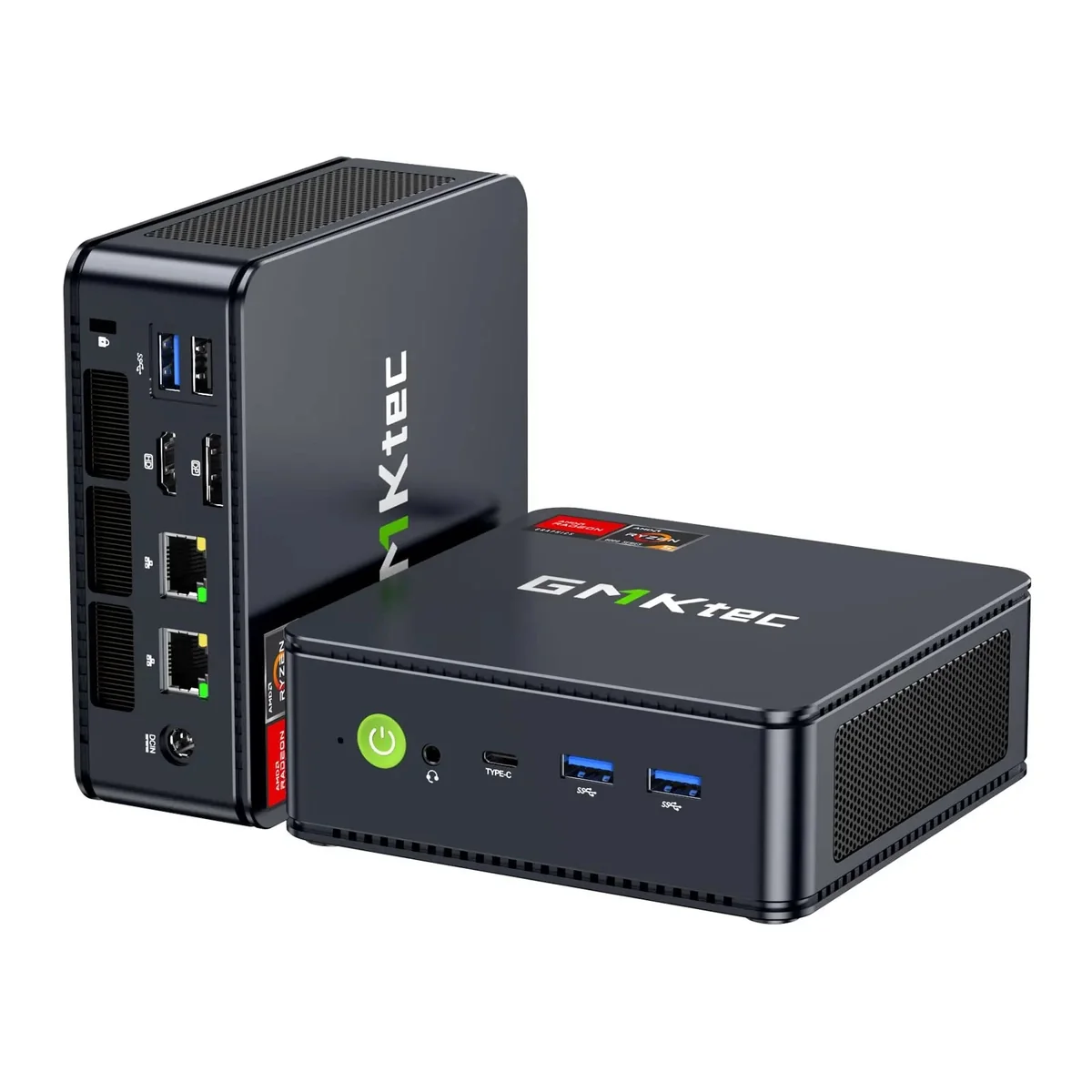
The M6 Ultra is a clean, minimal box in a bronze finish, with GMKtec’s signature green power button on the front. At 528 g it all but disappears behind a monitor on a VESA mount.
The port loadout is unusually complete for the price:
- USB4 (40 Gbps): full-function, with DisplayPort 1.4 video out up to 8K@60 and 100 W USB-PD input
- 3× USB-A 3.2 Gen 2 (10 Gbps) + 1× USB-A 2.0
- HDMI 2.0 (4K@60) + DisplayPort 1.4 (8K@60), with triple-display support alongside USB4
- 2× 2.5 GbE Ethernet
- Wi-Fi 6 + Bluetooth 5.2, 3.5 mm combo jack
The USB4 port deserves emphasis: at this price it’s rare, and it means the M6 Ultra can drive a Thunderbolt dock, a fast external NVMe enclosure, or even an eGPU later in its life.
Memory, storage, and upgrades
GMKtec sells the M6 Ultra barebones or configured with 16 GB / 512 GB or 32 GB / 1 TB. Everything user-facing is upgradable: two DDR5 SO-DIMM slots accept up to 128 GB, and there are two M.2 2280 NVMe slots, one occupied from the factory. One honest caveat: GMKtec’s own materials are inconsistent about whether the slots run PCIe 3.0 or 4.0. Treat SSD speeds as PCIe 3.0-class until you’ve tested your unit; for an office machine the difference is academic.
That upgrade path matters at this price. Like the Geekom A8 Max a tier up, this is a machine you can buy in a modest configuration today and grow into for years.
Pricing and where to buy
As of July 2026, the 32 GB / 1 TB configuration sits in the $550–$700 range on Amazon, and it dropped to roughly $550 during the June 23–26 Prime Day event. The 16 GB / 512 GB configuration dips to around $399, and GMKtec’s own store lists a barebones unit (no RAM, SSD, or OS) at about $270 when discounted.
For most buyers the 32 GB / 1 TB Amazon listing is the sweet spot: you get double the memory and storage headroom for a machine you’ll keep for years, plus standard Amazon return handling. If the budget is tighter still, the Kamrui Hyper H2 plays in the sub-$400 bracket, but gives up the M6 Ultra’s USB4 and dual LAN. Related: the 10 best mini PCs under $500 on Amazon.
What we’d flag
A positive review, but not an uncritical one:
- Wi-Fi 6, not 6E or 7. Lon.TV found wireless throughput lagged well behind the wired ports. Fine for a desk PC (you have two excellent Ethernet jacks), but worth knowing.
- HDMI 2.0, not 2.1. The 4K@60 ceiling on the HDMI port is dated for 2026; high-refresh 4K needs the DisplayPort or USB4 output.
- Spec-sheet sloppiness. GMKtec’s pages disagree with each other on M.2 PCIe generation (3.0 vs 4.0) and Wi-Fi version. Reviewer hardware teardowns consistently show Wi-Fi 6, which is what we’ve listed.
- The 760M is entry-level graphics. Don’t buy this for AAA gaming; it isn’t sold as that, but it bears repeating.
Is the GMKtec M6 Ultra good enough as a main PC?
For office work, study, and home desktop duty: yes, comfortably. Six Zen 4 cores and 32 GB of DDR5 are more computer than most productivity users will saturate, and Lon.TV measured just 13 W at idle, so it costs very little to leave running.
GMKtec M6 Ultra vs GMKtec M8: which one?
The M8 brings a stronger 8-core Ryzen 7 for heavier multitasking and better iGPU performance. The M6 Ultra counters with USB4 and dual 2.5 GbE at a lower price. For work-and-study buyers, the M6 Ultra is the better-balanced pick.
Verdict
The GMKtec M6 Ultra earns its reputation. It takes the spec sheet of a mid-range mini PC (Zen 4 CPU, DDR5, dual NVMe slots, USB4, dual 2.5 GbE) and sells it at a budget price, with real reviewer consensus (TechRadar, TechPowerUp, Lon.TV) behind the value claim rather than marketing alone. The weaknesses are honest ones: last-generation Wi-Fi, an entry-level iGPU, an HDMI port a spec behind.
If you want a small, quiet, upgradable PC for home or office work in the $400–$600 window, the GMKtec M6 Ultra is the machine to beat, and during sale events, it’s simply the best value in its class. Recommended.