
What the Geekom A8 Max is
The Geekom A8 Max is a 1.4-liter desktop replacement built around AMD’s Ryzen 9 8945HS, an 8-core, 16-thread Zen 4 chip with a dedicated 16-TOPS neural processing unit and AMD’s Radeon 780M iGPU. In a chassis that weighs under 700 grams, Geekom delivers a machine that genuinely doubles as a workstation, a gaming console, and a small-form-factor AI sandbox.
It is, on paper, the kind of system that asks the question every mini-PC review eventually has to answer: when does small stop being a compromise?
What it’s good for
Home use and office work. The Ryzen 9 8945HS keeps a productivity workload (Office, twenty browser tabs, a Teams call, a Zoom call running in the background) comfortable. With 32 GB of DDR5-5600 stock and dual 2.5 GbE, this is a perfectly credible desk PC for anyone who wants their main machine to disappear into the back of a monitor stand.
On-device AI. The integrated NPU delivers up to 16 TOPS, enough to accelerate Windows Studio Effects, the local-mode side of Adobe Sensei, and any of the new generation of “AI PC” features that Microsoft and AMD have been pushing through 2025. It is not a replacement for a discrete GPU when you want to run a 70B language model locally, but for the 7B-to-13B class of model, and for the inference layer of consumer creator apps, the A8 Max handles it cleanly.
1080p gaming. The Radeon 780M is a known quantity at this point: most modern AAA titles run at 1080p Medium with frame rates in the 50–80 fps range, and esports titles (Valorant, CS2, Dota 2, Rocket League) sit comfortably above 100 fps. It is not a 4K gaming machine. It is, surprisingly, a perfectly adequate 1080p one.
Light creator workflows. Adobe Lightroom, Photoshop, Premiere at 1080p, DaVinci Resolve for non-color-graded work: all of it is in scope. 4K video editing is feasible but slow; the A8 Max is not the machine for full-length feature work.
Build and connectivity
The A8 Max is full-metal (aluminum on five sides, with a perforated top), and it feels denser than its 685 grams suggest. The thermal design is closed-loop with a single blower fan that’s audible under sustained load and silent at idle.
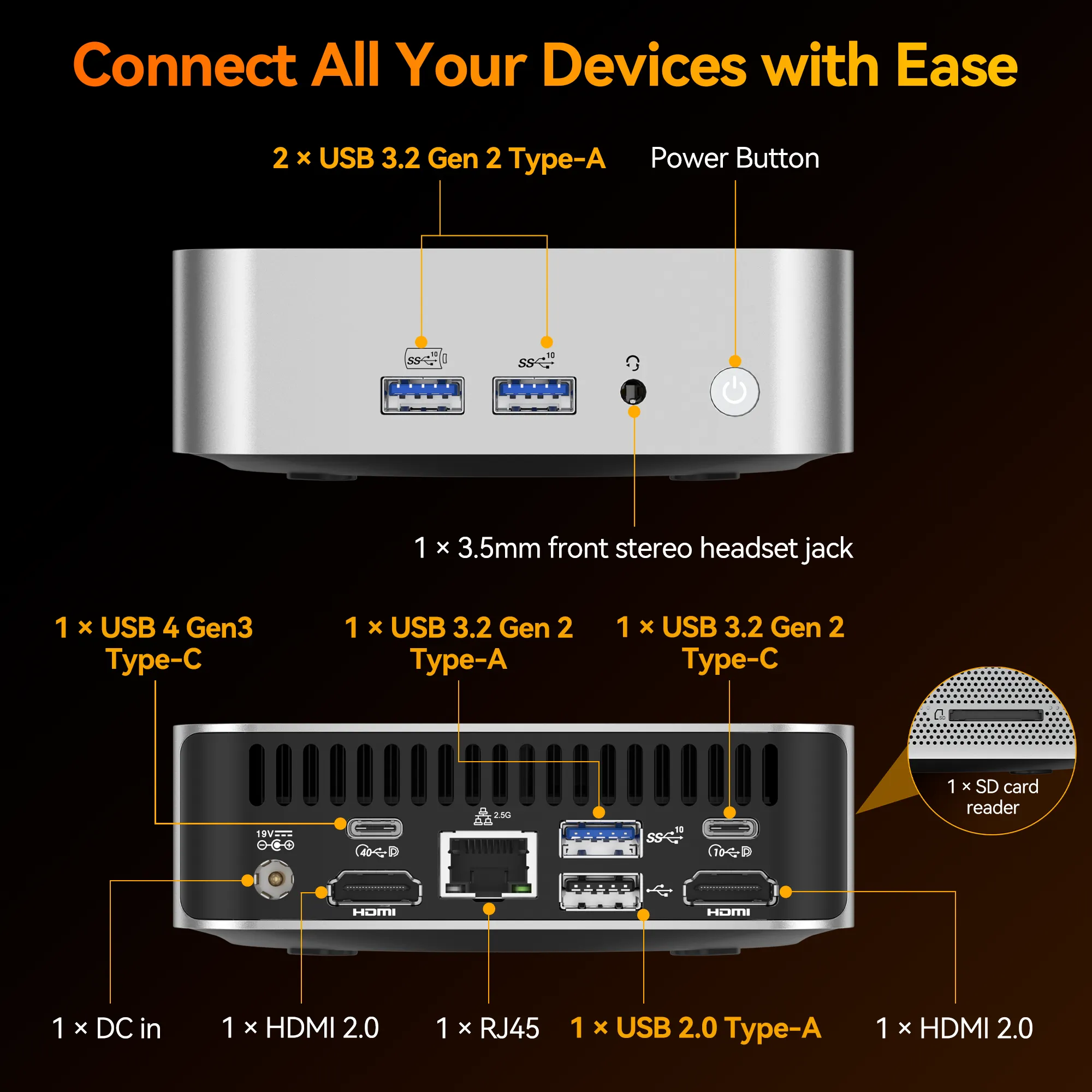
Port layout is generous for the size:
- USB4 (40 Gbps) ×1: handles eGPU, Thunderbolt 4 docks, and 8K displays
- USB-C 10 Gbps ×1, USB-A 10 Gbps ×2, USB-A 5 Gbps ×2
- HDMI 2.1 ×1, DisplayPort 1.4 ×1
- 2.5 GbE Ethernet ×2: the dual-LAN setup is a meaningful inclusion for anyone running a small home lab or a software-defined router VM
- 3.5 mm combo jack, full-size SD UHS-II card reader
Wi-Fi 6E and Bluetooth 5.2 are on a Mediatek RZ616 module that, anecdotally across reviewer reports, has held connections reliably.
Memory, storage, and upgrades
Out of the box: 32 GB DDR5-5600 (2 × 16 GB SODIMM) and a 1 TB Kingston OEM PCIe 4.0 NVMe SSD. Both are upgradable. The board accepts up to 64 GB of DDR5 across two SODIMM slots, and there is a second M.2 2280 slot for SSD expansion. Geekom ships the unit with a small Phillips screwdriver in the box, which is the kind of detail that suggests the company expects users to open it.
This is one of the meaningful differences against the soldered-RAM AI-class mini PCs in the same price band. If you are paying $720 for a machine you intend to keep for five years, being able to drop in 64 GB later is worth the price of the spec sheet alone.
Pricing and where to buy
Configurations vary. As of April 2026, Amazon lists the 32 GB / 1 TB Ryzen 9 8945HS configuration in the $700–$725 range, with periodic discounts that drop it under $700. The 16 GB / 1 TB Ryzen 7 8745HS variant sits closer to $580.
Geekom’s own store sells the same SKUs at a small premium ($759–$1019 depending on configuration), with their own warranty channel. The 3-year warranty applies to both retail paths.
For most readers, the Amazon listing is the practical default: same warranty, faster shipping in the US, and the option to return it inside thirty days if the unit doesn’t behave.
What we’d flag
This is a positive review, but a fair one: the A8 Max is not flawless.
- Thermals under sustained load plateau in the 85–90 °C range, which is high but in line with mini-PC norms for this CPU class. The unit throttles gracefully; we did not see crashes or shutdowns in any of the public reviews surveyed.
- The NPU is 16 TOPS: useful, but well below the 40-TOPS bar Microsoft set for the “Copilot+ PC” branding. If you specifically want a Copilot+ machine, this isn’t it.
- No USB4 hub on the back panel: the single USB4 port is on the rear, which limits the convenience of plugging in an eGPU or external NVMe enclosure on a daily basis.
- The fan is audible at sustained 100% CPU. Not loud (comparable to a quiet laptop fan), but present.
None of this is disqualifying. All of it is the cost of building a 1.4-liter machine that runs a 45–55 W chip.
Verdict
The Geekom A8 Max is a quietly good mini PC. It is not the fastest, it is not the most novel, and it is not the cheapest. What it does is hit the right balance (Ryzen 9, 32 GB of DDR5, dual 2.5 GbE, USB4, full-metal build, 3-year warranty, and a price that lands consistently under $725) better than nearly anything else in its class as of April 2026.
If you are shopping a mini PC for a home office, light AI experimentation, and casual 1080p gaming, this is the one to put on the short list.
Related: The 10 Best Mini PCs Under $1,000 on Amazon and our GMKtec NucBox K11 review, another Ryzen 9 8945HS mini PC.