
Jensen Huang has never hidden where NVIDIA came from. On the Acquired podcast in 2023 he explained how CUDA, the software that later made NVIDIA the engine of the AI boom, spread: it let “a chip that got paid for running DirectX and OpenGL to create an install base for CUDA.” Put simply, gamers bought the chips, and those chips carried NVIDIA’s bet on AI into millions of homes.
In 2026 those same gamers cannot find a card at a sane price, NVIDIA has not launched a new GeForce graphics card all year, and its earnings releases no longer mention gaming at all. This is our read of how that happened, built on NVIDIA’s own filings, its executives’ own words, and the reporting around them. Where a claim is reported but not confirmed, we say so.
Gamers paid for the bet
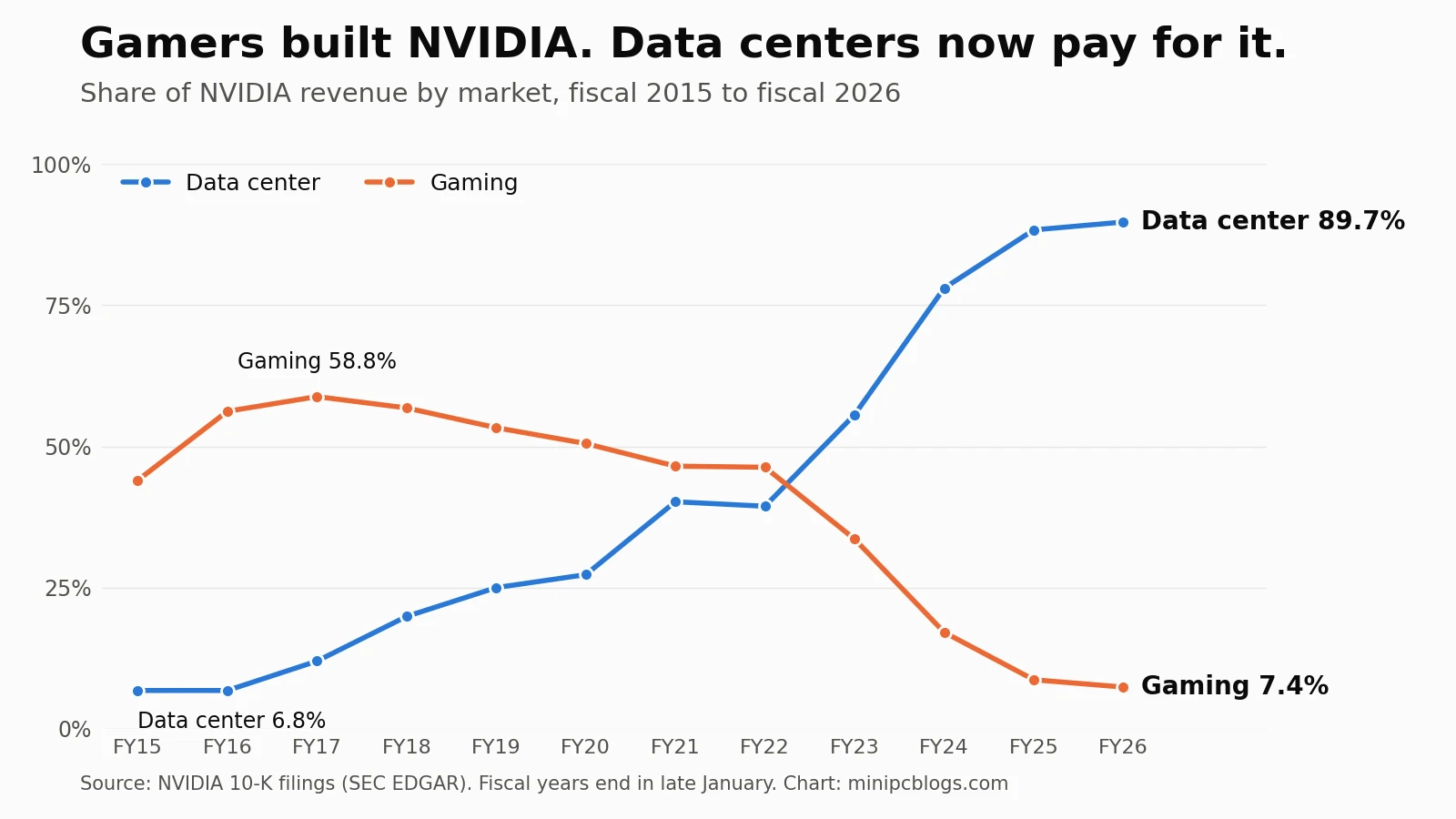
The numbers are in NVIDIA’s annual reports. In fiscal 2017, gaming was 58.8% of NVIDIA’s revenue and the data center business was 12%. By fiscal 2026, which ended in January 2026, gaming was 7.4% and data center 89.7%.
| Fiscal year | Total revenue | Gaming | Gaming share | Data center | Data center share |
|---|---|---|---|---|---|
| 2015 | $4.7B | $2.1B | 44.0% | $0.3B | 6.8% |
| 2017 | $6.9B | $4.1B | 58.8% | $0.8B | 12.0% |
| 2022 | $26.9B | $12.5B | 46.3% | $10.6B | 39.4% |
| 2024 | $60.9B | $10.4B | 17.1% | $47.5B | 78.0% |
| 2026 | $215.9B | $16.0B | 7.4% | $193.7B | 89.7% |
Source: NVIDIA 10-K filings. NVIDIA’s fiscal year ends in late January, so fiscal 2026 is roughly calendar 2025.
Gaming did not shrink. It grew to a record $16.0 billion in fiscal 2026. It just stopped mattering next to an AI business that is now twelve times larger.
The price of a GeForce
The climb in list prices started before the AI boom. The fastest GeForce went from $999 for the RTX 2080 Ti in 2018 to $1,499 for the RTX 3090, $1,599 for the RTX 4090 and $1,999 for the RTX 5090 in 2025. The 80-class card sat at $699 for two generations, then jumped to $1,199 with the RTX 4080.
When PCWorld asked Huang in September 2022 to answer “all the loud screams” about RTX 40 prices, his reply, as reported by PC Gamer, was: “Moore’s law is dead.” And: “the idea that the chip is going to go down in cost over time, unfortunately, is a story of the past.”
In 2026 the list prices stayed put. What changed is that almost nobody pays them. Hardware Unboxed tracks the cheapest in-stock card in ten countries. Its survey found GPU prices up 15% in August, 7% in September and about 11% in October 2026, roughly 35% in three months. The cheapest RTX 5080 in the U.S. went from $1,580 in September to $2,200 in October, against a $999 MSRP. In October Tom’s Hardware found the RTX 5090 listed for $8,500 on Amazon, more than four times its list price.
Where the chips and memory went
Every modern GPU needs two scarce things: a slice of a TSMC wafer and fast memory. AI servers want both, and they pay far more for them.
What NVIDIA itself confirms:
- Its fiscal 2026 annual report says: “We expect supply constraints to be a headwind to Gaming in the first quarter of fiscal year 2027 and beyond.” CFO Colette Kress said the same on the February 2026 earnings call.
- Its supply commitments jumped from $95.2 billion in January 2026 to $279 billion by July 26, 2026. The filing says they are “for our data center infrastructure systems, primarily memory and manufacturing facilities.”
- The same filings blame slower consumer PC sales on “elevated memory and systems prices.”
- Regulators in the EU, the U.S., the UK, China and South Korea have asked NVIDIA about “our efforts to allocate supply.” France’s competition authority is questioning whether gaming and data center GPUs are even separate products.
- The money explains the incentive. In the quarter that ended July 26, 2026, NVIDIA’s AI segment made about $16 of operating profit for every $1 its graphics segment made, at a margin of about 71% against 49%.
What is reported, but not confirmed by NVIDIA:
- In February 2026 The Information reported that NVIDIA planned no new gaming GPU in 2026, the first such year in nearly three decades, and was steering limited memory toward AI chips. NVIDIA replied that it “continues to ship all GeForce products.”
- Gigabyte’s CEO told Tom’s Hardware that NVIDIA will “calculate how much revenue [each segment] contributes per gigabyte of memory.” By Tom’s Hardware’s math, an RTX Pro 6000 brings in 41% more revenue per gigabyte of GDDR7 than an RTX 5090, using the same GB202 chip.
- In October 2026 the RTX 5090 disappeared from NVIDIA’s store and from retailers such as Micro Center. NVIDIA senior vice president Jeff Fisher told 4Gamers it has “certainly not been discontinued” and that supply is “somewhat constrained.” A week later an unnamed board partner told der8auer it can no longer order the GB202 chip with its 32GB memory kit.
- A leaked video reported by PC Gamer shows workshops in China stripping brand new RTX 5090s and moving the chips and memory onto blower cards for AI servers. Even the GeForce cards that do ship are being turned into AI hardware.
Back in March 2026, Huang told a Morgan Stanley conference: “I’ve got all the memories, I’ve got all the wafers, I got all the CoWoS.” And: “I think the fact that everything is scarce is fantastic for us.” To be fair, he was answering a question about AI data centers, not gamers. But it is the same company, and the same scarcity.
We covered the consumer side of this memory crunch in who pays for the RAM crisis, and the 5090’s disappearance in RTX 5090 vanishes as modders unlock older RTX cards.
NVIDIA stopped counting gamers
In May 2026 NVIDIA changed how it reports its business. Gaming is no longer its own line. It now sits inside “Edge Computing,” next to workstations, cars, robots and telecom gear. NVIDIA’s August 2026 results release does not contain the words “gaming” or “GeForce” once. Data center brought in $89.0 billion that quarter; all of Edge Computing, $7.2 billion.
A company is free to report its results however it likes. But the practical effect is that gamers, and investors, can no longer see how much GeForce NVIDIA sells.
In NVIDIA’s defense
The other side deserves a fair hearing:
- The memory shortage is industry-wide. NVIDIA does not make DRAM. AMD cards went up too: the cheapest RX 9060 XT 16GB in the U.S. hit $620 in October 2026, against a $349 launch price.
- Gaming had a record year in fiscal 2026, at $16.0 billion, before the new reporting started.
- NVIDIA kept investing in games. DLSS 4.5, announced in January 2026, brought its new upscaling model to every RTX card back to the 2018 RTX 20 series.
- Gamers keep choosing NVIDIA. Jon Peddie Research data, as reported by the press, puts its share of desktop graphics cards at about 90% in 2026.
- NVIDIA says it still ships every GeForce card, and has not confirmed any production cut.
Each of those points is true. None of them changes what a gamer sees at checkout.
We have seen this before
This is not the first time gaming demand and NVIDIA’s disclosures collided. In 2022 the U.S. Securities and Exchange Commission fined NVIDIA $5.5 million for not telling investors in fiscal 2018 that crypto mining was driving a large part of its gaming growth. Then, during the 2021 shortage, NVIDIA sold $550 million of dedicated mining cards while gamers paid scalper prices.
Our verdict
Jensen Huang did not wake up one day and decide to hate gamers. He did something simpler: he followed the money, and in 2026 the money is in AI. A chip and its memory are worth far more in a data center than in a desktop, and NVIDIA’s filings, margins and supply commitments all point in that direction. Gamers built the install base that made the AI empire possible. Today they get what is left over, at two to four times the list price, from a company that no longer reports how much it sells them.
If you are shopping, read our GPU and DGX Spark price backlash roundup before you pay, and check any listing against the MSRP.
Shorts from other creators
Below are three YouTube Shorts on the same story by other creators. They are their work, credited and linked. Their views are their own. Some of what they say, like the 5090 being discontinued, is reported by leakers and denied by NVIDIA, and the Toasty Bros clip is a comedy sketch.