
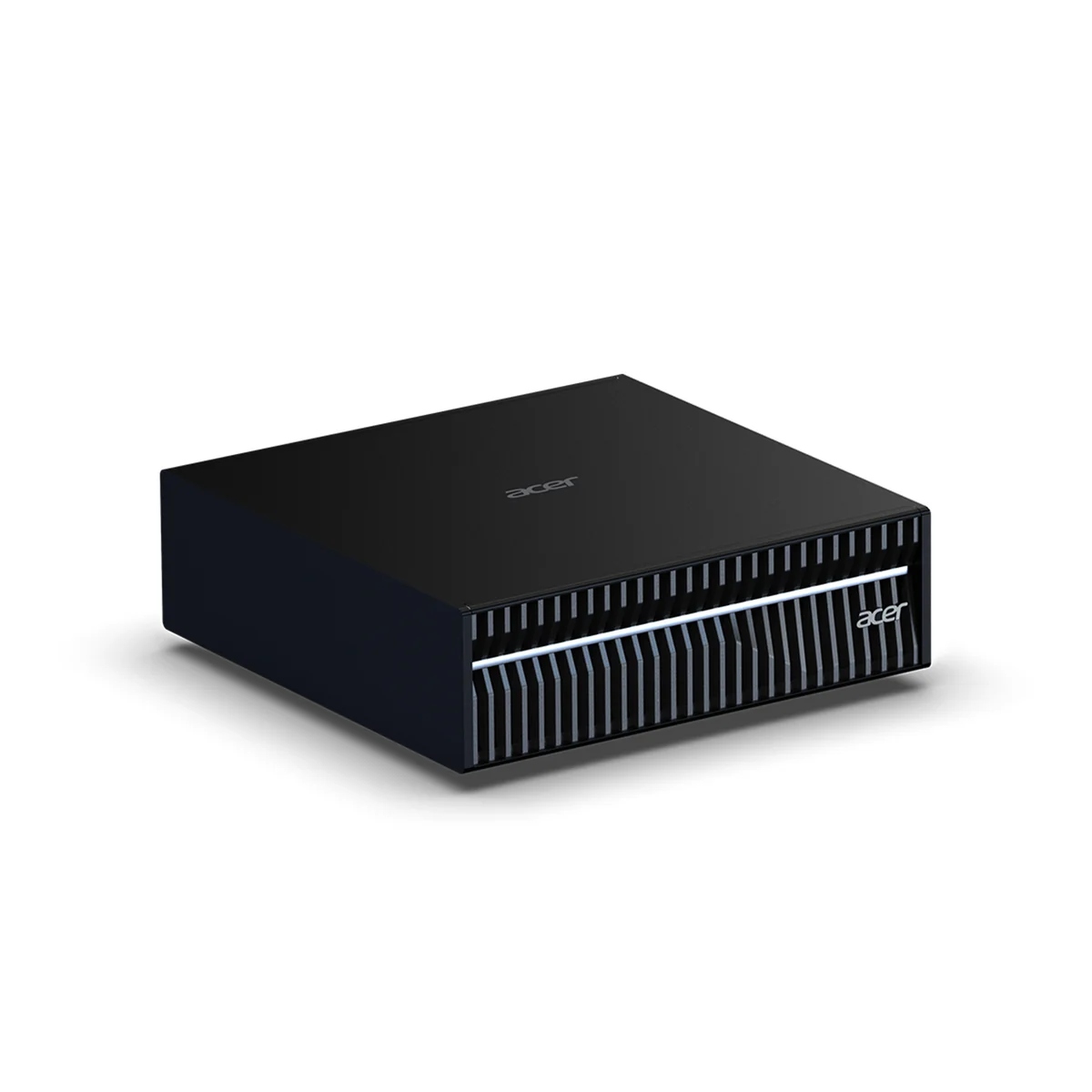
What the Acer Veriton GN100 is
The Acer Veriton GN100 is a $3,999 AI mini workstation built on NVIDIA’s GB10 Grace Blackwell superchip, the same “DGX Spark”-class platform that NVIDIA, Dell, ASUS and GIGABYTE are all shipping. It is not a general-purpose mini PC. It is a personal AI supercomputer roughly the size of a thick paperback (150 × 150 × 50.5 mm, under 1.5 kg) that pairs a 20-core Arm CPU with a Blackwell GPU over NVLink-C2C, fronts it with 128 GB of unified LPDDR5x memory, and ships with NVIDIA’s full DGX OS software stack already installed.
Acer’s angle in a crowded GB10 field is the out-of-box experience. Where rival boxes can leave you assembling a CUDA environment, the GN100 boots into DGX OS with PyTorch, Jupyter and Ollama preloaded, arguably the cleanest software preload of any Spark-ecosystem machine. For a buyer who wants to fine-tune or serve a local model the same afternoon the box arrives, that matters more than a spec-sheet bullet.
What it’s good for: local LLM dev
The GN100’s reason to exist is local large-language-model work that won’t fit on a consumer GPU. The 128 GB unified pool lets you load models in the ~70B–120B range comfortably, and NVIDIA rates the platform for inference on models up to 405B parameters when two units are linked over ConnectX-7. In StorageReview’s vLLM testing, GPT-OSS-20B scaled from roughly 92 to 1,565 tokens/second depending on batch size, results that sat “tightly grouped with the broader Spark ecosystem,” exactly as you’d expect from shared GB10 silicon.
This is a developer and creator machine: fine-tuning, retrieval-augmented generation, agentic prototyping, batch inference, and diffusion-model image work. If your interest is running a 7B–13B model for chat on a budget, you do not need this: a Strix Halo box that runs 70B models or even a Mac mini M4 Pro for local LLMs is far cheaper. The GN100 is for people whose models, datasets or throughput targets have outgrown those options.
The GB10 superchip & unified memory
The GB10 Grace Blackwell superchip combines a 20-core Arm CPU and a Blackwell GPU on one package, joined by NVLink-C2C so both sides address the same 128 GB LPDDR5x-8533 pool with no PCIe copy in between. NVIDIA quotes 1 PetaFLOP of FP4 AI performance (1,000 TOPS) from the 5th-generation Tensor Cores, and the full CUDA stack runs natively.
The headline number is the unified memory. On a 24 GB RTX 4090 you spend real effort sharding a 70B model; here it simply loads. That capacity, not raw FLOPS, is what makes the GB10 class interesting for anyone doing serious local AI. If you want the background on why CPU, NPU and GPU paths differ so much for this work, our explainer on NPU vs iGPU vs CPU for mini-PC LLMs is a useful primer.
Build, connectivity, and clustering
Physically the GN100 is dense and quiet. StorageReview measured the coolest thermal profile in its entire Spark comparison (CPU peaking at 74.7 °C and GPU at 69 °C under burst load), crediting an efficiency-first tuning rather than aggressive power-pushing. The trade-off they noted is cosmetic: an unfinished cast-metal bottom plate that reflects “a different design and cost philosophy,” though it stays structurally sound.
Connectivity is purpose-built for AI, not desktops:
- 2× 200 Gbps NVIDIA ConnectX-7 (QSFP): the high-speed fabric for pairing two GN100s into one 405B-capable node
- 10GbE RJ-45 for conventional networking
- 4× USB 3.2 Type-C, HDMI 2.1b, Wi-Fi 7, Bluetooth 5.1
That ConnectX-7 pairing is the standout: two units clustered behave as a single larger machine, which is how you cross from ~200B into 405B-parameter territory.
Memory bandwidth: the real-world ceiling
Here is the honest limit every GB10 buyer should internalize. Unified memory bandwidth is roughly 273 GB/s. That is generous against a CPU but modest against a discrete GPU: an RTX 5090 moves well over 1.7 TB/s. Token-generation speed in LLM inference is bound by memory bandwidth, so the GN100 will feel slower per-token than a big discrete card on the models that do fit in 32 GB of VRAM.
The GN100’s win is the opposite case: the models that don’t fit on any single consumer GPU. You are trading peak tokens/second for the ability to hold a 70B–120B model in memory at all. Buy it for capacity and a turnkey CUDA environment, not for the fastest possible chat response.
Pricing and where to buy
In North America the Veriton GN100 starts at $3,999 (EMEA €3,999; AUD $6,499). It is listed on Amazon under ASIN B0GJZY12GQ. That places it squarely in the DGX Spark cohort, a touch under ASUS’s Ascent GX10 at $2,999 only on paper, since Acer’s price buys the larger 4 TB Gen5 SSD configuration and the same GB10 core. IT Pro called it “an exemplary machine for running and experimenting with AI workloads… but with a huge price tag,” which is the fair summary for the whole category.
What we’d flag
- No USB Type-A and no USB4. TechRadar flagged this directly: every USB port is Type-C 3.2, so legacy peripherals need adapters.
- Effectively zero upgradeability. Memory is soldered LPDDR5x by design, and TechRadar notes the internal NVMe is not easily user-accessible. Buy the storage tier you need up front.
- 273 GB/s bandwidth caps token-generation throughput versus a discrete GPU, covered above, but worth repeating before purchase.
- DGX OS is Arm Linux, not Windows. This is a developer environment. If you expected a Windows desktop that also does AI, this is the wrong machine. Wait for the consumer RTX Spark respin instead.
- Pricey in Europe. The €3,999 / AUD $6,499 regional pricing is materially steeper than the US figure.
Verdict
The Acer Veriton GN100 is one of the most polished entries in the GB10 Grace Blackwell field. It runs the coolest of the Spark boxes StorageReview tested, carries a fast 4 TB Gen5 SSD, and (its real differentiator) boots straight into a DGX OS image with PyTorch, Jupyter and Ollama already configured, sparing you the setup tax that bites on rival units. The dual 200 Gbps ConnectX-7 fabric makes two-node, 405B-parameter clustering a genuine path rather than a footnote.
Its limits are the category’s limits, not Acer’s missteps: ~273 GB/s memory bandwidth makes per-token speed modest, there is no meaningful upgrade path, and DGX OS is a developer platform rather than a daily-driver desktop. For an ML engineer, researcher or creator who needs 128 GB of unified memory and a turnkey CUDA stack on their desk, the GN100 is an easy recommendation, and the cleanest software experience in the Spark lineup. For anyone whose models comfortably fit a 32 GB GPU, or who just wants to chat with a 13B model, a Strix Halo desktop or Framework Desktop will save thousands.