
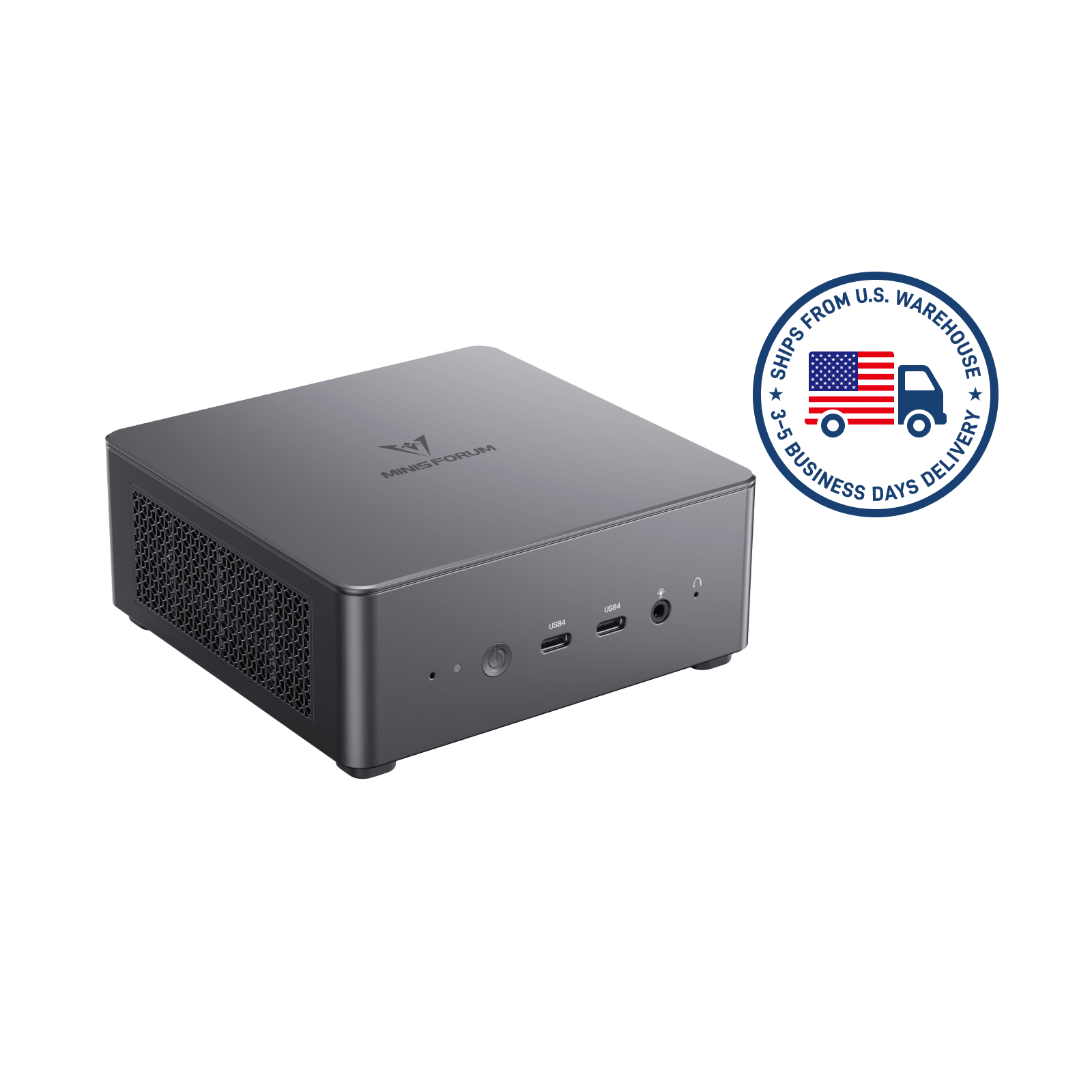
There is a version of this story where Minisforum looks good. It is worth telling that version first, because it is real: when the company discovered that a batch of its NAB9 mini-PCs had been built with the wrong capacitors, it published a public quality notice and offered affected customers a replacement. In a category dominated by China-based brands that prefer to handle defects quietly (one confused customer, one polite email, one unit swapped in a closed feedback loop), saying it in writing is not a given. Minisforum did, and the statement is still live on its own blog, opening with the sentence: “This issue is due to a mix-up in the capacitor materials supplied by our vendor for this batch.”
That is the high-water mark of the NAB9 story. Everything downstream of it is less flattering.
What the Minisforum NAB9 quality notice actually covers
The “affected batch” is not narrow in the way the word “batch” suggests. According to Minisforum’s own quality notice, units manufactured between 19 September 2024 and 14 March 2025 (a production window of nearly six months) may carry the suspect capacitors. Customers are asked to inspect the serial number and check whether the third through fifth characters fall inside two specific ranges, 386 to 526 or 017 to 117.
In plain language: a buyer who ordered an NAB9 from Minisforum or one of its resellers at almost any point during late 2024 or early 2025 is in scope and should manually check their unit. Nothing on the product page alerts them. Nothing in the shipped box alerts them. The default state for the affected customer is to not know.
What the failure looks like
The symptom is specific and harsh: the unit may fail to power on after a normal shutdown, or may shut down spontaneously and not come back. Press coverage from PC Gamer, NotebookCheck, VideoCardz and Guru3D treated the story as consequential, with PC Gamer pointedly invoking the early-2000s capacitor plague, a generation-defining quality-control disaster that the industry spent years unlearning.
There is no intermediate state. The machine does not slow down. It does not warn. It simply fails to turn on one day, in a way that reads to most consumers as “I unplugged it wrong” or “I bumped something.” The most natural first instinct is to try a different outlet, try holding the power button, try a different power cable, the exact troubleshooting steps that waste weeks before someone suggests checking the serial number.
What “replacement” actually means
Minisforum’s remediation is a replacement-upon-verification program. Affected customers contact support, return the suspect unit, and receive a new NAB9. On paper this is the correct response. In practice there are three frictions that tilt the cost back onto the buyer.
First, the warranty clock on the replacement does not reset to a fresh two years. According to published coverage of the program, the replacement device carries an additional 12-month warranty, not a clean two-year start from the date of the new unit. A buyer who purchased in October 2024 and receives a replacement in June 2026 has, effectively, consumed time on their original clock for a defect that was never their fault.
Second, return shipping and customs. Minisforum’s general warranty policy places return shipping on the customer after the first week of ownership, and its duty-free insurance does not cover the return leg. Customers in the United Kingdom, Germany, France, Japan and Korea (markets where international courier returns to China can easily run three figures) are, in effect, paying to fix a factory error.
Third, awareness is DIY. The company did not email a proactive notice to the credit-card addresses on file. It posted a blog entry. Someone who bought an NAB9 for a silent home server, set it in a closet, and never Googled the product again has zero feedback path. Their ticking unit is indistinguishable from a working one, right up until the day it isn’t.
Related: Minisforum’s EU warranty depreciation fees, Minisforum’s warranty gap in Korea and the UM790 Pro batch Minisforum never formally recalled.
The credit, and the cost of the credit
Minisforum deserves credit for acknowledging the defect in public. That credit is the nuance this article opened with, and it is genuine. But credit that is claimed on one axis has a habit of obscuring costs on others.
The cost here is that a six-month window of production was affected; the discovery path is serial-number lookup the customer must initiate; the replacement warranty clock is short; and the logistics of exercising the remedy fall on the buyer. A fair accounting of the NAB9 recall is not “Minisforum did the right thing.” It is “Minisforum did one right thing, and buyers are quietly paying for the rest.” If your NAB9 was built during the window, you are on the hook to discover that, ship it yourself, and accept a warranty that is shorter than the one you originally bought. That is the version of the story most press coverage left unfinished, and it is the version that will matter to the next customer considering the brand.