
What it is
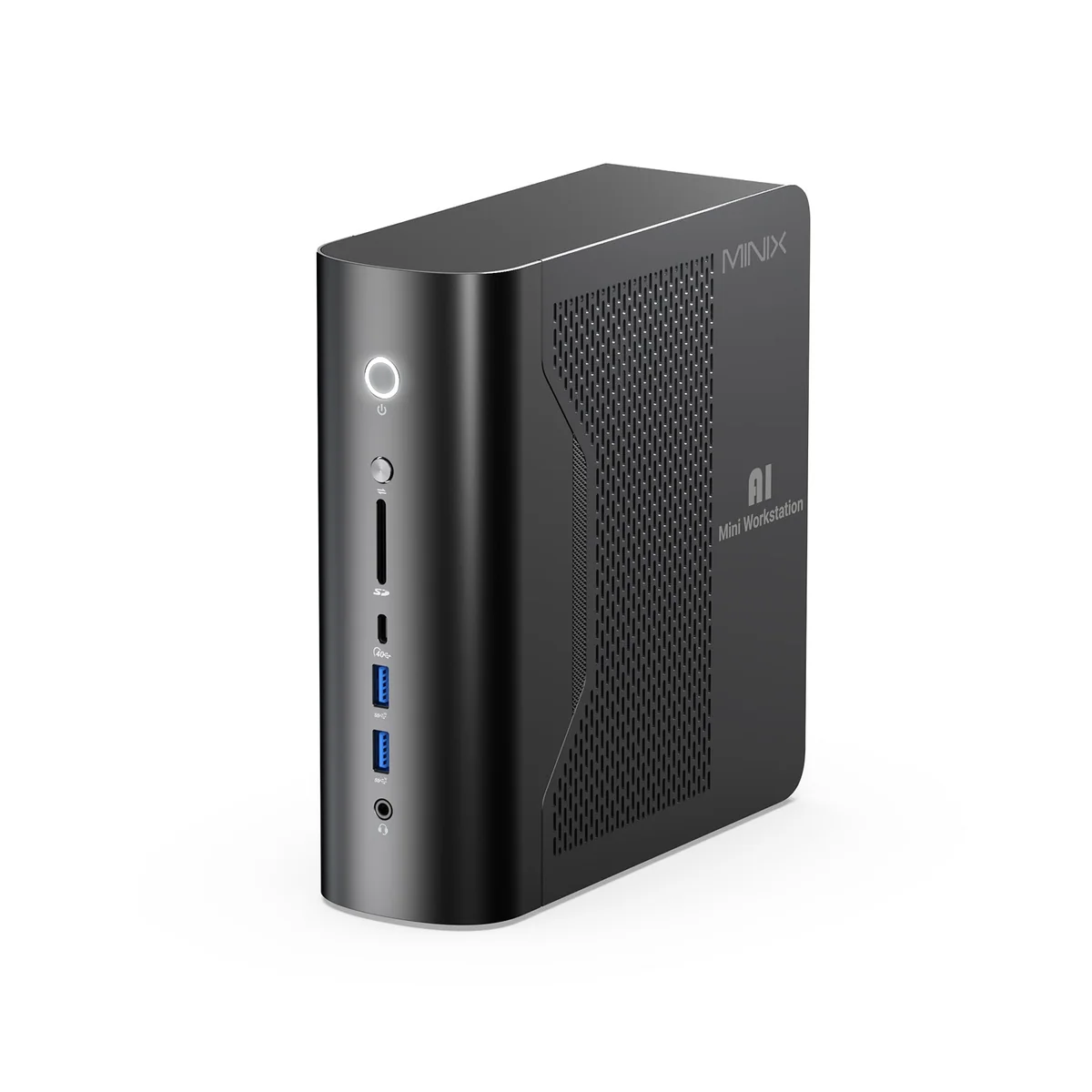
The MINIX Elite ER939-AI is MINIX’s first Strix Halo mini PC: a 2.8-liter, book-shaped tower built around the AMD Ryzen AI Max+ 395 with 16 Zen 5 cores, the 40-CU Radeon 8060S iGPU and a 50 TOPS NPU (AMD quotes 126 TOPS for the whole platform). The configuration MINIX actually sells pairs that chip with 128 GB of LPDDR5X-8000 and a 2 TB PCIe 4.0 SSD, which puts it in the same local-AI bracket as the Beelink GTR9 Pro, the BOSGAME M5 and the OneXStation.
MINIX is a Hong Kong brand better known for its ER936/ER937 Ryzen AI 300 boxes. The ER939-AI is its bid for the workstation tier, and it launched at $2,899 in late 2025.
What the MINIX Elite ER939-AI is good for
This is a machine for running large language models locally, and secondarily for creators who want a quiet 16-core box that never needs a discrete GPU.
- Local LLM inference. 128 GB of unified memory on a 256-bit bus lets you load 70B-class models at 4-bit quantization with room for context, something no 24 GB consumer graphics card can do. Bandwidth, not compute, is the ceiling: The Tech Revolutionist measured 120.8 GB/s in AIDA64’s read test, which is the normal Strix Halo figure and translates to single-digit tokens per second on 70B models and comfortable speeds on 20B to 32B models.
- Content creation. In the 120 W Performance mode, The Tech Revolutionist logged Cinebench 2024 multi-core 1,148 / single-core 94, Geekbench 6 multi-core 17,296 / single-core 2,943 and PCMark 10 Extended 8,960. That is desktop Ryzen 9 territory for encoding and rendering.
- AI-assisted office work. Geekbench AI on the Radeon 8060S returned 24,010 (single precision) and Procyon’s Computer Vision test on the NPU scored 1,784, so Windows Copilot+ features and DirectML apps run on the accelerator rather than the CPU.
Gaming is a bonus, not the pitch. The 8060S sits near an entry-level discrete card, good for 1080p high settings and 1440p medium in most titles.
Build and connectivity
MINIX describes the housing as a metal and plastic combination; both Tech Critter and The Tech Revolutionist called the outer shell metal and said the 1.37 kg unit feels solid rather than cheap. It stands upright at 205 x 192 x 70 mm, pulls air in from the bottom and sides and exhausts out the back through a triple-fan stack MINIX calls a twin-turbo intercooler.
Port selection is generous for a box this size. Front: a fingerprint power button (Windows Hello), an SD 4.0 reader, one USB4 (40 Gbps, DP Alt Mode), two USB-A 3.2 Gen 2 and a 3.5 mm jack. Rear: a second USB4, another USB-A 3.2 Gen 2, two USB-A 2.0 for peripherals, HDMI 2.1 and DisplayPort 1.4 (both 8K@60), 2.5 GbE, audio, the 240 W DC input and a Kensington slot. Four 8K displays at once is supported.
Wireless is a tri-band Wi-Fi 7 M.2 2230 module with Bluetooth 5.4. Tech Critter topped out around 2.4 Gbps in ideal conditions and noted the module does not do full 320 MHz channels, so it behaves more like a fast Wi-Fi 6E card.
Does the MINIX ER939-AI run hot or loud?
Both hands-on reviews say no in daily use. The Tech Revolutionist ran it for hours without throttling symptoms and called fan noise “responsive but not overly loud”. Tech Critter was more precise: under sustained full-CPU load the chip does eventually pull clocks back, but noise stays controlled. Three power modes are available, Silent 55 W, Balanced 85 W and Performance 120 W, though you switch them in the BIOS; there is no Windows utility.
Memory, storage, and upgrades
The 128 GB is soldered LPDDR5X and cannot be changed later. MINIX’s spec sheet writes it as “8 x 16 GB” and NotebookCheck repeated that as “eight slots”, but those are eight memory packages on the board, as on every Strix Halo system. Buy the capacity you will need in three years.
Storage is where you do have room. The 2 TB PCIe 4.0 x4 boot drive sits in an M.2 2280 slot and a second 2280 PCIe 4.0 slot is free; MINIX rates the system for up to 8 TB. Tech Critter’s early unit shipped with DRAM-less SSDs, fine for boot duty but worth swapping for a drive with a DRAM cache if you stream 40 GB model files from disk.
Pricing and where to buy
MINIX launched the 128 GB / 2 TB ER939-AI at $2,899 (€2,999, £2,579). The official store currently lists it at $3,150 and shows it sold out; a 64 GB / 2 TB configuration has appeared at Best Buy, and European buyers can find it at Geekbuying for about €3,910 from an EU warehouse. We could not locate a US Amazon listing for the standard model, so there is no affiliate link here.
MINIX also sells the ER939-AI Pro at $3,500, which swaps the single 2.5 GbE for dual 10 GbE, adds an aluminum shell with a leather handle. An ER939-AI Ultra was also shown at Computex 2026. Warranty is two years with US and EU local delivery support.
MINIX Elite ER939-AI vs Beelink GTR9 Pro
Same APU, same 128 GB. The GTR9 Pro gives you dual 10 GbE and a vapor-chamber cooler for well under $2,000; the ER939-AI counters with a front SD reader, a fingerprint button and a taller chassis at a price roughly $1,000 higher. If networking matters, the Beelink wins on paper.
What we’d flag
- A single 2.5 GbE port on a $3,000 box is thin. Anyone moving datasets or model weights across a LAN will want the Pro or a USB4 10 GbE adapter.
- Price versus the field. At $2,899 to $3,150 it is at the top of the Strix Halo range without a headline feature that justifies the gap.
- Availability. The standard model has been sold out on MINIX’s store; stock has been inconsistent since March 2026.
- Support footprint. MINIX is a small brand with two-year coverage and no US repair depot on the scale of ASUS or HP. The early hands-on reports are positive, but the long-term track record on this tier is short.
- Minor: Wi-Fi 7 without 320 MHz, DRAM-less stock SSDs, BIOS-only power modes and a large 240 W brick.
Verdict
The MINIX Elite ER939-AI does what a first Strix Halo workstation should: it delivers the full 120 W Ryzen AI Max+ 395 with 128 GB of memory, runs cool and quiet, and packs the I/O a creator or AI developer actually uses, including USB4 on both faces and an SD reader up front. Its weaknesses are the price tag and the lone 2.5 GbE port, not the engineering.
We recommend it if you want a quiet, well-built 128 GB Strix Halo desktop and can find it near its $2,899 launch price. If dual 10 GbE matters more than a fingerprint reader, buy the Beelink GTR9 Pro instead.