
What it is
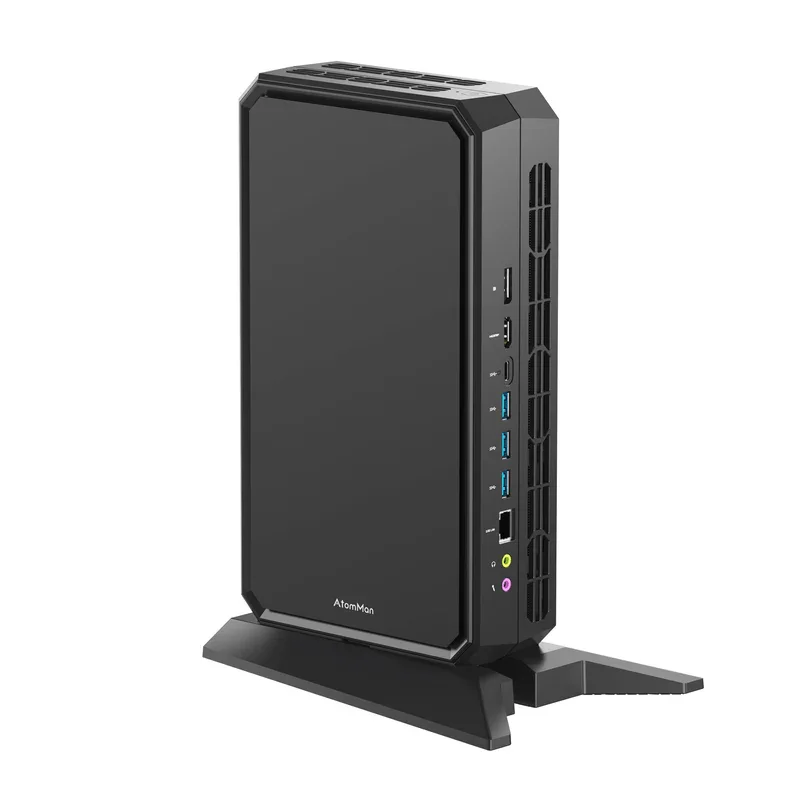
The Minisforum HX200G is a 2.6-liter mini gaming PC built around AMD’s Ryzen 9 7945HX (a 16-core, 32-thread Zen 4 part originally designed for desktop-replacement gaming laptops), paired with a discrete Radeon RX 7600M XT GPU on RDNA 3, with 32 compute units and 8 GB of GDDR6. It was unveiled at CES 2024 as the HX200G, rebranded mid-launch to the AtomMan G7 Pt when Minisforum spun out the AtomMan sub-brand for its premium SKUs, and it is the world’s first mini PC to carry AMD Advantage certification.
A note on naming and silicon: the assignment brief for this article referenced a “Ryzen 9 9955HX3D” variant. We cannot find a 9955HX3D HX200G SKU on Minisforum’s site, in their store, on Amazon, or in any reviewer database as of late May 2026. The shipping HX200G / AtomMan G7 Pt uses the Ryzen 9 7945HX (Zen 4, not Zen 5), and that is the unit this review covers. If Minisforum refreshes the chassis with a 9955HX3D drop-in later, we will revisit it. For now, what you can buy is the 7945HX SKU.
It is also a Minisforum, and that matters more than the spec sheet does.
What it’s good for (on paper)
1080p and entry-1440p gaming. This is the rare mini PC with real discrete graphics. The RX 7600M XT lands roughly between a desktop RTX 4060 and RTX 4060 Ti at native resolutions, and with FSR Super Resolution + Frame Generation it holds Ultra settings at 1440p in titles like Cyberpunk 2077 and Ghost of Tsushima. 1080p high-refresh in esports titles is the comfort zone. The platform total (85 W CPU + 120 W GPU = 205 W of cooling headroom under the “Cold Wave Ultra” liquid-metal solution) is class-leading for the size.
Heavy multi-threaded creator work. Sixteen Zen 4 cores at up to 5.4 GHz chew through Blender, DaVinci Resolve, code compiles, and 4K video timelines in a way no APU-only mini PC can match. Cinebench R23 multi-core scores from reviewer units land in the 28,000–30,000 range, territory that puts this unit ahead of any iGPU-only mini PC including Minisforum’s own AI X1 Pro-370.
Living-room PC duty. With a vertical stand, AAA gaming under a TV, and a chassis that’s noticeably smaller than a console, the HX200G is one of the few mini PCs that can credibly replace a PlayStation 5 or Xbox Series X and a desktop work machine on the same shelf.
All of that is real. None of it is the reason we cannot recommend this unit.
Build and connectivity
The chassis is metal with large perforated intake and exhaust vents front and back, oriented vertically. Quad-fan cooling with liquid-metal TIM on both CPU and GPU is the headline cooling story, and reviewer measurements confirm sustained sub-45 dBA noise under full load, genuinely quiet for the wattage. Port layout is generous for a 2.6 L unit:
- 2× USB4 (40 Gbps): display output, eGPU-capable on top of the built-in dGPU
- 4× USB 3.2 Gen 2 Type-A
- 1× USB-C with DisplayPort alt-mode
- HDMI 2.1 (4K @ 120 Hz)
- DisplayPort 2.0
- 2.5 GbE Ethernet
- Wi-Fi 7 + Bluetooth 5.4
- 3.5 mm combo audio jack, SD card reader
- Two M.2 2280 NVMe slots: 1× PCIe 5.0 + 1× PCIe 4.0 (the Gen 5 slot is one of the first in the mini PC category)
The original Minisforum spec sheet at CES 2024 advertised dual 5 GbE networking. The shipping AtomMan G7 Pt has single 2.5 GbE. This is a quiet downgrade from the announcement specs that buyers comparing against the CES coverage should be aware of.
The unit uses an internal power supply rather than a brick, a real refinement at this class.
Memory, storage, and upgrades
Two SODIMM slots, DDR5-5200 (note: the announcement specced DDR5-5600; the shipping unit is 5200), up to 96 GB total with 2× 48 GB SODIMMs. The barebones SKU ships with no RAM, no SSD, and no OS for users who already have parts; the 32 GB / 1 TB pre-built SKU is the most common configuration sold on Amazon and Minisforum’s store. The PCIe 5.0 NVMe slot is genuinely useful for users with Gen 5 drives on hand, though Gen 5 thermals in a chassis this dense are a real consideration. Keep an eye on SSD temperatures with a high-performance drive installed.
Pricing and where to buy
As of late May 2026, the AtomMan G7 Pt’s pricing has settled into a tight range. The 32 GB / 1 TB pre-built SKU is listed at $1,249 MSRP, with regular promotional discounts taking it to $999 on Minisforum’s own store and around $1,069 on Amazon US (ASIN B0DDC4CTMC). The barebones SKU sits roughly $250 below that. The 3-year factory warranty is the published policy on both channels, in theory. See below.
What we’d flag
This is the section that decides whether the HX200G belongs on your desk.
Measured weaknesses on this specific unit
- Single 2.5 GbE downgrade from announcement. The CES 2024 spec sheet advertised dual 5 GbE; the shipping unit ships with one 2.5 GbE port. If you bought based on the announcement coverage, this is a real change.
- DDR5-5200 instead of DDR5-5600. Another quiet downgrade from announcement specs. Real-world performance impact is small, but the marketing-to-shipment delta is a pattern worth noting.
- Gen 5 NVMe thermals in a dense chassis. The PCIe 5.0 slot is a headline feature, but thrashing a Gen 5 SSD under load in a 2.6 L box next to a 120 W GPU is going to thermally throttle most drives without aftermarket heatsinks. The slot exists; the headroom to actually use it does not, fully.
- 205 W of heat in 2.6 L. Cooling is class-leading for the size, but it is for the size. Ambient room temperature, dust accumulation, and case-on-carpet placement matter more here than they do on a tower PC. Plan accordingly.
- Single-channel storage on PCIe 4.0 + 5.0 mixed. Two slots is fewer than the three on the AI X1 Pro-370. For a unit at this price, 12 TB on two slots is a real maximum.
- No OCuLink. The USB4 ports cover eGPU expansion, but Minisforum’s own AI X1 Pro-370 includes OCuLink, and the HX200G’s discrete dGPU arguably means most buyers do not need it, but it’s a notable omission against the company’s own lineup.
Brand-level concerns specific to Minisforum
The reliability tax that comes with buying a Minisforum is not theoretical, and it is more relevant here than on most SKUs because the HX200G’s sibling product (the AtomMan G7 Ti) is the centerpiece of our most-read sudden-death case study.
- The AtomMan G7 Ti (same chassis lineage, same sub-brand) went dark six months into ownership at $1,500, with the owner publicly concluding “don’t buy a mini PC without local support.” The full case study is here. The HX200G shares the AtomMan thermal-density design philosophy directly.
- The UM790 Pro shipped dead motherboards in identifiable batches across 2023–2024, with RMA turnaround times stretching well past published SLAs in a non-trivial number of cases.
- The MS-01 has a documented history of VRM fires and thermal paste application defects from the factory. Both are relevant to a 205 W mini PC that depends on factory-applied liquid metal TIM.
- The NAB9 had a capacitor recall that was handled inconsistently across regions.
- BIOS updates have bricked units across multiple SKUs (documented here).
- Support response patterns across the company have been unresponsive enough to warrant their own writeup. The 3-year warranty is only as good as the company’s willingness to honor it.
- Chassis warranty denials have been contradictory across cases: same defect, same brand, different outcomes. EU buyers should additionally be aware of warranty depreciation fees that other brands do not apply.
None of these incidents are specific to the HX200G. The AtomMan G7 Ti sudden-death case is specific to its direct sibling. All of them are specific to the company that builds the HX200G. A buyer choosing this unit is implicitly accepting that, if something goes wrong, the support experience may be the one documented in the articles above.
Minisforum HX200G verdict: we do not recommend
The HX200G / AtomMan G7 Pt is, in pure spec-sheet terms, one of the most ambitious mini PCs ever built. Sixteen Zen 4 cores, a discrete RX 7600M XT, dual liquid-metal cooling, PCIe Gen 5, AMD Advantage certification, internal PSU, sub-45 dBA noise under load: there is no other mini PC at this size delivering this combination of CPU power and dGPU gaming.
We still do not recommend buying it. Two concrete alternatives:
-
If you want a powerful AMD mini PC and you do not strictly need a discrete GPU at this price, the Beelink SER9 HX370 is the cleaner buy. Ryzen AI 9 HX 370 (Zen 5, twelve cores), Radeon 890M with 50 TOPS XDNA 2 NPU, and a support track record that is, while imperfect, materially better-documented and more responsive than Minisforum’s, at roughly $300–$500 less than the HX200G’s promo price. You lose the dGPU, but the 890M handles 1080p Medium and any non-gaming workload you’d throw at the HX200G. Our review: Beelink SER9 HX 370 review.
-
If you specifically want desktop-class dGPU gaming and you can give up the mini form factor, a Mini-ITX build with a Ryzen 7 7700 / 7800X3D and an RTX 4060 or 4070 lands in the same $1,000–$1,400 range with materially better cooling headroom, a real desktop GPU, full upgrade paths on every component, and a warranty model where every part has its own manufacturer behind it rather than a single point of failure. You give up the 2.6-liter footprint; you gain serviceability, repairability, and the ability to RMA an individual component without shipping the whole machine to Shenzhen.
Related: Best gaming mini PCs with RTX or OCuLink.
The premium you pay for the HX200G over those alternatives buys you the small chassis and the engineering achievement of fitting 205 W into 2.6 L. Both are real. What it also buys you is Minisforum’s post-sale support, and on a product class where a sibling AtomMan SKU is our most-read sudden-death case study, that is not a tradeoff we can in good conscience send our readers into.
The HX200G is a remarkable mini PC. It is not a remarkable purchase.