
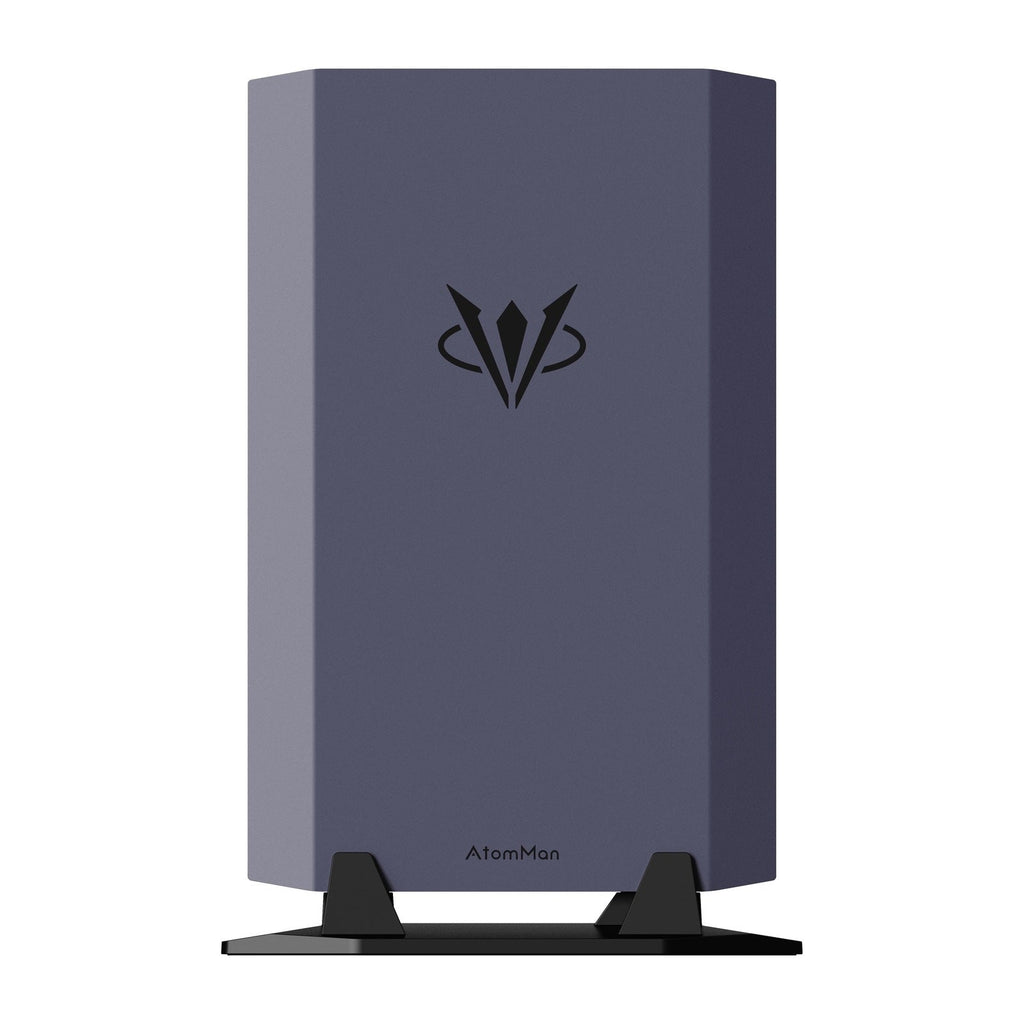
It needs to be said upfront that the AtomMan G7 Ti is ambitious hardware. A Core i9-14900HX paired with an RTX 4070 mobile GPU, shoehorned into a mini-PC chassis that is dramatically smaller than any equivalent gaming desktop and cheaper than any equivalent gaming laptop with the same silicon. The NotebookCheck review framed it, accurately, as a gaming-laptop-without-a-screen: a space-saving alternative to the standard gaming desktop form factor. Cramming a desktop-replacement CPU and a mid-range gaming GPU into a box that size is a real engineering achievement. The PC Gamer review gave Minisforum credit for pulling it off.
Thermal headroom at that density was always going to be the question.
What Mike Shouts published
The case study that has circulated through enthusiast communities is Mike Shouts’ “Don’t Buy A Mini PC Without Local Support”. The author’s timeline is specific and short: unit purchased in August, delivered in October, used as a primary gaming and work machine through the following months. In February 2025, less than six months after delivery, the screen went blank mid-use. Blank as in: the displayed output stopped without warning, the system became unresponsive to keyboard or mouse, and after the customer cycled power, the unit did not boot. No POST. No indicator lights progressing through their normal startup sequence. No recovery from BIOS reset, CMOS pull, or RAM reseating.
The machine was dead to troubleshooting. Not a problem a user could diagnose and fix. A manufacturer-recovery event, inside the warranty window.
What happened next is the part of the post that matters most. The author, writing from Singapore, discovered that the machine was purchased from a sales channel with no local-entity presence for warranty service. The options available were: ship the dead unit back to Minisforum’s international RMA address at his own cost, wait through an RMA cycle measured in weeks, and either receive a repair, a replacement, or (in the worst case) an assessment that the failure was out-of-scope for warranty coverage. The cost of the shipping leg alone, on a chassis that size to an international destination with customs and duties handling, was a meaningful fraction of the machine’s original price.
The author walked through the arithmetic and wrote the post title. The word “without” in “don’t buy a mini-PC without local support” is load-bearing; the piece is not arguing that mini-PCs are bad, but that a mini-PC purchased outside the warranty jurisdiction is a bet that nothing goes wrong, and at $1,500 with the specific Core i9 + RTX 4070 thermals involved, that bet has odds the average buyer does not calculate before checkout.
The surrounding evidence on Minisforum AtomMan G7 Ti thermals
The PC Gamer review flagged thermal and noise concerns on the G7 Ti, calling out that the platform runs hot for mobile-grade CPU-in-slim-chassis products. NotebookCheck’s review corroborated the noise-and-cooling-headroom profile. Neither of these is a direct causal mechanism for the sudden-death failure Mike Shouts reported (a dead system can have many origins), but both establish that the chassis was running close to its thermal envelope at normal operating conditions.
When a system operates close to its thermal envelope for six months, and then dies, the probabilistic answer is that something in the power-delivery or solder-joint stack reached a degradation threshold that a cooler-running chassis wouldn’t have reached in the same window. The Mike Shouts post does not do an electrical post-mortem (the author is not a board-level technician), but the timeline fits the thermal pattern that professional reviewers had already flagged.
The single case and the general rule
One documented failure on one customer’s G7 Ti does not prove the G7 Ti is a six-month-lifespan product. The evidence does not support that claim, and this article isn’t making it. What the case does prove is that when the failure does come (on this specific product, purchased outside Minisforum’s direct support geographies), the cost of exercising the warranty is high enough to convert the warranty into a partial remedy rather than a full one. The customer who walks through the shipping math, as Mike Shouts did, ends up with a dead machine, an RMA cycle, and a post that doubles as a warning to the next buyer. Related: Minisforum Japan’s warranty and parts gap, the Korean after-sales gap for parallel imports, and an MS-01 owner’s VRM fire warranty experience.
The rule the author draws is the practical one. Before buying a $1,500 mini-PC with desktop-replacement silicon inside, verify what happens when it fails. If there is no local RMA entity in your country (if the path back runs through a support portal in another region and a courier bill with no insurance subsidy), the sticker price is not the full price. The full price includes an option on a future RMA event that may or may not fire, but that compresses the warranty’s real value whether or not it does. The G7 Ti’s engineering is ambitious. The backstop for when the engineering doesn’t hold is not there for the customer who bought it at a distance, and that is the sentence most likely to still be true for the next buyer who clicks add-to-cart without reading Mike Shouts’ piece first.