
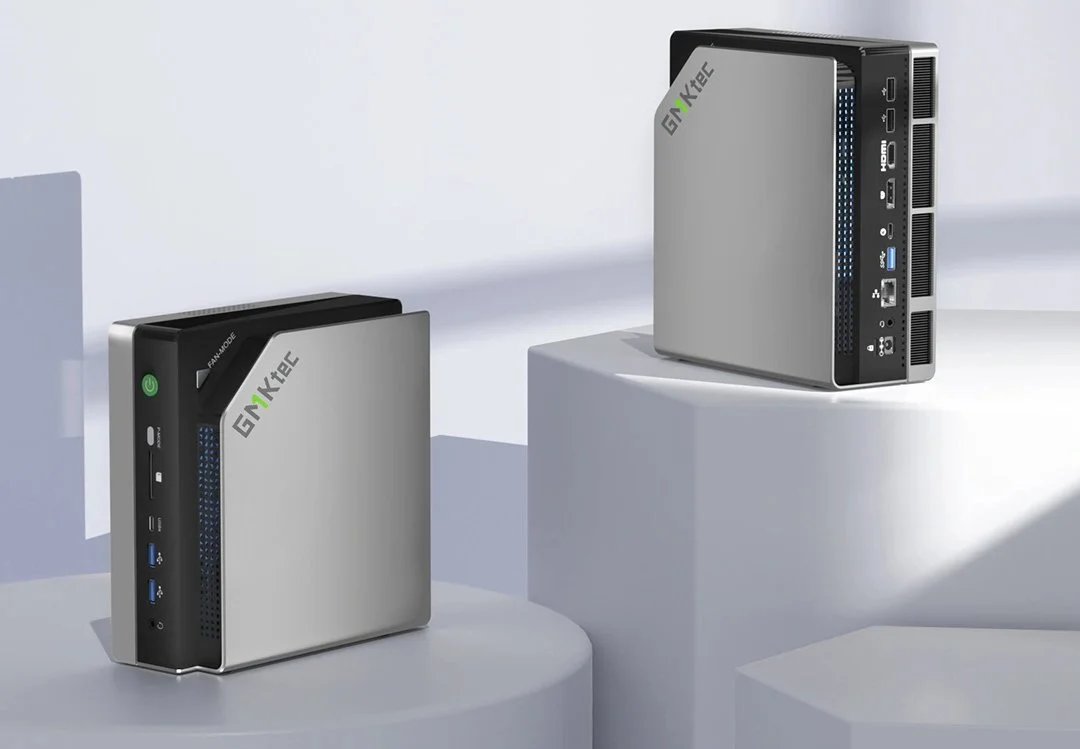
There is a version of the EVO-X2 story that reads like a coup. AMD’s Ryzen AI Max+ 395, codenamed Strix Halo, is the most ambitious x86 APU ever shipped: a 16-core Zen 5 CPU welded to a 40-CU RDNA 3.5 iGPU, fed by up to 128 GB of LPDDR5X-8000 on a 256-bit bus, with a 50-TOPS XDNA 2 NPU bolted on for good measure. Framework announced a desktop around it. HP announced the ZBook Ultra. Asus announced the ROG Flow Z13. And then GMKtec, a Shenzhen mini-PC maker best known until last year for budget N100 boxes, put one in a 4-litre chassis and started shipping it before any of them.
That is the high-water mark of the story, and it is genuinely impressive. Everything downstream of it is more complicated.
What the GMKtec EVO-X2 hardware actually is
The EVO-X2 is, on paper, what every “AI PC” launch since 2023 has been promising and not delivering. Tom’s Hardware measured the top configuration with 128 GB of unified LPDDR5X-8000, a 2 TB Gen 4 SSD, and a Ryzen AI Max+ 395 sustaining well above its 120 W cTDP under combined CPU+GPU load. The iGPU benchmarks within shouting distance of a mobile RTX 4060, and (the headline number for the AI crowd) the unified memory architecture means the GPU can address up to 96 GB of that pool as VRAM-equivalent.
In practical terms, that is the difference between running a 70-billion-parameter language model in 4-bit quantisation locally and not running one at all. NotebookCheck’s review walked through exactly that workflow, loading Llama-3.3-70B and Qwen2.5-72B in llama.cpp’s Vulkan backend and getting usable interactive token rates from a desktop that fits under a monitor stand. Until Strix Halo, that workload required a discrete RTX 4090, a 3090 with 24 GB, or a Mac Studio.
ServeTheHome’s deep-dive framed the platform’s significance in blunter language: this is the first time a single SoC at this price point can credibly host enthusiast-tier local AI inference, and GMKtec is the first vendor a buyer can actually order one from. Related: our full GMKtec EVO-X2 review and our look at 70B-class local AI on the EVO-X2.
What the software stack is not
The caveat that runs through every serious review is the same caveat that has shadowed AMD’s AI strategy for two years: the hardware is ahead of the software. The XDNA 2 NPU advertised at 50 TOPS is, on launch, supported by a narrow set of frameworks, primarily AMD’s own Ryzen AI software and a handful of ONNX paths. It is not what is doing the heavy lifting on the 70B model demos in any of the reviews. The iGPU is, via Vulkan or AMD’s ROCm stack.
Phoronix benchmarked the platform on Linux at length and the picture is consistent: when ROCm works, it works very well; when it doesn’t, the fallback is CPU inference and the whole AI pitch collapses. The iGPU is technically gfx1151, a target that ROCm 6.x supports unevenly and that several upstream projects (PyTorch nightly, vLLM, sglang) treated as experimental at launch. Buyers who plan to use the EVO-X2 for serious local AI work need to be comfortable with build flags, kernel versions, and the occasional rebuild from source.
The Phawx made the same point in plainer terms in his Strix Halo deep-dive: this is a halo platform that rewards Linux power users and punishes everyone else. On Windows, the LM Studio path works, but the throughput leaves performance on the table that the hardware can clearly deliver.
The thermals, the price, and the brand
The chassis is small, and the SoC is not. Reviewers consistently noted the EVO-X2 runs warm under sustained AI load, fan-audible in a quiet room, with surface temperatures that confirm the cooler is doing real work. ETA Prime’s first-impressions video recorded the fan curve on a multi-hour inference run and described the noise floor as “tolerable, not silent,” which is roughly the honest answer for any 120-watt mini-PC.
Pricing is the other reality check. The 128 GB / 2 TB configuration that makes the local-AI story work launched at roughly $2,000, with lower-memory SKUs starting around $1,500. That is mini-PC territory only by chassis volume. By cost, it is competing with a Mac Studio M4 Max and with a self-built ATX workstation carrying a used RTX 3090.
And then there is the brand question. GMKtec is not Framework. It is not HP. Its warranty is the standard one-to-two-year window familiar to anyone who has bought a Beelink, AceMagic or NiPoGi unit, fulfilled out of Shenzhen, with the same return-shipping frictions that have defined the category. A buyer spending $2,000 on a first-of-its-kind platform is, in effect, paying enthusiast-platform money for consumer-mini-PC support. That trade is fine if you know you are making it. It is less fine if you assumed the price tag bought you workstation-class service.
The takeaway
GMKtec deserves credit for shipping. In a category where being first usually means a Kickstarter render and a six-month delay, the EVO-X2 is on doorsteps and being benchmarked by the press that matters. The hardware does what AMD promised it would do, the unified memory architecture is a genuine inflection point for local AI work, and the engineering of fitting Strix Halo into 4 litres at 120 W is not trivial.
But the EVO-X2 is a halo product from a value brand, and the seams show. The software stack will mature; ROCm gfx1151 support will land in mainline PyTorch; the NPU will eventually have frameworks worth the TOPS number on the box. Until then, what GMKtec has shipped is the best available mini-PC for users who already know exactly what they want to do with it, and a frustrating overspend for anyone who bought the marketing instead of the benchmarks. Buy it for what reviewers measured this month, not for what the spec sheet implies it will do next year.