
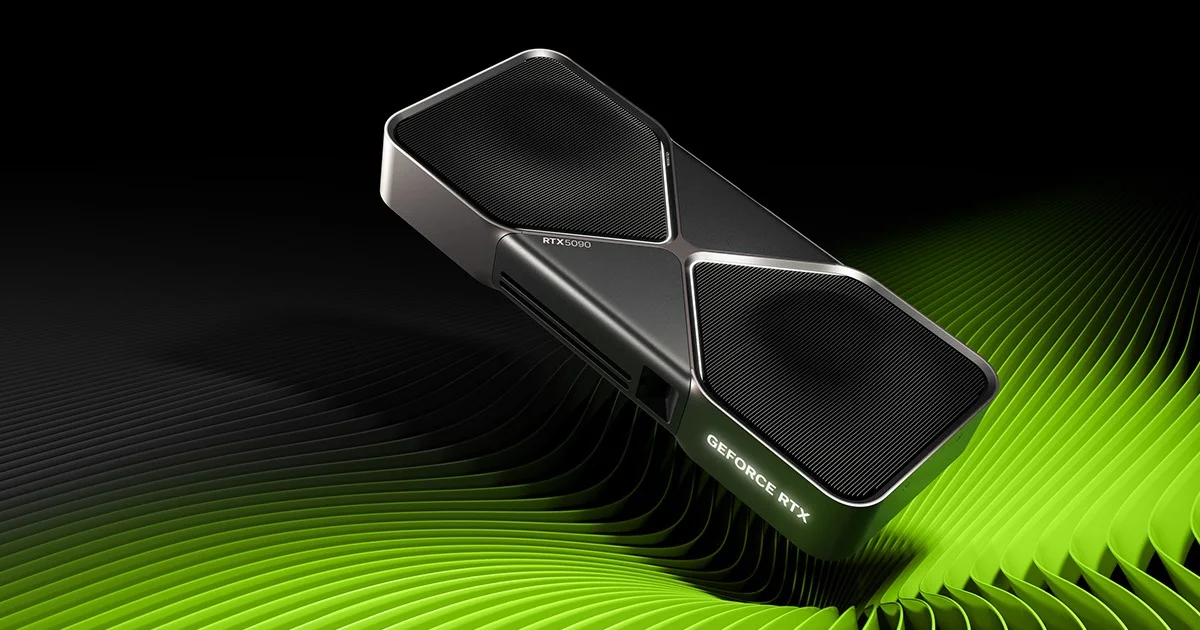
Three stories about GeForce cards collided this week. NVIDIA insists its fastest consumer GPU is still a product, while the shelves say otherwise. A group of modders found that older GeForce cards have been running AI math at half speed on purpose, and shipped a way to turn that off. And the newest driver breaks video playback. Here is what is confirmed, what is measured and what is still a rumor.
The RTX 5090 that is not discontinued, and not on sale
The rumor started on October 10, when leaker MEGAsizeGPU wrote that NVIDIA had confirmed the GB202 chip in the RTX 5090 would no longer go into new RTX 5090 cards, with supply going to RTX PRO workstation boards instead. Micro Center then changed several RTX 5090 models to “Not Carried” and NVIDIA removed the card from the model selector on its US marketplace.
On October 16, at the RTX Spark launch event in Taipei, NVIDIA’s senior vice president for PCs, Jeff Fisher, pushed back. According to 4Gamers, he said supply chain capacity “is indeed somewhat constrained” but that the RTX 5090 “has not been discontinued, and NVIDIA will continue shipping.” Taiwan’s Central News Agency reported the same remarks.
That is the official position. It does not explain the rest:
| Signal (October 2026) | Status |
|---|---|
| NVIDIA US marketplace | RTX 5090 removed from the model list; the 5080 is now the top option |
| Micro Center | Multiple RTX 5090 models listed as “Not Carried” |
| PC Games Hardware sources | Retail, distribution and partner sources confirm an end to new GB202 allocations for GeForce |
| Newegg (October 19) | Most listings above $9,300; most expensive $10,899 |
| Amazon (October 19) | One listing, $11,565, ships from Germany in 2 to 3 weeks |
| ASUS US store (October 20) | TUF RTX 5090 at $4,799.99, in stock |
| NVIDIA product page | Still shows $1,999, nothing to buy |
Notebookcheck’s read is the one we share: companies routinely deny supply chain reports, and admitting “constraints” lets NVIDIA quietly send more GB202 dies to the RTX PRO 6000, which sells for far more. Whether the word is “discontinued” or “constrained”, the result for a buyer is the same. A $1,999 card costs $4,800 from a board partner and $9,000 or more from resellers, as it has since September’s price surge. The cause is the one behind every price in this market right now: GDDR7 and the AI buildout, which we covered in Consumers are paying for the RAM crisis.
Modders double tensor throughput on RTX 20, 30 and 40
The second story is more interesting for anyone running AI at home. Every GeForce card since Turing runs tensor core math at half speed when it accumulates results in FP32, the mode that training and most full-precision inference use. Workstation and data center cards run at full rate. The limit is not a smaller chip. It is a set of “speed select” values the GPU reads from fuses at boot, and NVIDIA’s own whitepapers print the resulting numbers: the RTX 5090, for example, is listed at 419 TFLOPS for FP16 with FP16 accumulate and exactly half, 209.5, with FP32 accumulate.
In October, several open-source projects learned to override those values before the stock NVIDIA driver loads. The Ada version is a Linux kernel module called gpu-unlock-ada; developer Zagitta adapted the approach for RTX 30 cards in the GPU-Unlock project, and a Turing version followed. No firmware is flashed and no driver is patched. The override resets when the card loses power.
The headline numbers, from the projects and reported by HotHardware and VideoCardz on October 25:
| Card | Before | After |
|---|---|---|
| RTX 4090, FP16 with FP32 accumulate | 165.6 TFLOPS | 331.6 TFLOPS |
| RTX 3090 Ti, BF16 | 87.5 TFLOPS | 157.4 TFLOPS |
| RTX 3090, PyTorch GEMM test | 73.0 TFLOPS | 122.8 TFLOPS |
| RTX 2080 Ti, FP16 to FP32 | 59.9 TFLOPS | 111 TFLOPS |
| RTX 4070 Ti SUPER, FP16 with FP32 accumulate | 95.0 TFLOPS | 189.9 TFLOPS |
What that means in practice
Those are instruction issue rates, measured with no memory traffic. The project’s own README is careful about what happens in real code, and it is worth reading before you get excited:
- cuBLAS matrix multiplies on an RTX 4090 gained 12% to 34% in FP16 and 16% to 20% in BF16 depending on shape, and were “essentially unchanged” at 4096 cubed.
- FP8 did not move: an E4M3 GEMM went from 59.326 to 59.495 TFLOPS, a 0.3% difference.
- A quantized mixture-of-experts serving workload on a modified 48GB RTX 4090 showed no gain at all (0.983x on an 8K prefill). Quantized matmuls do not use the FP32-accumulate tensor path.
- INT8, dp4a and scalar FP32 stayed at baseline. Games, which use none of the affected paths, do not get faster. HotHardware’s summary: “Gamers shouldn’t get too excited about this one.”
So the unlock matters if you train or fine-tune in FP16 or BF16 on a consumer card, or run full-precision inference. If you run llama.cpp or Ollama with 4-bit or 8-bit models, which is most local AI use, the memory bus is still your limit and this changes little. Running a kernel module that writes GPU registers before the driver loads also carries risk; the project reports one card, one cold boot and one workload for several of its results.
Does it work on RTX 50?
No, not as of October 26. The published modules cover RTX 20, 30 and 40. VideoCardz reports no confirmed unlock for the RTX 50 series. A measurement published at ai.rs on October 25 found the same half-rate split on an RTX 5090 (441.4 TFLOPS with FP16 accumulate against 224.3 with FP32, a ratio of 1.97) and argues that the fix cannot be ported because the older unlocks go through a signed boot firmware component that Blackwell cards do not ship. That is one blog’s analysis, not a project statement, so treat it as the best current explanation rather than a settled fact. If you own a 5090 or 5080, the practical answer is that nothing is available today.
The driver that breaks video
Smaller, but relevant if you own any RTX card on Windows: NVIDIA has confirmed that GeForce Game Ready driver 621.01 can freeze video playback and produce black screens. Users report that rolling back to 617.42, released on October 6, resolves it. NVIDIA has not said when a fix will ship. If you have not updated, wait.
And the next cards?
The RTX 50 Super refresh, the one with 3GB GDDR7 modules and more memory per card, is now rumored for CES 2027 after being pushed back repeatedly, and there is still no RTX 60 model or date. NVIDIA has not shipped a new gaming GPU in 2026. For local AI buyers, that leaves the same options we listed in our DGX Spark review: a used RTX 3090 or 4090 for models that fit in 24GB, now with a possible training bonus from the unlock, or a 128GB unified-memory box for models that do not.