
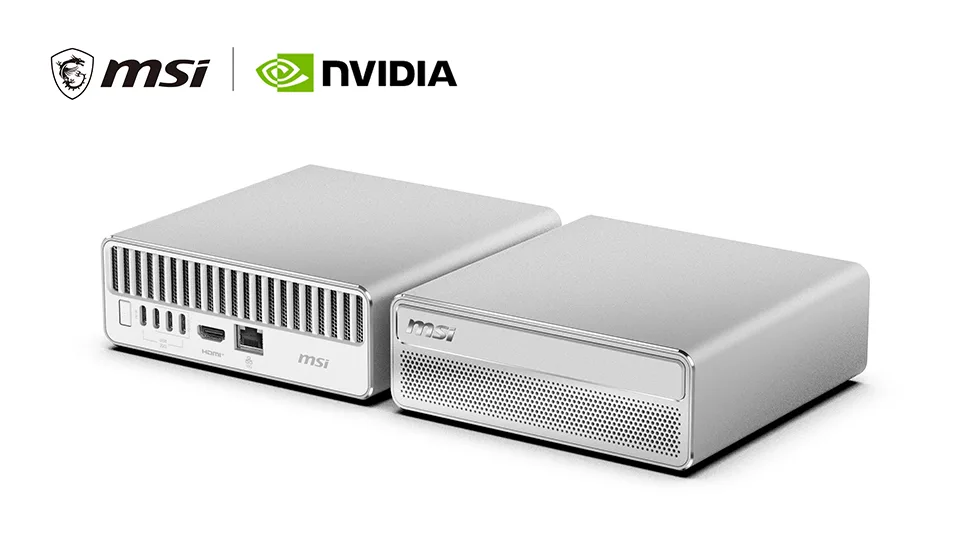
What is the MSI EdgeMesa N AI+
The MSI EdgeMesa N AI+ is a small-form-factor mini PC, unveiled at COMPUTEX 2026, built on NVIDIA’s new RTX Spark platform. It is one of a wave of RTX Spark boxes that landed at the show (alongside the Asus ProArt RTX Spark mini PC and HP’s OmniDesk), but it is the one with the most distinctive pitch. Where most vendors are selling RTX Spark as a desktop AI workstation, MSI is explicitly aiming the EdgeMesa N AI+ at edge-AI vertical deployment: healthcare, retail, finance, robotics and smart-city infrastructure.
If you’ve followed the GB10 “DGX Spark” class of machines, RTX Spark will look familiar. It is the consumer / Windows-on-Arm respin of the same Grace Blackwell superchip family, not a next-generation part, and not “GB10 v2.” The EdgeMesa N AI+ is a forward-looking announcement, not a product you can buy today: MSI showed it at Computex but has not finalized pricing, and units aren’t expected to ship until Fall 2026. Treat the numbers below as confirmed-at-announcement, with the SKU-level details still open.
What’s confirmed
MSI and the press coverage from the show line up on the hardware platform and the I/O. Here’s what is genuinely confirmed:
- NVIDIA RTX Spark platform: the same Grace Blackwell silicon family as the DGX Spark / GB10 boxes, in its consumer guise. RTX Spark pairs a 20-core Arm CPU with a 48-SM Blackwell GPU (6,144 CUDA cores) and up to 128 GB of LPDDR5X unified memory shared between CPU and GPU.
- Compact ~1.6-liter chassis in a rectangular SFF design. MSI’s unit stands out for its white aluminum case, distinct from the gray-and-black look most RTX Spark competitors chose.
- 10 Gigabit Ethernet: a single 10GbE LAN port for moving large datasets in and out, which matters far more in an edge/appliance role than a desktop one.
- Up to four external displays, driven by 1× HDMI plus 3× USB-C (20 Gbps).
- Edge-AI positioning. MSI is selling local processing as the point: lower latency, better data privacy, and reduced reliance on cloud infrastructure for LLM development, generative AI and real-time inference deployed in the field.
- Advanced cooling rated for sustained heavy loads in a small enclosure, a necessity given the silicon and the appliance use case.
One important platform note from ServeTheHome’s hands-on: RTX Spark omits the ConnectX-7 200GbE NIC that the GB10 DGX Spark machines use for two-node clustering. That single 10GbE port is the headline network interface here, which keeps cost and complexity down but means RTX Spark boxes aren’t designed to be lashed together into clusters the way DGX Spark units are. Related: see our coverage of the Lenovo RTX Spark mini PC and the Dell XPS RTX Spark desktop.
What’s still unknown
This is an announcement, so the gaps are real and worth being honest about:
- Memory configuration for this specific SKU. RTX Spark supports up to 128 GB of unified memory, and it’s reasonable to presume the EdgeMesa N AI+ tops out there, but MSI has not published the exact memory tiers for this model.
- Price. None announced, for either the EdgeMesa N AI+ or its sibling laptop. Given where the GB10 class sits (see our DGX Spark 64GB pricing analysis), expect a developer-priced box rather than a cheap mini PC, but that’s an inference, not a quote.
- Storage, exact dimensions, OS image and warranty/support terms for edge deployment: all still blank.
- Memory bandwidth. RTX Spark inherits the GB10 family’s LPDDR5X memory subsystem, which on the DGX Spark side lands around 273 GB/s. MSI hasn’t confirmed the figure for this part, so don’t quote a number yet.
What it means for mini PCs
The interesting thing about the EdgeMesa N AI+ isn’t the silicon (every RTX Spark box shares that); it’s the framing. MSI is the only vendor so far explicitly pitching an RTX Spark mini PC as an edge-AI appliance for vertical industries rather than a developer’s desk toy. That changes which specs matter: the 10GbE port, the four-display output and the sustained-load cooling read as features for a kiosk, a clinic, a retail back-room or a robotics controller, not a workstation.
It also signals where this class of machine is heading. A ~1.6-liter box that can hold a 70B-class model in unified memory and run inference locally, without a cloud round-trip, is a genuinely useful thing to bolt into a fixed installation. Whether MSI backs that pitch with the deployment-grade support, imaging and pricing that edge customers actually need is the open question, and it’s one a spec sheet can’t answer.
Expected timeline and price outlook
- Status: firmly announced, shown in working form at Computex 2026.
- Availability: Fall 2026 (MSI pointed to late summer at the earliest; broader coverage says systems won’t ship until the fall).
- Price: no price announced. Expect it to track the RTX Spark / GB10 developer-box bracket rather than mainstream mini PC pricing.
Sources & caveats
Specs here are drawn from MSI’s official Computex 2026 announcement, ServeTheHome’s show-floor hands-on, and corroborating coverage from NotebookCheck and Guru3D. Everything above is confirmed at announcement; SKU-level details (memory tiers, storage, exact dimensions, price) are not yet public, and we’ve flagged each inference as such.
We’ll review the EdgeMesa N AI+ properly when it ships. In the meantime, if you want a sense of what this Grace Blackwell silicon actually does in a shipping product, read our on-sale GB10 reviews: the NVIDIA DGX Spark and the more aggressively priced ASUS Ascent GX10, both of which are the on-sale siblings of these upcoming RTX Spark desktops.