
What it is
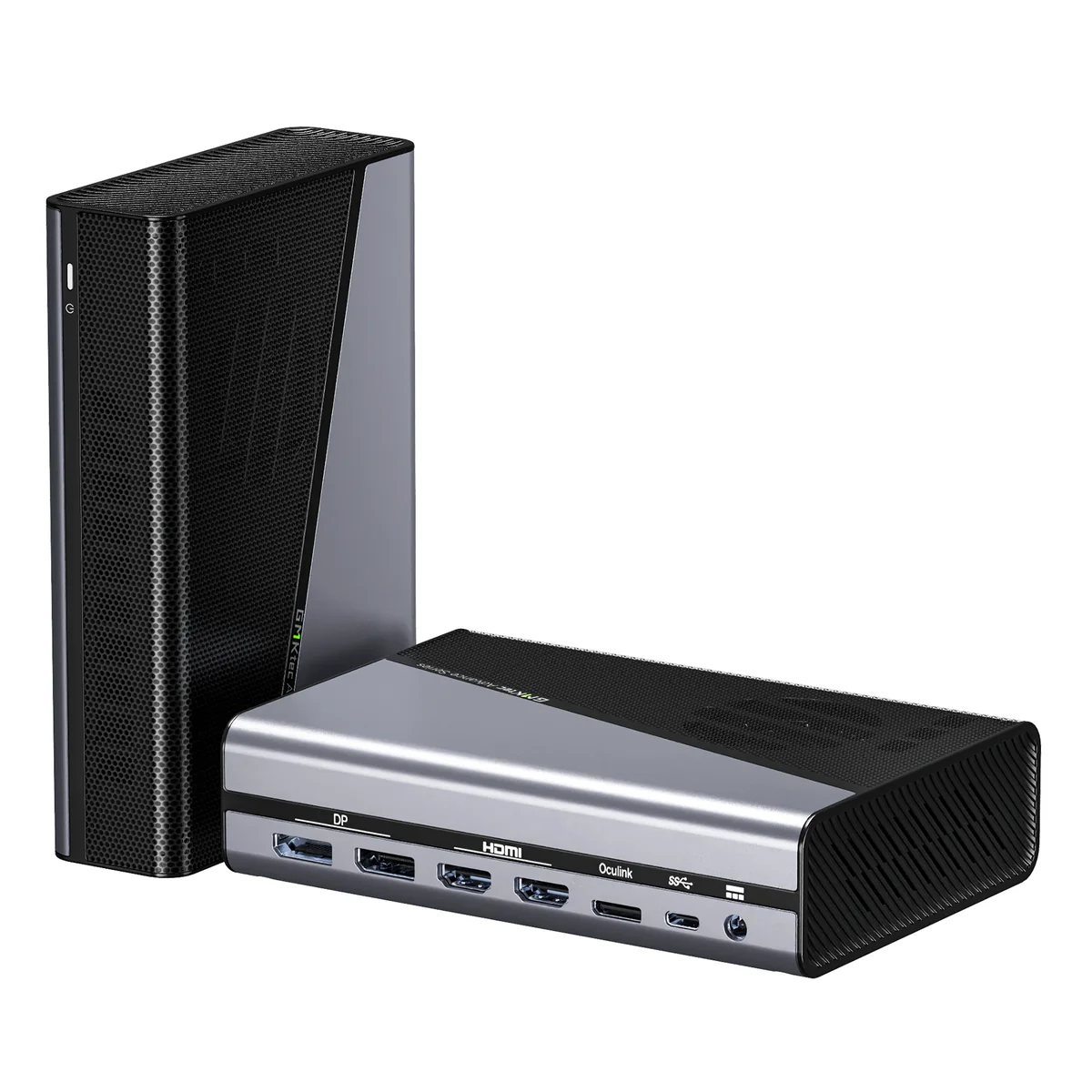
The GMKtec AD-GP1 is an external GPU dock that takes a different approach from almost every other eGPU on the market: instead of giving you an empty enclosure and a PCIe slot to fill, it ships with the graphics card already built in. Inside the 708-gram aluminum body sits an AMD Radeon RX 7600M XT (an RDNA 3 mobile GPU with 8 GB of GDDR6 and a 120 W power target), wired to a host through either an OCuLink port (64 Gbps, PCIe 4.0 x4) or USB4 / Thunderbolt.
That integration is the whole pitch. At roughly 163.9 × 110.5 × 39.9 mm, the AD-GP1 is barely larger than a chunky external SSD enclosure, and it bundles its own 240 W power supply. There’s no ATX brick to source, no GPU to seat, no side panel to wrestle off. For owners of OCuLink-equipped mini PCs and USB4 laptops, it’s the closest the eGPU category has come to genuinely plug-and-play. It’s currently listed around $429–$469.
Interface and bandwidth: how the AD-GP1 connects
The AD-GP1 gives you two ways in, and the choice matters more than the marketing suggests.
- OCuLink (SFF-8612) is the fast path: a direct PCIe 4.0 x4 link rated at 64 Gbps. This is the connection you want, and it’s why the dock exists. OCuLink carries raw PCIe with very little protocol overhead, so it loses far less performance than USB4 to the same GPU.
- USB4 / Thunderbolt is the compatibility path. It tops out around 40 Gbps and, more importantly, adds tunneling overhead and higher latency. The convenience is real (USB4 also delivers up to 100 W of Power Delivery back to the host, so a thin laptop can charge off the same cable), but you give up frame rate to get it.
OCuLink vs USB4: how much speed do you lose?
Even OCuLink’s PCIe 4.0 x4 is a quarter of the lanes a desktop card gets in a full x16 slot, so expect some loss versus the same silicon in a tower: typically single-digit to low-double-digit percentages at 1080p/1440p, widening in CPU- and bandwidth-bound titles. The gap between OCuLink and USB4 on this dock is the more meaningful one: reviewers consistently measure OCuLink ahead, sometimes substantially in games sensitive to interface bandwidth and latency. If your host has an OCuLink port, use it. Treat USB4 as the fallback for machines that lack one. Related: our guide to the best eGPU adapters for mini PCs covers OCuLink, USB4 and M.2 options.
What GPUs and hosts it supports
This is the AD-GP1’s biggest departure from a conventional eGPU enclosure: the GPU is integrated and non-upgradable. You are buying a Radeon RX 7600M XT, full stop. There’s no slot to drop a 4090 into later, and no path to a newer card down the line. If your plan is to reuse a desktop GPU you already own, this is the wrong product; look at an open enclosure like the Beelink EX Dock instead.
What you gain in return is that nothing about the host side is fussy. The AD-GP1 works with:
- OCuLink mini PCs: the ideal hosts. GMKtec’s own OCuLink-equipped boxes like the GMKtec K8 Plus are a natural match, as are OCuLink-port machines from other brands such as the Minisforum MS-A2.
- USB4 / Thunderbolt laptops and mini PCs: anything with a USB4 or Thunderbolt 3/4 port can drive the dock over that interface, including machines that have no OCuLink port at all. Popular USB4 hosts like the Beelink GTi14 Ultra fall in this camp (the GTi14 also offers a dedicated PCIe dock route).
- Handhelds and game consoles with OCuLink or USB4: the dock is small enough to make a desk-side handheld station practical.
The RX 7600M XT lands in the same broad performance neighborhood as a desktop RX 7600 / RTX 4060: comfortable 1080p high and competent 1440p gaming, smooth esports titles, and a useful accelerator for creator work (GPU-accelerated export in Resolve/Premiere, Blender viewport) and light AI inference where its 8 GB of VRAM is the real ceiling. Related: the GPD G1 is a pocket OCuLink eGPU built around the same RX 7600M XT.
Build, power, and cooling
The chassis is dense aluminum with a blower-style cooler venting out one end, and the whole thing weighs about 708 grams, genuinely portable, the kind of object you can drop in a backpack alongside a mini PC. The 240 W power supply is in the box, which removes the single most annoying part of most eGPU builds: sourcing and sizing your own ATX or SFX unit. Because the GPU is a 120 W mobile part rather than a 250 W+ desktop card, 240 W is plenty of headroom for the GPU plus the dock’s USB-PD passthrough.
Display flexibility is a quiet strength. The dock drives four monitors directly (2× HDMI 2.1 and 2× DisplayPort 2.0, all rated to 8K60), so you can run the GPU’s outputs straight to your panels rather than routing back through the host. For a multi-monitor desk that alone can justify the form factor.
Under sustained load the blower is audible, as every compact GPU cooler is, and the metal body gets warm to the touch; both are expected for a 120 W card in a sub-liter enclosure.
Pricing and where to buy
The AD-GP1 sells for roughly $429–$469, with GMKtec’s own store listing it near $469.99 and Amazon and other retailers fluctuating a little below that. It’s available on Amazon as well as Newegg, Walmart, and Micro Center.
For value, the math is straightforward: a comparable build of an empty OCuLink enclosure ($60–$120), a discrete RX 7600 ($250–$300), and a separate PSU lands in similar territory but takes more parts, more space, and more assembly. The AD-GP1 trades the upgrade path for an all-in-one box that’s smaller than the GPU alone would be.
What we’d flag
The AD-GP1 is a likeable product, but the compromises are real and worth stating plainly.
- The GPU is permanent. No upgrade path, ever. When the RX 7600M XT feels slow in a few years, the whole dock is what you replace.
- 8 GB of VRAM is the practical limit. Fine for 1080p/1440p gaming and most creator tasks today, but it constrains higher-resolution texture settings, large AI models, and future titles that lean on VRAM.
- USB4 leaves performance on the table. If your host lacks OCuLink, you’re on the slower, higher-latency path: still usable, but not what the hardware is capable of.
- Hot-plug is not guaranteed. As with most OCuLink setups, treat connect/disconnect as a powered-off operation unless your specific host and driver stack are confirmed to tolerate hot-plug. Live OCuLink pins also mean you should mind cable handling.
- Mobile-GPU driver quirks. The 7600M XT is a mobile part; occasional driver/branding oddities show up versus its desktop sibling, though AMD’s recent Adrenalin releases have been stable in reviewer testing.
GMKtec AD-GP1 verdict
The GMKtec AD-GP1 is the most genuinely portable, lowest-friction way to add real graphics horsepower to an OCuLink mini PC or a USB4 laptop. By integrating the Radeon RX 7600M XT, bundling a 240 W supply, and shrinking the whole package to 708 grams, GMKtec sidesteps the assembly, sizing, and clutter that make conventional eGPU builds a project rather than a purchase.
Buy it if you want plug-and-play 1080p/1440p gaming and GPU-accelerated creator work next to a small host, and you value compactness over flexibility. Skip it if you already own a desktop GPU you want to reuse, need more than 8 GB of VRAM, or expect to upgrade the card later. In those cases an open enclosure such as the AOOSTAR AG02 is the smarter spend. Within its lane, though, the AD-GP1 has very little direct competition, and for OCuLink mini-PC owners it’s an easy recommendation.