
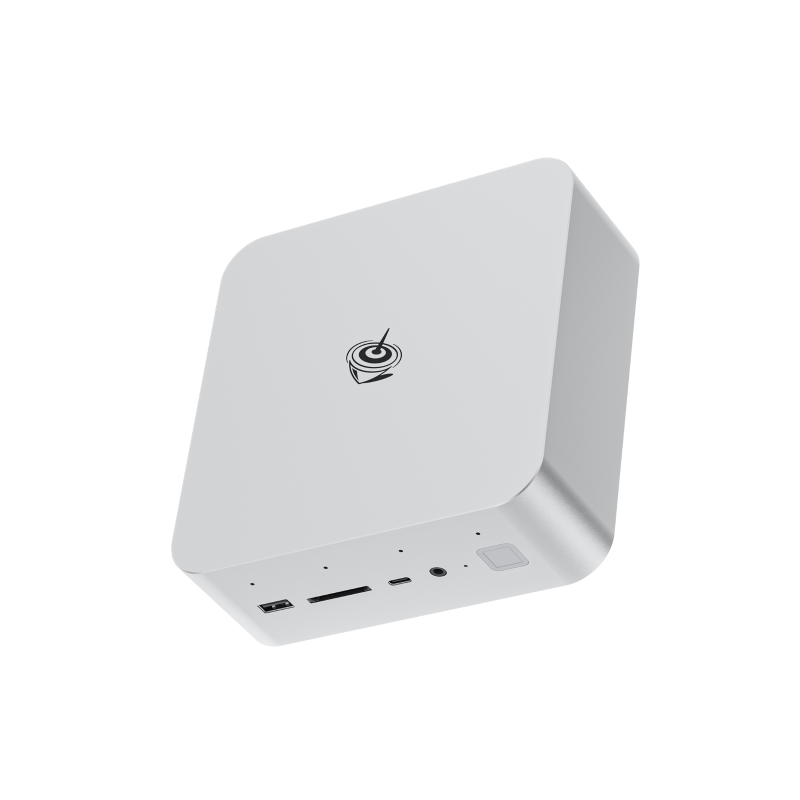
What the Beelink GTi14 Ultra is
The Beelink GTi14 Ultra is the most ambitious mini PC the company has ever shipped. On its own it’s a 1.4-liter Intel Core Ultra 9 185H workstation in an aluminum chassis, with Wi-Fi 7, dual Thunderbolt 4, dual 2.5 GbE, and a fingerprint reader on the lid. That alone makes it a serious office/creator desktop.
The reason to actually buy it is on the bottom. Beelink hid a PCIe x8 connector under the GTi14, designed to mate with their EX docking station, a chassis with a 600 W PSU and an open-frame slot that accepts a full-length desktop GPU up to an RTX 4090 or Radeon RX 7900 XTX. The GTi14 Ultra is, in effect, the most flexible mini PC sold today: an Ultra 9 box at the desk, a 4090-class gaming rig at home.
What it’s good for
Office and creator work (standalone). The Core Ultra 9 185H is a 16-core (6P + 8E + 2LPE), 22-thread chip with a 5.1 GHz peak. Cinebench R23 lands around 13,500 multi / 1,750 single. Photoshop, Lightroom, Premiere 1080p, DaVinci Resolve at 1080p, software development workloads: all comfortable. The platform’s 34.5-TOPS combined AI capability (CPU + iGPU + NPU) is enough for Windows Studio Effects, local Whisper transcription, and the inference side of consumer creator apps.
Gaming (with the EX dock attached). This is where the GTi14 stops being like other mini PCs. ETA Prime’s bench runs with an RTX 4090 in the dock posted Cyberpunk 2077 1440p Ultra with ray tracing above 60 fps, Black Myth: Wukong maxed at 1440p above 60 fps, Forza Horizon 5 Extreme above 160 fps, and Shadow of the Tomb Raider averaging 175 fps at 1440p Highest. The PCIe x8 connection is functionally lossless versus a tower PC at the same GPU, better than the OCuLink solution Minisforum shipped on the MS-A2.
Home server / dev box. Wi-Fi 7, dual 2.5 GbE, Thunderbolt 4 × 2, USB4, three M.2 slots inside the chassis. If you want a quiet desk machine that can also host VMs, run a Docker stack, and push 10 GbE through a Thunderbolt adapter, this is one of very few mini PCs that doesn’t make you compromise on connectivity.
Light AI experimentation. With a 4090 in the dock you can run 30B-class language models locally at usable speed, and the platform’s NPU handles the Microsoft Copilot+ feature set on its own. This is the closest a mini PC gets to a full AI workstation.
Build and connectivity
The chassis is full aluminum, 168 × 145 × 60 mm, and around 1.5 kg. The lid has a fingerprint sensor: unusual on a desktop, useful in practice for anyone running Windows Hello.
Port layout is generous:
- Thunderbolt 4 ×2 (40 Gbps, front and rear)
- USB-A 3.2 Gen 2 ×4
- USB-C 3.2 Gen 2 ×1
- HDMI 2.1 ×1, DisplayPort 1.4 ×1
- 2.5 GbE ×2 (dual LAN, meaningful for home lab use)
- 3.5 mm combo jack, microphone array, fingerprint reader
Wi-Fi 7 and Bluetooth 5.4: current-generation wireless, which is the right call at this price.
Memory, storage, and upgrades
The retail unit ships with 32 GB DDR5-5600 (2 × 16 GB SODIMM) and a 1 TB PCIe 4.0 NVMe SSD. Beelink lists support for up to 96 GB across the two SODIMM slots. Two M.2 2280 slots are accessible from the bottom panel; a third M.2 2230 slot is reachable as well, designed for the Wi-Fi card but expandable.
The hidden PCIe x8 connector underneath is the single feature that justifies the platform. Without the EX dock, the slot just sits there. With the dock, it becomes a PCIe 4.0 x8 desktop GPU connection. Beelink documents PCIe 5.0 support on the GTi14/GTi15 platforms when paired with the EX Pro dock.
Pricing and where to buy
The standalone GTi14 Ultra (Core Ultra 9 185H, 32 GB, 1 TB) sits at $999 direct from Beelink and $899–$949 on Amazon depending on coupon stacks. The 64 GB / 2 TB configuration runs around $1,199.
The EX docking station sells separately at around $329 (the older “EX” model) or $429 (the EX Pro with PCIe 5.0). Bundle deals on Amazon occasionally pair the GTi14 + EX at around $1,299 total, meaningful savings versus buying separately.
This means the realistic out-the-door price for a “mini PC + 4090-capable dock” setup is around $1,300 + your GPU. Compared to a desktop tower with the same GPU, that’s a wash on raw cost. What you get in return is a desk machine that’s silent during the workday and a gaming rig in the evening.
What we’d flag
This is a genuinely impressive product, but there are honest caveats.
- The EX dock is sold separately. The GTi14’s hidden PCIe slot is useless on its own. Budget for the dock if you intend to use it as a gaming machine.
- Thunderbolt 4 fan noise under sustained workstation load is audible: not loud, but present. The dual-fan cooling system stays quiet in office work and ramps when the Ultra 9 stays pinned.
- Linux support on Core Ultra Meteor Lake is improving but still rough around the edges. iGPU acceleration, NPU support, and power management are not at parity with the Windows experience as of 2026 H1. If you’re a Linux-first buyer, factor that in.
- One-year warranty through Beelink. Geekom’s three-year is a meaningful gap at this price.
- EX dock open-frame design is great for cooling and aesthetics but exposes the GPU to dust. Plan accordingly if your environment isn’t a clean room.
Verdict
The GTi14 Ultra is the most interesting mini PC sold in 2026, full stop. The hidden PCIe slot is not a gimmick. It’s a genuinely useful piece of engineering that makes a single $999–$1,299 machine cover the space normally occupied by both a Mac mini and a tower gaming PC.
If you only need an office mini PC, the SER8 or Geekom A8 Max is cheaper and quieter. If you only need a gaming desktop, build a tower. The GTi14 Ultra exists for the buyer who wants both jobs done by one machine, and for that buyer, nothing else in the mini-PC space comes close as of April 2026.