
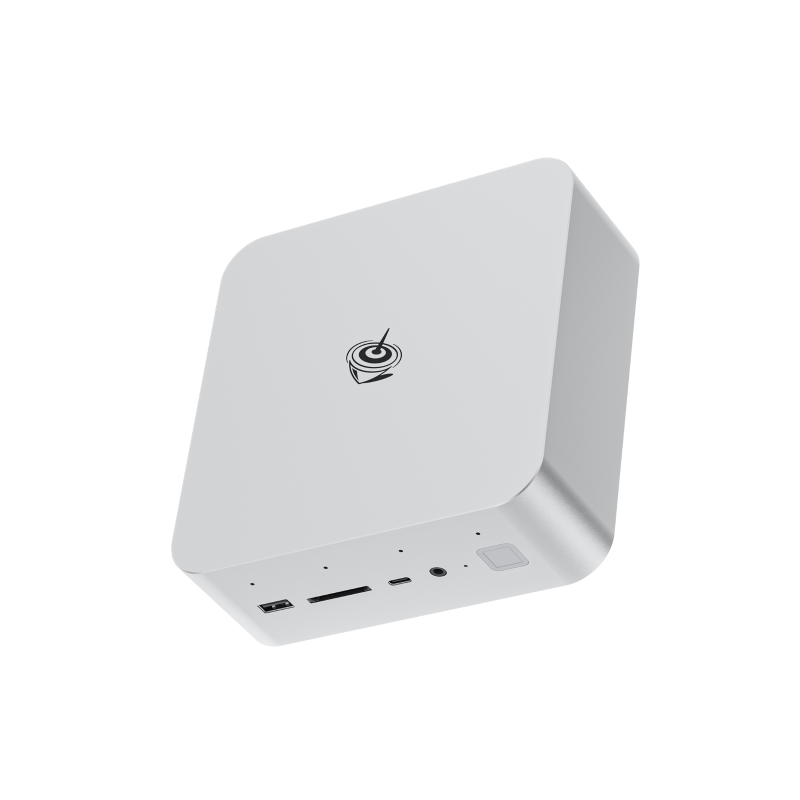
There is a version of this story where Beelink looks like the most interesting company in the mini-PC business, and that version is also true. In July 2024 the brand shipped a 158 mm aluminium cube called the GTi14 Ultra with a feature no other mainstream mini PC had: a latchable PCIe x8 connector on its underside, designed to mate with a separate 600 W docking station that turns the cube into a desktop tower with a full-size discrete GPU. Tom’s Hardware covered the launch as a category-defining moment; Liliputing called the connector “an uncommon approach in the mini-PC market.” It was. Thunderbolt and OCuLink eGPU enclosures had existed for years; nobody had bolted a proper PCIe slot to the chassis of a sub-litre PC.
That is the high-water mark. What Beelink did next is where the story gets nuanced.
What the Beelink EX Pro Docking Station actually delivers
The hardware is not marketing fluff. The EX Pro Docking Station carries a PCIe x16 mechanical slot wired electrically as PCIe 5.0 x8 on the GTi14/15 generation and PCIe 4.0 x8 on the GTi12/13. Beelink fits two PCIe 5.0 signal-enhancement chips on the dock board, an integrated 600 W power supply with two 8-pin GPU connectors, and an open frame that does not constrain card length. NVIDIA RTX 50 and AMD RX 9000 cards drop in.
Reviewers who actually tested the combination did not hedge. PC Gamer described the GTi12 Ultra plus dock as a real desktop replacement with a desktop GPU, not a Thunderbolt eGPU compromise. SFF Geek ran the GTi14 Ultra against an RTX-class GPU through the dock and reported Cyberpunk at 69 fps with ultra settings and 46 fps with ray-tracing on. The PCIe x8 link is real bandwidth. The platform works.
This matters because the cottage industry of OCuLink-based eGPU adapters has spent two years getting close to this experience without quite reaching it: cable-fragile, BIOS-finicky, often capped at PCIe 4.0 x4. Beelink shipped a clean PCIe x8 connection, mechanically latched, with the PSU already inside the dock. Among Chinese mini-PC vendors, this was the most ambitious single hardware bet of the past two years.
The open-source announcement
In late 2024 Beelink published a follow-on statement that was widely covered as an open-sourcing of the EX dock. Tom’s Hardware framed it as “Beelink is open-sourcing its eGPU docking station: PCIe 4.0 x8 could become more common in docks.” VideoCardz ran the headline “full specs, 2D models free to grab and use.” NotebookCheck called the dock “free for anyone to build with open-source documentation.” The plain reading of those headlines is that a small competitor or hobbyist could now produce a compatible dock.
The underlying announcement does not quite say that. Beelink’s statement is that the company has “open-sourced the interface definitions, technical specifications, and patents” of the EX dock and that anyone may “download and utilize these resources for projects, including commercial applications, no authorization required.” That is a real and unusual concession in a category where vendor lock-in is the norm. It is not, however, a hardware open-source release in the sense the term carries in projects like Framework’s modular laptops or the RISC-V reference boards.
What was actually published, as Liliputing noted in its follow-up, was a set of mechanical drawings: physical dimensions, connector placement, the geometry needed to mate a third-party chassis to the GTi14 Ultra’s underside. The drawings carry watermarks reading “Confidential” on every page. There are no schematics. No PCB Gerbers. No bill of materials. No firmware. No reference design for the two PCIe 5.0 redrivers that make the link work at full bandwidth across a vertical board-to-board connector.
In other words, a competitor can now build a dock that fits the GTi14 Ultra’s footprint. It still has to reverse-engineer the signal-integrity stack on its own.
Why the gap matters
Beelink’s framing leaves a real ambiguity. “Open-source” in hardware contexts usually implies the artefacts a builder needs to reproduce a working device: schematic, layout files, mechanical, firmware. What Beelink released is closer to an interoperability spec: enough to ensure third parties cannot accidentally build something that doesn’t physically fit, but not enough to commoditise the dock. The patents named in the release are not freely licensed in any irrevocable, written sense visible on the product page; the assurance that “no authorization is required” lives in marketing copy, not in a public licence file like Apache 2.0 or CERN-OHL.
This is not a scandal. Beelink is a privately held Chinese hardware brand, not the Linux Foundation, and the company is plainly trying to position the GTi14 connector as a de facto standard the rest of the industry might adopt, which would be good for Beelink and arguably good for buyers. But the headlines that ran in late 2024 implied a release more open than the one Beelink delivered, and there is no evidence as of the time of writing that any third party has actually shipped a compatible dock. The promised ecosystem has not appeared.
The credit, and the asterisk
The GTi14 Ultra plus EX Pro dock remains, on technical merits, the most interesting mini-PC platform sold in 2025–2026. A buyer who wants a silent 158 mm office cube on weekdays and a 4090-class gaming workstation on weekends has exactly one product that delivers that today, and it is this one. The engineering is real, the bandwidth is real, the reviews from people who put cards in the slot are uniformly positive on the core question: does it work? It does.
The asterisk is the open-source claim. Beelink deserves credit for publishing more documentation than its competitors and for committing in writing that the interface can be used commercially without permission. It does not deserve credit for an open hardware release it did not actually make. Buyers and resellers reading the late-2024 coverage and waiting for cheaper third-party docks to appear are still waiting, eighteen months later, and the artefacts that would have made those docks possible are still inside Beelink. That is the part of the story most coverage left unfinished, and it is the part that will matter the next time a mini-PC vendor announces an “open” platform.