
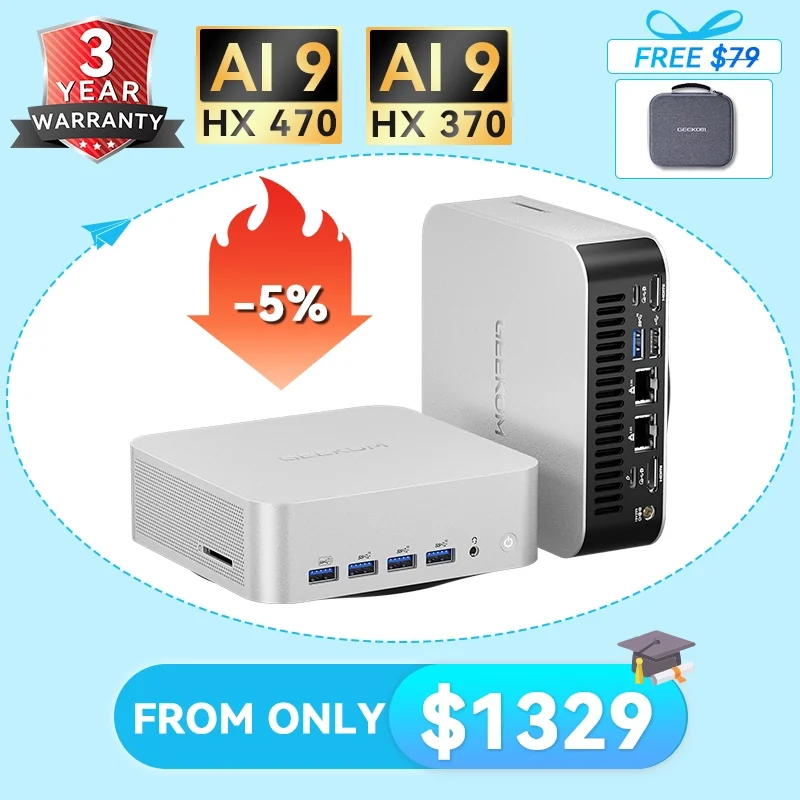
What it is
The GEEKOM A9 Max is a Copilot+ certified mini PC built around AMD’s Ryzen AI 9 HX 370, a 12-core, 24-thread Zen 5 processor paired with an XDNA 2 neural engine and the Radeon 890M integrated GPU. In a metal chassis measuring roughly 135 × 132 × 46 mm (about 0.84 liters), GEEKOM has packaged a genuine on-device AI workstation that you can hide behind a monitor.
The pitch is straightforward: this is the local-NPU counterpart to the big GB10 AI desktops (the NVIDIA DGX Spark and ASUS Ascent GX10 class of machines) at roughly a quarter of the price. You are not getting 128 GB of unified memory or a Blackwell GPU here. You are getting a Windows 11 desktop that runs Copilot+ features natively, handles small local models, and doubles as a fast everyday PC.
What it’s good for
On-device AI and Copilot+. This is the headline. The HX 370’s XDNA 2 NPU is rated at 50 TOPS on its own, clearing Microsoft’s 40-TOPS bar for the Copilot+ PC badge, with a total platform AI throughput of around 80 TOPS across CPU, GPU, and NPU. That unlocks Windows Studio Effects, Live Captions with translation, Recall, and the local inference layer of a growing list of creator apps, all running without a cloud round-trip. For 7B-to-14B-class language models and quantized image generation, the A9 Max is a credible local sandbox (see our explainer on NPU vs iGPU vs CPU for local LLMs).
Creator workflows. With 32 GB of DDR5 stock and the Radeon 890M, Lightroom, Photoshop, 1080p/4K Premiere timelines, and DaVinci Resolve for non-graded edits all sit comfortably in scope. Twelve Zen 5 cores make this a real export machine, not just a previewer.
Office and everyday desktop. Twenty browser tabs, a Teams call, a spreadsheet, and a background sync is a non-event for this chip. Dual 2.5 GbE and four-monitor output (2× HDMI 2.1 plus 2× USB4 DisplayPort) make it a tidy fit for a multi-display desk or a small home lab.
Light gaming. The Radeon 890M, with up to 24 GB of shared VRAM, plays modern titles at 1080p Medium in the 50–80 fps band and runs esports games (CS2, Valorant, Rocket League) well above 100 fps. It is not a 4K gaming box, but it is a perfectly capable 1080p one.
Build and connectivity
The A9 Max uses a full-metal chassis with an actively cooled, perforated top. Reviewers describe it as sturdy and dense for its size, with a fan that is near-silent at idle and audible, but not intrusive, under sustained load.
The port selection is unusually generous:
- 2× USB4 Type-C (40 Gbps, DisplayPort-Alt and Power Delivery): eGPU, Thunderbolt-class docks, and 8K output
- 5× USB 3.2 Gen2 Type-A (10 Gbps)
- 2× HDMI 2.1: drives 4K displays, or a single 8K panel
- 2× 2.5 GbE RJ45: genuine dual-LAN for routing VMs or NAS links
- Wi-Fi 7 + Bluetooth 5.4 for current-gen wireless
- SD 4.0 card reader, 3.5 mm combo jack, and a Kensington lock slot
Two USB4 ports plus dual 2.5GbE is a notably complete set for a sub-1-liter machine. Most rivals make you choose.
Memory, storage, and upgrades
This is where the A9 Max separates itself from the soldered-RAM AI minis. Memory is DDR5 on two SO-DIMM slots, shipping at 32 GB and officially upgradable to 128 GB. Storage runs across two M.2 PCIe 4.0 NVMe slots (one 2280, one 2230), so you can keep the factory drive and add a second without displacing anything.
If you are spending around $1,000 on a machine you intend to keep for years, being able to drop in 96 GB of extra RAM and a second SSD later is worth real money, and it is something the GEEKOM A8 Max and most fixed-memory competitors can’t all match at this tier.
Pricing and where to buy
Pricing depends on configuration. The 32 GB / 1 TB HX 370 unit reviewed here lands in roughly the $899–$1,199 range, with NotebookCheck and others pricing it around $999 at launch. A higher-tier sibling swaps in the Ryzen AI 9 HX 470 (86-TOPS total AI, larger SSD) for more money.
On Amazon US, the 32 GB / 1 TB HX 370 configuration is the one to anchor on. GEEKOM’s own store carries the same SKUs, typically at a small premium, through its own warranty channel. The 3-year warranty applies either way; for most US buyers the Amazon listing is the practical default for shipping and returns.
What we’d flag
This is a positive review, but a fair one.
- Memory bandwidth is the AI ceiling. Like every LPDDR/DDR5 AI mini, the A9 Max is bandwidth-limited for large-model token generation. It is excellent for Copilot+ tasks and small models; it is not a substitute for the GB10 boxes or a discrete GPU when you want to run 70B-class models at speed.
- Price creeps toward desktop territory. At $999+, this competes with capable small-form-factor desktops that can hold a discrete GPU. You are paying for the size, the NPU, and the build. Make sure that trade matches your needs.
- The 2230 second slot is shorter. The secondary M.2 is a 2230 length, so your add-in SSD options there are narrower (and often pricier per GB) than a full 2280.
- Fan is audible under sustained load. Comparable to a quiet laptop: present during long exports or gaming, silent at idle.
None of this is disqualifying; it is the cost of an 0.84-liter machine running a 12-core chip.
GEEKOM A9 Max verdict
The GEEKOM A9 Max is one of the most complete AI-era mini PCs you can buy right now. A 12-core Zen 5 CPU, a Copilot+ NPU, the Radeon 890M, upgradable DDR5 to 128 GB, two NVMe slots, dual USB4, dual 2.5GbE, and Wi-Fi 7, in a sub-1-liter metal box with a 3-year warranty, is a genuinely strong package around the $999 mark.
If you want a quiet, capable Windows desktop that runs Copilot+ features and small local models natively, and you don’t need GB10-class memory for giant LLMs, the A9 Max earns a confident recommendation. For most people who type “Ryzen AI 9 HX 370 mini PC” into a search bar, this is the one to put at the top of the short list.
Related: our Beelink SER9 HX 370 review and Minisforum AI X1 Pro-370 review.