
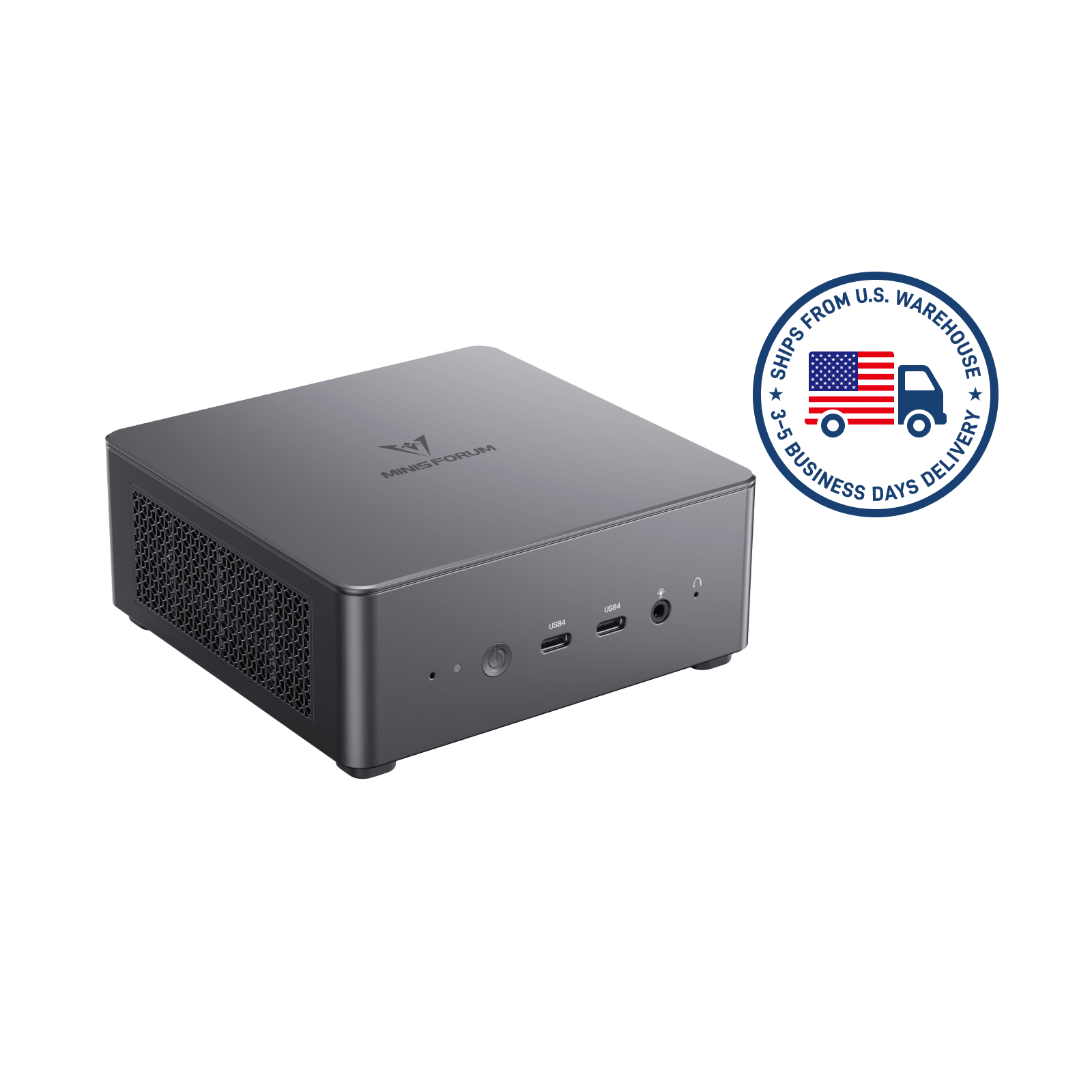
The Minisforum N5 and N5 Pro are, considered on their hardware specifications, interesting products. They target the prosumer NAS space (the market Synology, QNAP, TrueNAS-on-bare-metal and increasingly Asustor have been competing in), and they do so with price points, CPU choices, and connectivity options that are genuinely competitive. ServeTheHome’s review characterised the platform as awesome, which from a publication that evaluates many NAS products a year is not a word given lightly. The hardware deserves the description; on paper, the N5 Pro is the most capable all-in-one NAS platform Minisforum has shipped.
And yet the part that deserves the most scrutiny is the one that doesn’t show up on the spec sheet.
The Minisforum N5 Pro external power brick
The N5 Pro ships with a 280-watt, 19V DC external power adapter. The unit does not contain an internal PSU. Instead, a large laptop-style brick sits on the floor or desk near the chassis, connecting to the NAS via a barrel-connector cable, supplying all power to a storage appliance that is designed to run continuously, for years, storing the customer’s data.
NASCompares’ review flagged this directly, describing the power arrangement as “not the most secure power” for a NAS. That is a careful sentence from a publication whose audience is exactly the buyers this matters to. The word “secure” in that context does not mean encrypted; it means resilient against the specific class of failures that NAS buyers are, by definition, building their purchase to protect against.
Why external power matters on a NAS specifically
There is nothing inherently wrong with external power bricks. Laptops use them. Mini-PCs use them. A desktop computer that is powered by a brick instead of an internal PSU is a cost-optimised machine whose power source is one more thing to diagnose when it fails, but it is not a category-defining architectural flaw.
A storage appliance is a different category. The NAS’s entire purpose is to present a single logical unit that the customer can trust to hold their data across a multi-year ownership horizon. That trust is the product. Every decision about how the NAS is built (drive-bay redundancy, hot-swap support, RAID implementations, UPS compatibility, filesystem choice) is in service of maximising the probability that the data remains accessible even when individual components fail. Synology and QNAP’s design language around internal PSUs, redundant-PSU options on their higher SKUs, and engineered-for-24×7 components is not cosmetic; it reflects the category’s first principle.
An external brick on a NAS introduces a failure mode that the category’s first principle explicitly tries to eliminate. When the brick fails (which bricks do, at a rate higher than integrated PSUs), the NAS goes offline instantly. There is no secondary path. No redundant brick. No seamless failover. The customer, whose entire reason for owning the NAS was to avoid a single-point-of-failure on their data, has bought a product whose power path is, literally, a single point of failure. And the specific brick that failed is a proprietary part that can only be replaced through the vendor’s supply chain.
The vendor’s position
Minisforum has not, in the review period captured by the sources above, addressed the power-architecture critique directly. The Unraid community thread on the N5 / N5 Pro and the NASCompares follow-up forum contain owner discussions that circle around the brick concern without producing a vendor statement that engages with it. The design choice is presented in product literature as a feature (smaller chassis, cooler operation, quieter running), which are all true and all beside the point for the specific failure mode under discussion. Related: Minisforum’s own acknowledgment that its support portal needed upgrading and an MS-01 owner’s VRM fire and warranty experience.
Synology and QNAP do, fairly, also ship external-brick SKUs in their lower-end product lines. What they do not do is position those SKUs as their flagship prosumer AI NAS with a price tag starting at $999. The N5 Pro’s positioning (AI branding, prosumer target market, comparable pricing to entry-level QNAP rack units) invites comparison to products whose power architecture is more conservative. The customer who is paying the premium associated with that positioning has reason to expect the power architecture to be part of the premium. On the N5 Pro, it isn’t.
The lasting calculation
The math the N5 Pro asks the buyer to do is specific. The brick will probably hold up for several years. Several years is not indefinite. At some point inside the product’s useful life, the brick will fail. When it does, the buyer’s data becomes inaccessible until the brick is replaced, a replacement that, on a Minisforum product with Minisforum’s documented parts-supply patterns, may not be a next-day operation. If the buyer has alternate access to their data through backups that are external to the N5 Pro itself, the brick failure is an inconvenience; if the N5 Pro is the primary store and the customer has been backing up less rigorously than they should, the brick failure is a measurable outage.
A NAS is supposed to reduce the probability that a buyer finds themselves in that conversation with their own data. The N5 Pro’s external brick does not reduce that probability as effectively as an internal PSU would, and the cost saving on Minisforum’s side of that trade does not show up as a discount to the customer. The customer pays the full NAS price for a power architecture that does not match the NAS-category standard, and the first time the brick dies is the moment they discover the difference. That moment arriving before the data is recoverable elsewhere is the scenario the brick’s single-point-of-failure design makes more likely than it had to be.