
What it is
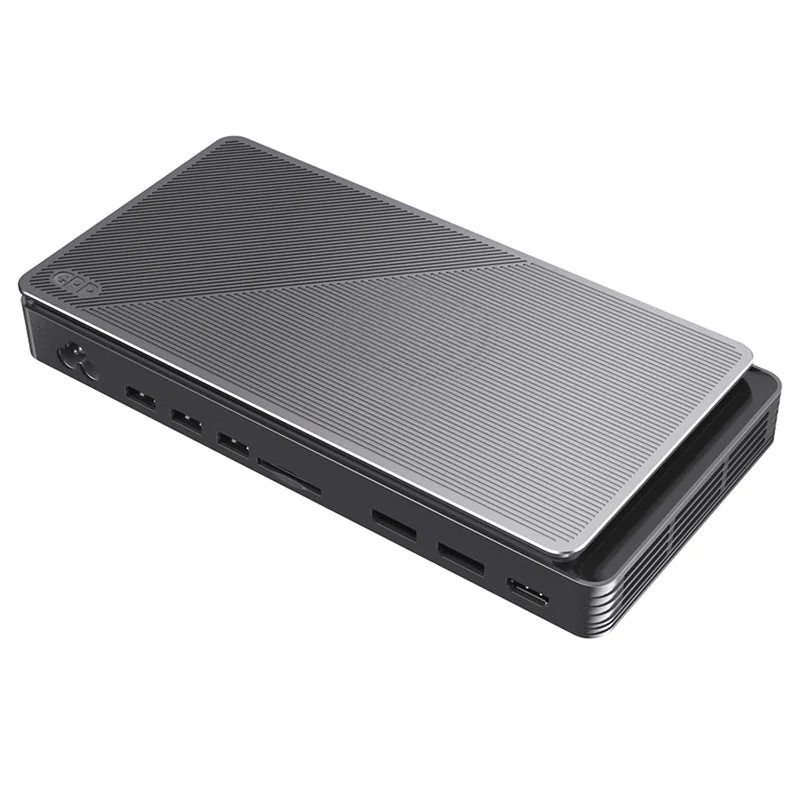
The GPD G1 is an external GPU that breaks the usual eGPU formula. Most docks are an empty box: you supply the graphics card and an ATX power supply, then bolt it all together. The G1 ships as a sealed, finished appliance: an AMD Radeon RX 7600M XT with 8 GB of GDDR6, an integrated 240W GaN power supply, and a fan, all packed into an aluminium slab that measures 225 × 111 × 30 mm and weighs about 920 g. It is roughly the footprint of a GPD WIN 4 handheld, and GPD bills it as the smallest self-contained eGPU you can buy.
You connect it one of two ways: OCuLink (SFF-8612) for full PCIe 4.0 x4 bandwidth, or USB4 / Thunderbolt 3–4 for plug-and-play convenience on hosts that lack an OCuLink port. There is no GPU to choose and no upgrade path. What’s inside is what you get. That trade is the whole story of the G1, and it’s a more interesting one than it first appears.
Is the GPD G1 worth it?
For a specific buyer, yes. If you own a handheld or a mini PC with an OCuLink port and you want desktop-class 1080p gaming without building a second machine, nothing else is this portable. For everyone else (particularly people who already have a desktop with a free PCIe x16 slot), a plain graphics card is cheaper and faster. The G1 sells convenience and size, not raw value. Related: our ONEXGPU 2 review and our guide to the best eGPU adapters for mini PCs.
Interface and bandwidth: OCuLink vs USB4
This is the single most important thing to understand before buying. The G1 has two connection paths and they are not equivalent.
- OCuLink (SFF-8612) carries a native PCIe 4.0 x4 link, roughly 63 Gbps. This is the connection the G1 is built for, and it’s where the RX 7600M XT delivers its full performance.
- USB4 / Thunderbolt tunnels PCIe over a 40 Gbps link, and in NotebookCheck’s testing the G1 negotiated only PCIe 3.0-class speeds over USB4. Liliputing measured the gap directly: in Shadow of the Tomb Raider at 1080p High, OCuLink returned 143 fps versus 121 fps over USB4, a ~15% loss purely from the interface.
The takeaway: use OCuLink whenever your host has the port. Reserve USB4 for laptops and mini PCs that don’t expose OCuLink, and accept the performance tax as the price of compatibility. One more cable caveat that bites buyers: OCuLink is bandwidth-hungry and length-sensitive. Reviewers found that a 50 cm cable held a stable link where a 1 m cable occasionally dropped. Keep the run short.
OCuLink vs USB4: how much speed do you lose?
About 15% in real games, more in synthetic transfer-bound tests. If you’re chasing maximum frames, OCuLink is mandatory, not optional.
What GPUs and hosts does it support?
The G1’s GPU question is already answered: it’s a fixed RX 7600M XT, an RDNA 3 mobile part rated around 21.4 TFLOPS. In practice that lands within about 15% of a desktop RTX 4060 and roughly 20% behind the desktop RX 7600, with the 8 GB frame buffer being the limiter in the most demanding titles.
Host compatibility is the part that needs a checklist:
- GPD’s own handhelds (WIN 4, WIN Max 2, WIN Mini) were designed alongside the G1 and expose OCuLink directly.
- OCuLink mini PCs are the sweet spot. Plenty of recent small-form-factor boxes ship an OCuLink port; if you’re shopping for a host, our GMKtec K11 review covers one such OCuLink-equipped mini PC, and the same OCuLink logic applies to any AMD- or Intel-based SFF machine that exposes the SFF-8612 connector.
- USB4 / Thunderbolt laptops and mini PCs work through the USB4 path, at the reduced bandwidth noted above. Most 2024-onward Intel and AMD laptops with USB4 qualify.
A practical note for NVIDIA-host owners: because the G1’s GPU is AMD, you sidestep the classic Error-43 headaches that plague some NVIDIA-card eGPU setups. The driver story here is plain Radeon software.
Build, power, and cooling
The G1’s headline engineering trick is the built-in 240W GaN power supply. There is no external brick and no ATX PSU to source: you plug a standard IEC power lead into the unit and a single data cable into the host. That GaN supply also powers the dock’s downstream ports, so the USB4 connection can deliver power-delivery passthrough to charge a connected handheld or laptop.
Connectivity is genuinely dock-like:
- 3× USB 3.2 Type-A
- 1× USB4 (data + PD)
- Full-size SD 4.0 card reader
- HDMI 2.1 (4K120) and 2× DisplayPort 1.4a
So beyond graphics, the G1 doubles as a display-and-USB hub, useful if it lives on your desk.
Cooling is where the compromises surface. The chassis offers a BIOS-level TGP toggle: a Quiet profile that caps the GPU near 60W and a Normal profile up to 100W (the silicon itself is a 120W-class part). The performance profile is meaningfully louder: Liliputing measured 62 dBA at full tilt, and hotspot temperatures reached 100 °C under sustained load. Squeezing a 100W+ GPU into a 30 mm-thick aluminium box has acoustic consequences, and the G1 doesn’t escape them. NotebookCheck flagged noise as one of the unit’s two main weaknesses.
Pricing and where to buy
The G1 typically sells in the $549–$699 range depending on bundle and region, with European pricing landing around €630–€700 before tax in reviewer coverage. On Amazon it’s listed under ASIN B0CHMXSG8Y (with alternate live listings under B0CWZC44DQ and B0CLV1X669).
Budget for one extra line item: the OCuLink cable is not included. GPD bundles the USB4 cable in the box, but the OCuLink cable (the one you actually want for full performance) is a separate add-on. Factor that into the total cost, because buying the G1 without it means running on the slower USB4 path out of the gate.
What we’d flag
The G1 is a clever product with a few honest rough edges:
- 8 GB of VRAM is the ceiling. It’s fine for 1080p, but the most demanding modern titles will stutter when the frame buffer fills. Reviewers singled out poor results in VRAM-heavy games like Ratchet & Clank: Rift Apart.
- Fan noise under the Normal profile is loud (up to ~62 dBA). The Quiet 60W profile is far more livable but leaves performance on the table. GPD has iterated on this with later quieter revisions, but it remains a real consideration.
- OCuLink cable sold separately, and the link is length-sensitive: keep cable runs short (≈50 cm) for a stable connection.
- No upgrade path. The soldered RX 7600M XT is what you keep for the life of the unit; you can’t drop in a faster card later the way you can with a BYO-GPU dock.
- USB4 costs ~15% performance versus OCuLink: fine as a fallback, not as your primary plan.
Verdict
The GPD G1 is a niche product that nails its niche. For owners of OCuLink handhelds and mini PCs who want genuine desktop-class 1080p gaming in something they can throw in a backpack, there’s nothing else this small or this self-contained. The integrated 240W supply and fixed RX 7600M XT remove all the BYO-PSU and GPU-shopping friction that makes traditional eGPU docks a project rather than a purchase.
It is not the value pick. If you have a desktop with a spare PCIe slot, a plain graphics card is cheaper and faster. And if you buy the G1, buy the OCuLink cable with it and plan to run the Quiet profile unless you can tolerate the noise. Go in clear-eyed about the 8 GB VRAM and the fixed GPU, and the G1 is the most portable real eGPU on the market. For the right buyer, that is exactly the point.