
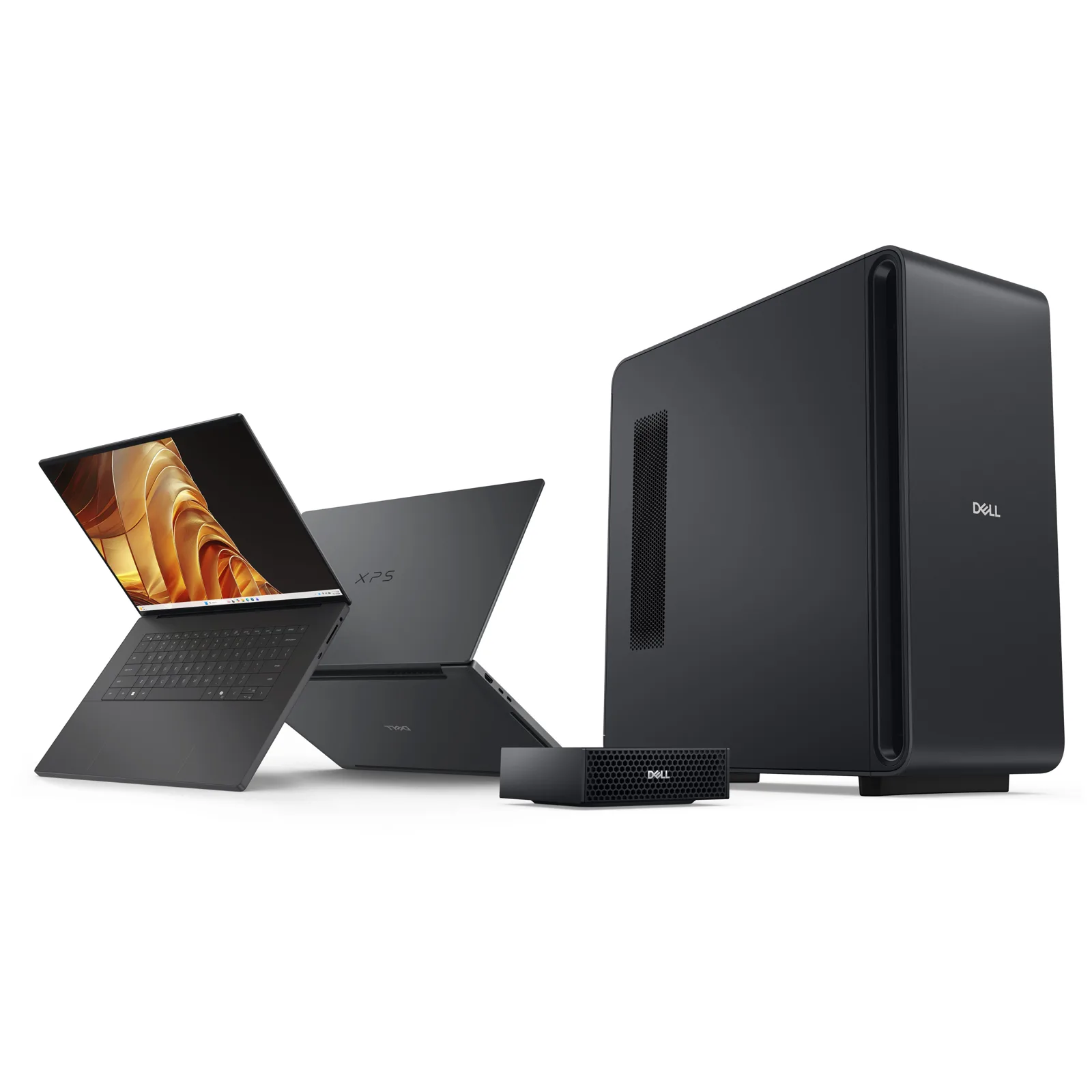
What is the Dell XPS RTX Spark Desktop?
The Dell XPS RTX Spark Desktop is a small-form-factor mini PC concept Dell showed behind closed doors at Computex 2026, built on NVIDIA’s new RTX Spark platform. Important caveat up front: this is a concept, and Dell explicitly labeled the design “not final.” Nothing about the chassis, ports, memory tiers, name, or price is locked. What we describe here is a hands-on preview of an early unit, not a shipping product. Treat every detail as subject to change before launch.
What makes the XPS RTX Spark Desktop worth flagging anyway is its angle. Where most RTX Spark boxes are pitched as headless AI appliances, Dell put creator-friendly front I/O on the front face (two USB-C ports and an SD card reader), bringing the kind of plug-in-a-camera-card convenience you’d expect from a workstation to the GB10/RTX Spark class. Reviewers repeatedly described it as “the most Mac Studio-looking” RTX Spark mini PC yet.
What is RTX Spark?
Before the Dell specifics, the platform. RTX Spark is NVIDIA’s consumer, Windows-on-Arm respin of the GB10 Grace Blackwell superchip, the same silicon family that powers the on-sale NVIDIA DGX Spark and the ASUS Ascent GX10. It is not a next-generation chip or a “GB10 v2”; ServeTheHome calls the RTX Spark SoC “almost certainly a rebadged version of NVIDIA’s GB10 chip.” The high-end variant, the N1X, pairs a 20-core Arm Grace CPU with a 48-SM Blackwell GPU and up to 128 GB of LPDDR5X unified memory, good for roughly 1 petaflop of AI compute.
The difference from the DGX Spark line is positioning: RTX Spark is aimed at Windows users and prosumers running AI locally, rather than the DGX OS (Arm Linux) developer audience. Dell’s XPS box is reported to use the higher-tier N1X chip.
What’s confirmed (so far)
Bear in mind “confirmed” here means “shown and described at Computex,” not “finalized for sale.” From the hands-on previews:
- Chassis: a compact, dark-gray SFF box with perforated mesh / vented sides and a removable bottom lid for SSD access. Taller than Dell’s existing GB10 system, with a front-mounted power button.
- Front I/O: 2× USB-C plus an SD card reader, the standout creator-oriented detail that sets it apart from rival RTX Spark boxes.
- Rear I/O: additional USB-C (including a Power Delivery input and a 20 Gbps port), HDMI, and a 10 Gb Ethernet jack. Coverage puts the total USB-C count around six across front and rear.
- Platform: NVIDIA RTX Spark N1X: 20 Arm Grace cores, a 48-SM Blackwell GPU, up to 128 GB unified memory, ~1 petaflop AI compute.
- Common platform baseline: across the RTX Spark SFF systems shown, ServeTheHome lists shared specs of Wi-Fi 7 + Bluetooth 5.4, USB-C at 20 Gbps, and PCIe Gen5 x4 M.2 storage.
What’s still unknown
This is the honest part, and for a concept it’s a long list:
- Final name. “XPS RTX Spark Desktop” is how it was shown; Dell has not committed to a retail name.
- Memory and storage tiers. “Up to 128 GB” is the ceiling, but Dell hasn’t published the configuration ladder or SSD capacities.
- Price. No price has been announced (for the Dell box or, frankly, for most RTX Spark systems).
- Final port layout and chassis. Because the design is explicitly not final, the SD reader, the exact USB-C count, and the mesh-sided enclosure could all shift before launch. (Some early coverage even differs on whether the card slot is full-size SD or microSD, and front- vs rear-mounted, a sign of how preliminary this is.)
- Memory bandwidth. No figure was given, but if it mirrors the GB10 parts, expect the ~273 GB/s class: the real ceiling on local LLM token-generation speed, as we detail in our DGX Spark review.
- OS and software stack. RTX Spark is the Windows-on-Arm story, but Dell hasn’t detailed the shipped software image.
What the Dell XPS RTX Spark Desktop means for mini PCs
If it ships close to what was shown, the XPS RTX Spark Desktop is interesting for one reason: it tries to make a GB10-class AI box feel like a creator desktop instead of a developer appliance. Front-facing USB-C and an SD card reader sound mundane, but on this class of hardware they’re rare: the DGX Spark and Ascent GX10 are built for clustering and headless inference, not for sliding in a camera card between shoots. Dell is betting there’s a prosumer who wants 128 GB of unified memory for local AI and a machine that lives on the desk like a Mac Studio.
For the broader mini PC market, it’s another data point that the RTX Spark platform is going wide: ASUS (ProArt GA10), Lenovo, MSI (EdgeMesa N AI+), and HP all showed RTX Spark SFF systems at the same event. That competition is good news for buyers, assuming pricing eventually lands somewhere sane, which is far from guaranteed in the current memory-cost climate.
Expected timeline and price outlook
The RTX Spark SFF systems, Dell’s included, are targeted at a Fall 2026 window. No price has been announced for the XPS RTX Spark Desktop, and given that GB10-class boxes currently sell for roughly $3,000–$4,700, you should set expectations accordingly rather than hoping for a budget mini PC. We’ll update this piece (and price it honestly) if and when Dell publishes real numbers.
Sources & caveats
This article is based on Computex 2026 hands-on previews from ServeTheHome, NotebookCheck, XDA Developers, TechRadar, and Tom’s Hardware. Everything here describes a concept that Dell labeled “not final.” Specs, ports, the chassis, the name, and the price can all change before the product ships, and some may not survive to launch at all.
We don’t review concepts, we review hardware you can buy. We’ll put the Dell XPS RTX Spark Desktop through a full review when it ships. Until then, if you want the same GB10 silicon today, read our reviews of the NVIDIA DGX Spark and the more affordable ASUS Ascent GX10, the on-sale siblings of the RTX Spark desktops coming this fall.