
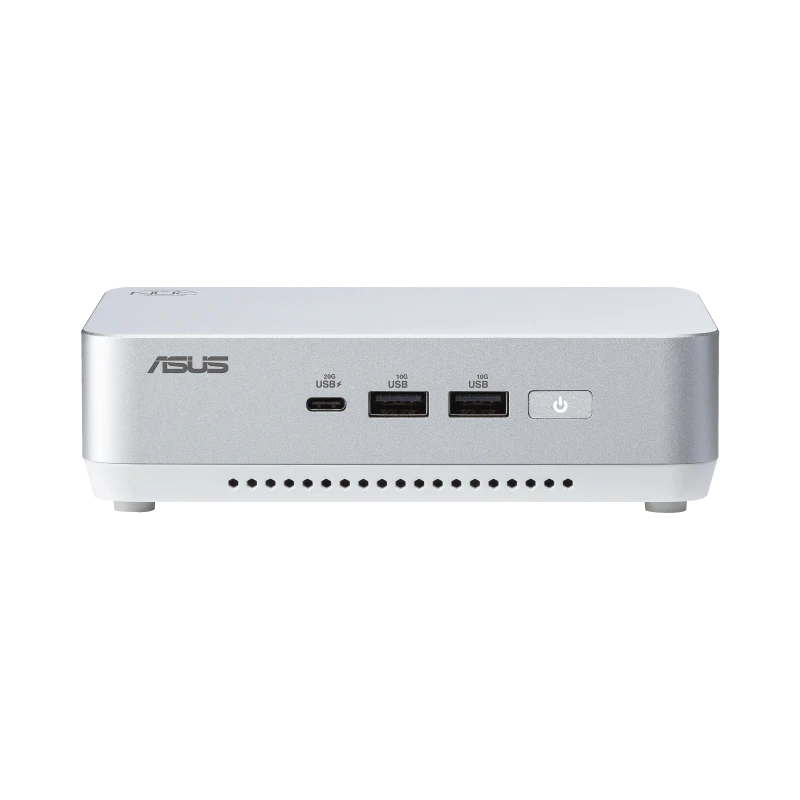
The NUC was, for more than a decade, an Intel object. The shape, the four-inch footprint, the bare-bones kit-and-CPU bundle, the spartan-but-functional support pages: all of it carried the unmistakable feel of a chip company that had wandered into systems-building because nobody else was going to prove the form factor for them. When Intel announced in July 2023 that it was exiting the NUC business and licensing the line to ASUS, it ended an era that had outlasted three generations of mini-PC fashion. The Intel newsroom statement framed the deal in measured corporate language: ASUS would receive “a non-exclusive license to Intel’s NUC systems product line designs, enabling ASUS to manufacture and sell 10th to 13th Gen NUC systems products and develop future NUC systems designs.” The ASUS signing-ceremony release was warmer, but said the same thing: a new ASUS NUC business unit would carry the torch.
That is the press-release version. The interesting story is what shipped underneath it.
What ASUS actually got, and what it didn’t
Tom’s Hardware and ServeTheHome both flagged the same structural detail at the time: the license was non-exclusive, covered 10th- through 13th-generation NUC designs, and granted ASUS the right to develop future NUC systems on its own. Intel did not sell the NUC business; it licensed the right to keep it alive. The hardware IP, the chassis tooling, the firmware: all of that transferred under license. The brand “Intel NUC” did not. ASUS calls its products “ASUS NUC,” with Intel inside as the chip vendor of record. For most consumers, the practical difference is a logo. For procurement teams writing standards documents that say “Intel NUC required,” the practical difference is a contract revision.
The support handoff, in writing
The most consequential change for existing owners landed on January 16, 2024, the date both companies pinned as the support transition. Per Intel’s own support article and the ASUS transition FAQ, as of that date ASUS took over technical support, warranty service, BIOS and firmware updates, and security advisories for NUC 7 through NUC 13 systems. NUC 6th-generation and older units stayed with Intel. Intel-branded NUC laptops also stayed with Intel. The dividing line is clean on paper; it has produced more confused support tickets in practice than either company’s PR team likely anticipated, because a 2018-era NUC8 and a 2017-era NUC7 sit in adjacent boxes on the same shelf and route to different support portals.
ASUS’s stated warranty for the existing inventory honored the original Intel terms (generally three years limited), but the channel partner programs did not survive the move intact.
The Intel Partner Alliance casualties
Buried in the ASUS NUC transition FAQ and the corresponding Intel PDF is a sentence that matters more than its placement suggests: the Intel Partner Alliance program, including its Advanced Warranty Replacement (AWR) service, would not transition to ASUS. Customers who had bought NUCs before September 1, 2023 (i.e., the buyers who paid a premium specifically for AWR coverage) were told they “may experience changes in the AWR service” when filing RMAs through ASUS after January 15, 2024. ASUS introduced a successor program called Advanced Replacement Services (ARS), but enrollment, terms, and SLA did not auto-migrate. A B2B buyer who had standardized on NUCs partly because Intel’s partner program guaranteed next-business-day swaps had to re-evaluate that assumption from scratch.
Stock-rotation benefits, another channel-partner staple, ceased entirely on December 30, 2023. Distributors holding NUC inventory through the transition swallowed the difference.
What ASUS has shipped under its own brand
The product side of the story has been less fraught. The ASUS NUC 14 Pro and Pro Plus, unveiled at CES 2024 and launched commercially in 2024, were the first NUCs designed end-to-end inside ASUS’s new business unit. Reviews were generally favorable: XDA Developers praised the tool-less serviceability, and most outlets credited ASUS for keeping the form factor and upgrade path that NUC buyers expected, while modernizing the platform to Intel’s Meteor Lake Core Ultra silicon with NPU support. The launch of the ROG NUC, which paired the chassis lineage with discrete RTX 4070 mobile graphics, marked a clear strategic pivot: a brand-level signal that ASUS intends to push the NUC into prosumer and gaming territory the original Intel program never seriously courted.
The complaint that recurs in reviews is consistent and small: a chassis that feels more plastic-forward than the Intel-era machined finish, and thermal envelopes that run hot under sustained load. Neither rises to the level of a quality scandal. They are the trade-offs of a brand that is more aggressive on price-performance than Intel’s NUC team was willing to be. Related: our ASUS NUC 14 Pro+ review and ASUS NUC 14 Essential review.
Net assessment
For new buyers, the ASUS-era NUC is, on balance, a better-equipped product than the Intel-era line it replaced: refreshed silicon cadence, an actual marketing budget, a discrete-GPU SKU that Intel never green-lit, and a serviceability story that holds up against the rest of the mini-PC market. For existing owners of NUC 7 through NUC 13 systems, the picture is mixed: warranty coverage carried over, but the partner-program scaffolding around it did not, and the support portal a buyer used in 2023 is not the one they file a ticket through in 2026. The transition was done about as cleanly as any IP handoff of this size gets. It was not, however, transparent enough that a typical owner would discover the changes before needing them. That is the part of the story the press releases left for the support FAQs to tell.