
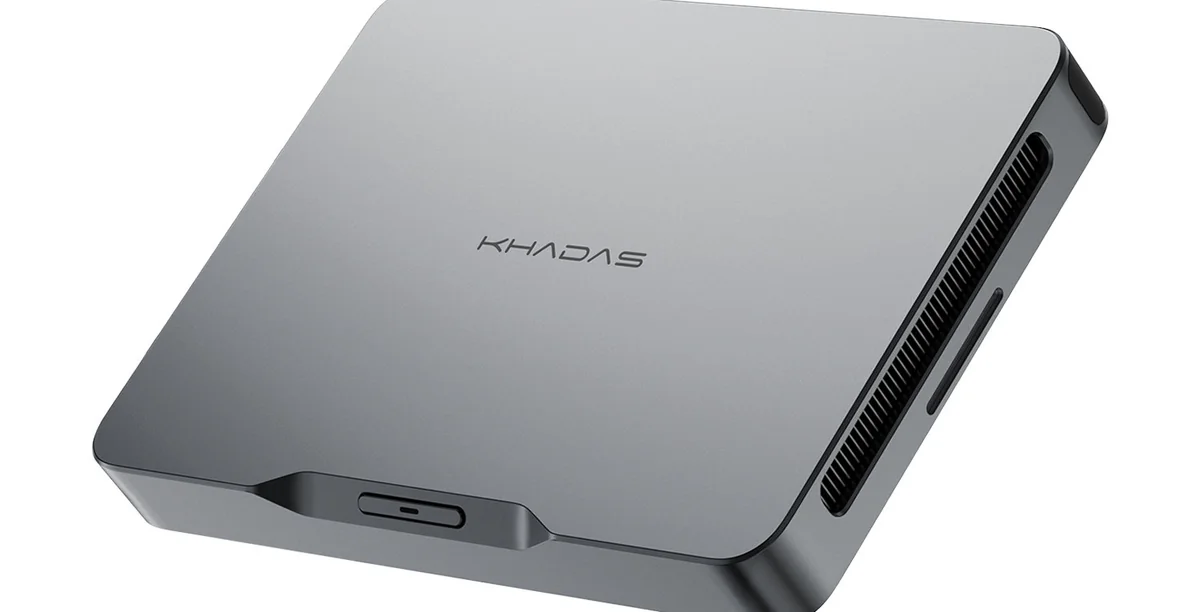
What the Khadas Mind 2S is
The Khadas Mind 2S is a refresh of one of the most distinctive mini PCs on the market: a 146 × 105 × 20 mm slab that weighs 435 grams (roughly the same as a hardcover novella) and contains a full Intel Core Ultra 7 255H, 64 GB of LPDDR5X-8400 RAM, a 2 TB NVMe SSD, and a built-in 5.55 Wh battery. It is not a laptop. It is not a NUC. It is a portable workstation in the literal sense: you put it in a bag, you take it somewhere, you plug it in, and you keep working.
What makes the 2S different from the rest of the ultra-portable class is the Mind Link connector on its underside, a proprietary 256 GT/s edge connector that mates with two optional accessories: the Mind Dock ($179), which adds Ethernet, extra USB ports, an SD reader and audio I/O; and the Mind Graphics eGPU dock ($999–$1,499 depending on GPU), which gives the Mind 2S a desktop-class discrete GPU over a PCIe 4.0 x8 link. Where every other mini PC in this size class limits you to whatever Thunderbolt eGPU bandwidth allows, the Mind 2S is engineered around a docking story.
The headline use case is not “another iGPU gaming PC.” It is “carry your workstation in your jacket pocket, and the GPU lives at the desk.”
What it’s good for
Portable workstation work. Arrow Lake-H’s Core Ultra 7 255H is a 16-core, 16-thread CPU with a 5.1 GHz turbo and a 24 MB cache. Paired with 64 GB of LPDDR5X-8400 (the fastest memory configuration shipping in any mini PC of this size as of mid-2026), it handles real workstation loads comfortably: Lightroom catalogs, Premiere 1080p timelines, multi-tab IDE work with containers, Figma at a hundred frames. The 5.55 Wh battery is not enough to run on for hours, but it is enough to keep the machine alive while you carry it between a dock at home and a dock at the office, and to give you a graceful 25-hour standby with a 2-second wake.
On-device AI. Intel quotes up to 96 TOPS of combined AI performance across the CPU, Arc 140T iGPU, and NPU. That’s well above the 40-TOPS Copilot+ threshold and is genuinely useful for the 7B–14B parameter class of local language model, for Stable Diffusion inference at SDXL resolutions, and for the Adobe / Topaz / DaVinci Neural Engine workloads that have been moving onto integrated NPUs through 2025–2026.
Home and office use. The Mind 2S is a desk machine that disappears. You can mount it behind a monitor, you can stand it vertically next to one, you can put it inside a drawer. Combined with the Mind Dock, you get a clean two-cable setup at the desk (power + dock) that the unit slips out of in seconds when you want to take it with you.
Creator workflows. Photo work, 1080p and 4K timeline editing in DaVinci or Premiere with proxies, audio production, light 3D: all in scope on the iGPU. When you do want serious GPU power, the Mind Graphics eGPU is the path: an RTX 4060 Ti or RTX 5060 Ti dock turns the same 435 g slab into a creator desktop without forcing you to swap machines.
Gaming is a stretch, not the headline. The Arc 140T is a respectable iGPU for esports titles and older AAA at 1080p Medium, but the Mind 2S is not the machine to buy for gaming. If gaming matters, factor in the Mind Graphics dock. The combination is excellent, but it is also a $2,500-ish bundle, which is a different value proposition than the bare unit.
Build and connectivity
The chassis is full aluminum, with a textured top and a single rear-vented cooling exit. At 20 mm thick and 435 g, it is the thinnest and lightest fan-cooled x86 mini PC you can buy in 2026. Khadas’s industrial design here genuinely has no direct competitor.
Port layout on the unit itself is sparse by mini-PC standards, but that is by design (the dock is meant to do the heavy lifting):
- Thunderbolt 4 (40 Gbps) ×1: display, eGPU, dock, charging
- USB4 (40 Gbps) ×1: second high-speed link, alt-mode display
- HDMI 2.1 TMDS (18 Gbps) ×1: 4K/60 native, 8K/60 via DSC
- USB-A 3.2 Gen2 (10 Gbps) ×2
- Mind Link (256 GT/s): proprietary edge connector on underside
- 3.5 mm combo jack
Quad-display output is supported (Thunderbolt + USB4 + HDMI + the Mind Dock’s HDMI/DP). Wi-Fi 6E and Bluetooth 5.3 are on board. There is no built-in Ethernet. For wired networking, you need the Mind Dock or a Thunderbolt adapter.
Memory, storage, and upgrades
This is the section where the Mind 2S shows its laptop DNA. RAM is soldered. The 64 GB LPDDR5X-8400 you order is the 64 GB you keep: there are no SODIMM slots. For a 435 g chassis this is the correct engineering decision (SODIMM at 8400 MT/s does not exist), but it is also the single most important caveat to flag: buy the 64 GB SKU if you are planning to keep this machine more than two years.
Storage is more flexible than it looks. The Mind 2S ships with a 2 TB PCIe 4.0 NVMe SSD in an M.2 2230 slot, the small form-factor used in the Steam Deck and the Surface Pro line. Khadas exposes an expansion door, so the drive is user-replaceable. Capacity tops out at 2 TB given the 2230 footprint, but 2 TB 2230 drives are now widely available from Sabrent, Corsair, and WD at sane prices.
The Mind Link dock connector is the upgrade story that matters. The Mind Graphics eGPU dock (now shipping with NVIDIA RTX 5060 Ti 16 GB GDDR7 in the Mind Graphics 2 variant) runs over PCIe 4.0 x8 (256 GT/s aggregate), which is meaningfully better than the PCIe 4.0 x4 you get from a Thunderbolt 4 eGPU. If you ever want to add a discrete GPU, the Mind 2S is one of the very few mini PCs designed around that path rather than retrofitted to it. Related: GMKtec EVO-T1 review.
Pricing and where to buy
As of May 2026:
- Mind 2S bare unit (64 GB / 2 TB, Core Ultra 7 255H): $1,599 MSRP, with periodic Amazon and Khadas store discounts to the $1,299–$1,499 band.
- Mind Dock: $179.
- Mind Graphics 2 eGPU (RTX 5060 Ti 16 GB): ~$1,199.
Amazon US lists the Mind 2S at B0DWJSPPXF, with bundle SKUs available that combine the Mind 2S, Mind Dock, and Mind Graphics into a single order at a small discount. Khadas’s own store carries the same SKUs with international shipping and direct manufacturer warranty.
For US buyers the Amazon path is the practical default: same one-year warranty as Khadas direct, faster shipping, and Amazon’s return window for a unit that’s still a relatively niche product line.
What we’d flag
The Mind 2S is one of the most genuinely impressive mini PCs of the year, but a fair review names the trade-offs:
- Price. At $1,599 MSRP for the top SKU, this is laptop-money. Compared on raw specs alone against a 14-inch ultrabook or a sub-1 kg desktop tower, it loses on flexibility. You are paying for form factor and the dock ecosystem, and that is a real but specific value proposition.
- Soldered RAM. 64 GB at 8400 MT/s is genuinely fast, but it is fixed for life. If 64 GB feels marginal in three years, you will be replacing the whole unit.
- Fan noise under sustained load. Multiple reviewers (TechRadar, Tom’s Guide, NotebookCheck) note that the cooler is audible when the Core Ultra 7 255H is pinned at full power for extended periods. At idle and light load it is effectively silent.
- Dock ecosystem lock-in. The Mind Link connector is proprietary. The Mind Dock and Mind Graphics docks only work with Khadas Mind-series machines. If Khadas exits the product line, the docks become orphaned. The Thunderbolt 4 and USB4 ports give you a portable fallback, but the Mind Link investment is a Khadas-only bet.
- No built-in Ethernet. For most readers this is a non-issue; for anyone running a wired-first home lab, it means the Mind Dock or a USB-C adapter is not optional.
Verdict
If you want a desktop-class x86 machine you can put in a jacket pocket, the Khadas Mind 2S is the clear answer in 2026. Nothing else in the mini-PC market hits the same combination of 435 g chassis, Core Ultra 7 255H performance, 64 GB of LPDDR5X-8400, 2 TB of NVMe, and a credible discrete-GPU upgrade path via Mind Link.
We recommend the Mind 2S for the portable workstation use case: creative pros who shuttle between locations, AI developers who want a 96-TOPS machine without buying a workstation tower, and home/office users who value form factor over raw price-performance. We do not recommend it as a pure gaming machine on the iGPU alone; that is the role of the Mind Graphics dock, and budgeted accordingly the combination is excellent.
This is a niche product that does its niche better than anyone else. For the right buyer, it is one of the easiest mini PCs to recommend this year.