
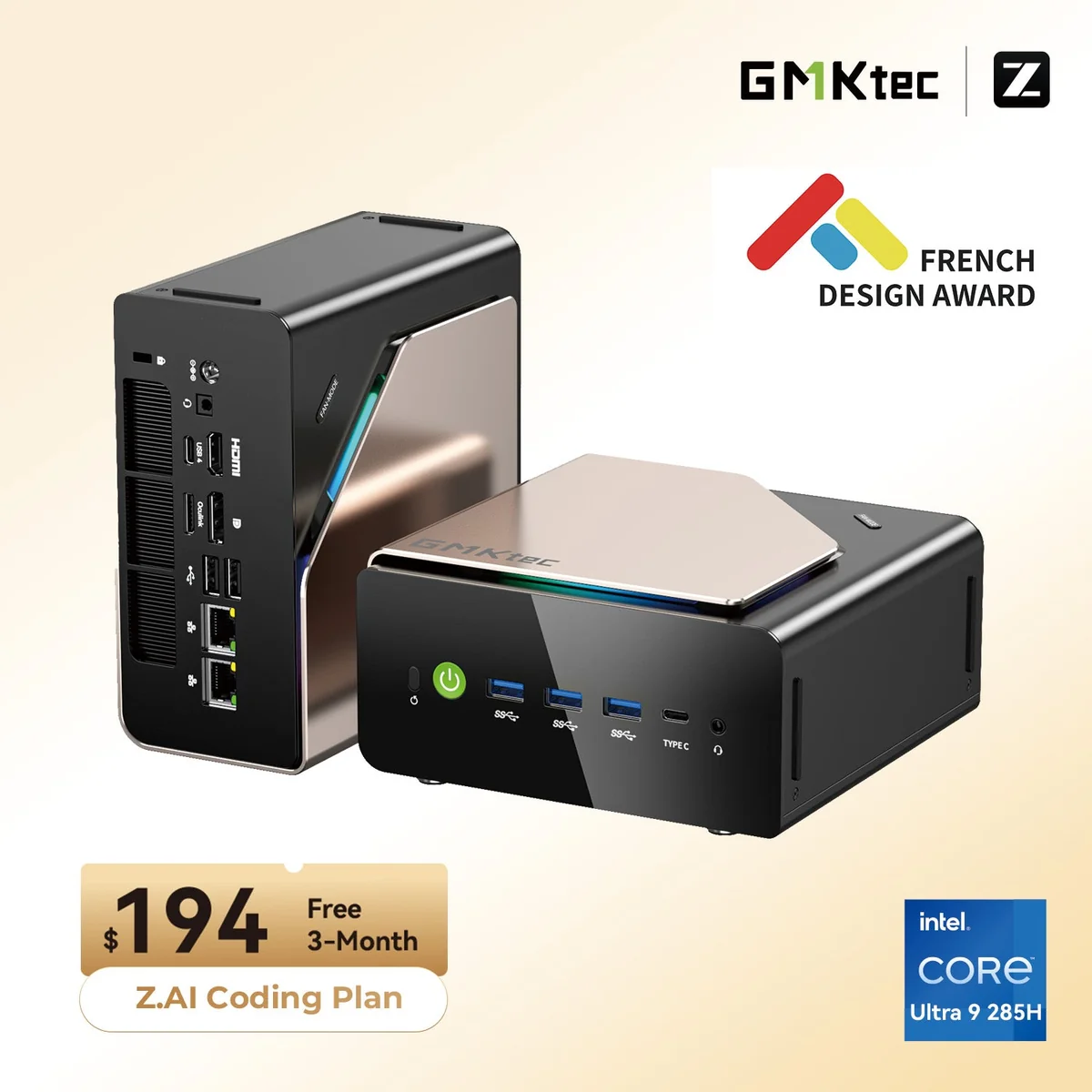
What it is
The GMKtec EVO-T1 is a sub-two-liter desktop built around Intel’s Core Ultra 9 285H: the top mobile SKU of the “Arrow Lake-H” generation, with six P-cores, eight E-cores, and two low-power E-cores on TSMC’s N3B node. It pairs that CPU with Intel’s Arc 140T integrated graphics (eight Xe-cores), an Intel AI Boost NPU, 64 GB of dual-channel DDR5-5600, three PCIe 4.0 M.2 slots, and (the headline feature) an OCuLink port that exposes four PCIe 4.0 lanes directly to an external GPU enclosure.
In a market currently dominated by AMD’s Ryzen AI 300 series and Strix Halo, the EVO-T1 is GMKtec’s bet that there’s still a strong case for the Intel platform, specifically for buyers who want OpenVINO, Quick Sync media acceleration, and the broadest possible compatibility for Intel-optimized inference stacks.
What it’s good for
Home use and office work. Sixteen cores at up to 5.4 GHz, 64 GB of DDR5, and dual 2.5 GbE is overkill for browser-and-Office work, and that’s the point. The EVO-T1 is the kind of desk machine you buy once and don’t replace for five years. The 80 W sustained TDP ceiling means the CPU actually gets to stretch its legs, unlike thinner mini PCs that quietly cap Arrow Lake-H at 30–45 W.
On-device AI (non-NPU paths). This is where the EVO-T1 makes its strongest case. The NPU itself is modest: Intel AI Boost on Arrow Lake-H delivers around 13 TOPS, well below the 40-TOPS Copilot+ bar. But the rest of the platform is genuinely capable: Arc 140T accelerates Intel’s OpenVINO runtime cleanly, 64 GB of DDR5 means you can hold a 13B–30B-class language model in CPU memory and run it through Ollama or llama.cpp at usable rates, and Quick Sync handles AV1/HEVC encode/decode for any AI video pipeline. Combined, GMKtec advertises up to 99 TOPS of platform-wide AI throughput across CPU + GPU + NPU, a number that’s marketing-flavored, but the underlying components are real.
Creator workflows. Quick Sync is still the best media engine in the consumer space for AV1 encode, and the Arc 140T handles Premiere, DaVinci Resolve, and Photoshop GPU acceleration competently at 1080p and 1440p. For 4K timeline scrubbing the OCuLink port is the escape hatch: a $300 OCuLink dock plus a used RTX 4070 turns the EVO-T1 into a creator workstation that holds its own against a tower.
1080p gaming, with caveats. The Arc 140T is a solid 1080p iGPU (esports titles run well above 60 fps, modern AAA titles land in the 35–55 fps range at 1080p Medium), but AMD’s Radeon 890M in the HX 370 platform is measurably ahead. If gaming is your primary use case, the EVO-T1 is not the right pick. If gaming is a secondary use case and you have OCuLink in mind for serious play, it’s an excellent base.
Build and connectivity
The chassis measures 154 × 151 × 73.6 mm (closer in footprint to a Mac Studio than to the palm-sized AMD-class mini PCs), and the larger volume buys real thermal headroom. NotebookCheck measured sustained 70 W on the CPU with 80 W bursts, well above the 33 W cap that some smaller Arrow Lake-H designs (notably the Geekom Mini IT15) settle at.
Port layout is generous and unusually balanced:
- Front: USB-C 10 Gbps (PD/DP/Data), 3 × USB-A 10 Gbps, 3.5 mm combo jack
- Rear: HDMI 2.1 (8K@60 / 4K@144), DisplayPort 1.4, USB4 (40 Gbps), 2 × USB-A 2.0, OCuLink (PCIe 4.0 ×4), 3.5 mm combo jack, DC-in
- Network: Dual Realtek RTL8125BG 2.5 GbE
- Wireless: Intel AX201 Wi-Fi 6 + Bluetooth 5.2
Quad-display output works across HDMI 2.1, DisplayPort 1.4, USB4, and the front USB-C, useful for trading desks, multi-monitor coding setups, or video editors who want a reference monitor on the side.
The one note on wireless: Wi-Fi 6 (not 6E or 7) on the Intel AX201. In 2026 that’s a step behind the competition. If you’re on a 6 GHz network it matters; if you’re on 5 GHz it doesn’t.
Memory, storage, and upgrades
This is where the EVO-T1’s case sharpens. The top panel pops off to expose three M.2 2280 PCIe 4.0 ×4 slots, each rated for up to 8 TB, for a theoretical 24 TB ceiling. We have not seen another mini PC at this price point with three full-bandwidth NVMe slots; most ship with one, a few with two.
Memory is dual SODIMM DDR5-5600. GMKtec officially supports up to 64 GB (2 × 32 GB) and ships the top SKU in that configuration. Some reviewers have reported wider compatibility (Wccftech notes 128 GB seating with non-validated modules), but for a clean, supported build, treat 64 GB as the realistic maximum and the spec-sheet ceiling.
OCuLink turns this from “good Intel mini PC” into “the Intel mini PC for serious users.” Four PCIe 4.0 lanes is enough to feed a desktop RTX 4070 or 4070 Super at near-native throughput, and unlike Thunderbolt-based eGPU paths, OCuLink doesn’t pay the encapsulation tax. If you ever want to graduate to discrete graphics, the EVO-T1 is already wired for it.
Pricing and where to buy
As of May 2026, the 64 GB / 1 TB EVO-T1 configuration lists at $819 on GMKtec’s own store (sale price, regular $1,199) and is available on Amazon US under ASIN B0FH54R8J3 at the same configuration. A 2 TB SSD variant exists at ASIN B0FHJSGCGT for a small premium. Micro Center carries the unit physically for in-store pickup at $999.
Realistic price band for the 64 GB / 1 TB SKU: $819–$999 depending on channel and discount cycle. The 1-year limited warranty is the same across retail paths.
What we’d flag
This is a recommended unit, but it’s not flawless.
- The NPU is ~13 TOPS, well below the 40-TOPS Copilot+ bar. If you specifically need a Copilot+ PC for Windows Recall, Cocreator, or other NPU-gated features, the EVO-T1 doesn’t qualify. The Arc 140T iGPU + OpenVINO path is the better story here than the NPU itself.
- Arc 140T graphics trail Radeon 890M / Radeon 8060S in raw gaming throughput. For pure gaming you’d be better served by an HX 370 or Strix Halo platform. The EVO-T1’s GPU value is in OpenVINO, Quick Sync, and OCuLink, not in iGPU framerates.
- Wi-Fi 6, not Wi-Fi 6E or 7, on the AX201 module. Replaceable via M.2 if you care, but the stock card is one generation behind.
- 1-year warranty is the floor of what’s acceptable in this price band; Geekom and Beelink both offer 3 years at comparable prices. GMKtec’s support reputation has improved but the warranty length itself is a deliberate gap.
- 64 GB is the officially supported memory ceiling, with anecdotal reports of higher capacities working unofficially. If you need a strict 96 GB or 128 GB platform, treat the EVO-T1 as a 64 GB machine and look elsewhere.
None of this is disqualifying. All of it is the cost of choosing the Intel side of this market in 2026.
GMKtec EVO-T1 verdict
The GMKtec EVO-T1 is the right Intel-side answer to the Strix Halo and HX 370 mini PCs, and the answer is built differently. It doesn’t try to win on iGPU framerates. It wins on platform balance: 16-core Arrow Lake-H with a real 80 W power budget, the Arc 140T plus OpenVINO for non-NPU AI work, Quick Sync for media pipelines, three full-bandwidth NVMe slots, and OCuLink for the day you decide you actually want a discrete GPU.
If you specifically want OpenVINO, Quick Sync, OCuLink, and the broadest Intel software compatibility, and you can live with a 13-TOPS NPU and a 1-year warranty, this is the mini PC to put on the short list. For Intel buyers in 2026 it is, plainly, the most interesting machine in its class.